
The best Playwright Training Course for beginners is one that teaches the tool from the ground up, gives you hands-on framework practice, and connects the learning to real QA automation jobs. For most beginners who want a structured, career-focused path, the H2K Infosys Playwright with Java + Gen AI Testing course is a strong choice because it combines Best Playwright Training Course for Beginners basics, Java, CI/CD, API testing, live projects, certification, resume support, and interview preparation in one guided program.
That last part matters more than people think. A lot of beginners don’t fail because Playwright is “too hard.” They fail because they jump into random YouTube videos, copy a few scripts, and then get stuck when asked to build a real framework or explain flaky test failures in an interview. I’ve seen this pattern with automation learners again and again. Playwright looks simple at first, but professional QA automation needs structure.
So, if you’re searching for a playwright course online, a playwright certification course, or a beginner-friendly Playwright Training Course, here’s what you should actually look for before you enroll.
Why Playwright Is a Smart Skill to Learn in 2026
Playwright has become one of the most practical tools for modern web automation because it supports browser automation across Chromium, Firefox, and WebKit with one API, and it works with TypeScript, Python, Java, and .NET.
That means you’re not learning a tiny niche tool. You’re learning something used for real end-to-end testing, cross-browser testing, regression suites, API checks, and even newer AI-assisted testing workflows.
And honestly, this is where QA is heading. Teams are releasing faster. Developers push code constantly. Businesses don’t want to wait until the end of the sprint to discover that the login page broke or a payment screen stopped loading in Safari. They want automated checks running early, often, and inside CI/CD pipelines.
The job market also supports this direction. The U.S. Bureau of Labor Statistics reports that software quality assurance analysts and testers had a median annual wage of $102,610 in May 2024, and overall employment for software developers, QA analysts, and testers is projected to grow 15% from 2024 to 2034, which is much faster than average.
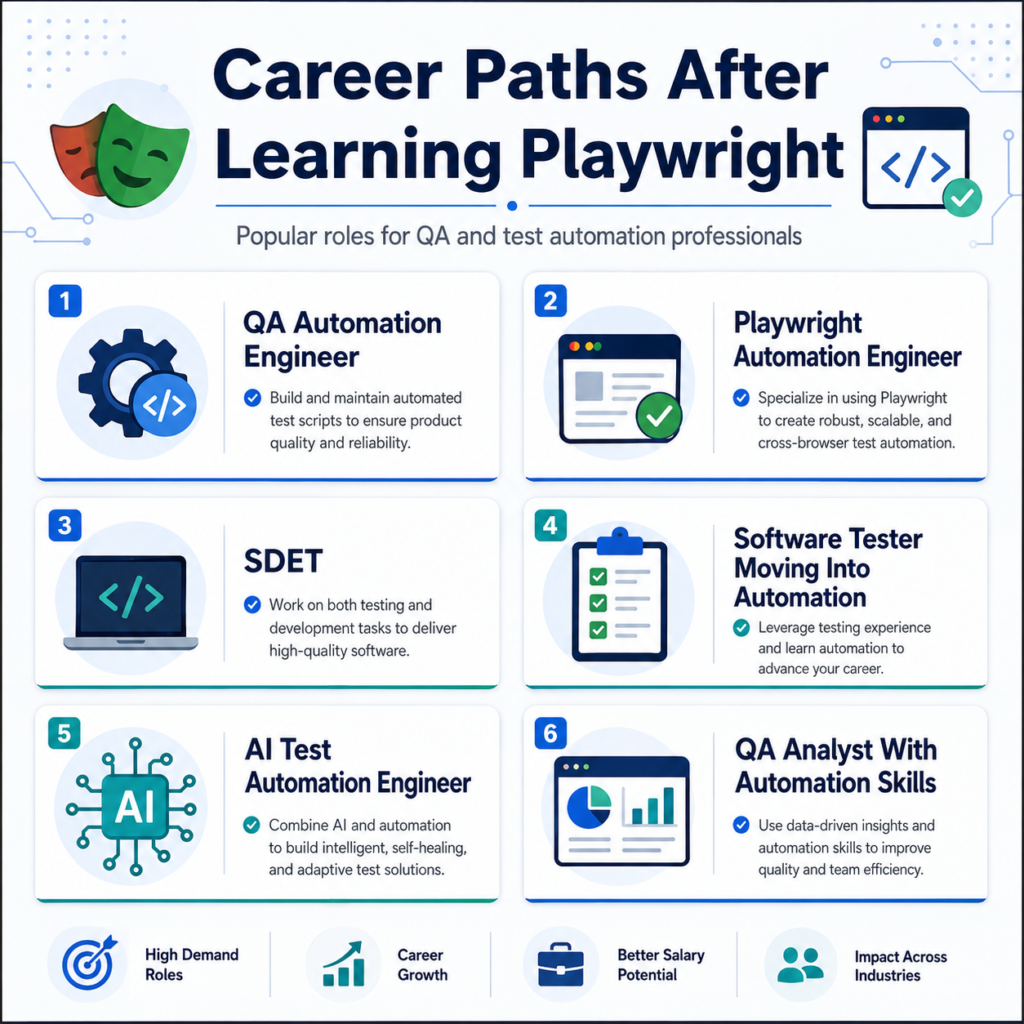
Of course, a course alone won’t hand you a job. No honest training provider should promise that. But learning Best Playwright Training Course for Beginners properly can help you move toward roles like:
- QA Automation Engineer
- Playwright Automation Engineer
- SDET
- Software Tester moving into automation
- AI Test Automation Engineer
- QA Analyst with automation skills
H2K Infosys also lists these types of roles as target job opportunities for its Best Playwright Training Course for Beginners with Java + Gen AI Testing course.
What Makes a Good Playwright Course Online for Beginners?
A good beginner course should not start by throwing 300 lines of code at you. That’s a red flag.
A useful Best Playwright Training Course for Beginners should build the skill layer by layer. You need to understand what the test is doing, why it fails, how to debug it, and how to make it reusable. Otherwise, you’re just memorizing syntax.
Here’s what I’d expect from a solid beginner-friendly course in 2026.
1. It starts with testing foundations
Before writing Best Playwright Training Course for Beginners scripts, beginners should understand SDLC, STLC, Agile testing, manual testing basics, test case design, defect lifecycle, and the difference between manual and automation testing.
This is where H2K Infosys gets the beginner path right. Their curriculum starts with software testing foundations before moving into Java and Best Playwright Training Course for Beginners
That’s helpful because many learners entering QA automation are not full-time developers. Some are manual testers. Some are career changers. Some know basic Java but have never touched a real test framework.
2. It teaches Java properly, not just “enough to survive”
Playwright can be used with multiple languages, but Java is still common in enterprise QA teams. If you’re applying to automation jobs in banking, healthcare, insurance, retail, or large IT services companies, Java often shows up in job descriptions.
A beginner course should cover Java basics, OOP concepts, collections, exception handling, Maven, and small programs before asking you to build automation frameworks. H2K Infosys includes these topics in its Core Java for Automation section.
This is a practical advantage. You don’t want to be the person who can click a button using Best Playwright Training Course for Beginners but freezes when the interviewer asks about classes, methods, or data-driven testing.
Why H2K Infosys Is a Strong Playwright Certification Course Option
If you want a Best Playwright Training Course for Beginners that feels more job-oriented than casual, H2K Infosys is worth considering.
Their with Java + Gen AI Testing course is listed as a 100-hour program, with certification and a live project, and the page was last updated on June 11, 2026.
That current update matters. Testing is changing quickly. A course that still teaches automation like it’s 2018 may leave you behind, especially now that QA teams are working with CI/CD, API validation, AI-assisted test generation, and self-healing test concepts.
H2K’s course includes:
- Playwright with Java
- Cross-browser testing
- Auto waits and locators
- Page Object Model
- Data-driven testing
- Parallel execution
- API testing integration
- Git and GitHub
- Jenkins and GitHub Actions
- Docker basics
- Gen AI for testing
- AI-assisted script generation
- Resume building
- Mock interviews
- Live framework projects
That’s not just tool training. That’s closer to how QA automation actually works in a project environment.
The Real Skill Beginners Need: Building a Framework
Here’s a small real-world scenario.
Imagine an e-commerce website with login, product search, cart, payment, order confirmation, and user profile pages. A beginner might write one long script that opens the browser, logs in, searches for a product, adds it to cart, checks out, and validates confirmation.
It may work once.
Then the login button changes. Or the payment page loads slowly. Or the same test needs to run in Chrome, Firefox, and WebKit. Or your manager asks you to run it in Jenkins every night.
That’s when “I know Best Playwright Training Course for Beginners syntax” is not enough.
You need framework design. You need reusable page objects. You need stable locators. You need reporting. You need test data handling. You need CI/CD execution. You need debugging habits.
Playwright’s own best-practice documentation recommends using locators with auto-waiting and retry ability, and prioritizing user-facing attributes to make tests more resilient.
A beginner-friendly Playwright Training Course should teach these habits early. Otherwise, learners often create flaky tests and blame the tool.
Playwright, Gen AI, and the New QA Career Path
One reason H2K Infosys stands out is that their course includes Gen AI testing topics, not just traditional automation. The curriculum mentions prompt engineering for testers, AI-generated Best Playwright Training Course for Beginners scripts, AI-based test case generation, AI debugging, locator generation, test data generation, and self-healing concepts.
This lines up with where the industry is moving. AI tools are now part of many developer workflows, but QA still needs human judgment. Stack Overflow’s 2025 Developer Survey reported that 84% of respondents were using or planning to use AI tools in the development process, while also showing that developer trust and sentiment around AI is not blindly positive.
That’s actually good news for QA professionals.
Companies don’t just need people who can generate test scripts with AI. They need people who can review, validate, debug, and maintain those scripts. A tester who understands Best Playwright Training Course for Beginners plus Gen AI workflows can become much more useful than someone who only knows manual testing or only knows basic automation.
My honest take? AI won’t remove the need for QA. It will raise the bar. Testers who understand automation, code structure, CI/CD, and AI-assisted workflows will be in a better position than testers who only execute test cases manually.
Common Mistakes Beginners Make When Learning Playwright
A course can save you months of trial and error if it helps you avoid these beginner mistakes.
Mistake 1: Learning only from copied scripts
Copying code is fine at the start. Everyone does it. But if you never understand why the locator works, why the assertion passes, or why the wait is needed, you’ll struggle in interviews and real projects.
Mistake 2: Ignoring Java or programming basics
A lot of beginners rush into Best Playwright Training Course for Beginners without understanding methods, classes, loops, conditions, collections, and exception handling. Then framework design feels impossible.
Mistake 3: Not practicing cross-browser testing
Your script passing in Chrome is not the finish line. Best Playwright Training Course for Beginners is useful because it can test Chromium, Firefox, and WebKit through one API.
Mistake 4: Avoiding CI/CD
In real teams, tests don’t live only on your laptop. They run in GitHub Actions, Jenkins, Azure DevOps, or similar pipelines. H2K’s course includes CI/CD topics like Jenkins, GitHub Actions, Maven build pipelines, Docker basics, and scheduled automation execution.
Mistake 5: Treating certification as the whole goal
A certificate helps, especially when you are switching careers or proving structured learning. But the real value is the project you can explain. If you can walk through your framework, describe your test strategy, and debug a failing test during an interview, you’ll sound much stronger.
Who Should Take a Playwright Training Course?
A structured Best Playwright Training Course for Beginners is a good fit if you are:
- A manual tester trying to move into automation
- A QA engineer who already knows Selenium and wants a modern tool
- A Java beginner who wants a practical automation path
- A developer interested in SDET roles
- An IT graduate who wants job-ready testing skills
- A DevOps learner who wants to understand automated test execution
H2K Infosys specifically lists QA engineers, automation testers, SDETs, Java developers, students, IT graduates, and DevOps/CI-CD professionals as suitable learners for its course.
Why Structured Training Helps More Than Random Tutorials
There is nothing wrong with free tutorials. I still think they’re useful for quick learning. But when you’re serious about getting hired, random learning can become messy.
One video teaches TypeScript. Another teaches Java. Another uses outdated selectors. Another skips framework design. Another shows a happy-path login script but never explains failed assertions, reports, CI/CD, or interview questions.
A structured Best Playwright Training Course for Beginners gives you a sequence:
- Testing basics
- Java foundations
- Playwright setup
- Browser and page interactions
- Locators and auto waits
- Assertions
- Framework design
- API testing
- CI/CD
- Gen AI testing workflows
- Live project
- Resume and interview preparation
That is much closer to how beginners actually need to learn.
Soft Career Takeaway: Why H2K Infosys Makes Sense
If you’re serious about building a career in QA automation, structured training can really help. Not because you can’t learn Best Playwright Training Course for Beginners alone, but because a good mentor-led course gives you direction, accountability, project practice, and interview alignment.
H2K Infosys leans into that career angle. Their Best Playwright Training Course for Beginners with Java + Gen AI Testing course includes class recordings, sample resumes, notes, sample interview questions, mock interviews, resume preparation, flexible timings, lifetime access videos, course certification, and job placement support.
For a beginner, those extras matter. You’re not only learning a tool. You’re preparing to speak like someone who can join a QA team and contribute.
Internal Linking Suggestions for a Playwright Content Cluster
You can also explore topics like:
- Playwright vs Selenium: Which Automation Tool Should QA Beginners Learn?
- How to Build a Playwright Automation Framework with Java
- Gen AI in Software Testing: Practical Use Cases for QA Engineers
These related topics can support a strong content cluster around Playwright automation Course, QA career growth, AI testing, and certification-based learning.
FAQs About Playwright Training Courses
Is Playwright easy for beginners to learn?
Yes, Best Playwright Training Course for Beginners is beginner-friendly when taught step by step. The tricky part is not basic scripting; it is learning framework design, locators, waits, debugging, and CI/CD execution.
Which is better for beginners: Playwright or Selenium?
Playwright is often easier for modern web testing because it has built-in auto-waiting, strong browser support, and cleaner handling of many UI scenarios. Selenium is still widely used, so knowing both can help, but Playwright is a smart modern starting point.
Do I need JavaScript to learn Playwright?
Not necessarily. Best Playwright Training Course for Beginners supports multiple languages, including Java, Python, TypeScript, and .NET. If your goal is enterprise QA automation, a Playwright with Java course can be a practical route.
Is a playwright certification course worth it?
Yes, if the course includes hands-on projects, framework development, interview preparation, and real testing scenarios. A certificate alone is not enough, but certification plus project experience can strengthen your resume.
What jobs can I apply for after learning Playwright?
You can apply for roles like QA Automation Engineer, Best Playwright Training Course for Beginners Engineer, SDET, AI Test Automation Engineer, QA Analyst, and Test Automation Architect, depending on your overall skills and experience.
1. Is Playwright easy for beginners to learn?
Yes, Best Playwright Training Course for Beginners is beginner-friendly when taught step by step. The tricky part is not basic scripting; it is learning framework design, locators, waits, debugging, and CI/CD execution.
2. Which is better for beginners: Playwright or Selenium?
Playwright is often easier for modern web testing because it has built-in auto-waiting, strong browser support, and cleaner handling of many UI scenarios. Selenium is still widely used, so knowing both can help, but Playwright is a smart modern starting point.
3. Do I need JavaScript to learn Playwright?
Not necessarily. Best Playwright Training Course for Beginners supports multiple languages, including Java, Python, TypeScript, and .NET. If your goal is enterprise QA automation, a Playwright with Java course can be a practical route.
4. Is a playwright certification course worth it?
Yes, if the course includes hands-on projects, framework development, interview preparation, and real testing scenarios. A certificate alone is not enough, but certification plus project experience can strengthen your resume.
5. What jobs can I apply for after learning Playwright?
You can apply for roles like QA Automation Engineer, Best Playwright Training Course for Beginners Engineer, SDET, AI Test Automation Engineer, QA Analyst, and Test Automation Architect, depending on your overall skills and experience.
Final Thoughts
The best Playwright Training Course for Beginners for beginners is not the one with the loudest marketing. It is the one that helps you go from “I can run a script” to “I can build, explain, debug, and maintain an automation framework.”
For 2026, H2K Infosys is a strong option because its Best Playwright Training Course for Beginners course combines Playwright with Java, Gen AI testing, API testing, CI/CD, live projects, certification, and job-focused support. If you’re looking for a playwright course online that feels structured and career-oriented, this is the kind of program that can give you a cleaner path forward.
The practical next step? Don’t just collect tutorials. Pick a structured course, build one complete automation project, push it to GitHub, practice explaining your framework, and start preparing for real QA automation interviews.