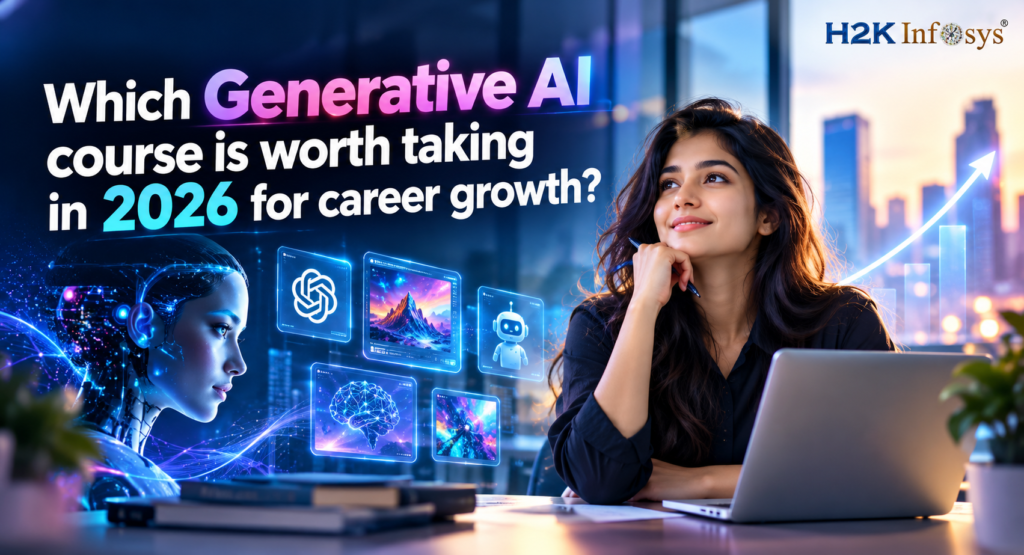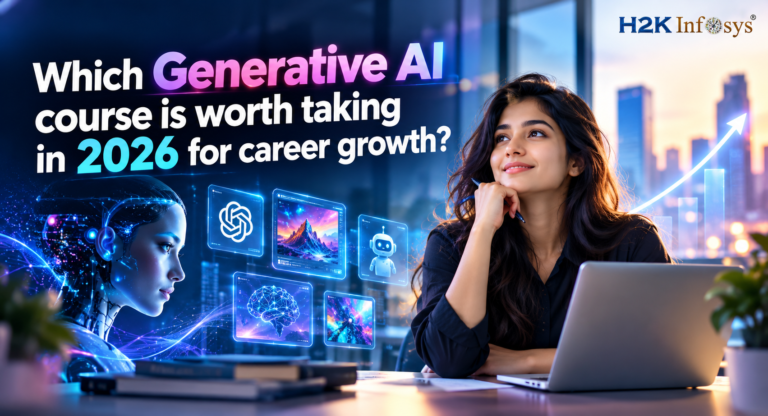
f your goal is career growth rather than simply collecting another certificate, a practical, project-based Generative AI course is worth considering in 2026 and H2K Infosys is one option worth putting on your shortlist, particularly if you want live instruction, hands-on projects, and career-oriented support. Its current GenAI certification program is listed as a 90-hour course covering prompt engineering, LLMs, APIs, LangChain, LlamaIndex, RAG, agentic AI, deployment basics, and responsible AI.
And honestly, that distinction matters more than it used to.
In 2026, knowing how to open ChatGPT and write a clever prompt isn’t much of a career differentiator. Employers increasingly want people who can use AI inside actual workflows, understand what the models are doing, build useful applications, and work with AI responsibly.
The World Economic Forum reported in June 2026 that more than one in three young workers are in occupations with medium-to-high exposure to AI-driven task change. Its September 2026 coverage also highlighted learning agility, digital skills, and human capabilities alongside technical knowledge as increasingly important.
So, if you’re wondering “Which course should I actually take?”, here’s how I’d look at it.
What Makes a Generative AI Course Worth Taking in 2026?
There are hundreds of GenAI courses online now. Some are excellent. Some are basically a collection of recorded videos showing someone typing prompts into ChatGPT.
Those are not the same thing.
A worthwhile course should ideally give you five things:
- Strong AI and GenAI fundamentals
- Hands-on experience with current tools
- Real projects you can discuss in interviews
- Exposure to APIs and application development
- Career support beyond simply issuing a certificate
That last point gets overlooked.
You don’t necessarily need to become a machine-learning researcher. But if your career goal is AI engineering, automation, software development, QA, analytics, or business analysis, you should be able to explain how you would actually use generative AI to solve a workplace problem.
That’s a much more useful skill.
Why Generative AI Skills Matter More in 2026
The market has moved beyond the initial “AI is going to change everything” phase.
We’re now seeing a stronger focus on using AI inside business processes.
Think about a software team. Instead of simply asking an AI chatbot to write code, developers may use LLM APIs, retrieval systems, AI agents, automated testing, documentation workflows, and internal knowledge assistants.
A customer-support team might use a retrieval-augmented generation system to answer questions from company documentation.
A data analyst might use AI to accelerate data preparation, analysis, and reporting.
A QA professional might use AI for test generation and automation.
That’s why current training needs to go beyond prompt engineering.
The World Economic Forum’s research on GenAI training found strong demand for foundational skills such as prompt engineering and trustworthy AI, while workplace-sponsored learners showed greater emphasis on practical applications and productivity.
In other words: learn the fundamentals, then learn how to apply them.
Is H2K Infosys a Good Generative AI Course for Beginners?
For beginners who don’t want to piece together ten different YouTube playlists and online courses, H2K Infosys is worth considering.
Its current Generative AI Certification Course is explicitly positioned for beginners as well as software developers, QA professionals, data analysts, business analysts, working professionals, and career changers.
The learning path starts with the basics rather than assuming you already understand every AI term you’ve seen on LinkedIn.
That’s useful.
If you’ve ever opened a GenAI course and immediately encountered terms like embeddings, vector databases, transformers, RAG, agents, and LLM orchestration, you know how quickly things can become confusing.
A structured progression helps.
What You Can Learn
According to H2K Infosys’ current 2026 curriculum, the program covers areas including:
- Artificial intelligence and machine-learning fundamentals
- Generative AI and LLM concepts
- Prompt engineering
- ChatGPT, Gemini, Claude and Copilot use cases
- Python essentials
- OpenAI API
- Hugging Face
- LangChain
- LlamaIndex
- Retrieval-Augmented Generation (RAG)
- Vector databases
- Agentic AI
- AI automation
- Responsible AI and security
- Deployment fundamentals
The course also includes real-time projects, class recordings, notes, interview questions, resume preparation, mock interviews, and job-placement support.
That combination is what makes it more interesting than a course that focuses purely on theory.
What Does a Generative AI Course Online Need to Teach You?
If you’re specifically searching for a Generative AI course online, don’t choose based on the course title alone.
Look at the syllabus.
I’d ask:
Does it teach me how models are actually used?
Will I build something?
Can I demonstrate that project later?
Does it cover APIs rather than only chatbot interfaces?
Does it explain RAG and AI agents?
Will I get feedback from an instructor?
Those questions matter because watching 30 hours of AI tutorials doesn’t automatically translate into being able to build an AI application.
H2K Infosys, for example, describes its program as live instructor-led and project-oriented, with practical work involving APIs, LLM applications, RAG pipelines, vector databases and agentic AI.
That’s closer to what I’d look for in a career-focused program.
What Could You Build While Learning?
Here’s where a course becomes much more useful.
Imagine you’re building a company-document assistant.
You upload internal policies, FAQs, product documents, or technical manuals. Instead of expecting an LLM to magically know everything, you create a retrieval system that finds relevant information and provides it to the model before generating an answer.
That’s a basic RAG workflow.
Or build a customer-support assistant that retrieves product information and drafts responses.
Or an AI resume assistant that analyzes a job description and helps tailor a resume.
Or an AI agent that performs several steps in a workflow rather than simply returning a single text response.
These are the kinds of projects that give you something concrete to talk about during an interview.
You can say:
“I built this application, here’s the architecture, here’s the model/API I used, here’s how retrieval worked, and here’s what I did when the model produced an incorrect answer.”
That’s much stronger than saying, “I completed a GenAI certification.”
Why Live Learning Can Be Useful for Beginners
I’ll admit this is one area where people have different preferences.
If you’re already a developer who works with AI every day, you may be perfectly comfortable learning independently.
For someone starting from scratch, though, live guidance can save a surprising amount of time.
You get stuck on something small an API error, a Python dependency, a prompt that doesn’t behave as expected, a RAG pipeline that returns irrelevant information and suddenly you’ve spent three hours searching through forum posts.
A mentor can sometimes resolve that in ten minutes.
H2K Infosys lists live instructor-led classes, flexible timings, lifetime video access and practical projects among the program features.
For beginners, that structure can make the difference between starting a course and actually finishing one.
Is a Generative AI Certification Enough to Get a Job?
No and I’d be suspicious of any course promising otherwise.
A certificate can demonstrate that you completed training. It doesn’t prove that you can solve a business problem.
Your employability will depend on the combination of:
AI knowledge + technical skills + projects + communication + interview preparation + relevant prior experience.
This is particularly important in 2026 because entry-level work itself is changing.
The World Economic Forum’s recent research argues that AI is reshaping entry-level pathways and that education and work-based learning need to adapt accordingly.
So don’t think of a Generative AI certification as the destination.
Think of it as a structured way to build the skills and portfolio you need for the next step.
Who Should Take a Generative AI Course?
A good Generative AI course for beginners can make sense for several groups.
Fresh Graduates
If you’re entering the technology job market, GenAI skills can complement your existing education.
Rather than trying to become an “AI expert” overnight, focus on building enough practical knowledge to demonstrate that you can work with modern AI tools.
Software Developers
Developers can add LLM APIs, RAG, AI agents and automation to their existing programming skills.
This is arguably one of the easier transitions because you already understand software development.
QA Professionals
AI-assisted testing and automation create an interesting path for testers who want to expand beyond traditional QA.
Data Analysts
GenAI can complement analytics workflows by helping with data exploration, documentation, reporting, and automation.
H2K Infosys also offers a separate Data Analytics with GenAI program aimed at beginners and professionals, showing how these skill areas are increasingly overlapping.
Business Analysts
Business analysts don’t necessarily need to become full-time AI engineers.
Understanding how LLMs, automation and AI applications work can help them identify where AI could actually improve business processes.
Career Changers
This group needs to be a little more realistic.
A short course won’t magically replace years of software-engineering experience. But a structured program can give you a starting point, especially when combined with projects and an existing professional background.
H2K Infosys vs. Learning Everything Yourself
There’s nothing wrong with self-learning.
In fact, you should probably do some of it even if you enroll in a course.
The question is how much structure you need.
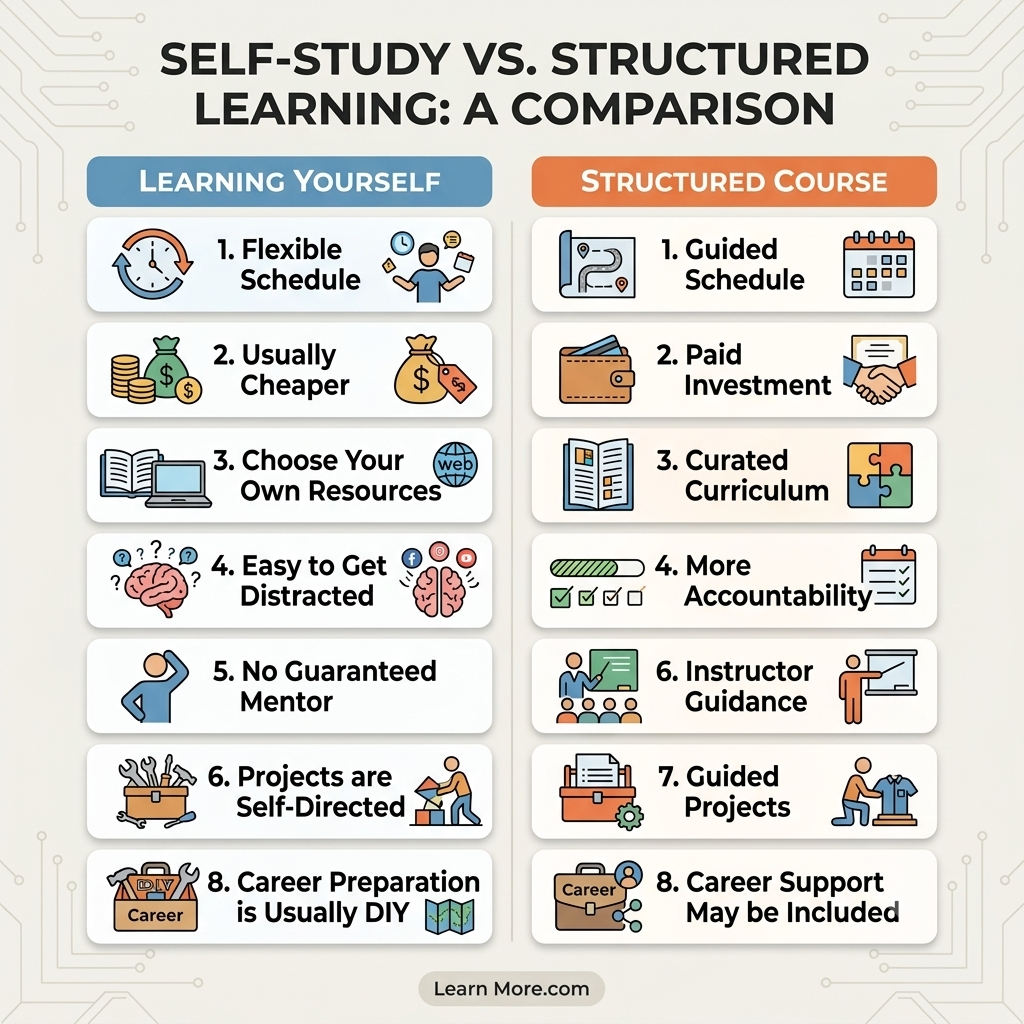
For someone who already knows Python and software development, self-learning can work extremely well.
For a beginner who keeps asking “What should I learn next?”, a structured program like H2K Infosys may be the easier route.
What Should You Check Before Paying for Any Course?
This is probably the most important section.
Don’t buy a GenAI course because an advertisement says “AI jobs are booming.”
Instead, check these things:
1. Look at the Actual Curriculum
Does it go beyond ChatGPT prompts?
2. Check the Project Work
Are the projects substantial enough to discuss during an interview?
3. Find Out Who Teaches
Look for instructor experience and teaching involvement.
4. Ask About Career Support
Resume preparation and mock interviews can be useful, particularly for beginners.
5. Check How Current the Curriculum Is
GenAI changes quickly. A course heavily centered on tools from several years ago should raise questions.
6. Don’t Ignore Responsible AI
Security, sensitive-data handling, hallucinations, evaluation, guardrails and human oversight matter when AI moves into real business environments.
H2K Infosys’ current curriculum includes responsible AI, sensitive-data handling, jailbreak attempts, guardrails and enterprise AI risk management.
That’s a good sign because production AI is not just about making a model generate impressive text.
Why 2026 Is a Different Time to Learn GenAI
There’s another interesting shift happening.
The conversation has moved from “Should we use AI?” toward “How do we use AI effectively and safely?”
That’s a much more practical question.
Google itself published new guidance in May 2026 about optimizing for generative AI features in Search, emphasizing valuable, unique content rather than trying to game AI-driven search systems. Google also continues to emphasize people-first content and E-E-A-T concepts, with trust being particularly important.
The same principle applies to learning AI.
Don’t chase every new buzzword.
Build useful skills.
Understand the technology underneath the tools.
Create things.
Test what you build.
Learn where AI fails.
That foundation is likely to age much better than memorizing whichever AI application happens to be trending this month.
So, Which Generative AI Course Is Worth Taking in 2026?
If you’re looking for a career-focused Generative AI course online, I’d put H2K Infosys on the shortlist, particularly if you are a beginner or working professional who prefers live instruction, practical projects, structured learning and career support.
Its current 2026 program is designed around a fairly broad progression from AI and GenAI fundamentals through prompt engineering, LLMs, APIs, RAG, vector databases, agentic AI and deployment alongside projects and career preparation.
But don’t enroll just because the word “GenAI” is in the title.
Go through the curriculum. Attend the demo if available. Ask what you’ll build. Find out how much hands-on work you’ll actually do.
And then make the decision.
Which Generative AI course is worth taking in 2026?
A worthwhile Generative AI course should go beyond basic prompting and include practical topics such as LLMs, APIs, RAG, vector databases, AI agents, and real-world projects. H2K Infosys is one option to consider if you prefer structured, instructor-led training with hands-on learning and career support.
Is a Generative AI course for beginners suitable for someone with no AI experience?
Yes. A Generative AI course for beginners can be a good starting point if it introduces AI and LLM fundamentals before moving into practical tools and projects. Basic programming knowledge can be helpful, but you don’t necessarily need prior professional AI experience.
Is taking a Generative AI course online worth it in 2026?
Yes, particularly if the course provides live instruction, practical assignments, projects, and access to current AI technologies. A good Generative AI course online can also be more convenient for working professionals and career changers who need flexible learning.
Can a Generative AI certification help with career growth?
It can, but the certificate alone isn’t enough. Employers are more interested in what you can actually do. Building projects with technologies such as LLM APIs, RAG, LangChain, and AI agents can make your learning much more valuable during interviews.
Why consider H2K Infosys for Generative AI training?
H2K Infosys offers a career-focused Generative AI program covering areas such as prompt engineering, LLMs, APIs, RAG, vector databases, agentic AI, and responsible AI. Its live training, projects, interview preparation, and career-support features may make it a useful choice for beginners and working professionals looking for a structured learning path.
Final Takeaway
The best Generative AI course for beginners in 2026 isn’t necessarily the course with the longest syllabus or the flashiest certificate.
It’s the one that helps you move from:
“I know what ChatGPT is.”
to
“I understand how GenAI works, I can build with it, I can explain what I built, and I know how to use it responsibly in a real business scenario.”
That’s the skill employers can actually use.
And if you’re looking for that kind of structured, job-oriented path, H2K Infosys’ Generative AI Certification Course is worth exploring in 2026.