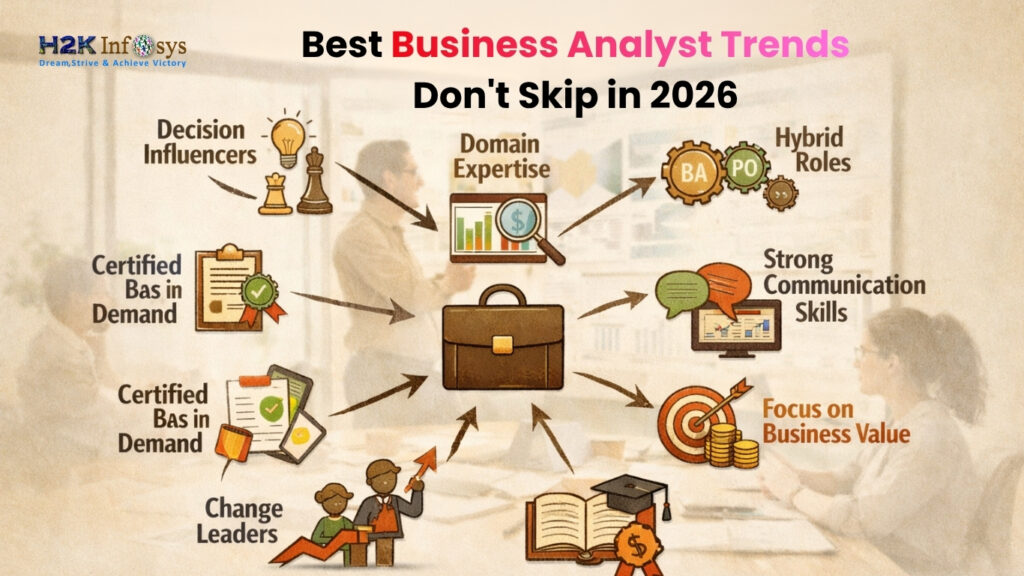
To become job-ready as a Business Analyst in 2026, H2K Infosys will assist you with a foundational and practical approach. Start by defining the BA role as the connector of stakeholders and the technical team, and embark on learning SDLC, Agile, Scrum, and techniques for effective requirements elicitation. Build your documentation skills through the creation of BRD and FRD, and strengthen your process modeling and data analysis skills. Build your profile through relevant projects, AI-driven productivity, specialization in a domain, and a solid portfolio to boost your confidence in the job market.
Why a Business Analyst Course Still Makes Sense in 2026
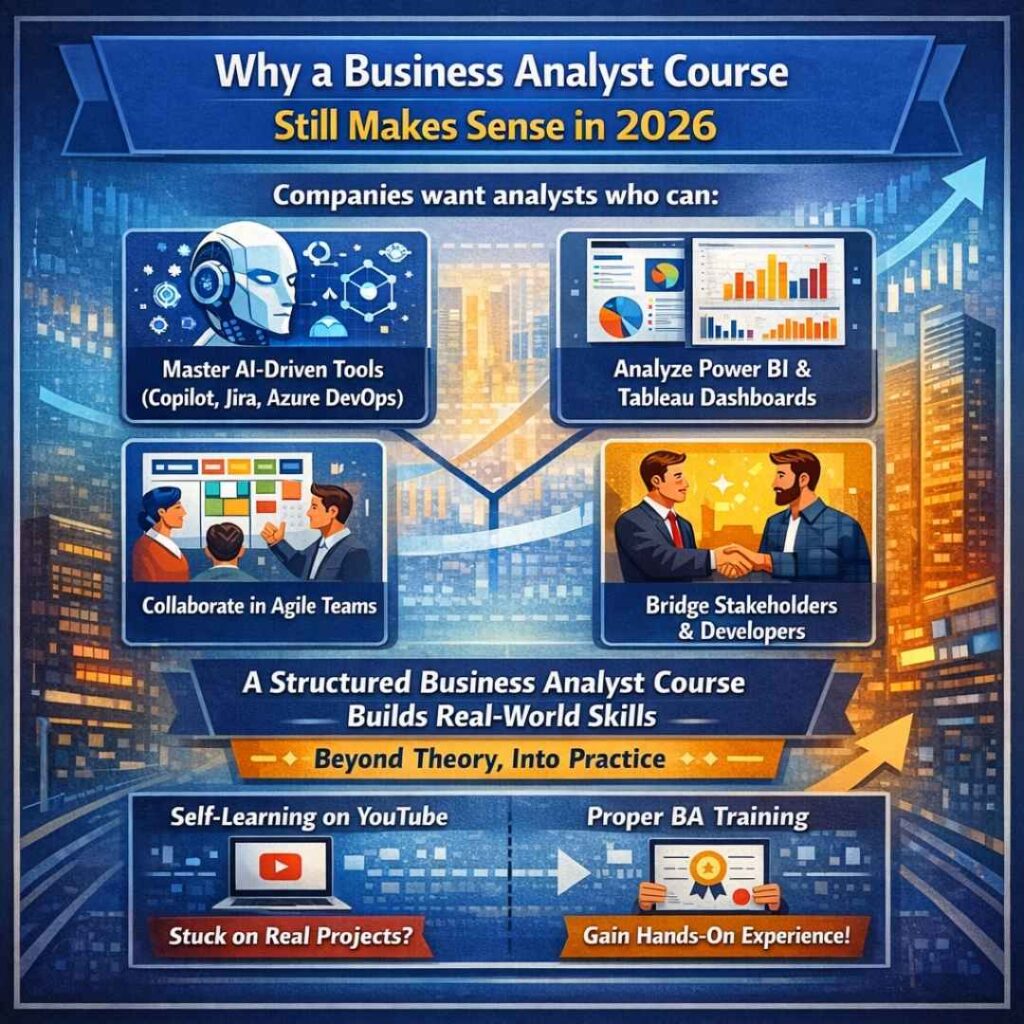
Companies aren’t hiring analysts just to “write requirements” anymore. In 2026, businesses want analysts who:
- Understand AI-driven tools (like Copilot integrations in Jira and Azure DevOps)
- Can interpret dashboards built in Power BI or Tableau
- Work alongside product managers in agile teams
- Speak the language of both stakeholders and developers
A structured Business Analyst Course helps you build this bridge. You’re not just learning theory you’re learning how companies actually operate today.
I’ve seen people try to self-learn everything from YouTube. Some succeed. Most get stuck when it’s time to build real project experience. That’s where proper business analysis training makes the difference.
Step 1: Comprehend the True Role of a Business Analyst
What does a Business Analyst do in practice?
In practice, a Business Analyst does the following:
- Collects and documents requirements
- Facilitates meetings with stakeholders
- Converts business challenges into technical answers
- Assists in UAT (User Acceptance Testing)
- Collaborates with Scrum teams
In 2024, a friend of mine moved from healthcare administration. She thought analysts did nothing but write documents. While completing her Business Analyst Course, she came to understand that communication and stakeholder engagement constituted 60% of the role.
That kind of thinking is important.
Step 2: Identify a Viable Business Analyst Course
Not all business analyst courses are created equal. Some courses are more theory-focused, while others have more tools-focused courses, but will skip the foundations.
In 2026, a Business Analyst Course should include:
- SDLC & Agile methodologies
- Requirement documentation (BRD, FRD, User Stories)
- Tools: Jira, Confluence, Azure DevOps
- Basics of SQL
- Foundations of Power BI
- Mock Interviews & Resume Building
- Live project simulations
If the Business Analyst Course doesn’t have project-based learning, run away.
This is the reason why many learners prefer structured business analysis online training programs that integrate theory, real scenarios, and interview preparation.
Step 3: Master the Core Skills Employers Actually Test
From what I’ve seen in 2025–2026 interviews, recruiters focus on:
- How you handled stakeholder conflicts
- Whether you understand agile ceremonies
- Your ability to write user stories properly
- Real-world use of Jira
A good Business Analyst Course will simulate:
“The client changed requirements mid-sprint. What did you do?”
That’s not theoretical. That’s real life.
Modern business analyst training and placement programs now include live capstone projects. That’s a huge upgrade compared to pre-2022 models.
Step 4. Focus on Certification (Then Strategy)
Let’s discuss business analyst certification online possibilities.
Some certifications are better known than others.
- International Institute of Business Analysis (IIBA) certifications such as ECBA and CBAP
- Project Management Institute (PMI-PBA)
In 2026, ECBA is well known for starters. But let’s be real, getting certified will not guarantee employment.
Completing a Business Analysis course along with a certification will enhance your resume. Completing a certification along with practical experience is the definitive differentiator.
Step 5: Getting Practical Project Experience (Even If You are a Beginner)
This is a step that lots of beginners get anxious about.
”How do I get experience without a job?”
Here is what you can do:
- Simulated internships located in your Business Analyst Course
- Live case studies in the healthcare and banking domains
- Volunteering in projects related to internal process improvement
- Freelancing gigs oriented towards documentation
A more recent development is that AI-based requirements tools have started to assist analysts in drafting initial versions more quickly. However, organizations still require human analysts to assess and refine the logic and business context. Thus, analytical skills are still essential.
Step 6: Understand Domain Specialization (Very Important in 2026)
In 2026, generalist analysts struggle more than domain specialists.
High-demand domains:
- Healthcare (EHR, claims systems)
- Banking & FinTech
- Retail analytics
- Insurance platforms
A domain-focused Business Analyst Course gives you a competitive edge.
For example, healthcare BA roles grew steadily after regulatory changes and digital record modernization efforts. Analysts who understood compliance had an advantage.
Step 7: Preparing for interviews is an entirely different skill set:
This is widely overlooked.
A proper Business Analyst Course should offer:
- Mock interviews
- Scenario-based Q&A
- Tailored resumes
- Optimized LinkedIn
By 2026, recruiters will be evaluating your ability to articulate the impact of your projects (not the responsibilities).
Instead of stating:
“Worked on requirement gathering.”
You should say:
“Facilitated requirement workshops that diminished change requests by 18%.”
Do you see the difference?
Online Vs Classroom: What is Better for 2026?

To be perfectly frank, we think online is better if there is a solid structure.
For example, Business analysis online training programs now provide:
- Live Instructor-led sessions
- Recorded Classes
- Virtual Labs
- Collaboration with Peers
- Mentorship for Careers
The flexibility provided by online programs can be valuable for career switchers, especially those who are juggling other employment responsibilities.
A Realistic 6-Month Roadmap to Become Job-Ready
Below is what I recommend:
Months 1-2:
Finish the basic Business Analyst Course modules (SDLC, Agile, documentation).
Months 3-4:
Practical tool training (Jira, SQL, Power BI).
Month 5:
Capstone project + specialization in the domain.
Month 6:
BA Certification preparation + mock interview + resume refinement.
This methodical strategy is effective as it gathers drive. Attempting to squeeze all the material in 6 weeks? More often than not, it results in burnout.
Salary Outlook in 2026
Entry-level Business Analysts in the U.S. are typically earning between $70K–$85K, depending on location and domain. Specialized analysts (especially healthcare + fintech) go higher.
Remote roles are still strong, though hybrid is becoming common again.
The key differentiator? Practical exposure from a credible Business Analyst Course and strong communication skills.
Is a Business Analyst Course Worth It in 2026?
Sure, if it’s the right one.
But considering the changing nature of the industry, my honest take is this.
Don’t rush to the cheapest alternative.
Don’t pursue certifications if you lack competency.
Don’t omit professional experience.
Your journey can be shortened by a number of years if you take a good Business Analyst Course with business analyst training & placement assistance, live project experience, and interview training.
In a competitive, AI & automation, and digital transformation-driven job market, the absence of structured learning is a lack of strategy.
Conclusion
As a prospective Business Analyst, simply acquiring scattered skills before 2026 will not make you job-ready. It will involve a specific set of steps, including:
- Organized BA training
- Relevant project work
- BA Certification
- Domain specialization
- Interview finishing
If you Business Analyst Course as more than just another online class, you will definitely differentiate yourself.
Additionally, the market will continue to have demand for people who are able to bridge the gap between business and technology.