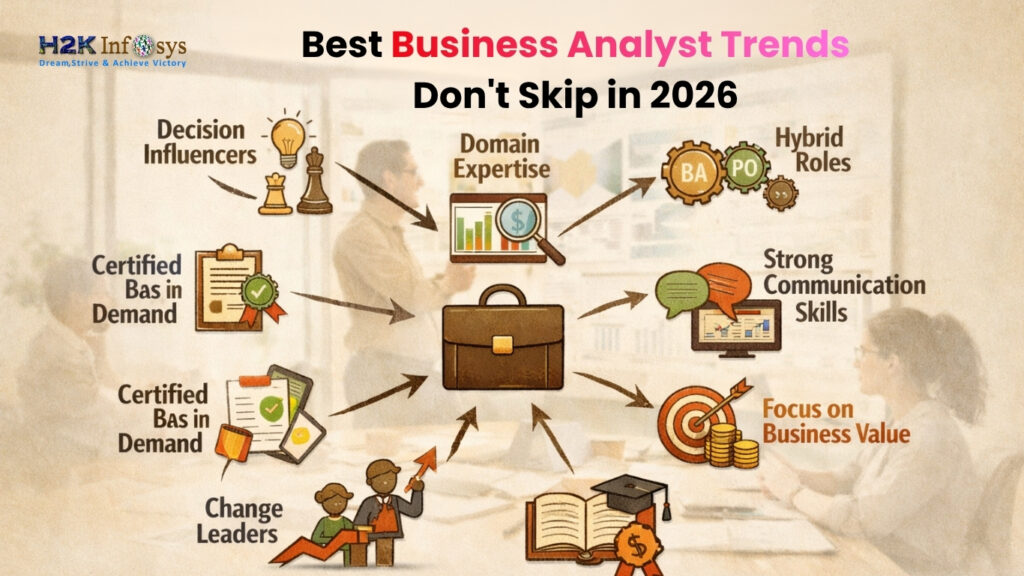
Business Analysts in the USA play a crucial role in aligning business goals with technology across industries such as finance, healthcare, retail, and IT. As digital transformation accelerates, the role is shifting from basic documentation to strategic decision-making. The future demand for BAs remains strong due to data growth, AI adoption, and Agile delivery models. To stay competitive, professionals are increasingly investing in Business Analysis Training to build skills in analytics, automation, stakeholder communication, and cybersecurity awareness. With steady job growth projected, continuous learning, hands-on training, and certifications are essential for long-term success in the evolving BA landscape.
What is the Future Scope of Business Analysts in the USA?
The future scope of Business Analysts in the USA is closely tied to how organizations adopt technology to improve operations, manage risk, and deliver measurable business outcomes. Business Analysts (BAs) are not limited to documentation tasks; they increasingly participate in solution design, stakeholder alignment, and data interpretation.
Key factors influencing this scope include:
- Continued enterprise investment in cloud platforms and SaaS tools
- Regulatory complexity in sectors like healthcare and finance
- Growth of Agile, DevOps, and product-based delivery models
- Emphasis on data quality, governance, and business intelligence
As a result, Business Analysts in the USA are expected to operate across both business and technical domains, often collaborating with architects, developers, QA teams, and product owners.
How Does Business Analysis Work in Real-World IT Projects?

In real-world IT projects, business analysis is an ongoing, structured activity rather than a one-time phase. Business Analysts in the USA typically work within defined delivery frameworks such as Agile Scrum, SAFe, or hybrid models.
Common Enterprise Workflow
- Problem Definition – Clarifying business objectives and constraints
- Stakeholder Analysis – Identifying decision-makers, users, and influencers
- Requirements Elicitation – Conducting interviews, workshops, and document reviews
- Requirements Analysis – Translating needs into functional and non-functional requirements
- Validation & Traceability – Ensuring requirements align with business goals
- Support During Delivery – Clarifying requirements during development and testing
Tools Commonly Used
| Category | Tools |
|---|---|
| Requirements | Jira, Confluence, Azure DevOps |
| Modeling | Visio, Lucidchart, Draw.io |
| Data Analysis | SQL, Excel, Power BI |
| Documentation | MS Word, Google Docs |
This structured involvement ensures that Business Analysts in the USA contribute directly to reducing rework, controlling scope, and aligning solutions with enterprise priorities.
Why Is the Role of Business Analysts Important for Working Professionals?
For working professionals, business analysis offers a career path that combines domain knowledge, analytical thinking, and communication skills. Business Analysts in the USA often serve as translators between technical teams and business leadership.
Reasons the role remains important include:
- Organizations rely on BAs to reduce ambiguity in complex initiatives
- Regulatory and compliance-driven industries require precise documentation
- Digital transformation projects demand cross-functional coordination
Unlike purely technical roles, business analysis allows professionals from QA, support, operations, or functional domains to transition without deep programming backgrounds, which explains sustained interest in ba training and business analysis training programs.
What Skills Are Required to Learn Business Analyst Roles?
To meet enterprise expectations, Business Analysts in the USA require a balanced skill set covering business, technical, and interpersonal competencies.
Core Skill Categories
Business Skills
- Process modeling (BPMN)
- Cost–benefit analysis
- Domain knowledge (banking, healthcare, insurance)
Technical Skills
- SQL for data validation
- Understanding APIs and system integrations
- Familiarity with SDLC and Agile methodologies
Communication Skills
- Stakeholder facilitation
- Documentation clarity
- Conflict resolution
Most business analyst courses and business analyst classes focus on building these skills progressively, often through case studies and simulated project environments.
How Is Business Analysis Used in Enterprise Environments?
In large enterprises, Business Analysts in the USA work within layered governance structures. Their responsibilities vary depending on project size and organizational maturity.
Typical Enterprise Use Cases
- ERP and CRM implementations
- Data migration and reporting initiatives
- Regulatory compliance projects
- Process automation and optimization
Common Challenges
- Managing conflicting stakeholder priorities
- Maintaining requirement traceability across releases
- Aligning business goals with technical feasibility
Best practices include maintaining a requirements traceability matrix (RTM), regular stakeholder reviews, and close collaboration with QA and architecture teams.
What Job Roles Use Business Analysis Skills Daily?
Business analysis skills are applied beyond the traditional BA title. Business Analysts in the USA often transition into or collaborate with the following roles:
| Role | Use of Business Analysis |
|---|---|
| Product Owner | Backlog prioritization, requirement refinement |
| Systems Analyst | Technical requirement translation |
| Data Analyst | Business rules and data interpretation |
| Project Manager | Scope and change management |
| Process Analyst | Workflow optimization |
This overlap explains why business analysis online training often includes exposure to adjacent roles and responsibilities.
Key Trends Shaping the Future Scope of Business Analysts in the USA
Several measurable trends influence how Business Analysts in the USA operate today and in the near future.
Increased Data-Centric Work
BAs are expected to validate data sources, define metrics, and collaborate with analytics teams rather than rely solely on reports.
Agile and Product-Based Delivery
Rather than fixed-scope projects, Business Analysts in the USA increasingly support ongoing product backlogs and incremental releases.
Tool Standardization
Enterprises prefer standardized toolchains, requiring BAs to adapt quickly to platforms like Jira, ServiceNow, and Power BI.
Remote and Distributed Teams
Clear documentation and asynchronous communication have become essential competencies.
These trends are commonly addressed in ba certification and business analyst certification online programs aligned with current enterprise practices.
What Careers Are Possible After Learning Business Analysis?
Learning business analysis opens multiple career paths. Business Analysts in the USA often progress based on specialization rather than hierarchy.
Common Career Paths
- Senior Business Analyst
- Product Owner or Product Manager
- Business Systems Analyst
- Program or Portfolio Analyst
- Domain Consultant
Career mobility depends on industry exposure, tool proficiency, and the ability to influence decision-making rather than tenure alone.
How Do Training and Certification Fit Into Career Development?

Formal learning provides structured exposure to industry practices. For Business Analysts in the USA, training typically focuses on applied skills rather than theory.
What Structured Training Covers
- Requirements elicitation techniques
- Agile and SDLC alignment
- Data analysis fundamentals
- Tool-based workflows
Programs offering ba training and placement often combine technical instruction with interview preparation and scenario-based exercises. While certification alone does not guarantee outcomes, it helps standardize knowledge and terminology across organizations.
Learning Path Overview for Aspiring Business Analysts
| Stage | Focus Area |
|---|---|
| Foundation | SDLC, business processes |
| Intermediate | Requirements analysis, Agile |
| Advanced | Data analysis, domain specialization |
| Professional | Stakeholder leadership, strategy |
This progression aligns with how Business Analysts in the USA typically gain responsibility over time.
Frequently Asked Questions (FAQ)
Is business analysis still relevant in the USA job market?
Yes. Business Analysts in the USA continue to be required across regulated and technology-driven industries where structured analysis reduces risk.
Do business analysts need coding skills?
Basic technical literacy is useful, but most roles emphasize analysis, communication, and process understanding rather than software development.
Can non-IT professionals transition into business analysis?
Yes. Many Business Analysts in the USA come from QA, operations, finance, or support backgrounds after completing business analysis online training.
How long does it take to become job-ready?
With focused study and practical exposure, learners typically require several months to build foundational competencies.
Key Takeaways
- Business Analysts in the USA remain integral to enterprise IT and digital transformation initiatives
- The role is evolving toward data literacy, Agile collaboration, and product support
- Practical skills, tool familiarity, and domain knowledge matter more than theory
- Structured ba training, business analyst courses, and business analysis training help standardize job-ready skills
Explore H2K Infosys programs to gain structured, hands-on exposure to real-world business analysis practices.
Learn through guided projects and enterprise-aligned training designed for working professionals.