
When you’re starting totally new, Entry Level Business Analyst Training can make the whole career path so much less confusing. Beginners get a better understanding of how business analysis works in real projects rather than trying to figure it all out alone. Things like requirements gathering, Agile workflows, documentation, and stakeholder communication all start to make more sense once you have learned them.
A lot of people still think business analysis is only for people with strong technical or IT backgrounds. That’s honestly not true anymore. In fact, many successful business analysts today started in completely different fields. Some came from customer support, some from banking or healthcare, and others from retail, operations, or even teaching.
What usually helps them transition isn’t necessarily a technical degree. It’s proper training, real project exposure, and learning how businesses actually solve problems. Programs offered by H2K Infosys often focus on these practical aspects, which makes the transition easier for beginners. Once beginners understand that part, the role feels much more approachable than it first seemed.
Why Beginners Struggle Without Proper Training
The business analyst field looks simple from the outside. People hear terms like “requirements,” “meetings,” or “data analysis” and think it’s mostly documentation work. Then they step into interviews and realize companies expect familiarity with Agile, Jira, SQL basics, user stories, workflows, and business communication.
That gap is where structured Business Analyst Training becomes valuable.
Instead of randomly watching videos online, proper training creates a guided learning process. You learn how projects actually move inside companies. You also understand how business analysts act as the bridge between technical teams and business stakeholders.
I’ve noticed beginners usually struggle with three things:
- Understanding business terminology
- Knowing how real projects operate
- Explaining their skills confidently during interviews
Good training solves all three gradually.
What You Actually Learn in Entry-Level Business Analyst Programs
Most modern business analyst online programs now focus heavily on practical learning because employers care more about applied skills than memorized theory.
A beginner-friendly course typically covers:
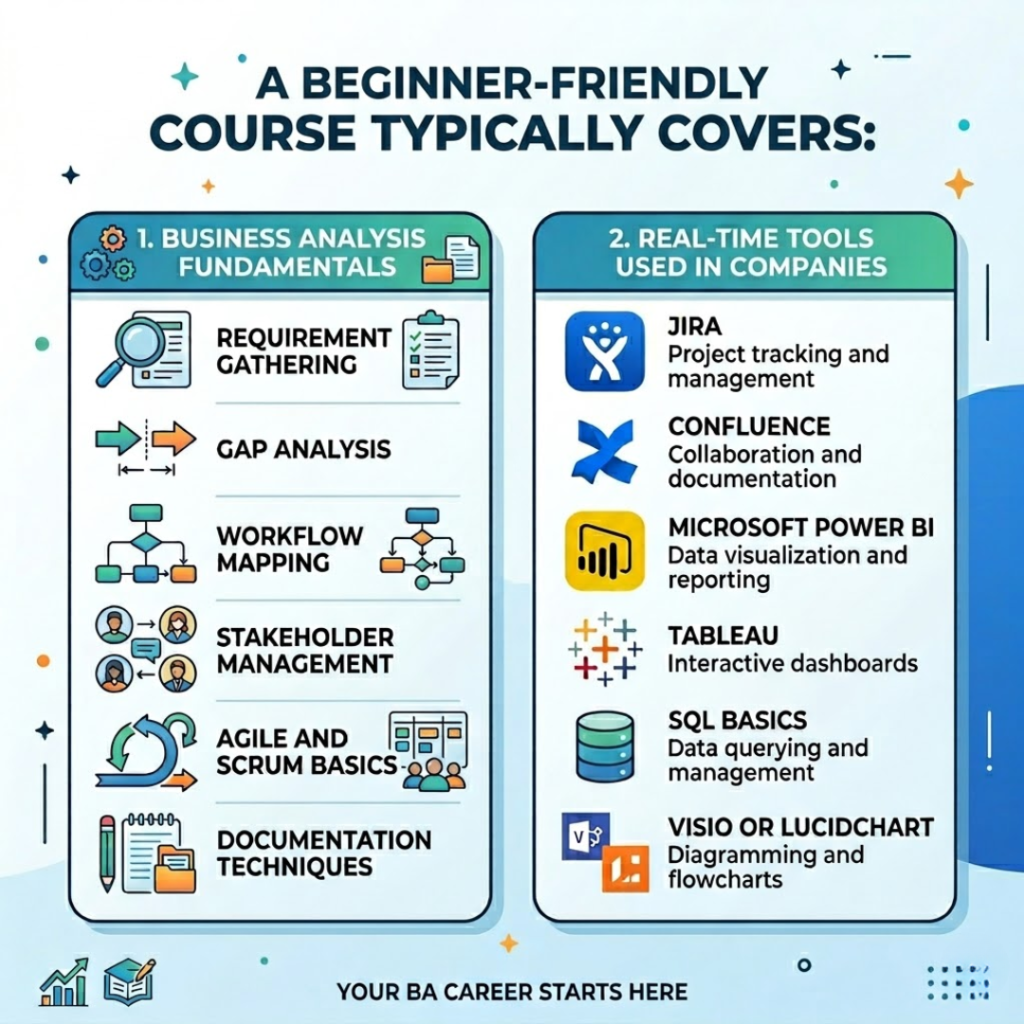
Business Analysis Fundamentals
This is where you learn the role of a business analyst inside real organizations. Topics usually include:
- Requirement gathering
- Gap analysis
- Workflow mapping
- Stakeholder management
- Agile and Scrum basics
- Documentation techniques
At first, these terms sound intimidating. After a few hands-on exercises, they start feeling surprisingly logical.
Real-Time Tools Used in Companies
One thing that changed a lot recently is employer expectations around tools. In 2026, recruiters increasingly expect even entry-level candidates to know platforms like:
- Jira
- Confluence
- Microsoft Power BI
- Tableau
- SQL basics
- Visio or Lucidchart
This is why many learners prefer practical Business Analyst Training instead of purely academic certification programs.
Why Online Training Became More Popular
A few years ago, people were still skeptical about learning business analysis remotely. That’s mostly gone now.
Today, many hiring managers actually care more about portfolio projects and communication skills than whether training happened in a classroom or online. Flexible business analyst online learning has become normal, especially for working professionals changing careers.
The advantage is obvious:
- Flexible schedules
- Recorded sessions
- Live project practice
- Access to mentors
- Interview preparation support
Some platforms also simulate real business meetings and requirement workshops, which help beginners gain confidence faster.
How H2K Infosys Helps New Business Analysts
A lot of beginners explore training programs from H2K Infosys because the learning style feels more practical and career-focused, not just theory on slides for weeks. That balance actually matters when you’re new and trying to understand how business analysis works in real companies.
Instead of only teaching concepts, the program tries to give learners exposure to situations they may face during actual projects. For many beginners, that makes the whole process feel less intimidating. You’re not just memorizing definitions and hoping for the best later.
The training usually includes things like:
- Live instructor-led classes
- Real-time project exposure
- Agile and Scrum training
- Resume preparation support
- Mock interview sessions
- Placement assistance
One thing many learners appreciate is the project-based approach. It helps connect the dots between theory and real work. Sometimes beginners understand a topic only after seeing how it’s used inside a project scenario, and honestly, that’s pretty normal.
The interview preparation side also helps a lot. Knowing concepts is one thing, but explaining them confidently during interviews is completely different. Programs that include mock interviews and mentor guidance tend to make people feel more prepared before they start applying for jobs.
Real Career Opportunities for Beginners in 2026
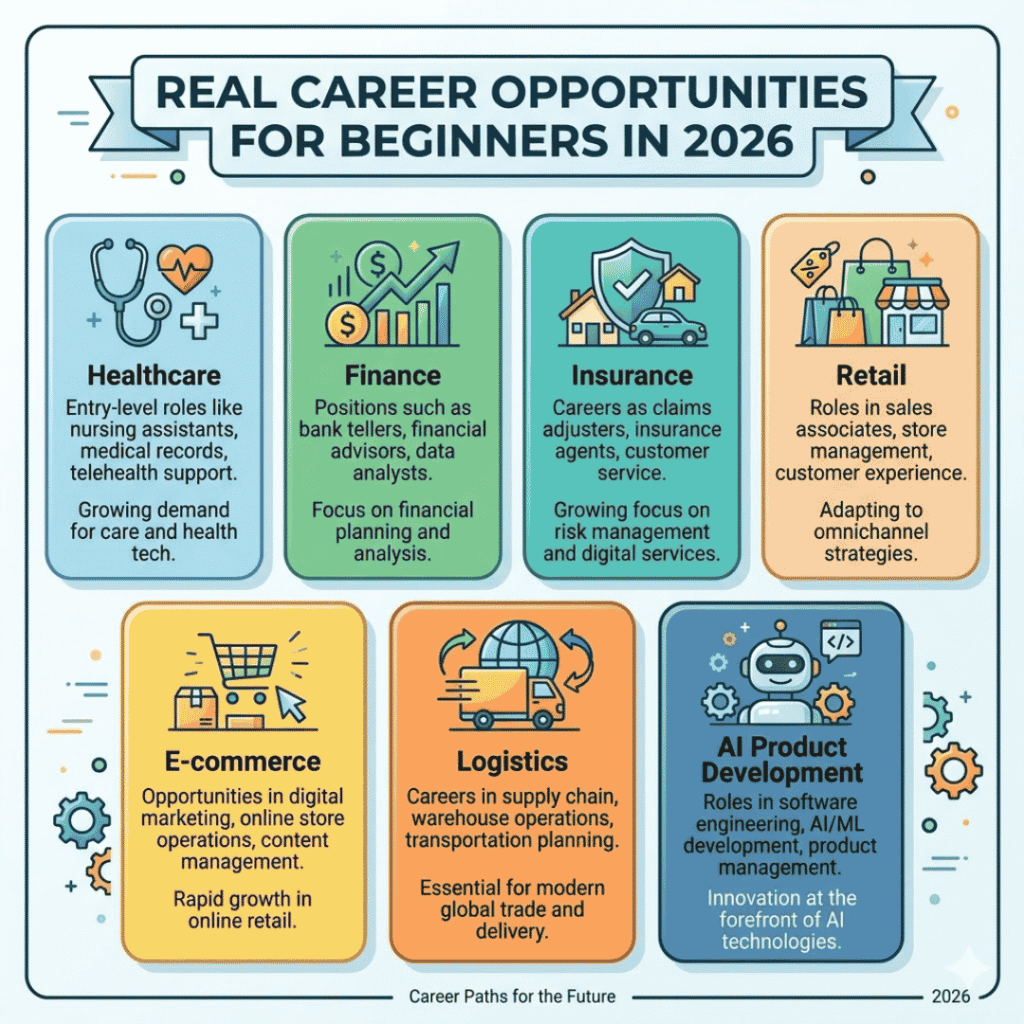
One thing that stands out about the business analyst field in 2026 is how many industries are hiring now. A few years ago, people mostly connected BA roles with IT companies. That’s changed quite a bit.
Today, businesses across different sectors are looking for analysts who can understand problems, improve processes, and help teams work more efficiently. You’ll find opportunities in areas like:
- Healthcare
- Finance
- Insurance
- Retail
- E-commerce
- Logistics
- AI product development
And honestly, the demand is still growing.
AI-driven automation is the big thing in the modern workplace, but businesses still need the human ability to think through business problems in practical terms. There’s no question that AI tools can generate reports, automate tasks, and sort data faster than ever before. However, businesses still need human analysts to understand priorities, communicate with stakeholders, and make sense of what actually matters for the project.
And that human decision-making part is hard to replace.” Someone still has to link business goals to actual workflows and make sure teams are headed in the right direction. This is where business analysts still have an important role, particularly in companies that are digitally transforming today.
A Practical Example
Imagine a retail company launching a new mobile shopping app.
Developers can build the software, but someone still needs to:
- Understand customer problems
- Gather business requirements
- Coordinate between teams
- Define feature priorities
- Document workflows
- Validate business needs
That’s exactly where business analysts fit in.
A beginner who completes strong Entry Level Business Analyst training with project simulations can realistically contribute to these activities much faster than someone learning randomly through free resources.
What Makes Good Training Different
Not all courses are equal, honestly.
Some training programs are mostly definitions, slides, and theory. You come out of the course with the terminology, but when it comes to real project work or interview-wise it’s a bit uncertain still. That happens more than people realize.
The good programs are those that actually prepare beginners to work in real environments. You get to see how projects move, how teams communicate, and what business analysts are really dealing with on a day-to-day basis. Honestly, that hands-on experience is a game-changer.
When you’re hunting for a good Business Analyst Training program, it is important to look beyond just certificates or course titles. In the end, a few things matter much more:
- Real-time projects similar to real work in the company
- Project simulations or internship-style learning
- Sample realistic questions for mock interviews
- Scrum and agile training
- Resume and LinkedIn Tips
- Case studies from the industry
- A mentor helps when you are stuck
Those details can seem small at first, but they make a huge difference when interviews start happening. It is usually easy to tell who has just learned the theory and who has actually gone through the process of solving business problems.
The Final Words
Getting into business analysis can be a little intimidating at first. Most entry-level job postings require experience, which can be frustrating when you’re trying to get a foot in the door. That’s why structured Entry Level Business Analyst training is so valuable. For beginners, it provides practical exposure, confidence, and a better understanding of how real projects work.
From what I’ve seen lately, employers are less interested in collecting random certifications and more interested in whether candidates can actually handle project scenarios. Practical experience is more important than ever.
This is one of the reasons why beginners continue to look for programs like H2K Infosys Business Analyst Training. The focus is more on real-world skills, project experience, and career preparation rather than just theory-heavy lessons that people forget after a few weeks.