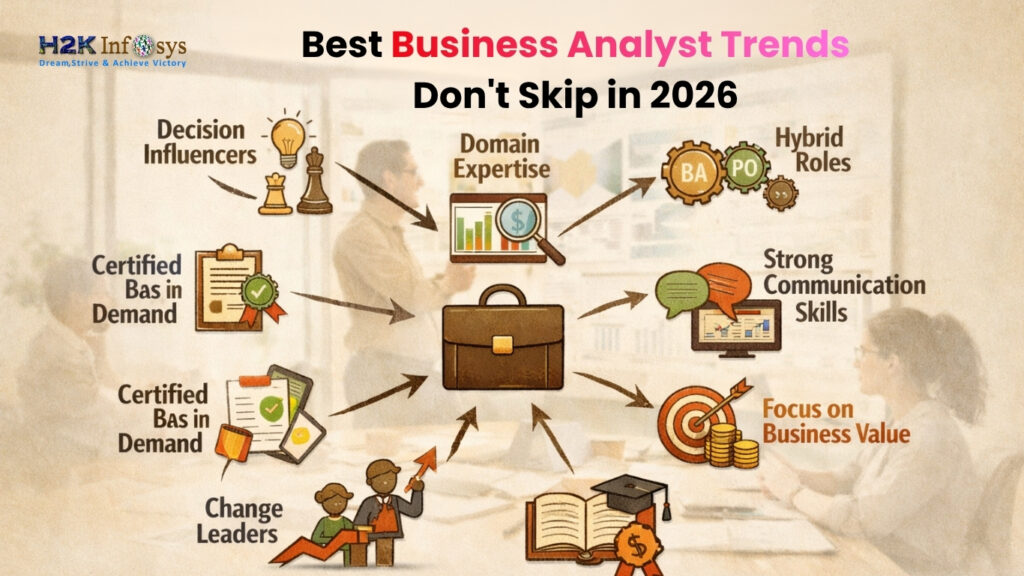
From 2026 onward, all Business Analysts, and particularly those professionals trained at H2K Infosys, will begin adapting and evolving with the transformation of Artificial Intelligence, which will encompass responsibilities as outcome-oriented, ethical, and proactive analysis, with an emphasis on incorporating coaching of autonomous workflows, and ensuring alignment of analytical output with transparent, actionable business reporting metrics.
Analysts will enhance team performance by ensuring conversational access to data and governance, as well as facilitating real-time and actionable awareness. Success will demand that these analysts have extraordinarily high levels of Artificial Intelligence knowledge, as well as the ability to articulate prompts, and to possess advanced levels of narrative writing ability to impact and drive changes in business thinking. Organizations demand the ability to think strategically, manage change, and directly link the insights to the operational and business outcomes. The current worldwide high-value Business Analyst role is defined by continuous self-learning, specific domain knowledge, and a product-oriented mindset.
And if you’re planning to enroll in Business Analyst Training, pursue a BA certification, or explore business analyst courses, you’ll want to align your learning with these changes.
Let’s break down the most important Business Analyst Trends of 2026, practical, current, and grounded in what’s actually happening in companies today.
1. AI-Augmented Business Analysis Is the New Normal
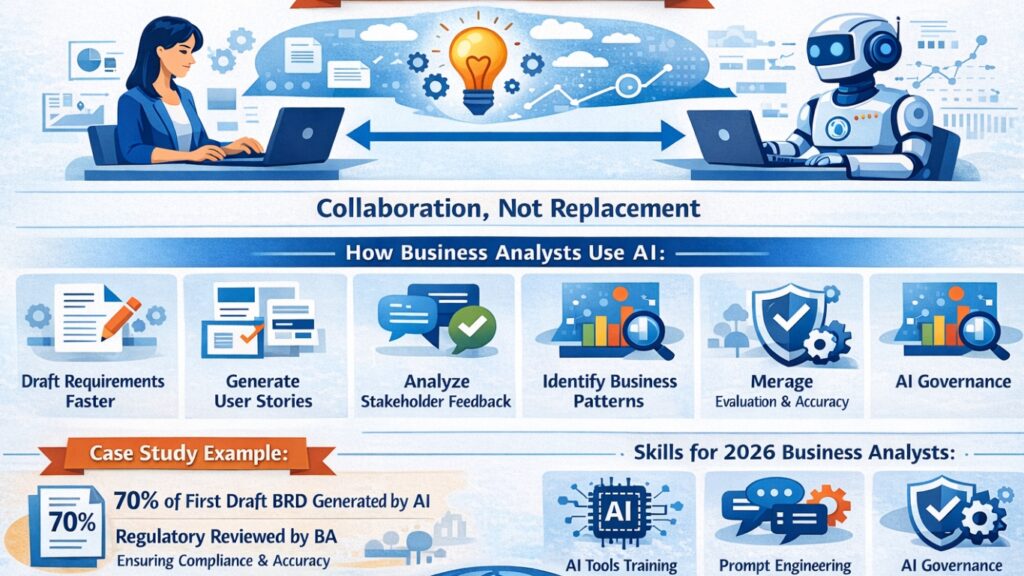
One of the biggest Business Analyst Trends right now is AI collaboration. Not replacement collaboration.
In 2025–2026, many enterprises adopted generative AI tools inside their internal systems. Business analysts are now using AI to:
- Draft requirement documents faster
- Generate user stories
- Analyze stakeholder feedback
- Identify patterns in business data
But here’s the catch: AI produces output. Analysts provide judgment.
In a recent fintech project I consulted on, AI generated 70% of the first draft BRD. The BA then validated regulatory requirements manually because compliance errors could cost millions. That’s the difference between automation and expertise.
Modern business analyst training programs now include AI tools, prompt engineering basics, and AI governance frameworks. If your business analysis online training doesn’t touch AI, it’s already outdated.
This shift alone defines several major Business Analyst Trends for 2026.
2. Data Storytelling > Data Reporting
Dashboards are everywhere. But insights? Not so much.
Another strong Business Analyst Trends shift is toward data storytelling. Executives don’t want raw numbers they want clarity. They want to know:
- What’s happening?
- Why is it happening?
- What should we do next?
Analysts who combine SQL skills with business narrative are thriving. A client of mine in retail transformed their inventory strategy because a BA connected sales patterns to regional behavioral data—not just charts, but a story behind the charts.
Many advanced business analyst classes now integrate visualization tools like Power BI and Tableau alongside stakeholder communication training. This blend is becoming core to business analyst certification online programs as well.
If you’re considering ba training, prioritize programs that teach interpretation, not just extraction.
3. Hyper-Specialization by Sector
Generalist BAs still exist, but specialization is dominating Business Analyst Trends.
Companies specializing in their domains will emerge in 2026; these will include:
- Healthcare Compliance Analysts
- Banking Regulatory Analysts
- SaaS Product Analysts
- Supply Chain Digital Transformation Analysts
With evolving global data privacy laws and AI regulations, Financial Institutions are now looking for BAs who understand AI Risk Assessment. That knowledge will not come from generic training.
What is the best decision made by professionals recently in the market? Pursuing a BA certification in conjunction with domain-specific knowledge. Some even go as far as integrating business analyst training and placement programs in a targeted manner within the domains of fintech or healthcare IT.
The focus on specialization is no longer a mere trend – it becomes the basis of sound strategy.
The hyper-specialization we are witnessing is one of the most significant Business Analyst Trends redefining the current landscape of recruitment.
4. Agile + Product Thinking is Anticipated, Not Optional
Agile is not a new concept. However, product thinking at the BA level is relatively new.
A trend evolving in Business Analysis is the expectation for analysts to act like product owners. Instead of only gathering and documenting requirements, they are also expected to:
- Be feature owners
- Understand user impact
- Assess ROI
- Integrate initiatives with the product vision
Especially in startups, BAs frequently report directly to the founders. I’ve done consulting at a SaaS company where the BA was responsible for backlog grooming and customer journey mapping. That was more of a strategic role than an operational one.
The top-rated business analyst certifications in 2026 will focus on the Scrum framework, backlog management, and delivery oriented to the highest value. If your business analysis online course is devoid of product lifecycle, it will be a challenge for you in contemporary environments.
This inclination toward product ownership is consistent with Business Analyst Trends across all digital-first organizations.
5. Remote & Global Collaboration Skills
Hybrid work is here to stay.
Cross-border teams are common now, especially in tech and consulting. One of the quieter but critical Business Analyst Trends is advanced remote collaboration capability.
Today’s analysts must:
- Facilitate virtual workshops
- Manage asynchronous documentation
- Align global stakeholders
- Handle timezone-sensitive planning
I’ve seen BAs fail not because of weak analysis but because they couldn’t manage stakeholder communication remotely.
Leading business analyst certification online programs now include collaboration simulations and remote facilitation training. That’s a smart addition.
Communication has always mattered. In 2026, it’s amplified.
6.Growing Emphasis on Change Management
Resistance to change is not only alive and well, it is growing.
Digital transformation, the adoption of AI, and automation are disruptive to the normal order of work. One of the major Business Analyst Trends developments is the migration of Business Analysts into change advisory roles.
In a number of enterprise rollouts this year, Business Analysts (BAs) have facilitated stakeholder alignment, addressed adoption risks, and
developed communication strategies.
That is not traditional analysis, it is behavioral strategy.
Contemporary behavioral analysis (BA) education includes change management methodologies such as ADKAR and the Organizational Transformation Model. It is increasingly prevalent in BA training and placement programs for enterprise roles.
Without a change management perspective, the technical aptitude will not create the desired impact.
7. Continuous Certification & Micro-Credentials
Static careers are fading. Continuous learning is replacing one-time certifications.
Another visible shift among Business Analyst Trends is micro-credential stacking.
Professionals now combine:
- Core business analyst certification online
- Agile certifications
- Data analytics badges
- AI fundamentals certificates
Instead of one big certification every five years, analysts are building skill portfolios.
I’ve noticed hiring managers increasingly ask:
“What have you learned in the last 12 months?”
If you’re exploring business analyst courses, choose flexible learning paths. The best business analysis online training providers now update their curriculum quarterly.
The days of outdated course content lasting 5 years are gone.
8. Knowledge of Ethical AI and Governance
As the regulation of AI technologies and the implementation of AI risk strategies by businesses enter the AI oversight space, Ethical oversight has now become a part of the BA functions.
Compliance integrated analysis is an emerging trend in Business Analytics.
BAs are starting to assess:
- AI model biases
- Opacity in data sourcing
- Risk
- Governance documentation
Even smaller firms are establishing AI Ethics Boards, with analysts often being involved in these processes.
Governance and regulatory modules have become standard features in revised BA certification curricula. If your training in Business Analytics does not incorporate the ethical implications of AI, it is outdated.
9. Business Analysts as Strategic Advisors
This one feels personal because I’ve seen it happen.
The strongest professionals in 2026 are no longer “requirement collectors.” They’re strategic partners.
Senior BAs participate in:
- Digital roadmap planning
- Budget discussions
- Risk evaluation
- Vendor selection
In a recent ERP transformation project, the BA led the vendor comparison framework. That level of involvement would’ve been rare a decade ago.
Among all Business Analyst Trends, this elevation of influence might be the most impactful long-term.
And honestly, it’s exciting.
10. Training with Placement Assistance Is Growing
There is evident demand for job-oriented education; hence, business analyst training and placement models are proliferating across borders.
As for students, there is a preference for:
- Practical projects
- Real-world scenarios
- Mock interviews
- CV reviews
- Networking with employers
The focus is more on practical exposure rather than theoretical.
Top-tier business analyst training includes live projects with real datasets, not dummy templates. That practical focus is aligned with the current Business Analyst Trends in the development of skills.
If you are considering enrolling for BA Training, placement support, and mentorship from the industry should be on your checklist.
Conclusions
The Business Analyst Trends shaping 2026 include AI partnership, data fluency, product thinking, specialization, ethical awareness, and continuous learning.
This role is expanding – not shrinking.
If you are thinking of taking ba training, a ba certification, business analyst courses, or a business analyst certification online, your learning should match with these trends. Your business analysis online training should be current, practical and aligned with industry standards.
Business analysis is about impact now, not just paperwork.
And based on what I observe in the actual projects this year, analysts who adapt most quickly are the ones leading the transformation – not just documenting it.
If you continue to keep up with the changing Business Analyst Trends, 2026 may be your year.