Let me be honest when I first started exploring Einstein features inside Salesforce, I expected something closer to autopilot. You know, the kind of AI that just figures things out. But after working on a few real implementations (and a couple of messy ones), I realized quickly understanding the Limitations of Salesforce is just as important as knowing its strengths.
This blog walks you through those limitations in a real-world, no-fluff way exactly how you’d want someone to explain it before you invest your time or money into it.
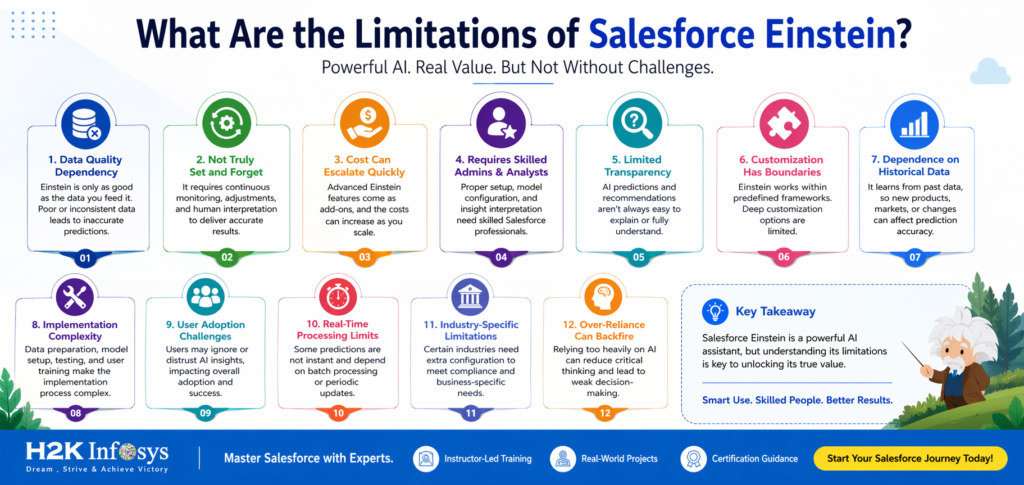
1. Data Quality: The Foundation That Can Break Everything
Here’s the thing Einstein is only as good as the data you feed it. Sounds obvious, but it’s where most businesses stumble.
If your CRM data is incomplete, inconsistent, or outdated, Einstein doesn’t magically fix it. It amplifies the mess.
I once worked with a sales team that had duplicate leads, missing fields, and random notes scattered everywhere. They turned on Einstein Lead Scoring expecting clarity and got confusing predictions instead. Why? Because the AI was learning from bad patterns.
That’s one of the core Limitations of Salesforce it doesn’t clean your data for you.
Real-world takeaway:
- Garbage in = garbage out
- You need strong data governance before AI even enters the picture
This is something you’ll see emphasized heavily in good Salesforce admin training programs because admins are the gatekeepers of data quality.
2. It’s Not Truly Set It and Forget It
A lot of marketing around AI suggests automation without effort. Einstein doesn’t quite work like that.
Yes, it automates predictions but it still needs:
- Monitoring
- Adjustments
- Interpretation
For example, Einstein Opportunity Insights might flag a deal as at risk. But it won’t always tell you why in a way that makes business sense. Someone still needs to interpret those signals.
That’s another subtle but important part of the Limitations of Salesforce human judgment is still essential.
My observation:
Teams that treat Einstein like a tool (not a decision-maker) get far better results.
3. Cost Can Escalate Quickly
Let’s talk about something people often hesitate to mention pricing.
Einstein features aren’t always included in standard Salesforce packages. Many advanced capabilities come as add-ons.
And once you start layering:
- Einstein Prediction Builder
- Einstein Discovery
- AI-powered automation
…the costs can stack up pretty fast.
This is one of the more practical Limitations of Salesforce that businesses feel immediately.
Real scenario:
A mid-sized company I worked with started small with Einstein, but within a year, their AI-related costs doubled because they kept adding features without a clear strategy.
That’s why structured learning like a proper Salesforce course really helps you understand what’s worth investing in and what’s not.
4. Requires Skilled Admins and Analysts
Einstein isn’t beginner-friendly if you want to use it properly.
Sure, you can enable some features with a few clicks. But to actually optimize it?
You need:
- Data modeling knowledge
- Reporting skills
- Understanding of AI outputs
- Business context
This is one of the most underestimated Limitations of Salesforce the skill gap.
I’ve seen companies invest in Einstein but struggle because their team didn’t fully understand how to configure or interpret it.
That is exactly why Salesforce Administrator Training is now covering the gap between here and there for many professionals.
5. Limited Transparency in AI Decisions
Einstein sometimes provides you with about an order of magnitude prediction but there’s no clear reasoning behind it!
Well, yes, and, as a result, you offer explanations that are somewhat technical or vague.
For example:
“Lack of engagement increased deal risk.
Fine but what does that mean, exactly?
One more of the Limitations of Salesforce is that it definitely does NOT provide full transparency, especially for those companies needing explainable AI for compliance (e.g., regulatory filings) or decision-making.
Why it matters:
One thing is clear, Sales teams do not trust the system
Leadership may question AI-driven decisions
6. Customization Has Boundaries
Flexibility is something Salesforce prides itself on, but there are constraints with Einstein.
AI models cannot be precisely fine-tuned in the way you want them to. Certain features function in predefined frameworks.
This becomes noticeable when:
- Every business process is unique and different (possibly)
- You are looking for prediction logic specific to a certain result
That’s another example of the Limitations of Salesforce in the real world. Flexibility yes infinite customization?
7. Dependence on Historical Data
Einstein learns from past behavior.
Which sounds great until your business changes.
Let’s say:
- You launch a new product
- Enter a new market
- Change your pricing model
Einstein may struggle initially because it doesn’t have historical data for those scenarios.
This is one of those subtle Limitations of Salesforce that you only notice during business transitions.
8. Implementation Complexity
Getting Einstein up and running properly isn’t always simple.
There’s:
- Data preparation
- Model setup
- Testing
- User training
I’ve seen teams underestimate this and rush deployment only to roll things back later.
That complexity is another important entry in the list of Limitations of Salesforce.
9. User Adoption Challenges
Even the best AI tool is useless if people don’t use it.
Sales reps sometimes:
- Ignore AI insights
- Distrust automated recommendations
- Stick to their old habits
This human factor is one of the most overlooked Limitations of Salesforce.
Personal insight:
The teams that succeed are the ones that train users not just deploy tools.
10. Real-Time Processing Isn’t Always Instant
Einstein feels fast but it’s not always real-time in the way people expect.
Some predictions:
- Update periodically
- Depend on batch processing
So if you’re expecting instant AI reactions to every data change, that’s another one of the Limitations of Salesforce to keep in mind.
11. Industry-Specific Limitations
Although Einstein is cross-industry, it does not include deep domain specialization by default.
For example:
Healthcare compliance needs extra configuration
Data management in financial services needs to be windtight
It gives one more dimension to the Salesforce Limitations one might have the need for customization or another tool to meet some of the industry needs.
12. Over-Reliance Can Backfire
This one is more of a mindset type thing, but still critical.
If teams rely too heavily on Einstein:
- Critical thinking drops
- Decision-making becomes passive
That’s a softer but very real part of the Limitations of Salesforce.
AI should assist not replace human judgment.
Why Training Matters More Than Ever
After seeing all these challenges, one thing becomes very clear:
The difference between success and frustration with Einstein often comes down to training.
That is exactly where enterprise structured applications like H2K Infosys come into the picture.
They are not just about teaching features but they also centre around:
- Real-world scenarios
- Data handling
- Admin best practices
- AI implementation strategies
If you are serious about excelling in Salesforce, getting Salesforce Certification training is arguably one of the best things ever.
A Quick Story From the Field
One time I worked for a retail company that aimed to improve customer predictions using Einstein.
Things didn’t start smoothly:
- Predictions were off
- Teams ignored the insights
- Leadership questioned the investment
But after their admins had taken structured Salesforce administrator courses, things were different.
They:
- Cleaned up data
- Redesigned workflows
- Trained users properly
Einstein began delivering real value in just a few months.
That experience really drove home the point:
Understanding the Limitations of Salesforce is what unlocks its true power.
Final Thoughts
Salesforce Einstein is impressive but it’s not magic.
The Limitations of Salesforce aren’t deal-breakers they’re reality checks.
If you go in expecting perfection, you’ll be disappointed.
If you go in prepared with the right skills, training, and mindset you’ll get incredible value.
And honestly? That’s what separates professionals from beginners in today’s AI-driven CRM world.
Thinking About Learning Salesforce?
If you’re planning to build a career in this space or just want to avoid the mistakes I’ve seen too many teams make start with proper training.
Programs like:
- Salesforce admin training
- A hands-on Salesforce course
- Structured Salesforce certification training
can save you months (or even years) of trial and error.
And if you’re looking for something practical, career-focused, and grounded in real-world use cases, H2K Infosys is definitely worth checking out.
One Last Thought
AI in CRM isn’t about replacing humans it’s about making smarter humans.
And once you truly understand the Limitations of Salesforce, you stop expecting miracles… and start building systems that actually work.
That’s when things get interesting.