learning python basics is the first step toward becoming confident in programming, but the real growth comes from applying those skills to practical projects and advanced concepts. After understanding Python fundamentals, learners should focus on improving problem-solving abilities, learning important programming concepts, and gaining hands-on experience. H2K Infosys helps learners strengthen their Python knowledge through structured training, practical exercises, and real-time learning approaches that prepare them for professional opportunities. The next stage after Python basics is about building deeper skills and understanding how Python is used in real-world applications.
The Learning Python Basics
A Learning Python Basics understanding of Python entails focus and determination, at least for a few weeks. Once you understand the basics of the language, unraveling and communicating becomes all the easier. Code readability increases dramatically once you master Python. Since Python is so close to English, it is easy to learn and interpret
The python basics tutorial begins with a few easy steps. They are uncomplicated, and all python tutors start off by recommending the installation of Python. Many platforms like HP already have Python pre-installed. Incase python is not installed on the PC; the installation process is relatively uncomplicated.
The learning python basics process begins almost immediately. Courses have many coding exercises to polish the skills of a python beginner. The guidebooks are tailored in such a way to assist people who may not even understand Python.
The Major Applications of Python
Once you are competent in understanding python, many doors swing open for you. Of the many popular options for a python expert, developing applications remains one of the most interesting ones. Apart from data sciences, python programming is useful in image processing and text processing. Moreover, Python is a versatile and high-level language.
Since Python is an interpreted language, it is easier to debug. Learning Python is essential for a developer who wants to learn quickly and easily. Web and game development remains the top applications for Python.
The Future Prospects after learning Python basics for beginners
Beginners who master the learning python basics generally move towards the field of data sciences and machine learning. Data science is a vastly set topic in itself, which requires tutoring and studying of its own. As far as Python is concerned, it is a useful tool for web scarping. Web scraping is one of its underrated uses. Python experts can extract all kinds of heavy data from websites.
Although it often gets classified as a beginner’s language, Learning Python Basics tutorial benefits professional developers and coders in a stream of scientific applications.
Artificial Intelligence
The artificial intelligence software is starkly different from other software since it requires a linear and consistent language. This is where Learning Python Basics comes in. If you have a skill set that appeals to AI software, it has to be Python. Python has a remarkably discreet and active community. It houses a library dedicated to assisting beginners interested in Artificial intelligence and machine learning. Most developers already know where they want to go when they are studying Python. learning python basics gives direction to your thoughts.
Real World Applications
Perhaps the best news for all python beginners is that the applications of the language are present all around us. The concepts are directly applied to software’s and thus serve immediate gratification. Python is a beginner’s language for the most part however people who do not aim to become developers can also study it. Similar to coding, learning python basics is also a hobby and an excellent job skill.
How to Practice Python Skills After Learning the Basics?
Learning Python Basics concepts is only the first step; regular practice is what helps you become confident. After completing the basics, start solving coding problems, improving existing programs, and working on small projects. Practice writing clean and efficient code, debugging errors, and understanding how different Python concepts work together.
Building projects based on real-world scenarios helps you apply your knowledge. For example, you can create automation scripts, data processing tools, web applications, or simple applications that solve everyday problems. Practical experience makes it easier to understand advanced Python concepts and prepares you for professional development work.
What Should You Learn After Learning Python Basics?
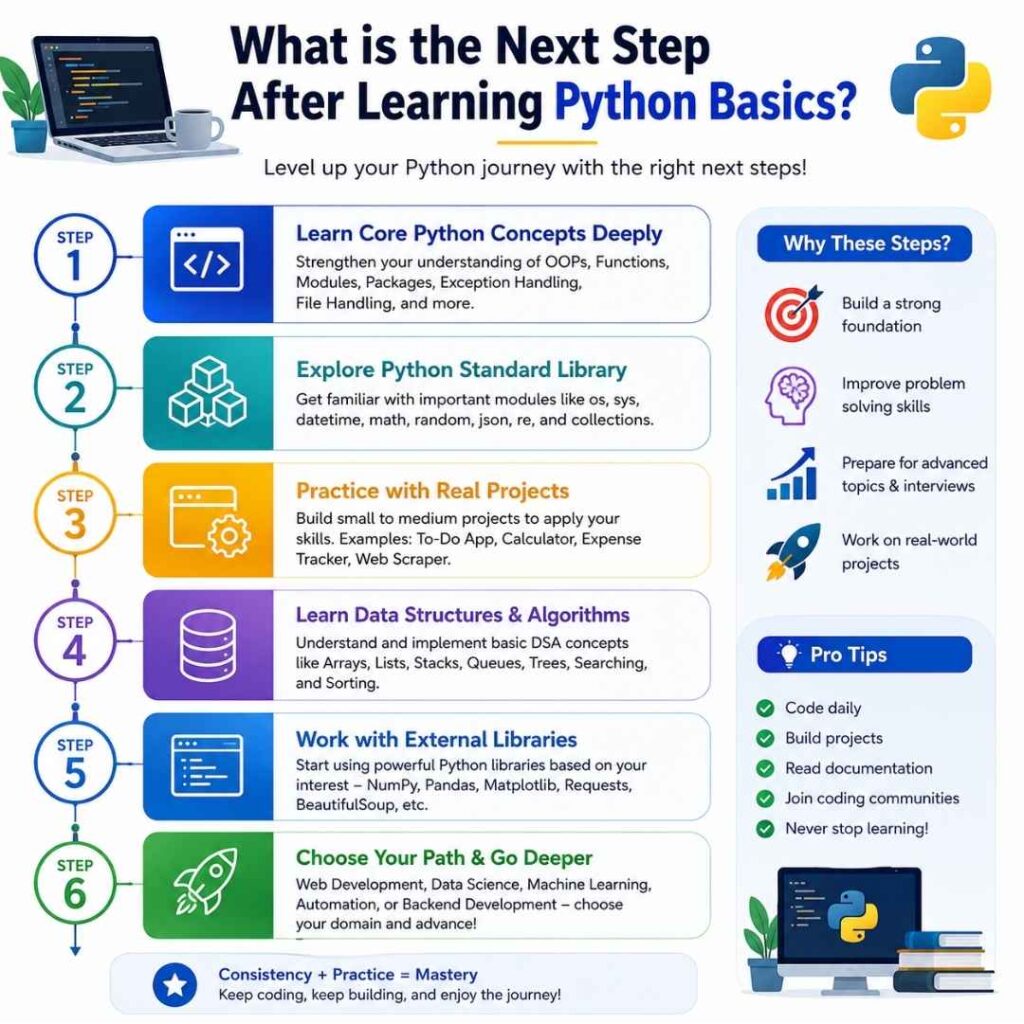
After Learning Python Basics, the next important step is to move toward practical programming skills and advanced concepts that help you apply Python in real-world scenarios. Instead of only focusing on syntax, learners should start improving problem-solving abilities, building projects, and understanding how Python is used in different career paths. Developing these skills helps create a strong foundation for software development, automation, data-related roles, and other Python-based opportunities.
Important topics to Learning Python Basics:
- Object-Oriented Programming (OOP): Learn classes, objects, inheritance, encapsulation, and polymorphism to write structured and reusable Python code.
- Data Structures and Algorithms: Improve your logical thinking by understanding lists, dictionaries, sets, stacks, queues, searching, and sorting techniques.
- Working with Python Libraries: Explore commonly used libraries to perform tasks efficiently and build practical applications.
- Database Integration: Learn how Python connects with databases to store, retrieve, and manage application data.
- API Integration: Understand how to work with APIs to connect Python applications with external services and real-time data.
- Build Real-World Projects: Create projects such as automation scripts, web applications, data analysis tools, or small software solutions to gain hands-on experience.
- Learn a Python Framework: Based on your career goal, explore frameworks that help you develop professional applications and improve job readiness.
- Practice Coding Challenges: Regular coding practice improves problem-solving skills and prepares you for technical interviews.
Why Should You Build Python Projects After Learning Basics?
Learning Python Basics,Practical projects are one of the best ways to improve Python skills. Creating projects helps you understand how different concepts work together and gives you experience solving real-world problems.
Some beginner-friendly Python projects include:
- Automation scripts
- Calculator applications
- Task management systems
- Web scraping tools
- Data analysis projects
- Simple web applications
Building projects also helps create a portfolio that can demonstrate your programming abilities to potential employers.
How Can You Improve Your Python Programming Skills?
Improving Python skills requires consistent practice and continuous learning. Instead of only watching tutorials Learning Python Basics, focus on writing code regularly and experimenting with different projects.
Some effective ways to improve include:
- Practice coding challenges regularly
- Read and understand other developers’ code
- Work on real-time projects
- Learn Python frameworks and tools
- Participate in programming communities
- Improve problem-solving techniques
Should You Learn Advanced Python Concepts?
Yes, advanced Python concepts help you become more confident and job-ready. Once you understand the Learning Python Basics, learning topics such as decorators, generators, file handling, modules, and advanced object-oriented programming can improve your programming efficiency.
These skills help developers create scalable applications and handle more complex programming tasks.
What Career Opportunities Are Available After Learning Python?
Python skills are valuable across multiple technology fields. After Learning Python Basics gaining advanced knowledge and practical experience, learners can explore opportunities in:
- Python development
- Automation testing
- Web development
- Data analysis
- Machine learning
- Backend development
The career path you choose depends on your interests and the additional skills you develop along with Python.
Conclusion
Learning Python Basics gives you a strong foundation, but continuing your learning journey is important to become confident in real-world programming. The next steps include practicing advanced concepts, building projects, improving problem-solving skills, and exploring areas where Python is widely used. Consistent practice and hands-on experience can help you transform your basic knowledge into practical skills.
Whether you want to move into software development, automation, data-related roles, or other technology fields, continuing beyond Learning Python Basics can open more career opportunities. By following a structured roadmap and gaining practical experience after Learning Python Basics, you can build the skills needed to grow as a Python professional.
FAQs: Next Steps After Learning Python Basics
1. What should I learn after Python basics?
After learning Python basics, focus on advanced Python concepts, data structures, object-oriented programming, databases, APIs, testing, and real-world projects.
2. Is Python enough to get a job after learning the basics?
No, Python basics alone are usually not enough. You need practical projects, problem-solving skills, frameworks, and domain-specific knowledge to become job-ready.
3. What Python skills should I learn next?
You should learn OOP concepts, file handling, exception handling, modules, libraries, database connectivity, automation, and working with APIs.
4. Should I learn Python frameworks after basics?
Yes, learning frameworks like Django or Flask can help you build web applications and gain practical development experience.
5. What projects should I build after learning Python basics?
Start with beginner-friendly projects such as automation scripts, web applications, data analysis projects, chatbots, or small software tools.