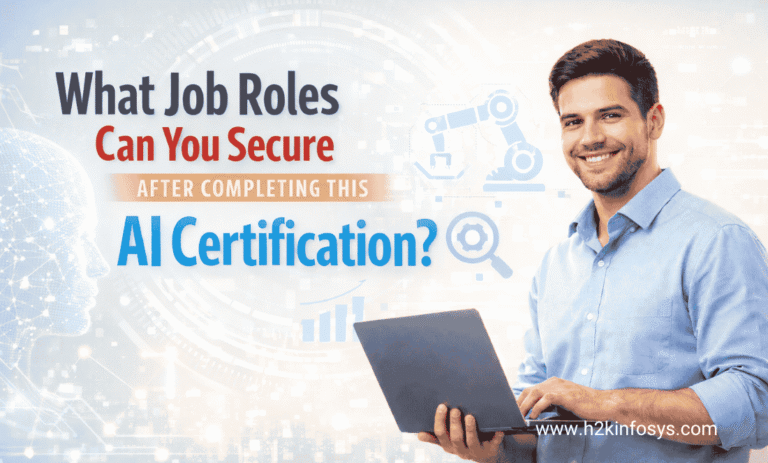
Completing an AI certification especially through structured online classes like those offered by H2K Infosys can take you in more directions than most people expect. It’s not just a straight path to becoming a “data scientist.” Depending on how deeply you engage with coding, model development, and deployment practices, you might naturally move toward roles such as machine learning engineer, AI engineer, or even a data analyst who works extensively with AI-driven tools. Some professionals also find themselves transitioning into MLOps roles over time, even if that wasn’t their initial goal.
After completing your AI certification, various job roles open up, highlighting the value of this qualification.
This hands-on experience is crucial for anyone pursuing an AI certification.
At the end of the day, a certification isn’t just a piece of paper it’s proof that you’ve actually worked through real problems. You’ve handled messy datasets, built models that didn’t always behave, and figured out how to make them work outside a notebook. And honestly, that “figuring out” phase is where most of the real learning happens.
Completing an AI certification can significantly enhance your career prospects.
What is an AI Certification Course?
Think of an AI Course Certification as a structured path that walks you through both the basics and the practical side of things AI, machine learning, data science, all bundled together. Most of these programs are online now, which helps if you’re juggling work or other commitments.
The better ones don’t just throw theory at you. They make you build things.
You’ll usually touch on areas like:
- Programming (mostly Python, sometimes SQL sneaks in)
- Machine learning algorithms
- Data cleaning and preparation (arguably the least glamorous, but most important part)
- Model evaluation figuring out what’s actually working
- A bit of deep learning
- Deployment basics and MLOps concepts
- Cloud platforms like AWS or Azure
By the time you finish, you’re not just watching tutorials you’re working with real datasets and solving problems that feel… well, real.
How AI Actually Works in Real IT Projects
Deep learning is a crucial aspect of many AI certification programs.
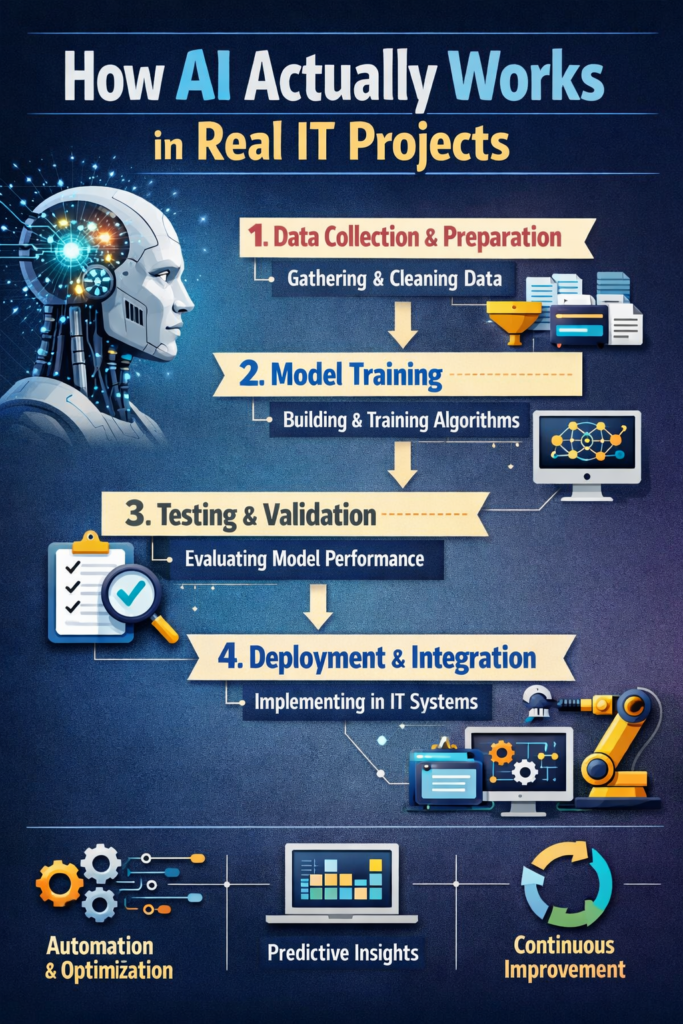
In real projects, AI isn’t some neat, isolated experiment. It’s usually a bit messy.
You start with a problem maybe predicting customer churn or spotting fraud. Then comes data collection, which sounds simple until you actually see the data. It’s rarely clean.
With an AI certification, you gain credibility in the fast-growing AI field.
So you clean it. Shape it. Try a model. Test it. Adjust it. Try again.
Eventually, something works well enough to deploy maybe as an API. But even then, it doesn’t stop there. Models need monitoring. They drift. They break in subtle ways. That part catches a lot of beginners off guard.
Real-world applications of an AI certification include tackling customer churn predictions.
Some common tools you’ll run into:
- Data work: Pandas, NumPy, Spark
- Modeling: Scikit-learn, TensorFlow, PyTorch
- Visualization: Matplotlib, Power BI
- Deployment: Docker, Kubernetes, Flask APIs
- Cloud: AWS SageMaker, Azure ML
It’s a mix, and you don’t need to master everything at once.
Why AI Certification Matters (Especially for Working Professionals)
Here’s the thing AI Certification skills are quietly becoming part of many roles, not just “AI jobs.”
Developers, testers, analysts… everyone’s expected to understand data a bit more now.
A certification can help because it:
- Makes transitioning into data-focused roles easier
- Adds depth to what you already do
- Aligns with how companies are evolving (automation, analytics, decision systems)
- Gives you hands-on experience which is usually what sets people apart
In real workplaces, AI Certification skills often show up in unexpected ways building a predictive dashboard, automating a workflow, analyzing customer behavior. It’s rarely just one neat task.
Skills You’ll Need (or Pick Up Along the Way)
Understanding the importance of AI certification is vital for career advancement.
AI certification skills are increasingly sought after across various industries.
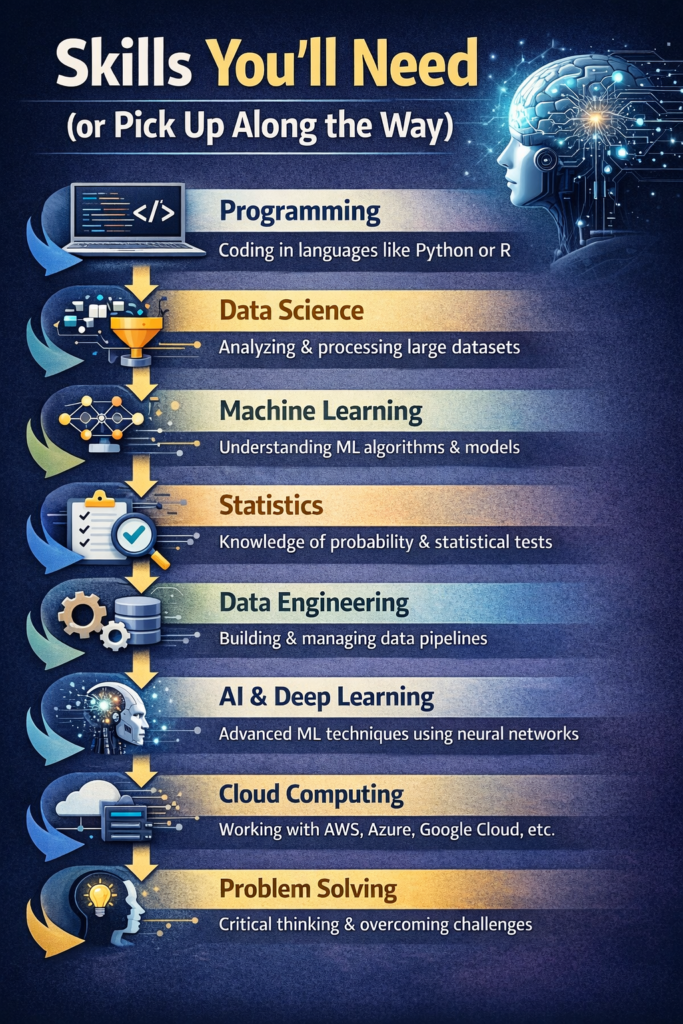
You don’t need to know everything before starting. That would defeat the purpose.
Still, a few basics make the journey smoother AI Certification:
- Programming: Python is the main one. Start simple.
- Math & Stats: Some probability, a bit of linear algebra enough to understand what’s going on behind the scenes
- Data Handling: SQL, cleaning messy datasets (you’ll do a lot of this)
- ML Concepts: Supervised vs unsupervised learning, evaluation metrics
- Tools: Jupyter Notebook, Scikit-learn, maybe TensorFlow or PyTorch later
It sounds like a lot written down like this, but most courses build it gradually. You don’t get thrown into the deep end right away.
Hands-on experience with AI tools enhances the value of your AI certification.
Where AI Fits in Real Businesses
AI certification opens doors to various roles, some of which may surprise you.
AI is already everywhere you just don’t always notice it.
- Finance: Fraud detection, risk scoring
- Healthcare: Medical imaging, predictions
- Retail: Recommendation engines
- IT Operations: Anomaly detection, predictive maintenance
- Marketing: Customer segmentation, personalization
Of course, reality adds some friction data privacy rules, legacy systems, scaling issues. It’s not always as smooth as the examples suggest.
Roles You Might End Up In
Where you land depends a lot on what you enjoy and where you focus.
- Machine Learning Engineer – builds and deploys models, focuses on performance
- Data Scientist – analyzes data, builds models, communicates insights (communication matters more than expected)
- AI Engineer – integrates AI into applications, more system-level work
- Data Analyst (AI-focused) – combines data analysis with some predictive modeling
- MLOps Engineer – handles deployment pipelines, monitoring, automation
- Business Analyst (AI-focused) – connects business needs with technical solutions
Sometimes people shift between these roles over time it’s not fixed.
Career Paths After AI Training
There’s no single path, and that’s actually a good thing.
- Entry-level: Junior Data Analyst, AI support roles
- Mid-level: Data Scientist, ML Engineer, AI Developer
- Advanced: AI Architect, Lead Data Scientist, AI Consultant
Some people move quickly. Others take time, build projects, switch gradually. Both approaches work.
How Online AI Classes Actually Prepare You
The stronger programs try to mirror real-world workflows.
You’ll usually go through:
- Learning concepts (algorithms, theory)
- Hands-on labs
- End-to-end projects
- Case studies based on real scenarios
A typical project might involve predicting customer churn cleaning data, engineering features, training a model, evaluating it, then deploying it.
That’s usually the moment things start to click.
Challenges You’ll Run Into (Because Yes, There Are Some)
It’s not always smooth.
A few common hurdles:
- Messy or incomplete data
- Overfitting models
- Deployment issues
- Communication gaps between teams
- Performance tuning
Over time, you pick up habits version control for models, monitoring drift, documenting workflows. Small things, but they matter a lot in real jobs.
Final Thoughts
An AI certification can open doors but it’s not magic. What really matters is what you build along the way.
If you spend time working on real projects, understanding how things actually flow in practice, and getting comfortable with data, you’ll be in a strong position to move into roles like data science or machine learning.
And if you’re looking for structured An Online Ai Classes, hands-on learning, platforms like H2K Infosys are one option to explore they focus on practical experience, which, honestly, is what makes the biggest difference.
Your AI certification journey will shape how you approach real-world challenges.
H2K Infosys offers AI certification with a focus on practical skills and real projects.
FAQs:
Is an AI certification worth it for getting a job?
Yes, an AI certification can improve your skills, strengthen your resume, and help you qualify for AI-related roles.
What jobs can I get after completing an AI certification?
You can pursue roles such as AI Engineer, Machine Learning Engineer, Data Scientist, AI Developer, NLP Engineer, and AI Consultant.
Do I need coding experience before enrolling in an AI certification?
It depends on the course. Many beginner-friendly AI certification programs teach programming basics before advanced AI concepts.
Which AI certification is best for beginners?
The best AI certification for beginners offers hands-on projects, foundational AI concepts, and practical tools like Python and machine learning.
How long does it take to complete an AI certification?
Most AI certification programs take anywhere from a few weeks to several months, depending on the curriculum and study schedule.