Artificial Intelligence (AI) training online especially through H2K Infosys is basically about learning how to actually build and use smart systems, not just reading about them. These are the kinds of systems that can automate decisions, make sense of messy data, and sometimes even improve on their own over time.
Benefits Most from Artificial Intelligence And it’s not just theory-heavy stuff either. The whole point up is to help people apply AI in real situations whether that’s in software development, data science, or even day-to-day business operations.
If your work involves data, systems, or anything that could be made a bit smarter or faster AI training usually ends up being pretty useful. Which, honestly, covers most jobs now.
So, what is AI online training, really?
At a basic level, it’s structured Ai machine learning courses learning delivered through online platforms. Simple enough. But the depth can vary a lot. Some courses are beginner-friendly, while others go deep into machine learning, neural networks, and all that.
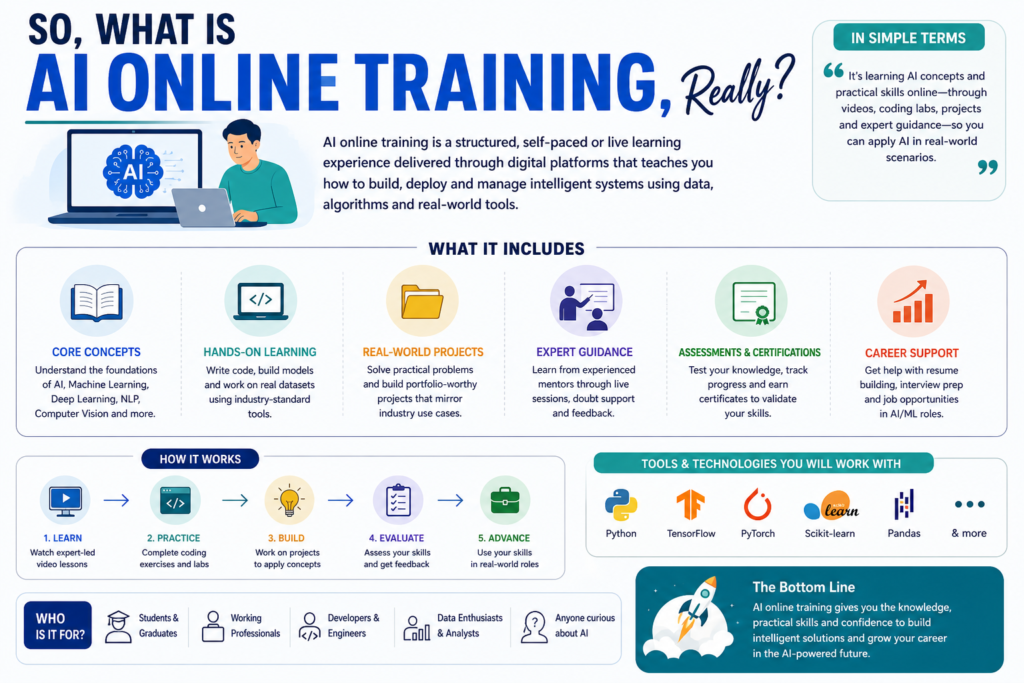
Most programs tend to include:
- Fundamentals (statistics, algorithms… the part people often rush through, but shouldn’t)
- Programming mostly Python
- Tools like TensorFlow, PyTorch, or Scikit-learn
- And hands-on projects (this is where things actually start to stick)
Once you move into machine learning specifically, you’re building models that learn from data and improve over time. That’s usually the moment it clicks for people—it starts feeling less abstract.
Why it actually matters (especially if you’re already working)
AI isn’t some future concept anymore. It’s already baked into a lot of systems we use daily—sometimes without even noticing.
Think:
- Customer support chatbots
- Product recommendations
- Predictive maintenance systems
For someone working in tech or even business learning AI can help you:
- Automate repetitive tasks (the boring ones, let’s be honest)
- Make decisions based on data instead of gut feeling
- Improve how systems perform and scale
- Stay relevant… which is kind of a big deal right now
A lot of it comes down to a few simple realities: there’s more data than ever, companies want automation, and better insights usually lead to better decisions.
How AI shows up in real projects
In practice, AI isn’t sitting off to the side as some standalone system. It’s part of a bigger workflow.
A typical setup looks something like this:
- Data gets collected (databases, APIs, logs—whatever’s available)
- It’s cleaned and prepared (this part takes longer than people expect)
- Models are trained
- Results are tested
- Everything gets deployed into real applications
- Then monitored… because things will break or drift over time
Take a retail example. A company might use AI to:
- Predict what customers will buy
- Recommend products in real time
- Detect fraud
None of that is hypothetical—it’s already happening.
What skills do you actually need?
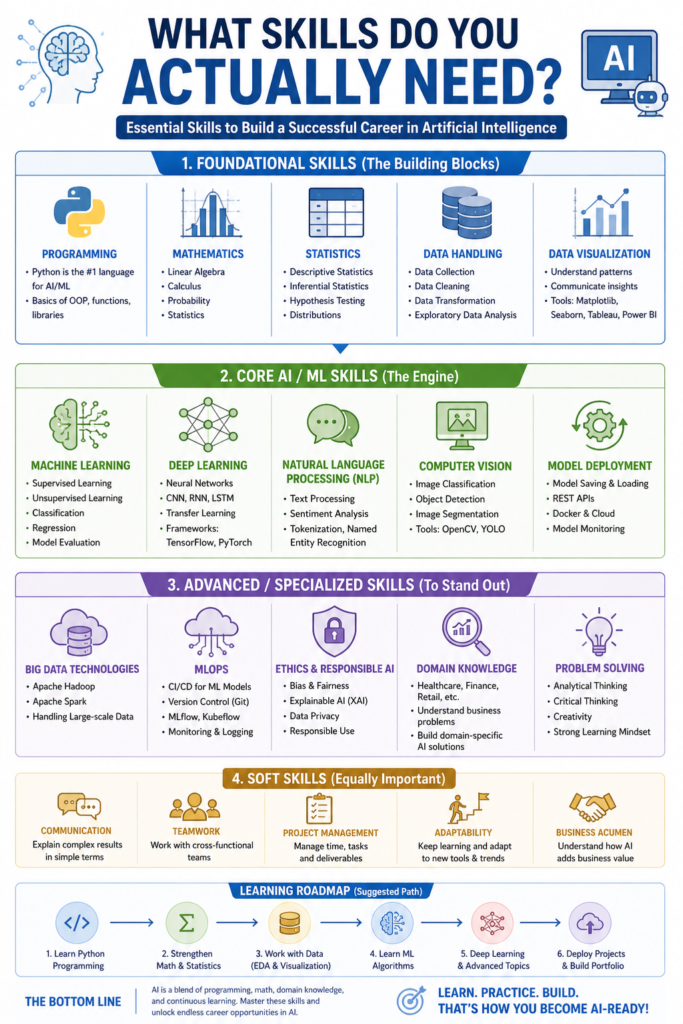
AI isn’t about mastering one thing. It’s more like connecting a few different areas.
You’ll usually need:
Programming
Python is the go-to. Libraries like NumPy, Pandas, Matplotlib come along with it.
Math & Statistics
Yeah, this part trips people up. But you don’t need to be a mathematician—just comfortable with concepts like probability and linear algebra.
Machine Learning Basics
Understanding how models work—regression, classification, evaluation methods.
Data Handling
Cleaning messy data, creating useful features, visualizing results.
Tools & Frameworks
Scikit-learn, TensorFlow, PyTorch… plus tools like Spark, Tableau, or Power BI.
It sounds like a lot when listed out. But once you start working with it, things connect more naturally than you’d expect.
Where AI is used in companies
AI is already woven into different parts of businesses—sometimes quietly.
Common areas include:
- Customer experience → chatbots, recommendations
- IT operations (AIOps) → predicting failures, automating alerts
- Finance → fraud detection, credit scoring
- Healthcare → image analysis, patient risk prediction
- Supply chain → demand forecasting, inventory planning
Of course, it’s not all smooth. There are challenges—data privacy, scaling systems, integrating with older tech stacks. Real-world stuff is rarely clean.
Who actually uses AI day-to-day?
It’s not limited to “AI specialists.”
Different roles use it differently:
- Data Scientists → build and analyze models
- Machine Learning Engineers → focus on deployment
- Software Engineers → integrate AI into apps
- Business Analysts → interpret results
- DevOps Engineers → manage pipelines
- QA Engineers → test AI systems (which is… surprisingly tricky)
Career paths after learning AI
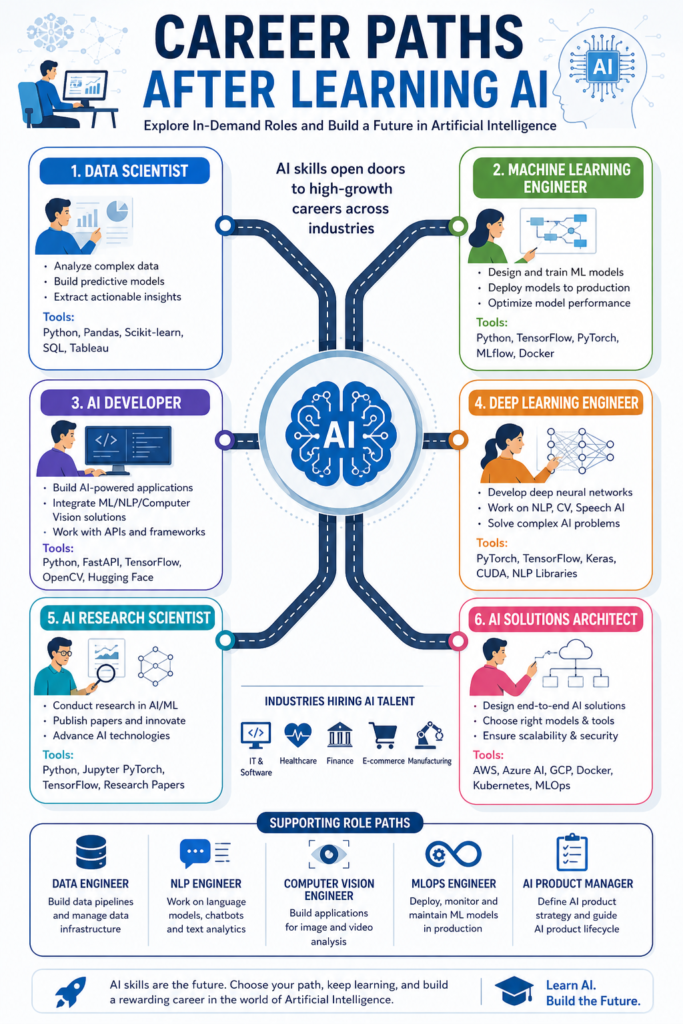
Once you’ve got the basics down, there are quite a few directions.
Entry-level:
- Junior Data Analyst
- AI Support Engineer
- Associate Data Scientist
Mid-level:
- Machine Learning Engineer
- Data Scientist
- AI Developer
Advanced:
- AI Architect
- Research Scientist
- Chief Data Officer
Demand is especially strong in areas like FinTech, healthcare IT, e-commerce, and cloud platforms.
Benefits Most from Artificial Intelligence?
It’s honestly not just for hardcore tech roles.
- Developers → adding smart features to apps
- Data professionals → going deeper into analytics
- IT teams → automating monitoring
- Business analysts → making better decisions
- Fresh graduates → building future-proof skills
- Managers → understanding what AI can realistically do
What the learning path usually looks like
Most people go step by step:
- Beginner → Python, basic statistics
- Intermediate → machine learning algorithms
- Advanced → deep learning, NLP
- Practical stage → real projects
That last part matters the most. Theory only gets you so far.
How it works in practice
A typical AI workflow might be:
- Identify a problem (say, customer churn)
- Gather data
- Clean it
- Choose a model
- Train and evaluate
- Deploy
- Monitor and improve
And yeah—it’s rarely a straight path. There’s always some backtracking.
Common challenges
Learning Benefits Most from Artificial Intelligence isn’t always smooth.
Some things people struggle with:
- The math can get confusing
- Data is often messy or incomplete
- Models can overfit (look great… until they don’t)
- Real datasets are harder to find than expected
- Deploying models into systems can get messy
A few practical tips that actually help:
- Start small
- Use existing libraries (don’t reinvent everything)
- Focus on projects
- Learn how to evaluate models properly
Quick questions people usually ask
Where should I start?
A course that covers Python basics + machine learning + projects.
Do I need coding experience?
It helps, but beginner courses often start from scratch.
How long does it take?
Roughly 3–6 months for a solid base, depending on consistency.
Can non-IT professionals learn AI?
Yes—especially if they work with data or decision-making.
Which tools first?
Start with Python → Pandas → Scikit-learn → then TensorFlow.
Are courses job-oriented?
Many are, especially those with real-world projects.
Final thoughts
Best Online Artificial Intelligence Course isn’t just about picking up another technical skill. It changes how you approach problems. Instead of building systems that follow fixed rules, you start building ones that learn and adapt.
And right now… that kind of thinking is valuable almost everywhere.
If you’re considering it, Benefits Most from Artificial Intelligence go for something structured and make sure it includes real projects. Understanding concepts is one thing. Actually using them? That’s where it starts to make sense.