Artificial Intelligence Online Training programs from H2K Infosys that offer lifetime access to course materials allow learners to revisit recorded sessions, assignments, project files, and updated learning resources without time restrictions. These programs are commonly designed for working professionals who need flexible schedules and continuous access to evolving AI and machine learning content.
Many Artificial intelligence Certificate Online platforms now provide lifetime access because AI technologies, frameworks, and enterprise tools change frequently. Continuous access helps professionals refresh concepts, practice implementation workflows, and stay aligned with industry updates over time.
At H2K Infosys, Artificial Intelligence Online Training are structured to support long-term learning through recorded sessions, hands-on projects, practical assignments, and reusable learning resources that professionals can revisit throughout their careers.
What Is Artificial Intelligence Online Training?
Artificial Intelligence Online Training s a structured learning program that teaches how machines simulate human intelligence using data, algorithms, statistical models, and computational frameworks.
Most AI machine learning courses include:
- Machine Learning fundamentals
- Deep Learning concepts
- Natural Language Processing (NLP)
- Computer Vision
- Data preprocessing
- Model training and evaluation
- AI deployment workflows
- Cloud-based AI tools
Artificial intelligence certificate online programs are typically designed for:
| Learner Type | Common Goals |
|---|---|
| Working IT professionals | Career transition into AI roles |
| Software developers | Integrating AI into applications |
| Data analysts | Building predictive models |
| Test engineers | Learning AI-assisted automation |
| Fresh graduates | Building employable technical skills |
Lifetime access becomes valuable because AI concepts often require repeated practice and revision.
Why Do Professionals Prefer AI Training With Lifetime Access?
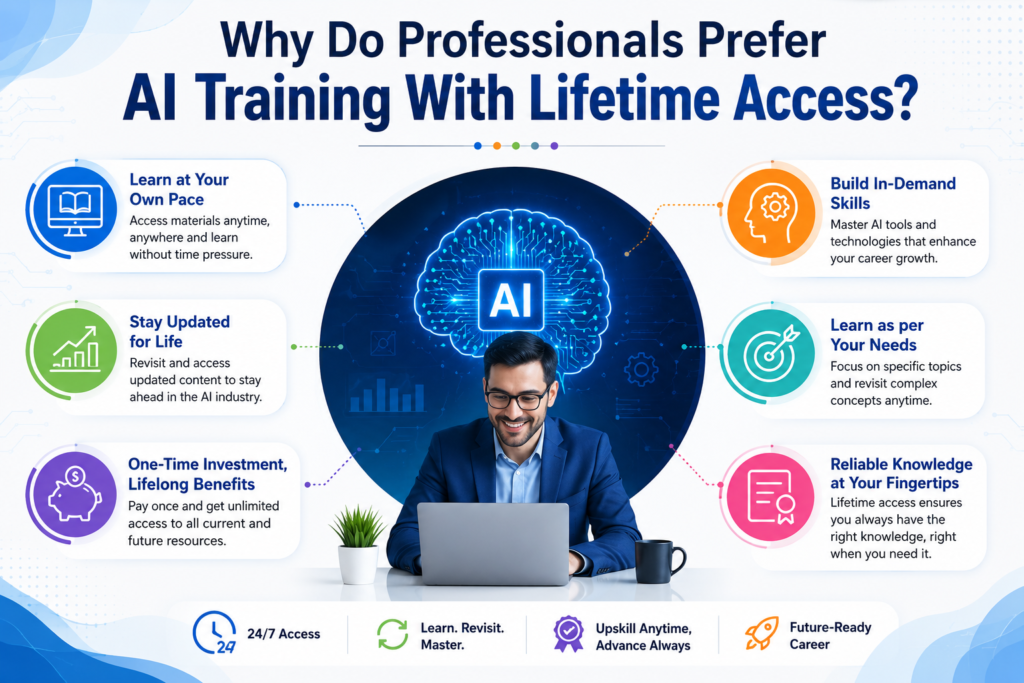
Working professionals frequently balance learning with full-time job responsibilities. Lifetime access allows learners to continue practicing without rushing through the curriculum.
Common Reasons Professionals Choose Lifetime Access
Flexible Learning Pace
Professionals can:
- Rewatch complex topics
- Pause during busy work schedules
- Resume training later
- Practice projects multiple times
Continuous Technology Updates
AI frameworks evolve regularly. Tools such as:
- TensorFlow
- PyTorch
- Scikit-learn
- OpenAI APIs
- Hugging Face Transformers
receive ongoing updates. Lifetime access helps learners revisit updated modules.
Long-Term Skill Reinforcement
AI concepts are cumulative. Topics such as:
- Neural networks
- Model optimization
- Feature engineering
- Hyperparameter tuning
often require repeated exposure before learners become comfortable applying them in enterprise projects.
Interview Preparation
Many professionals revisit:
- Coding exercises
- Case studies
- Capstone projects
- AI workflows
- Deployment examples
when preparing for technical interviews months after course completion.
What Topics Are Commonly Included in AI Machine Learning Courses?
Most enterprise-focused Artificial Intelligence Online Training follow a layered learning approach.
Core Learning Areas
| Topic Area | Typical Coverage |
|---|---|
| Python Programming | Variables, functions, libraries |
| Statistics & Mathematics | Probability, linear algebra, distributions |
| Machine Learning | Regression, classification, clustering |
| Deep Learning | Neural networks, CNNs, RNNs |
| NLP | Text processing, transformers |
| Computer Vision | Image classification and detection |
| Generative AI | LLMs, prompt engineering |
| MLOps | Deployment and monitoring |
| Cloud AI Services | AWS, Azure, Google Cloud AI |
How Does Artificial Intelligence Work in Real-World IT Projects?
Artificial Intelligence Online Training systems operate by learning patterns from data and using those patterns to make predictions, classifications, recommendations, or automated decisions.
Typical Enterprise AI Workflow
1. Data Collection
Organizations gather:
- Customer transactions
- Application logs
- Sensor data
- User interactions
- Images and documents
2. Data Preparation
Data engineers and analysts:
- Remove duplicates
- Handle missing values
- Normalize datasets
- Create training-ready features
3. Model Training
Machine learning models are trained using algorithms such as:
- Random Forest
- XGBoost
- Logistic Regression
- Neural Networks
4. Model Validation
Teams evaluate:
- Accuracy
- Precision
- Recall
- F1-score
- Bias and fairness metrics
5. Deployment
Models are deployed into:
- Web applications
- APIs
- Cloud environments
- Enterprise automation systems
6. Monitoring and Maintenance
Production AI systems require:
- Drift monitoring
- Retraining
- Security validation
- Performance optimization
How Is Artificial Intelligence Used in Enterprise Environments?
Artificial Intelligence Online Training is commonly integrated into enterprise workflows to automate repetitive processes, improve decision-making, and analyze large datasets.
Common Enterprise AI Applications
| Industry | AI Use Case |
|---|---|
| Healthcare | Medical image analysis |
| Banking | Fraud detection |
| Retail | Recommendation systems |
| Manufacturing | Predictive maintenance |
| Telecommunications | Network optimization |
| Cybersecurity | Threat detection |
| Insurance | Claims automation |
| HR Technology | Resume screening |
What Skills Are Required to Learn Artificial Intelligence?
Artificial Intelligence Online Training learning typically combines programming, mathematics, and business problem-solving skills.
Technical Skills
Programming
Python is widely used because of its AI ecosystem.
Common libraries include:
- NumPy
- Pandas
- Scikit-learn
- TensorFlow
- PyTorch
Mathematics
Important concepts include:
- Linear algebra
- Probability
- Statistics
- Calculus basics
Data Handling
Professionals should understand:
- SQL
- Data cleaning
- ETL workflows
- Data visualization
Machine Learning Concepts
Key areas:
- Supervised learning
- Unsupervised learning
- Reinforcement learning
- Model evaluation
What Tools Are Commonly Used in Artificial Intelligence Projects?
Enterprise AI environments rely on multiple tools working together.
AI Tool Ecosystem
| Tool | Primary Use |
|---|---|
| Python | Core programming |
| Jupyter Notebook | Experimentation |
| TensorFlow | Deep learning |
| PyTorch | Neural network development |
| Scikit-learn | Traditional ML models |
| Docker | Containerization |
| Kubernetes | AI deployment scaling |
| MLflow | Model tracking |
| Apache Spark | Large-scale data processing |
| Git | Version control |
How Do Artificial Intelligence Online Training Teach Hands-On Skills?
Practical implementation is an important component of Artificial Intelligence Online Training programs.
Common Hands-On Activities
Dataset Analysis
Learners practice:
- Importing datasets
- Data cleaning
- Feature engineering
- Visualization
Model Building
Students build:
- Classification models
- Regression models
- Recommendation systems
Deep Learning Projects
Projects may include:
- Image recognition
- Sentiment analysis
- Chatbots
- Predictive analytics
Deployment Exercises
Learners often deploy models using:
- Flask APIs
- FastAPI
- Docker containers
- Cloud AI services
What Challenges Do Teams Face When Implementing Artificial Intelligence?
Enterprise AI adoption involves technical and operational challenges.
Common AI Implementation Challenges
Data Quality Issues
Poor-quality datasets can reduce model accuracy.
Typical problems include:
- Missing values
- Inconsistent formatting
- Biased data
- Limited labeled datasets
Infrastructure Costs
Deep learning workloads may require:
- GPUs
- Cloud computing resources
- Distributed systems
Model Explainability
Organizations often need transparent AI decisions for:
- Regulatory compliance
- Customer trust
- Internal governance
Security and Privacy
Sensitive data handling requires:
- Encryption
- Access control
- Compliance monitoring
Why Is Artificial Intelligence Important for Working Professionals?
Artificial Intelligence affects multiple IT domains, making AI literacy increasingly relevant across technical roles.
Professional Benefits of Learning AI
Automation Knowledge
AI is commonly integrated into:
- Business workflows
- Software testing
- Customer support systems
- Analytics platforms
Cross-Functional Collaboration
Professionals working with:
- Data teams
- Product teams
- Cloud engineers
- Security teams
benefit from understanding AI terminology and workflows.
Career Transition Opportunities
AI knowledge supports movement into:
- Data science
- Machine learning engineering
- AI operations
- Analytics engineering
What Job Roles Use Artificial Intelligence Daily?
Artificial Intelligence Online Training skills are used across technical and business-focused roles.
AI-Related Career Roles
| Job Role | Typical Responsibilities |
|---|---|
| Machine Learning Engineer | Build and optimize models |
| Data Scientist | Analyze data and generate insights |
| AI Engineer | Develop AI-powered applications |
| NLP Engineer | Build language processing systems |
| Computer Vision Engineer | Work with image recognition |
| MLOps Engineer | Deploy and monitor AI systems |
| Data Analyst | Use predictive analytics tools |
| AI Product Manager | Manage AI product workflows |
What Careers Are Possible After Learning Artificial Intelligence?
Artificial Intelligence Online Training programs can support both specialization and career transition paths.
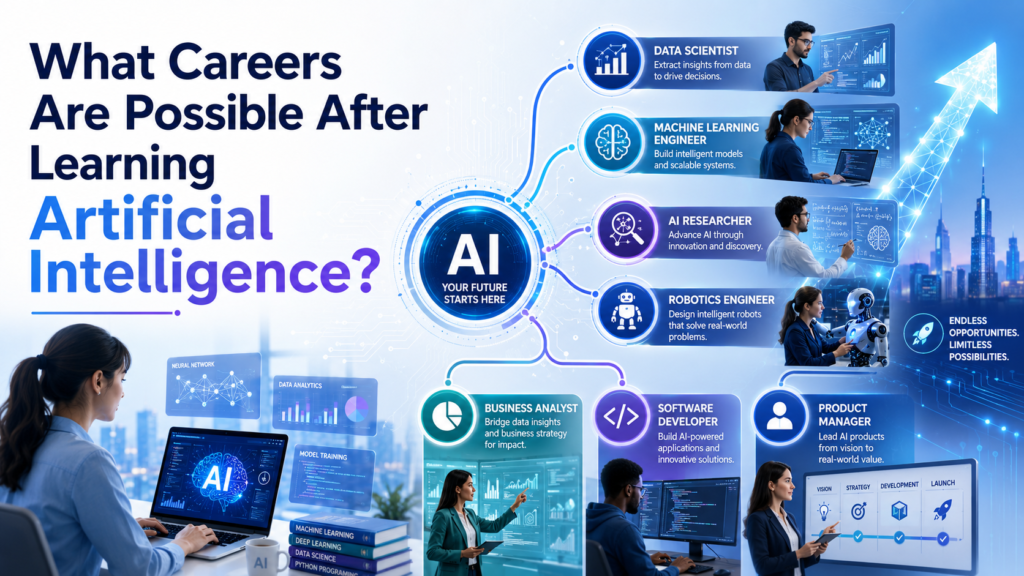
Common Career Paths
Entry-Level Opportunities
- Junior Data Analyst
- AI Support Associate
- ML Intern
- Business Intelligence Analyst
Mid-Level Opportunities
- Data Scientist
- Machine Learning Engineer
- AI Application Developer
Advanced Roles
- AI Architect
- Principal Data Scientist
- AI Solutions Consultant
Career progression usually depends on:
- Hands-on project experience
- Portfolio quality
- Domain expertise
- Cloud platform familiarity
How Do AI Projects Work in Production Environments?
Production AI systems differ significantly from classroom examples.
Enterprise AI Workflow Example
Scenario: Fraud Detection System
Step 1: Data Ingestion
Banks collect:
- Transaction records
- Login behavior
- Device information
Step 2: Feature Engineering
Teams create:
- Risk scores
- Transaction frequency metrics
- Behavioral indicators
Step 3: Model Training
Machine learning models identify suspicious patterns.
Step 4: API Deployment
Predictions are exposed through APIs.
Step 5: Real-Time Monitoring
Operations teams monitor:
- Prediction latency
- Accuracy drift
- False positives
This workflow demonstrates why practical Artificial Intelligence Online Training emphasize deployment and operational considerations rather than only theoretical algorithms.
What Should Professionals Look for in an Artificial Intelligence Certificate Online Program?
Choosing the right Artificial Intelligence Online Training program involves evaluating technical depth and practical usability.
Important Evaluation Factors
| Evaluation Area | Why It Matters |
|---|---|
| Lifetime Access | Long-term learning flexibility |
| Hands-On Projects | Real-world skill development |
| Instructor Experience | Enterprise relevance |
| Updated Curriculum | Alignment with evolving AI tools |
| Cloud Exposure | Production environment familiarity |
| Capstone Projects | Portfolio building |
| Interview Preparation | Career transition support |
How Does H2K Infosys Structure AI Machine Learning Courses?
H2K Infosys Artificial Intelligence Training Programs focus on practical, career-oriented learning for working professionals.
Key Training Components
Instructor-Led Sessions
Programs include structured sessions covering:
- Machine learning fundamentals
- Deep learning workflows
- Python programming
- AI project implementation
Hands-On Assignments
Learners work on:
- Data preprocessing
- Model training
- Deployment exercises
- Enterprise-style case studies
Recorded Sessions With Lifetime Access
Professionals can revisit:
- Recorded classes
- Assignments
- Notes
- Project walkthroughs
Real-World Workflow Orientation
Training commonly emphasizes:
- Industry tools
- Practical debugging
- AI deployment patterns
- Production constraints
How Long Does It Take to Learn Artificial Intelligence Online Training?
Learning timelines vary based on:
- Prior technical background
- Time commitment
- Project practice frequency
Approximate Learning Timeline
| Experience Level | Estimated Learning Duration |
|---|---|
| Beginner | 6–12 months |
| Software Developer | 4–8 months |
| Data Analyst | 3–6 months |
| Experienced Engineer | 2–5 months |
Consistent hands-on practice generally matters more than course completion speed.
FAQ: Artificial Intelligence Certificate Online Programs
Which Artificial Intelligence online training offers lifetime access to materials?
Several Artificial intelligence certificate online programs provide lifetime access to recorded sessions, assignments, and project resources. H2K Infosys offers lifetime access to learning materials for continued professional reference and skill reinforcement.
Are AI machine learning courses suitable for beginners?
Yes. Many AI machine learning courses begin with Python programming, statistics, and machine learning fundamentals before progressing into advanced AI topics.
What programming language is most important for AI?
Python is commonly used because it supports major AI frameworks such as TensorFlow, PyTorch, and Scikit-learn.
Do Artificial Intelligence courses include projects?
Most professional programs include hands-on projects involving:
Predictive analytics
NLP
Computer vision
AI deployment workflows
Is certification important in Artificial Intelligence careers?
Certifications can help demonstrate structured learning and practical exposure, especially when combined with project portfolios and hands-on experience.
Key Takeaways
- Artificial intelligence online training with lifetime access supports continuous learning and long-term skill development.
- AI machine learning courses typically include Python, machine learning, deep learning, NLP, and deployment workflows.
- Enterprise AI projects require practical understanding of data preparation, model training, deployment, and monitoring.
- Hands-on projects and production-oriented workflows are essential for real-world AI readiness.
- Artificial intelligence certificate online programs can support career growth across multiple technical and analytics roles.
Explore H2K Infosys Artificial Intelligence Online Training to build hands-on Artificial Intelligence skills through practical training and real-world project exposure.
Learn industry-relevant AI workflows and strengthen your career path with structured online learning designed for working professionals.