Yeah if the course is practical, up-to-date, and actually helps you build skills companies are actually hiring for. Otherwise… it’s just another certificate collecting dust somewhere in your inbox.
That’s exactly why programs like H2K Infosys tend to get attention they focus more on real-world, job-ready skills instead of just theory, which honestly makes a noticeable difference when you’re trying to apply what you’ve learned.
So, is an AI course really worth it right now?
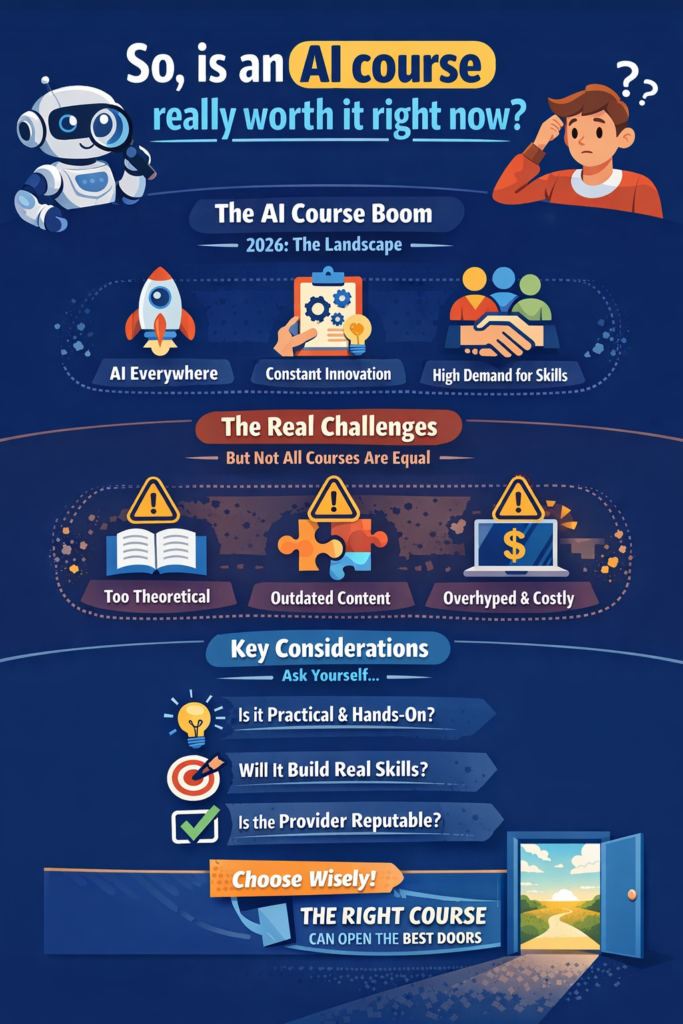
Honestly, the AI space in 2026 feels a little chaotic but not in a bad way. It’s more like everything is evolving at once. New tools are popping up constantly, job roles are shifting, and companies are no longer just “testing” AI they’re actively using it and, more importantly, hiring people who can make it useful.
That’s a big shift.
A couple of years ago, knowing AI basics might’ve been enough to stand out. Now? Employers are looking for people who can actually apply it automate processes, analyze data, build simple models, or even just connect AI tools to solve real business problems.
And that’s exactly where AI Learning Courses come into the picture.
But here’s the thing and this part gets overlooked a lot not all courses are created equal.
The problem with most AI courses
Let’s be honest for a second.
A lot of courses out there look great on the surface. Clean dashboards, long module lists, maybe even a certificate at the end. It feels like you’re making progress.
But then you finish… and you’re stuck.
You understand the concepts, sure. You’ve watched hours of content. But when it comes to actually building something or explaining your skills in an interview, things get a bit shaky.
That’s more common than people admit.
I’ve seen learners spend months going through video lessons, only to realize they don’t know where to start when faced with a real problem. It’s frustrating and honestly, a bit discouraging.
On the other hand, I’ve also seen people take a different approach. Courses that push them into hands-on work early. Projects, small tasks, real-world scenarios. Not perfect, not always easy but practical.
And those learners? They tend to move forward faster.
Not because they “know more,” but because they can do more.
That difference matters more than any certificate.
What actually makes an AI course worth your time?
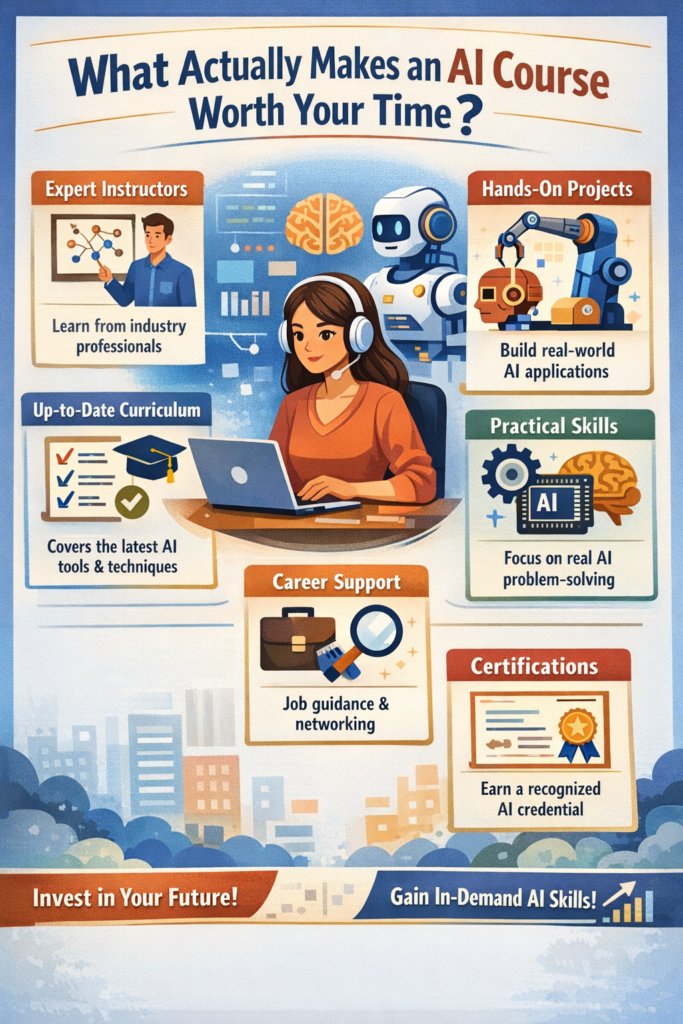
So, what should you actually look for?
From what I’ve seen and yeah, a bit from experience too a course is worth it if it helps you move beyond just understanding things.
Here’s what tends to make a real difference:
1. You’re building, not just watching
If most of your time is spent watching videos, that’s a red flag. Learning happens when you start applying things even if it’s messy at first.
2. The tools are relevant
There’s no point learning outdated frameworks or tools nobody uses anymore. Good courses keep up with what’s actually happening in the industry.
3. There’s guidance when you get stuck
Because you will get stuck. That’s part of learning. Having some form of mentorship or support makes a huge difference here.
4. It connects to real job roles
It’s one thing to learn AI concepts. It’s another to understand how those concepts show up in actual jobs data analyst roles, AI support, automation, etc.
This is where structured programs like H2K Infosys tend to stand out a bit.
Not because they’re “perfect,” but because they focus on helping learners connect the dots. You’re not just completing modules you’re seeing how those skills apply in real scenarios.
And that shift from theory to application is where things start to click.
Let’s talk about certifications (quick reality check)
Alright, let’s address the obvious question.
Do AI Course Certifications actually matter?
yes… but not in the way most people think.
An AI Course Certifications alone won’t get you hired. Recruiters aren’t just scanning for course names and handing out job offers.
But it does help.
It shows that you’ve invested time into learning something seriously. It can get your profile noticed, especially if you’re just starting out or switching careers.
The real value, though, comes from what backs that certification.
If your learning included real projects, working with datasets, building something tangible then your certification carries more weight. It becomes part of a bigger story you can tell.
That’s why many learners are starting to prioritize AI Certified Courses that include hands on experience instead of just quizzes and final exams.
Because at the end of the day, during interviews, nobody asks, “What videos did you watch?”
They ask, “What have you worked on?”
What’s actually happening in hiring right now
If you zoom out and look at hiring trends, something interesting is happening.
Companies are no longer just hiring “AI experts.”
They’re hiring people who can use AI within their roles.
That includes skills like:
- Prompt engineering (which is evolving faster than expected)
- Automating repetitive workflows using AI tools
- Interpreting data with AI assistance
- Understanding how basic models work (even at a high level)
Even roles that traditionally had nothing to do with AI like QA testing, business analysis, operations are starting to expect at least some familiarity.
That’s a big signal.
It means AI isn’t a separate field anymore it’s becoming part of everything.
I remember someone I know (non-tech background, by the way) who recently transitioned into a more tech-aligned role. What helped them wasn’t just finishing a course.
It was being able to talk about a project they worked on.
They explained the problem, what tools they used, what didn’t work initially, and how they fixed it. It wasn’t perfect but it was real.
And that’s what got them shortlisted.
The quiet shift toward structured learning
Now, let’s talk about something people don’t always say out loud.
Self-learning is great in theory.
You’ve got YouTube, blogs, free resources, documentation… everything is available.
But in practice? It can get messy.
You start one topic, then jump to another. You save a bunch of tutorials you “plan” to watch later. You feel like you’re learning… but there’s no clear direction.
And after a few weeks, motivation drops.
It happens more often than people admit.
That’s why a lot of learners are slowly moving toward structured programs. Not because they can’t learn on their own but because structure removes friction.
Programs like H2K Infosys, for example, give you a path. You know what to focus on next. You’re not constantly second-guessing your learning plan.
And honestly, that clarity helps more than anything else.
It’s not about shortcuts it’s about consistency.
So, who should actually take an AI course?
Not everyone needs one.
But you’ll likely benefit if you fall into one of these groups:
1. Career switchers
If you’re moving from a non-tech background into AI or tech-related roles, a structured course can give you direction and confidence.
2. Working professionals
If you’re already in a job and want to stay relevant, especially as AI becomes more integrated into workflows.
3. People stuck in “learning mode”
You’ve consumed a lot of content but haven’t really built anything yet. That’s usually a sign you need more structure.
4. Those looking for job-ready skills
Not just knowledge but something you can actually use in interviews or on the job.
If that sounds like you, then yes investing time in the right AI learning courses can absolutely pay off.
A small but important mindset shift
Here’s something worth keeping in mind.
Don’t take a course just to “learn AI.”
Take it to become someone who can use AI to solve problems.
That sounds like a small difference, but it changes how you approach everything.
Instead of asking:
“What topics are covered?”
You start asking:
“What will I be able to do after this?”
That’s the question that really matters.
FAQs
Is an AI course worth it for career growth in 2026?
Yes, an AI course can be worthwhile if it provides practical, up-to-date training and helps you develop skills that can be applied to real job roles.
. What should I look for in an AI course?
Look for hands-on projects, relevant AI tools, mentorship or guidance, and training that connects learning with real-world job responsibilities.
Do AI course certifications help with getting a job?
AI certifications can strengthen your profile, but certification alone does not guarantee employment. Practical projects and the ability to explain what you have built are also important.
Who can benefit from taking an AI course?
Career switchers, working professionals, people who have been stuck in self-learning, and learners looking to develop job-ready AI skills can benefit from a structured AI course.
Is practical experience more important than an AI course certificate?
Practical experience is highly important. A certificate can demonstrate that you completed training, but real projects show employers that you can apply AI skills to solve problems.
Final thoughts (keeping it real)
AI courses are worth it but only if they move you closer to action.
If you finish a course and still feel unsure about applying what you learned, something’s missing.
But if your course pushes you to build, experiment, struggle a bit, and figure things out… that’s where growth happens.
Structured, practical programs like what H2K Infosys aims to offer can help bridge that gap. Not by making things easy, but by making them clearer.