
Introduction
Companies do not hire business analysts just for theory. They hire people who can solve real problems, communicate clearly, and deliver results. Many learners complete a business analysis course but still struggle to get interviews. The reason is simple. Employers look for practical ability, not just certificates.
If you want to stand out, you must focus on the right business analysis skills. These are the skills that hiring managers test in interviews and expect you to apply on the job from day one. This guide explains those skills in a clear and practical way. It also shows how you can build them through structured learning and real world practice.
By the end, you will know exactly what to learn, how to apply it, and how to present it to get hired.
Why Skills Matter More Than Certificates
A certificate from a business analysis course adds value. But it does not guarantee a job. Recruiters often ask candidates to explain how they solved a business problem. They may ask for examples, case studies, or scenarios.
Here is what hiring managers usually evaluate:
- Problem solving ability
- Communication clarity
- Understanding of business processes
- Tool usage
- Real project experience
This means your business analysis skills must go beyond theory. You must show how you think, how you analyze, and how you deliver outcomes.
Core Business Analysis Skills That Employers Expect
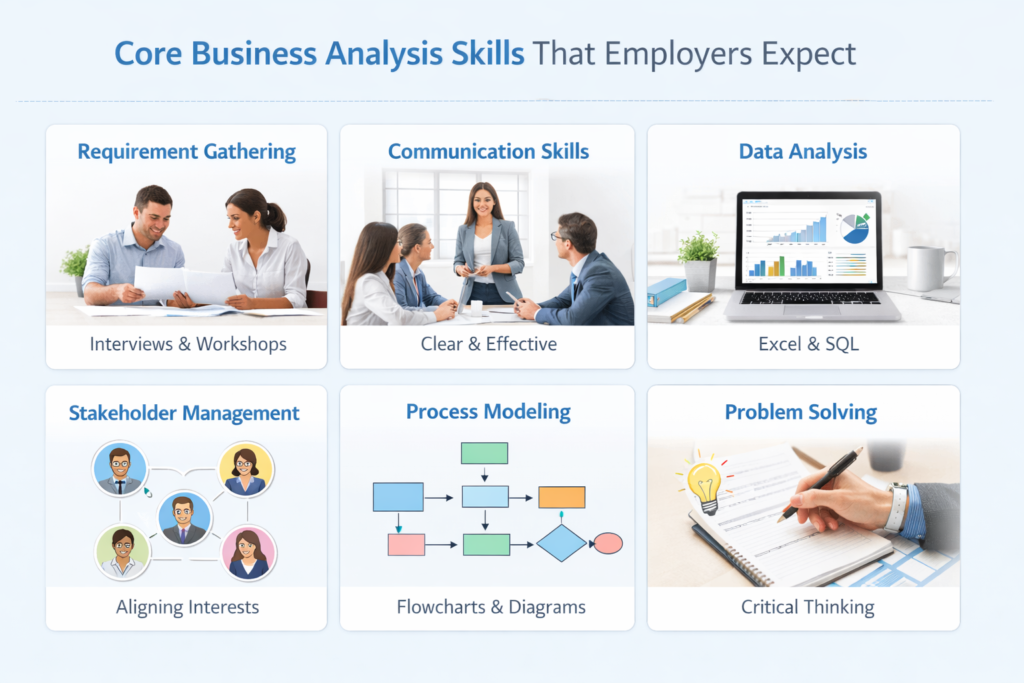
1. Requirement Gathering and Elicitation
Requirement gathering is the foundation of business analysis. You must understand what stakeholders need and translate that into clear requirements.
Common techniques include:
- Interviews
- Surveys
- Workshops
- Observation
Example
A retail company wants to improve its online checkout process. A business analyst interviews customers and finds that users drop off due to a long checkout form. The analyst suggests reducing fields and enabling guest checkout.
This is where strong business analysis skills create direct business value.
2. Communication Skills
A business analyst acts as a bridge between business and technical teams. Clear communication is essential.
You must:
- Write clear requirement documents
- Speak confidently in meetings
- Ask the right questions
- Avoid confusion
Simple Requirement Example
User Story:
As a customer,
I want to save my delivery address,
So that I can check out faster.
Good communication ensures that developers understand exactly what to build.
Strong business analysis skills in communication reduce errors and improve delivery speed.
3. Analytical Thinking
Analytical thinking helps you break down problems and find solutions. You must examine data, identify patterns, and suggest improvements.
Example
A company notices a drop in sales. A business analyst checks:
- Website traffic
- Conversion rates
- Customer feedback
The analyst finds that page load time has increased, which affects conversions.
This type of thinking shows practical business analysis skills.
4. Stakeholder Management
Projects involve many stakeholders such as managers, developers, and users. Each group has different expectations.
You must:
- Identify stakeholders
- Understand their needs
- Manage conflicts
- Keep everyone aligned
Example
A manager wants fast delivery. A developer wants more time for testing. A business analyst balances both and ensures quality and deadlines.
Effective stakeholder handling reflects strong business analysis skills.
5. Documentation Skills
Documentation helps teams stay aligned. It also acts as a reference throughout the project.
Common documents include:
- Business Requirement Document
- Functional Requirement Document
- User Stories
- Use Cases
Sample Use Case
Use Case: Login Function
Actor: User
Steps:
1. User enters email and password
2. System validates credentials
3. User gains access to dashboard
Clear documentation shows structured business analysis skills.
6. Knowledge of Tools
Modern business analysts use tools to manage requirements and data.
Common tools include:
- Excel for data analysis
- SQL for querying databases
- Visualization tools for dashboards
- Requirement management tools
Basic SQL Example
SELECT customer_name, order_amount
FROM orders
WHERE order_amount > 500;
Tool knowledge enhances your business analysis skills and improves efficiency.
7. Process Modeling
Process modeling helps you visualize workflows and identify gaps.
Simple Workflow Example
Customer Order Process:
- Customer places order
- System validates payment
- Order is processed
- Product is shipped
You can represent this using flowcharts or diagrams.
Strong modeling reflects advanced business analysis skills.
8. Problem Solving
Problem solving is the core of business analysis. Every project exists to solve a problem.
Approach
- Identify the issue
- Analyze root cause
- Suggest solutions
- Validate outcomes
Example
A banking app crashes during peak hours. The analyst finds server overload and suggests load balancing.
This shows practical business analysis skills in action.
9. Domain Knowledge
Understanding the industry helps you make better decisions.
Common domains include:
- Banking
- Healthcare
- Retail
- Insurance
If you understand the domain, you can:
- Ask better questions
- Predict challenges
- Suggest realistic solutions
Domain knowledge strengthens your business analysis skills.
10. Agile and Scrum Understanding
Many companies use Agile methods. Business analysts must understand Agile practices.
Key concepts:
- Sprints
- Backlogs
- Stand up meetings
- User stories
Example User Story
As a user,
I want to reset my password,
So that I can regain account access.
Agile knowledge improves your business analysis skills in modern teams.
How a Business Analysis Course Builds These Skills
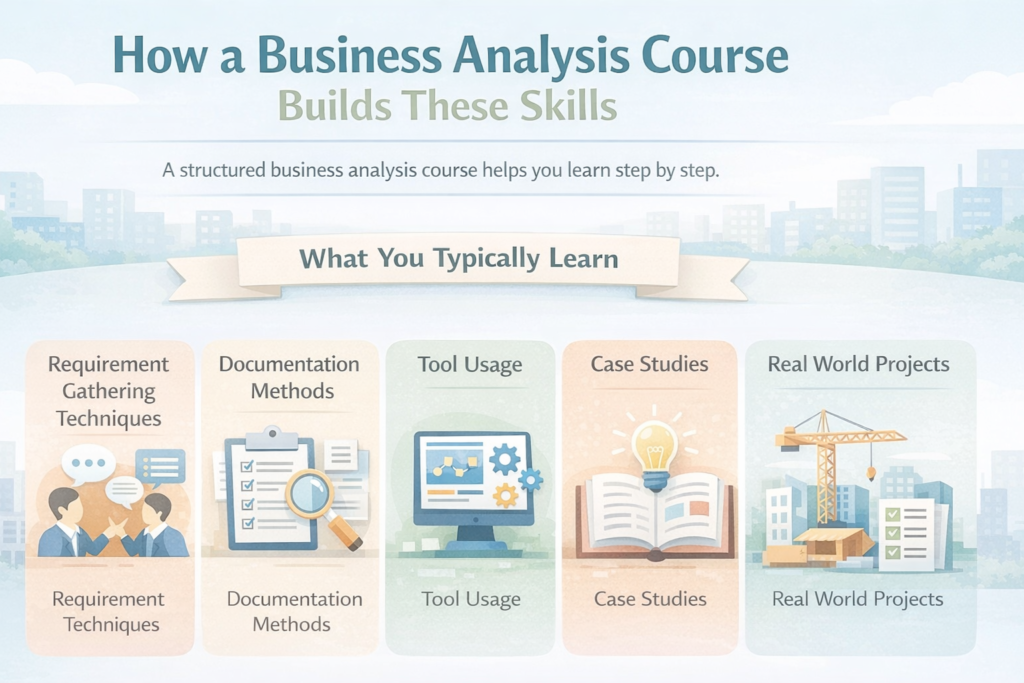
A structured business analysis course helps you learn step by step.
What You Typically Learn
- Requirement gathering techniques
- Documentation methods
- Tool usage
- Case studies
- Real world projects
Why Practice Matters
Learning theory is not enough. You must apply concepts through:
- Assignments
- Mock projects
- Case studies
This is how business analysis skills become practical and job ready.
Business Analyst Courses vs Real World Skills
Many learners ask if business analyst courses are enough. The answer depends on how you use them.
Courses Provide
- Structured learning
- Guided practice
- Concept clarity
Real World Requires
- Problem solving
- Communication
- Decision making
You must combine both to build strong business analysis skills.
Step by Step Plan to Build Job Ready Skills
Step 1: Learn Basics
Start with a business analysis course to understand core concepts.
Step 2: Practice Daily
Work on small case studies. Try to analyze simple business problems.
Step 3: Learn Tools
Practice Excel and SQL regularly.
Step 4: Build Projects
Create sample projects such as:
- E commerce checkout improvement
- Banking system analysis
- Inventory management system
Step 5: Prepare for Interviews
Focus on:
- Real examples
- Clear explanations
- Problem solving approach
This step by step process strengthens your business analysis skills.
Real World Case Study
Problem
An online store has high cart abandonment rates.
Analysis
The business analyst collects data and finds:
- Complex checkout process
- Lack of payment options
- Slow page speed
Solution
- Simplify checkout steps
- Add multiple payment methods
- Improve performance
Result
Conversion rate increases by 20 percent.
This case shows how business analysis skills directly impact business results.
Common Mistakes to Avoid
- Focusing only on theory
- Ignoring communication practice
- Not working on real projects
- Avoiding tools
- Not preparing for interviews
Avoiding these mistakes helps you improve your business analysis skills faster.
Key Takeaways
- Companies hire skills, not just certificates
- Practical experience matters more than theory
- Communication and problem solving are critical
- Tools and domain knowledge add strong value
- Continuous practice is the key to success
Conclusion
Focus on building real business analysis skills through practice, projects, and clear thinking with business analyst training with placement.
Start learning, apply daily, and position yourself as a problem solver to get hired faster.