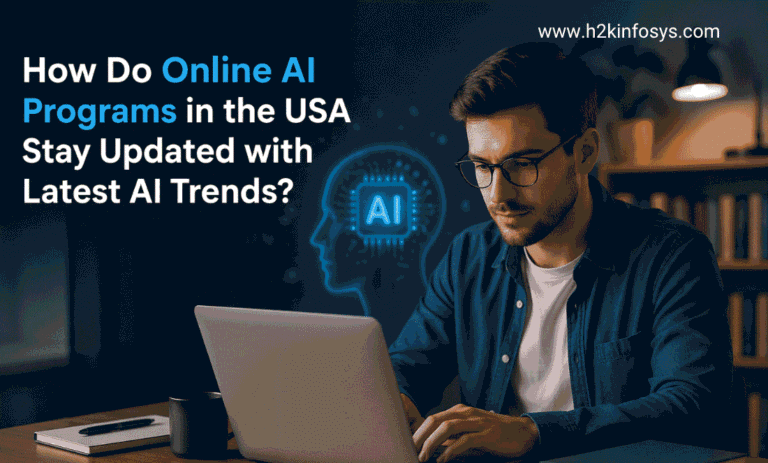
Online AI programs in the U.S. don’t really sit still for long and honestly, they can’t afford to. The way they stay relevant is by constantly tweaking what they teach: updating course content, bringing in newer tools, and reshaping projects so they reflect what’s actually happening in real-world environments. It’s less like a fixed syllabus and more like a living system.
That’s also where platforms like H2K Infosys come into the picture. Their approach leans toward keeping the curriculum aligned with current industry practices adding practical use cases, updating tools, and focusing on workflows that mirror real IT projects
A lot of this comes down to feedback loops. Programs listen to industry experts, collaborate with tech providers, and keep a close eye on how AI is evolving across companies. That’s why learners today are often working with fairly current methods in machine learning, not just outdated theory or static examples.
What does “staying updated” really mean?
In practical terms, it’s about keeping course content aligned with things like:
- New algorithms and modeling approaches
- Tools that teams actually use in production
- Real business use cases (not just textbook problems)
- Growing concerns around ethics, regulations, and deployment
Unlike traditional academic courses which might stay unchanged for years Online Ai Programs tend to be modular. That flexibility makes it easier to swap out older content and plug in something more relevant. One month it might be a new library, another time it’s an update in cloud APIs or a shift in data engineering practices. Lately, of course, generative AI has been a big driver of change.
Why this matters (especially for working professionals)
AI moves fast. What worked even a year ago can feel slightly off today. If your learning doesn’t keep up, it shows maybe in slower workflows, or tools that don’t match what companies are using.
A few things stand out here:
- Enterprise alignment: Companies want people who can work with current, scalable tools
- Standardization: Teams rely on widely adopted frameworks and platforms
- Career flexibility: Up-to-date skills make it easier to switch roles or grow
How programs actually keep things current
It’s not random. There’s usually a structure behind it.
1. Input from industry experts
Many programs involve professionals data scientists, ML engineers, cloud architects who’ve seen what’s happening on the ground. They help identify skill gaps and suggest what should be added or removed.
2. Tool and framework integration
You’ll see a consistent focus on tools like Python, TensorFlow, PyTorch, Pandas, Spark, and cloud platforms like AWS or Azure. When these tools evolve (and they do), courses get adjusted. Older or less-used technologies quietly fade out.
3. Watching the job market
An Artificial Intelligence Online Programs providers track job postings and hiring trends more closely than you might expect. If generative AI roles spike, suddenly you’ll see more NLP and transformer-based modules showing up.
4. Modular design
Instead of overhauling an entire program, they update parts of it:
- Replace outdated lessons
- Add new datasets
- Introduce fresh case studies
It’s quicker and less disruptive for learners already enrolled.
5. Project refresh cycles
Projects don’t stay the same either. A simple regression task might evolve into a full pipeline with real-time data and cloud deployment. That shift alone makes a big difference in how “job-ready” someone feels.
How AI actually works in real projects
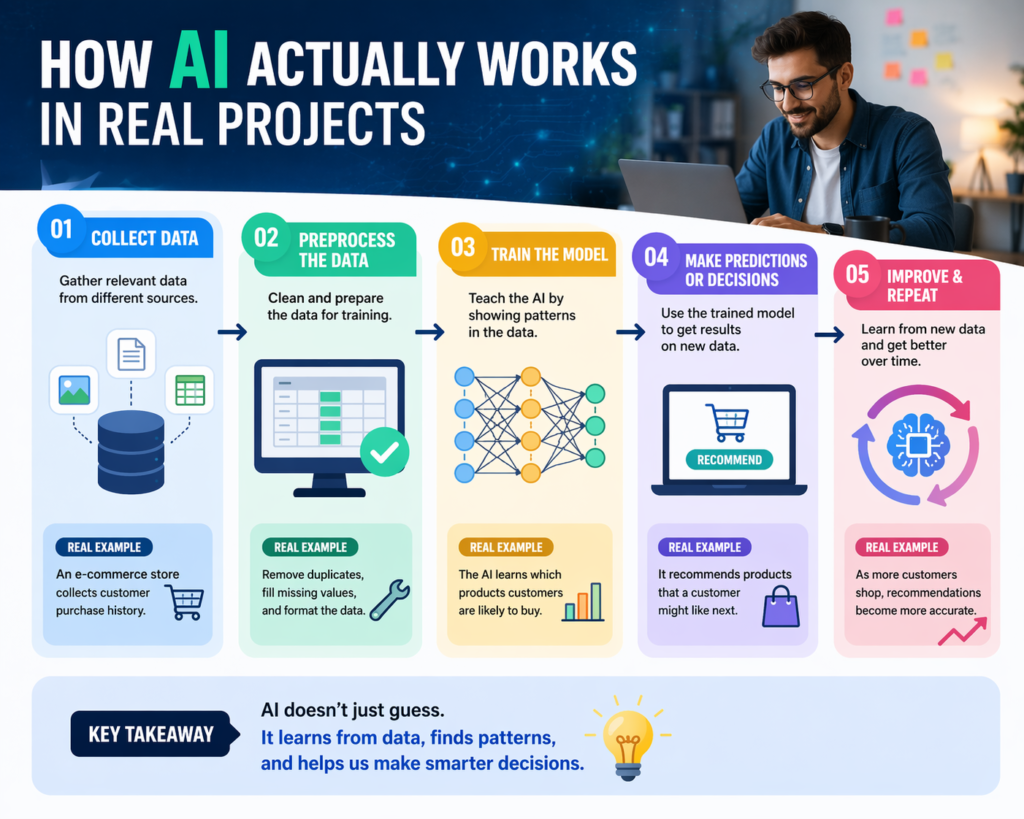
In real IT environments, AI isn’t just about building a model and calling it done. There’s a process:
- Define the business problem
- Collect and prepare data
- Build and validate models
- Deploy (often via APIs or cloud platforms)
- Monitor performance and retrain when needed
Good programs try to mirror this flow in their projects. It’s messy sometimes, but that’s kind of the point.
Where AI shows up in companies
You’ll find AI everywhere, but not in the same way across industries:
- Finance uses it for fraud detection
- Healthcare leans on it for diagnostics
- Retail builds recommendation systems
- IT teams use it for predictive maintenance
What’s common across all of these? Integration, scalability, and a need to keep things secure and monitored. That’s why modern courses include things like API integration and cloud deployment not just modeling.
Starting from scratch: what beginners actually need
If you’re new, the foundation still matters more than anything flashy.
- Programming: Basic Python, data structures, libraries like NumPy and Pandas
- Math: Linear algebra, probability, a bit of calculus
- Data skills: Cleaning, transforming, visualizing
- ML basics: Supervised vs unsupervised learning, evaluation metrics
- Tools: Jupyter Notebook, Git, cloud basics
A lot of beginner-friendly programs ease you into this step by step, so you’re not thrown into complexity right away.
How practical learning usually works
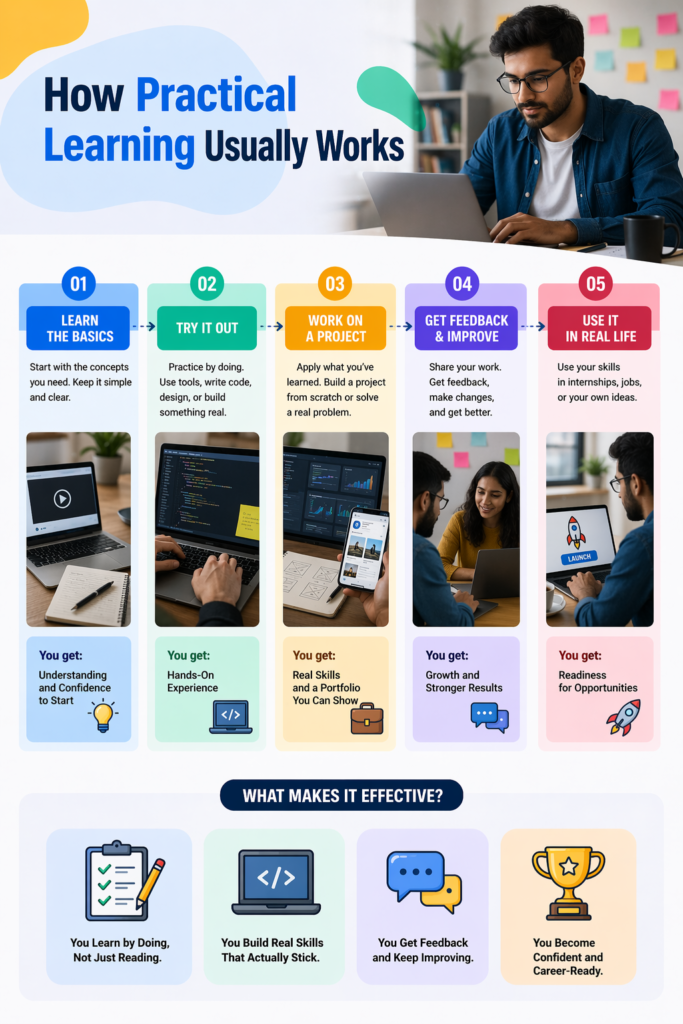
Most programs follow a pattern, even if they don’t spell it out:
- Introduce the concept
- Show how tools are used
- Walk through guided exercises
- Move into independent projects
Somewhere along the way, you’ll see workflows like:
load_data()
clean_data()
train_model()
evaluate_model()
deploy_model()
It looks simple, but each step can get pretty deep.
Roles that use AI day-to-day
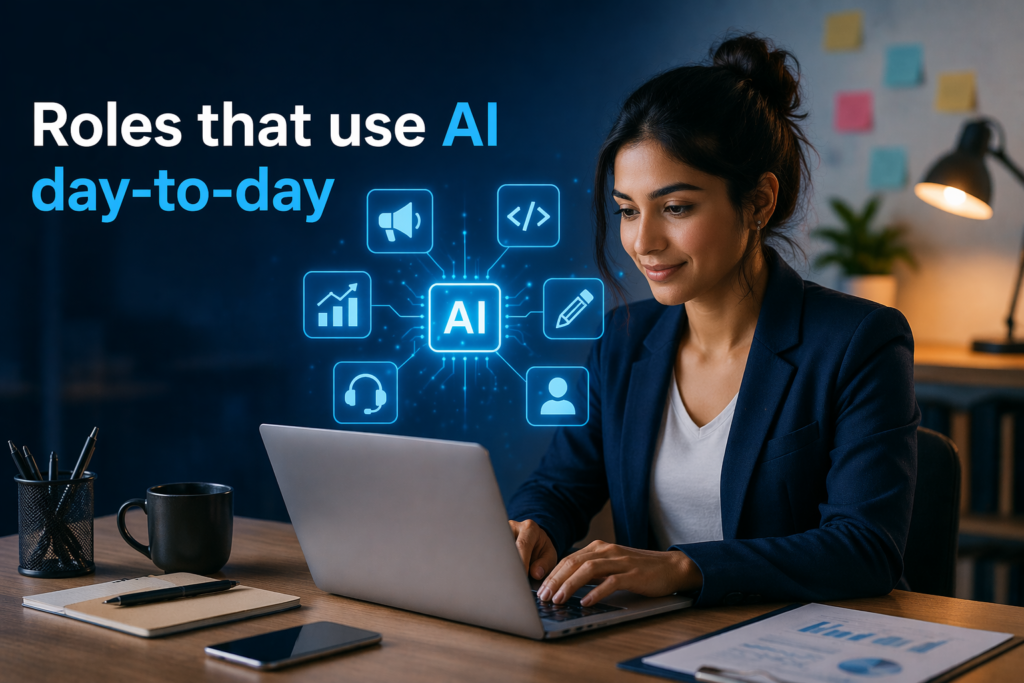
AI skills aren’t limited to one job title. Common roles include:
- AI/ML Engineer
- Data Scientist
- Data Analyst
- AI Solutions Architect
- Business Intelligence Analyst
Each role leans on AI differently, but the overlap is real.
Where this can lead
After finishing a solid program, people usually move into roles like:
- Entry-level: Data Analyst, Junior ML Engineer
- Mid-level: Data Scientist, AI Engineer
- Specialized: NLP or Computer Vision Engineer
How far you go depends a lot on your projects and how comfortable you are with tools not just certificates.
New trends that programs are folding in
You’ll notice a few themes popping up more often:
- Generative AI (text, images, prompt design)
- MLOps (deployment pipelines, monitoring)
- Responsible AI (bias, explainability)
- Cloud-based AI services and AutoML
These aren’t just “extras” anymore they’re becoming part of the core.
Challenges behind the scenes
Keeping content updated isn’t easy. The pace of change is intense, tools keep multiplying, and there’s always a tension between teaching fundamentals vs. chasing trends.
The better programs handle this by grounding everything in core concepts first, then layering tools on top.
Traditional vs modern approach (quick contrast)
- Static vs continuously updated content
- Limited tools vs industry-standard ecosystems
- Theory-heavy vs project-driven learning
- Minimal deployment vs cloud-based workflows
A few common questions
How often do programs update content?
Usually every few months—sometimes faster if there’s a big shift.
Do you need coding experience?
It helps, but many beginner tracks start from scratch with Python.
Are updated programs harder?
Not really. If anything, they’re clearer because they use better examples and tools.
Do they include generative AI now?
Most modern ones do, at least at a foundational level.
Is cloud knowledge necessary?
Yes, especially for deployment and scaling—pretty standard in real-world setups.
Key takeaways (in plain terms)
- AI programs stay relevant by constantly evolving there’s no “final version”
- Real tools and real workflows matter more than theory alone
- Modular updates make it easier to keep content fresh
- Enterprise needs shape what gets taught
- Practical skills are what ultimately make the difference
That’s really the big picture. It’s less about chasing every new trend and more about staying close to how AI is actually used in the real world.