AI training online in 2026, especially through platforms like H2K Infosys, doesn’t really look like it used to. It’s not just sitting through hours of lectures or trying to memorize definitions anymore. What The better programs feel closer to actual work. You learn the fundamentals, sure but you’re also working with real datasets, real tools, and workflows that resemble what teams actually use day to day.
The Best Artificial Intelligence Course Online don’t just explain concepts and move on. They show how AI fits into real business problems what it looks like when things get messy, when data isn’t clean, when models
don’t behave as expected. That part matters more than most people realize.
If you’re trying to figure out which artificial intelligence course is actually worth your time, it helps to ignore the flashy branding for a minute. What tends to matter more is how deep the content goes, whether you’re actually building things yourself, and how closely the material reflects real-world use not idealized examples.
What is AI Training Online in 2026?
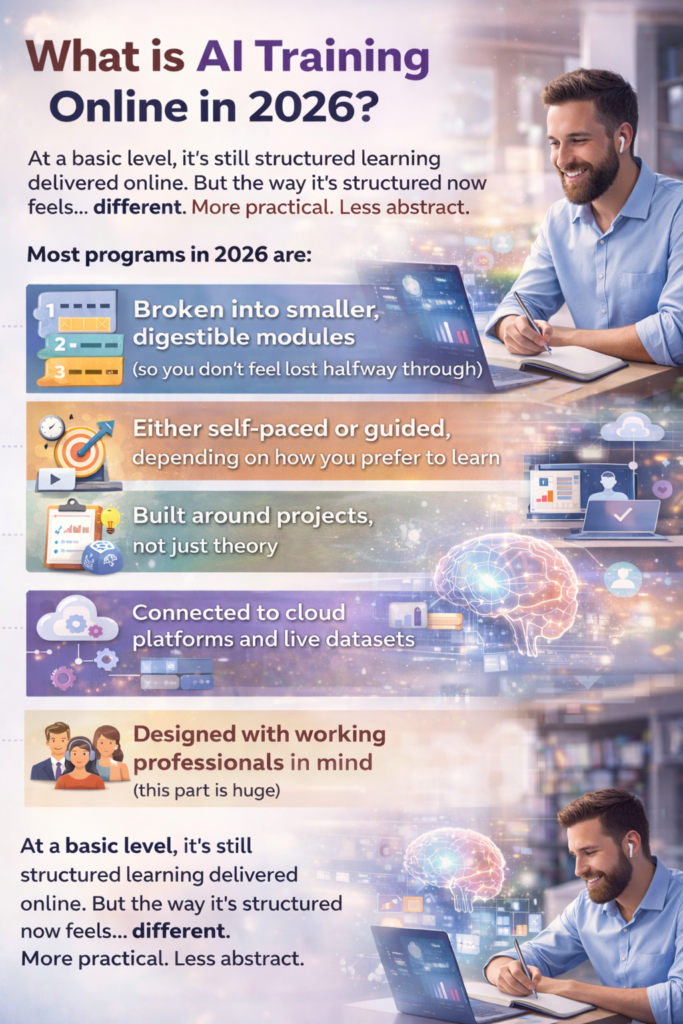
At a basic level, it’s still structured learning delivered online. But the way it’s structured now feels… different. More practical. Less abstract.
Most programs in 2026 are:
- Broken into smaller, digestible modules (so you don’t feel lost halfway through)
- Either self-paced or guided, depending on how you prefer to learn
- Built around projects, not just theory
- Connected to cloud platforms and live datasets
- Designed with working professionals in mind (this part is huge)
Because realistically, most people learning AI now aren’t full-time students. They’re juggling jobs, deadlines, maybe even switching careers quietly on the side.
There’s also been a noticeable shift over the years. Earlier courses leaned heavily on theory math, definitions, algorithms. Now, the emphasis is more on doing: building models, testing them, deploying them… and figuring out what happens when things break (which they usually do).
Why AI Training Matters for Working Professionals
AI training online in 2026 has quietly worked its way into everyday business systems. Sometimes it’s obvious like recommendation engines. Other times, it’s behind the scenes: fraud detection, analytics, automation workflows.
So even if you’re not planning to become a full-time ML engineer, understanding how AI works is becoming part of the job in a lot of roles.
A few reasons why:
- Routine tasks are getting automated more often
- Decisions are increasingly data-driven
- Teams are more cross-functional you’ll likely work with data teams at some point
- Basic AI literacy is becoming expected, not optional
In a way, learning AI helps bridge that gap between business thinking and technical execution. You don’t have to be an expert but you do need to understand what’s going on.
What to Look for in AI Training Online (Without Overthinking It)
There are a lot of Courses of Artificial Intelligence out there. Some are genuinely useful. Others… not so much. A few things tend to separate the good ones.
1. A clear learning path (this gets overlooked more than it should)
You don’t want to jump straight into complex models without a foundation. That’s usually where people get stuck.
A solid progression looks something like:
- Beginner: Python basics, simple statistics, working with data
- Intermediate: machine learning algorithms, evaluation techniques
- Advanced: deep learning, NLP, deployment
If it feels rushed or scattered, that’s usually a warning sign.
2. Real projects—not just “toy” examples
This is a big one. Maybe the biggest.
Good courses don’t stop at “train a model.” They go further:
- Collecting and cleaning data (often messy, by the way)
- Building and tuning models
- Deploying them somewhere usable
- Monitoring performance over time
Common projects might include fraud detection, churn prediction, recommendation systems. These feel a lot closer to actual work than isolated exercises.
3. Exposure to tools people actually use
Concepts matter, but tools matter too.
Most solid programs cover:
- Python
- Libraries like Scikit-learn, TensorFlow, PyTorch
- Pandas and NumPy
- Visualization tools
- Deployment basics (APIs, Docker)
- Cloud platforms like AWS, Azure, or GCP
You don’t need to master everything immediately. But getting familiar helps more than you’d expect.
4. The full workflow—not just modeling
AI isn’t just about building models in isolation. It’s part of a larger system.
A typical workflow looks like:
- Pulling data from databases or APIs
- Cleaning and preparing it (this takes longer than people think)
- Training and validating models
- Deploying them
- Monitoring performance
Courses that cover this end-to-end tend to be far more useful in practice.
5. Instructors with real-world experience
This makes a difference. A noticeable one.
People who’ve worked on real projects tend to bring up things like:
- Incomplete or messy data
- Bias in models
- Scaling issues
- Security or compliance concerns
These aren’t always in textbooks, but they show up quickly in real jobs.
6. Deployment and MLOps (not optional anymore)
A lot of older courses stop once the model is built. That’s… only half the story.
AI training online in 2026, it’s important to understand:
- How models are deployed
- CI/CD pipelines for machine learning
- Versioning and monitoring
- Containerization (Docker, for example)
This is what turns a project into something usable, not just theoretical.
7. Flexible learning (because life happens)
Most AI training online in 2026 learners are working professionals. So flexibility matters more than people admit.
Things that help:
- Recorded sessions you can revisit
- Weekend or evening options
- Modular structure
- Reasonable deadlines
AI training online in 2026 course is too rigid, people tend to drop off. It’s pretty common.
8. Real assessments—not just quizzes
Multiple-choice quizzes don’t build much confidence.
Better programs include:
- Assignments
- Capstone projects
- Feedback and reviews
That’s where actual learning happens.
9. Clear connection to job roles
It helps when courses explain where this leads.
For example:
- Data Scientist → modeling, analysis
- ML Engineer → deployment, pipelines
- AI Analyst → insights and interpretation
- NLP Engineer → working with language models
Without that context, it’s easy to feel like you’re learning… but not sure why.
10. Up-to-date content
AI changes quickly. What felt current two years ago can already feel outdated.
Courses should include:
- Transformer-based models
- Generative AI basics
- Responsible AI practices
- Model interpretability
If the content isn’t updated regularly, it shows.
How AI Actually Works in Real Projects
In real-world systems, AI training online in 2026 things follow a fairly structured pipeline but not always as neatly as diagrams suggest.
Take something like customer churn prediction:
- Data comes from CRM systems and transaction logs
- It gets cleaned (usually more effort than expected)
- Features are created
- Models are trained (logistic regression, random forests, etc.)
- Performance is evaluated
- The model is deployed, often via an API
- Over time, performance is monitored and adjusted
And honestly, this process repeats more than people expect. It’s rarely “build once and done.”
What Skills Do You Actually Need?
You don’t need everything at once. But a AI training online in 2026 few core areas help.
Core basics:
- Python
- Statistics and probability
- Some linear algebra
- Data preprocessing
More advanced:
- Machine learning algorithms
- Deep learning frameworks
- NLP
- Deployment concepts
And then there are the less obvious ones:
- Problem-solving
- Analytical thinking
- Understanding business problems
That last one tends to be underrated, but it makes a big difference.
Where AI Shows Up in Real Work
AI training online in 2026 is already everywhere just not always visible.
- Finance → fraud detection
- Healthcare → diagnostic support
- Retail → recommendation systems
- IT → predictive maintenance
- Marketing → customer segmentation
In enterprise settings, though, there are extra layers:
- Data privacy
- Scalability
- Integration with existing systems
That’s where things start getting complex.
Career Paths After Learning AI
There isn’t just one path.
- Data Science → analysis and modeling
- Machine Learning Engineering → deployment and scaling
- AI Research → developing new approaches
- AI Product Management → connecting tech with business
Where someone ends up usually depends on how deep they go technically—and what they enjoy, honestly.
Quick FAQ
What’s the best AI training online in 2026?
Usually the one that balances structure, hands-on work, and real-world tools. Branding alone doesn’t mean much if the content is shallow.
What’s the best AI course online?
Roughly 4–9 months to get comfortable with the basics and intermediate concepts, depending on your pace.
Do you need programming knowledge?
It helps—especially Python—but many people pick it up along the way.
Are certifications important?
They help a bit, but real project experience tends to matter more.
Can non-tech professionals learn AI?
Yes. Many programs start from the basics and build gradually.
Key Takeaways (short version)
- AI training in 2026 is practical and project-driven
- Real workflows matter more than theory alone
- Tools and cloud platforms are part of the learning
- Flexibility is essential for working professionals
- Clear career alignment makes learning more meaningful
If you’re exploring options, programs like H2K Infosys AI training online in 2026 tend to focus on structured, hands-on learning tied to real job roles. But regardless of where you learn, the goal is the same: not just understanding AI but actually being able to use it in real situations.