Introduction
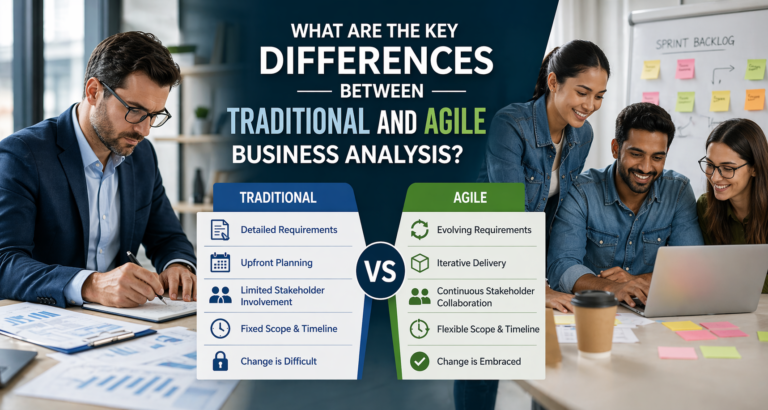
Projects fail when teams do not understand requirements. Many organizations still struggle to bridge the gap between business needs and technical delivery. This gap often depends on the approach used by business analysts. The differences between traditional and agile business analysis play a major role in project success, team collaboration, and delivery speed.
A business analyst acts as a link between stakeholders and development teams. The analyst gathers requirements, defines solutions, and ensures value delivery. However, the way this role works changes based on the methodology. Traditional methods follow structured planning, while Agile methods focus on adaptability and continuous feedback.
In this blog, you will learn the differences between traditional and agile business analysis with clear examples, practical insights, and real-world applications. This guide also connects these concepts to Business analyst certification, BA analyst course, and business analyst training and placement to help you build job-ready skills.
Understanding Traditional Business Analysis
What is Traditional Business Analysis?
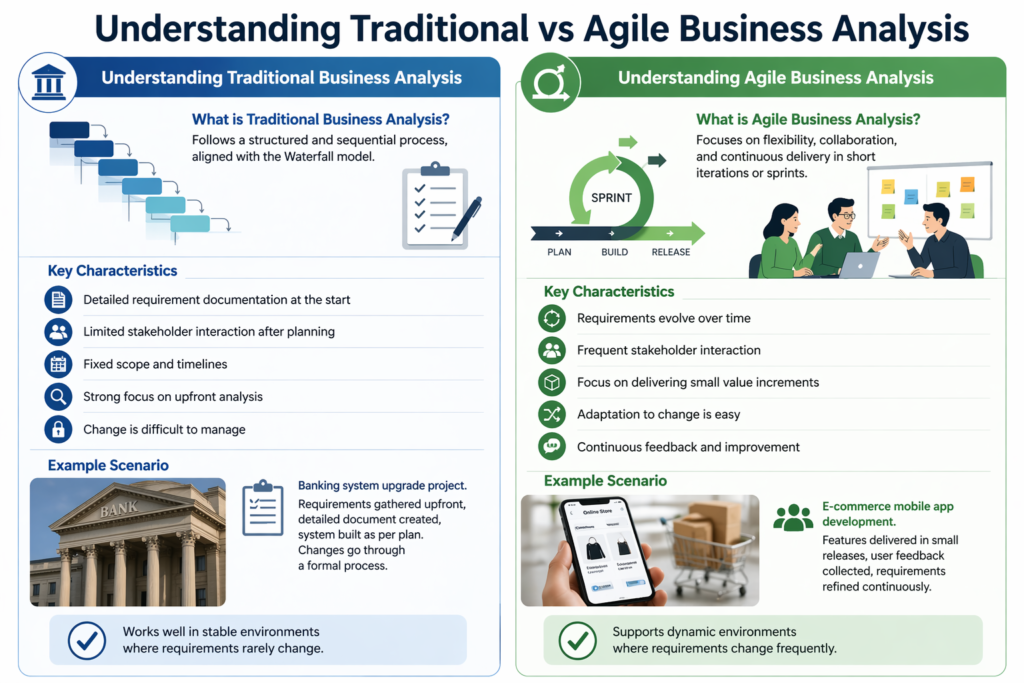
Traditional business analysis follows a structured and sequential process. It often aligns with the Waterfall model. Each phase completes before the next phase begins.
Key Characteristics
- Detailed requirement documentation at the start
- Limited stakeholder interaction after planning
- Fixed scope and timelines
- Strong focus on upfront analysis
- Change is difficult to manage
Example Scenario
A banking system upgrade project uses a traditional approach. The business analyst gathers all requirements at the start. The team creates a detailed requirement document. Developers then build the system based on this document. If stakeholders request changes later, the team must go through a formal change process.
This approach works well in stable environments where requirements do not change often.
Understanding Agile Business Analysis
What is Agile Business Analysis?
Agile business analysis focuses on flexibility, collaboration, and continuous delivery. It works in short cycles called iterations or sprints.
Key Characteristics
- Requirements evolve over time
- Frequent stakeholder interaction
- Focus on delivering small value increments
- Adaptation to change is easy
- Continuous feedback and improvement
Example Scenario
An e-commerce company develops a mobile app using Agile. The business analyst works closely with stakeholders and developers. The team delivers features in small releases. Users provide feedback after each release. The analyst refines requirements based on feedback.
This approach supports dynamic environments where requirements change frequently.
Core Differences Between Traditional and Agile Business Analysis
Understanding the differences between traditional and agile business analysis helps you choose the right approach for your project.
1. Requirement Gathering Approach
Traditional Approach
- Collects all requirements at once
- Creates detailed documents
Agile Approach
- Gathers requirements in phases
- Uses user stories instead of long documents
This is one of the key differences between traditional and agile business analysis because Agile promotes flexibility.
2. Documentation Style
Traditional
- Heavy documentation
- Formal requirement specifications
Agile
- Lightweight documentation
- Focus on user stories and acceptance criteria
These differences between traditional and agile business analysis reduce documentation overload in Agile projects.
3. Stakeholder Involvement
Traditional
- Limited interaction after requirement phase
Agile
- Continuous involvement throughout the project
This is a critical point in the differences between traditional and agile business analysis because Agile ensures better alignment with business needs.
4. Change Management
Traditional
- Changes require formal approval
- Changes increase cost and delay
Agile
- Changes are expected and welcomed
- Teams adapt quickly
These differences between traditional and agile business analysis make Agile more suitable for fast-changing environments.
5. Delivery Timeline
Traditional
- Single final delivery
Agile
- Incremental delivery in sprints
This is one of the practical differences between traditional and agile business analysis that improves time to market.
6. Collaboration Level
Traditional
- Limited collaboration
- Communication through documents
Agile
- High collaboration
- Daily communication
The differences between traditional and agile business analysis highlight how Agile improves teamwork.
7. Risk Management
Traditional
- Risks identified early
- Hard to adapt later
Agile
- Risks addressed continuously
- Faster issue resolution
These differences between traditional and agile business analysis reduce project failure risks.
8. Role of Business Analyst
Traditional
- Focus on documentation and requirement gathering
Agile
- Acts as facilitator and collaborator
The evolving role is a major aspect of the differences between traditional and agile business analysis.
Visual Comparison Table
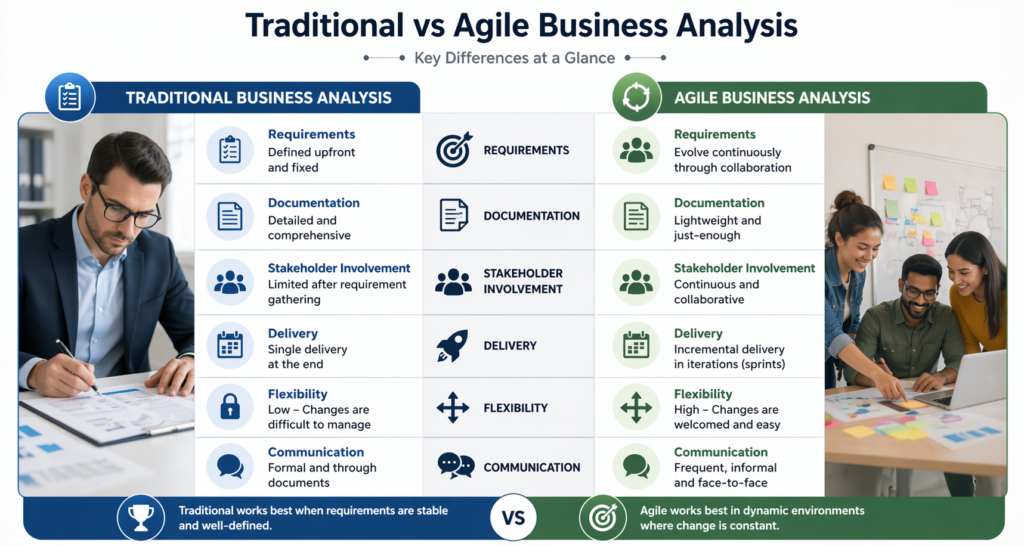
| Feature | Traditional Business Analysis | Agile Business Analysis |
| Requirements | Fixed at start | Evolve continuously |
| Documentation | Detailed and heavy | Lightweight |
| Stakeholder Role | Limited | Continuous |
| Delivery | One-time | Incremental |
| Flexibility | Low | High |
| Communication | Formal | Frequent |
Real-World Industry Insights
- According to industry reports, Agile projects show higher success rates compared to traditional methods.
- Agile teams deliver products faster due to iterative development.
- Organizations prefer Agile for digital transformation projects.
These insights support the growing shift due to the differences between traditional and agile business analysis.
Practical Skills for Business Analysts
To succeed in both approaches, you need specific skills.
Skills for Traditional Analysis
- Requirement documentation
- Process modeling
- Stakeholder interviews
- Risk analysis
Skills for Agile Analysis
- Writing user stories
- Backlog management
- Sprint planning
- Collaboration and communication
Learning these skills is essential in any BA analyst course.
Step-by-Step Guide to Transition from Traditional to Agile
Many professionals shift from traditional roles to Agile roles. Follow these steps:
Step 1: Learn Agile Fundamentals
Understand Agile principles and frameworks like Scrum.
Step 2: Practice User Stories
Write clear and concise user stories.
Example Format:
- As a user, I want to track orders so that I can monitor delivery status.
Step 3: Work on Backlog Management
Prioritize tasks based on business value.
Step 4: Improve Communication Skills
Engage with stakeholders regularly.
Step 5: Gain Practical Experience
Apply Agile concepts in real projects.
These steps help you understand the differences between traditional and agile business analysis in practice.
Tools Used in Business Analysis
Traditional Tools
- Microsoft Word
- Excel
- Visio
Agile Tools
- Jira
- Trello
- Confluence
Tool usage reflects the differences between traditional and agile business analysis in workflow and efficiency.
Role of Certification and Training
Why Certification Matters
- Validates your knowledge
- Improves job opportunities
- Builds industry credibility
Popular Learning Paths
- Business analyst certification
- BA analyst course
- business analyst training and placement
These programs teach both traditional and Agile methods. They also help you understand the differences between traditional and agile business analysis with practical examples.
Common Challenges and Solutions
Challenge 1: Resistance to Change
Solution: Provide training and awareness programs
Challenge 2: Lack of Agile Knowledge
Solution: Enroll in structured learning programs
Challenge 3: Poor Communication
Solution: Use collaboration tools and regular meetings
Understanding these challenges helps you adapt to the differences between traditional and agile business analysis effectively.
When to Use Traditional vs Agile
Use Traditional When:
- Requirements are stable
- Projects are large and predictable
- Compliance is strict
Use Agile When:
- Requirements change frequently
- Faster delivery is needed
- Customer feedback is important
Choosing the right method depends on your project needs and understanding the differences between traditional and agile business analysis.
Case Study Example
Traditional Approach Case
A government project uses a traditional model. The team defines all requirements upfront. The project takes two years to complete. Changes during development cause delays.
Agile Approach Case
A startup uses Agile for app development. The team releases updates every two weeks. Users provide feedback regularly. The product improves continuously.
These cases clearly show the differences between traditional and agile business analysis in action.
Future Trends in Business Analysis
- Increased adoption of Agile methods
- Integration with AI tools
- Focus on data-driven decisions
These trends highlight the importance of understanding the differences between traditional and agile business analysis for future careers.
Key Takeaways
- Traditional analysis focuses on planning and documentation
- Agile analysis focuses on flexibility and collaboration
- Agile supports faster delivery and continuous improvement
- Both approaches require strong analytical and communication skills
- Understanding the differences between traditional and agile business analysis helps in choosing the right approach
Conclusion
The right approach depends on your project goals, team structure, and business needs. Master both methods to build a strong career in business analysis.Start building your expertise today with business analyst training and placement, along with structured learning and practical experience.
FAQs:
Which is better: traditional or Agile business analysis?
Neither is universally better. Traditional business analysis is ideal for projects with stable requirements, while Agile business analysis works best for projects that require flexibility, frequent feedback, and rapid delivery.
Do business analysts need Agile skills in 2026?
Yes. Many organizations now use Agile frameworks such as Scrum and Kanban, making Agile skills highly valuable for business analysts. Understanding Agile practices can improve job opportunities and career growth.
Can a traditional business analyst work in an Agile environment?
Yes. Traditional business analysts can transition to Agile by learning Agile principles, participating in sprint planning, collaborating with cross-functional teams, and adapting to iterative requirement gathering.
What are the responsibilities of an Agile business analyst?
Agile business analysts work closely with product owners, developers, testers, and stakeholders. Their responsibilities include refining user stories, prioritizing requirements, supporting sprint planning, and ensuring business goals are met throughout the project.
Which industries use Agile business analysis the most?
Agile business analysis is widely used in software development, banking, healthcare, fintech, e-commerce, telecommunications, and other industries that require continuous product improvement and faster releases.