
If you’re wondering what people actually learn in a Business Analyst Class, the short answer is this: you learn how to solve business problems using data, communication, documentation, and real-world analysis techniques. A good class doesn’t just teach theory anymore. In 2026, employers want analysts who can work with tools, understand business goals, and communicate clearly with teams across departments.
That’s honestly why so many beginners are now searching for business analyst online programs instead of traditional classroom-only learning. The field has changed fast over the last couple of years, especially with AI tools becoming part of everyday business operations.
And if you’ve looked at job boards recently, you probably noticed something interesting: companies are hiring business analysts in healthcare, banking, retail, logistics, cybersecurity, and even AI startups. The demand is broader than most people expect.
Why Business Analyst Skills Matter More Than Ever
A few years ago, many companies treated business analysts as “documentation people.” Today, that role is much bigger.
Modern analysts aid businesses:
- Process improvements
- Learn about customer behaviour.
- Lower operating costs
- Work with AI-based systems
- Translate business needs into technical solutions.
One trend that many hiring managers say they’ve seen recently is that businesses don’t just want someone who knows Excel anymore. They are looking for professionals who can think critically, communicate with stakeholders, and adapt quickly when priorities change.
That’s exactly where structured business analysis training becomes useful. It helps beginners avoid the confusion of learning random tools without understanding how actual business projects work.
Core Skills You Learn in a Business Analyst Class
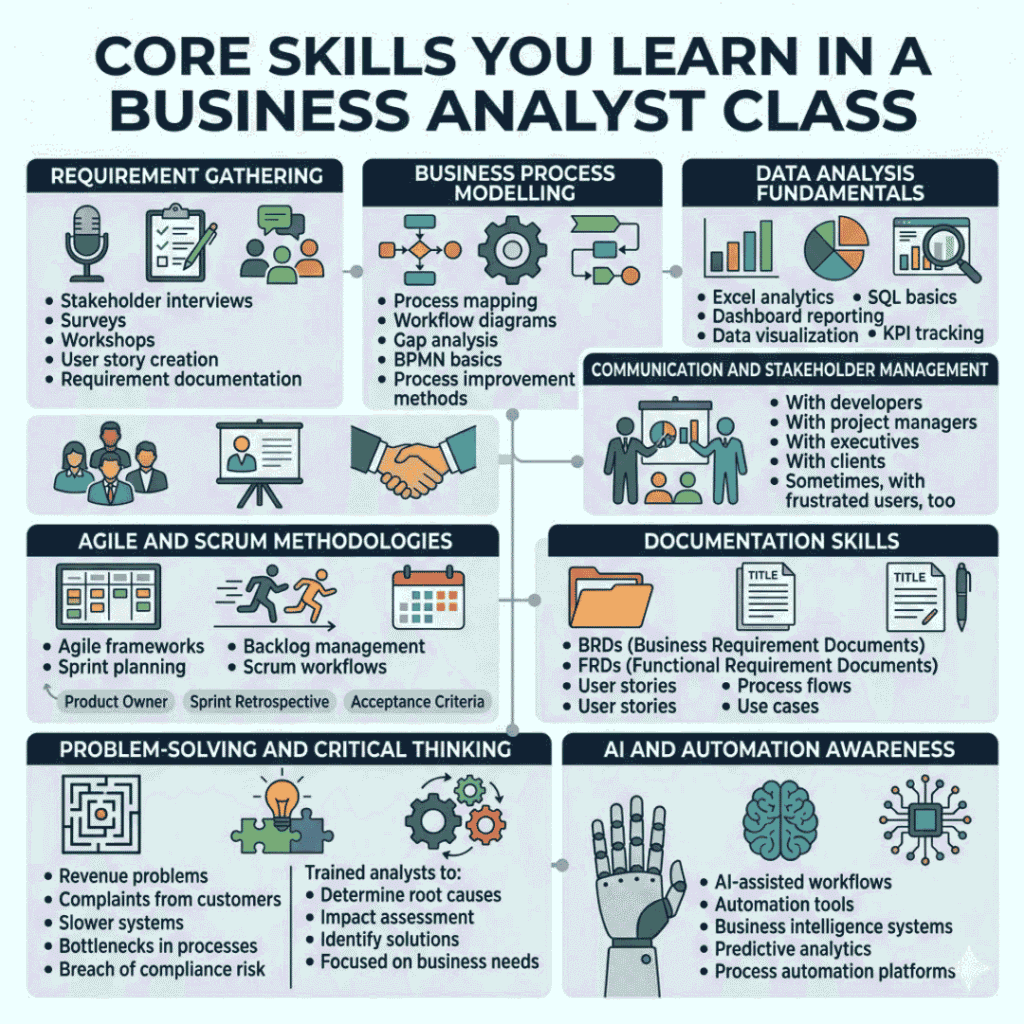
Every training program is slightly different, but most strong programs focus on a mix of technical, analytical, and communication skills.
Here’s what students usually learn.
1. Requirement Gathering
This is one of the biggest parts of a business analyst’s job.
You learn how to collect information from stakeholders, managers, clients, and users to understand what a business actually needs. Sounds simple at first… until you realize people often explain problems differently depending on their role.
In a real project, one department might want faster software, while another wants more security controls. A business analyst learns how to balance those needs.
Most Business Analyst Class programs teach techniques like:
- Stakeholder interviews
- Surveys
- Workshops
- User story creation
- Requirement documentation
Good training also includes mock sessions because, honestly, requirement gathering gets messy in real companies.
2. Business Process Modelling
This skill teaches you how businesses operate step-by-step.
You’ll often learn:
- Process mapping
- Workflow diagrams
- Gap analysis
- BPMN basics
- Process improvement methods
A lot of students initially think diagrams are boring. Then they work on a real project and realize businesses can waste thousands of dollars because workflows are unclear.
One instructor from H2K Infosys explained this really well during a webinar recently: Businesses don’t fail because they lack software; they fail because teams misunderstand processes.
That point sticks with people.
3. Data Analysis Fundamentals
You don’t necessarily need to become a data scientist, but you do need to understand data.
Most modern business analyst online programs include:
- Excel analytics
- SQL basics
- Dashboard reporting
- Data visualization
- KPI tracking
Some classes now even introduce Power BI or Tableau because companies increasingly expect analysts to explain data visually.
And honestly, employers appreciate candidates who can look at a dataset and tell a meaningful story instead of just creating charts nobody understands.
4. Communication and Stakeholder Management
This part surprises many beginners.
A business analyst spends a huge amount of time communicating:
- With developers
- With project managers
- With executives
- With clients
- Sometimes, with frustrated users, too
Strong communication skills can honestly separate average analysts from highly valued ones.
Many experienced analysts will tell you this privately: technical tools are easier to learn than people management.
That’s why practical business analysis training often includes:
- Presentation exercises
- Meeting simulations
- Documentation reviews
- Real-world communication scenarios
Some students initially underestimate this section… until they enter actual project meetings.
5. Agile and Scrum Methodologies
This became especially important after remote and hybrid work expanded globally.
Most companies now use Agile environments, which means business analysts often work alongside Scrum teams.
In many modern programs, students learn:
- Agile frameworks
- Sprint planning
- User stories
- Backlog management
- Scrum workflows
You’ll also hear terms like:
- Product Owner
- Sprint Retrospective
- Acceptance Criteria
At first, it feels like corporate jargon overload. Eventually, it becomes second nature.
6. Documentation Skills
A lot of business analysis still comes down to creating clear documentation.
This includes:
- BRDs (Business Requirement Documents)
- FRDs (Functional Requirement Documents)
- User stories
- Process flows
- Use cases
One thing beginners often discover is that unclear documentation causes major project delays. Small misunderstandings can create weeks of rework.
Good Business Analyst Class programs spend time teaching structured documentation because companies care deeply about clarity.
7. Problem-Solving and Critical Thinking
This is probably the most underrated skill.
Businesses hire analysts because there are problems.
* Revenue problems* Complaints from customers
* Slower systems
* Bottlenecks in processes
* Breach of compliance risk
Trained analysts to:
* Determine root causes
* Impact assessment
* Identify solutions
* Focused on business needs
And honestly, this skill is built more from exposure to projects than memorization.
Hence, most of the students prefer to enroll in courses like H2K Infosys, where they get to practice in live projects rather than regular lectures.
Real project experience changes the way people think.
8. AI and Automation Awareness
This has become a major trend in 2026, honestly, much faster than many people expected.
Business analysts are increasingly expected to understand:
- AI-assisted workflows
- Automation tools
- Business intelligence systems
- Predictive analytics
- Process automation platforms
No, most analysts are not building AI models themselves.
But companies now expect analysts to understand how AI impacts business operations.
You’ll notice many updated business analyst online courses now include discussions around:
- Generative AI tools
- AI reporting systems
- Workflow automation
- AI governance basics
That wasn’t common even three years ago.
Real-World Example of How These Skills Work Together
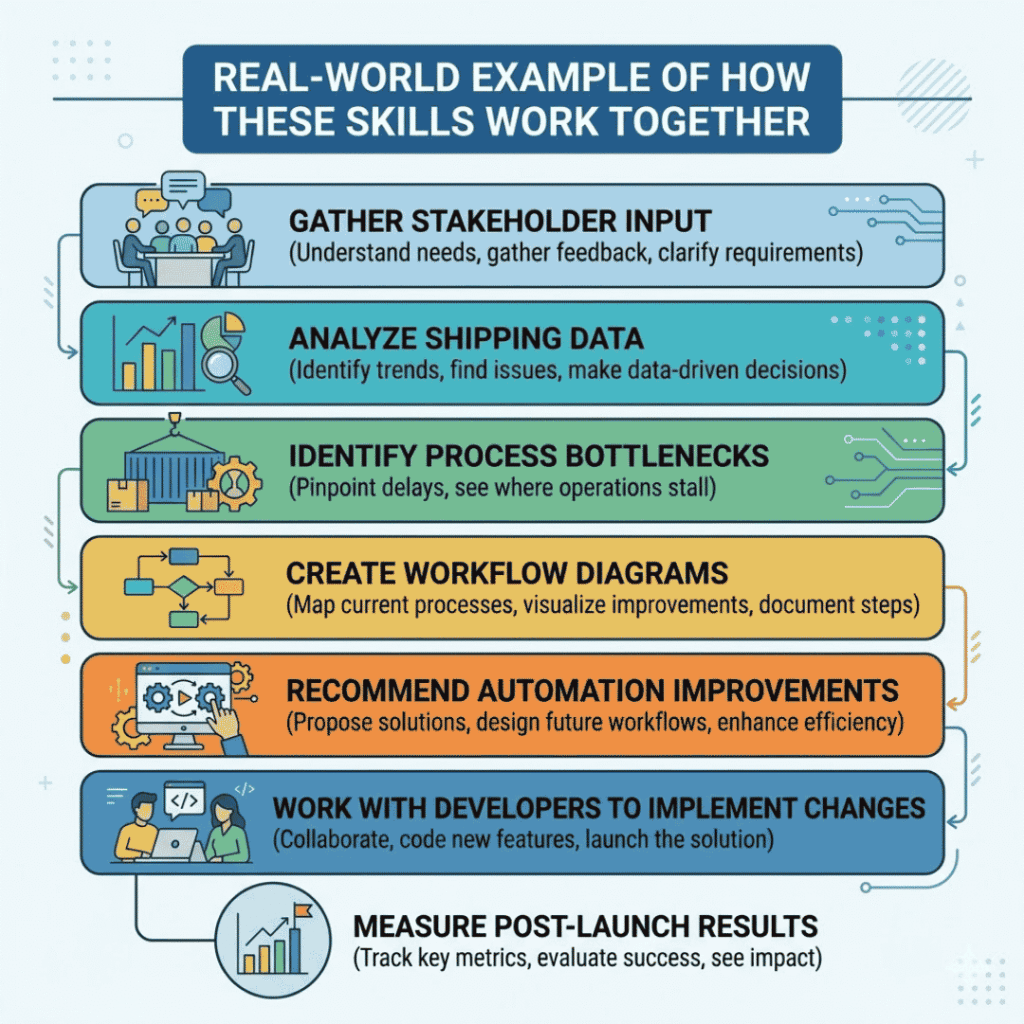
Imagine an online retail company receives thousands of customer complaints about delayed deliveries.
A business analyst might:
- Gather stakeholder input
- Analyze shipping data
- Identify process bottlenecks
- Create workflow diagrams
- Recommend automation improvements
- Work with developers to implement changes.
- Measure post-launch results
That’s why this career attracts people who enjoy both business thinking and structured problem-solving.
It’s rarely just “working with spreadsheets.”
What Beginners Usually Struggle With First
To be honest, many newcomers initially struggle with:
- Technical terminology
- Understanding workflows
- Writing requirements clearly
- Confidence during meetings
That’s normal.
The difference-maker is usually guided learning with real project examples.
A structured business analysis training program helps reduce the overwhelming feeling beginners often experience when trying to self-learn from random YouTube videos and disconnected tutorials.
Why Many Learners Choose Online Business Analyst Training
Flexible learning has become the preferred option for many working professionals.
People now want:
- Weekend classes
- Recorded sessions
- Live projects
- Career guidance
- Resume preparation
- Mock interviews
This is one reason programs like H2K Infosys continue getting attention among beginners looking for practical training instead of purely academic instruction.
A lot of students specifically look for programs that combine:
- Instructor-led sessions
- Hands-on projects
- Agile training
- Real documentation practice
Because hiring managers increasingly ask experience-based questions during interviews.
Final Thoughts
A good Business Analyst Class usually goes way beyond just teaching documentation or report writing. Sure, those things matter, but the real value comes from understanding how businesses actually function day to day, how teams communicate, where processes break down, and how data helps companies make smarter decisions. That’s the part many beginners don’t fully realize at first.
The strongest programs tend to mix a little bit of everything:
- Technical knowledge
- Business problem-solving
- Communication skills
- Hands-on project experience
- Agile and AI-focused learning
And honestly, that mix matters a lot right now. Probably more than it did even a few years ago.
Companies are changing fast. Automation is everywhere, cloud platforms keep evolving, and AI tools are becoming part of regular business operations instead of just “future technology.” Because of that, businesses want analysts who can understand both the technical side and the business side without getting lost in either one.
That’s one reason so many people are now choosing structured business analyst online programs and practical business analysis training courses through H2K Infosys. For a lot of beginners, having real project exposure and guided learning makes the whole career path feel far more realistic and, honestly, much less overwhelming.