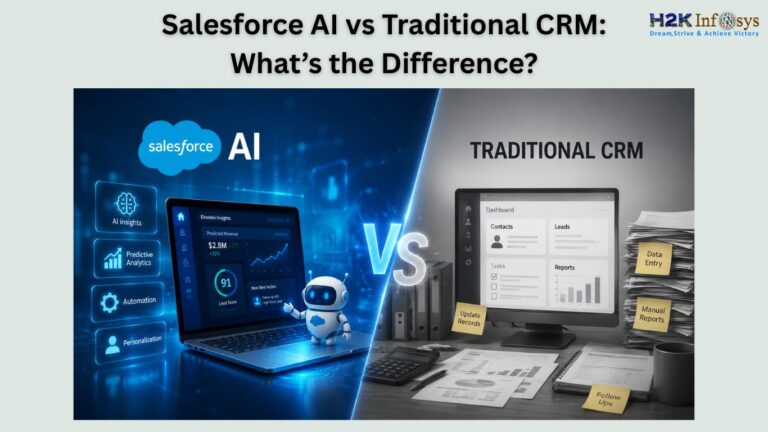
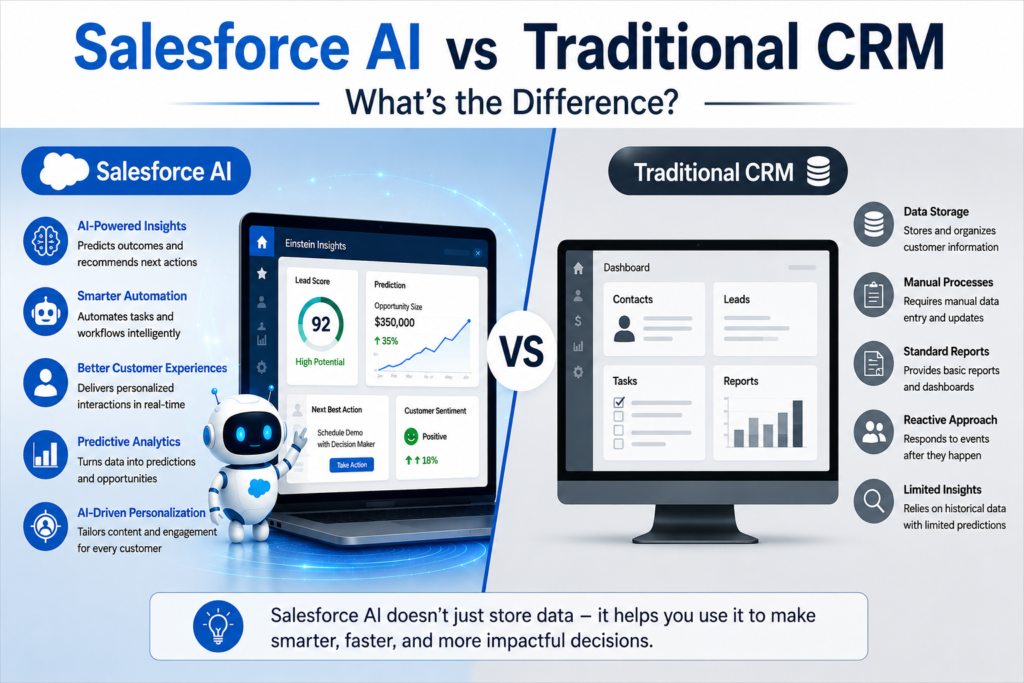
The biggest difference between Salesforce AI and Traditional CRM is simple: traditional CRM systems store and organize customer data, while Salesforce AI actively analyzes that data, predicts outcomes, automates decisions, and helps businesses act faster with less manual effort. One manages information. The other helps businesses think ahead.
That shift is changing how companies hire, train teams, and invest in technology. And honestly, if you’ve worked around sales or customer service teams recently, you’ve probably already seen it happening in real time.
A few years ago, most CRM users spent hours updating spreadsheets, tracking leads manually, and guessing which customer might convert. Today, AI-powered Salesforce tools can score leads automatically, draft emails, predict churn, and even suggest the next best action during a live customer conversation. It feels less like software and more like having an assistant sitting beside the sales rep.
Businesses are moving quickly toward AI-powered CRM platforms because customer expectations changed fast. People want instant responses, personalized experiences, and smoother interactions. Traditional systems struggle to keep up with that pace. That’s exactly where Salesforce AI stands apart from Traditional CRM solutions.
And because companies are aggressively adopting AI-powered CRM systems, demand for trained Salesforce professionals has exploded. That’s one reason many learners are now enrolling in Salesforce training and placement programs to build practical AI-driven CRM skills that employers actually want in 2026.
Understanding Traditional CRM
Before AI entered the picture, CRM platforms were mostly digital databases with workflow tools attached.
A Traditional CRM system helps businesses:
- Store customer information
- Track sales opportunities
- Manage contact records
- Monitor customer interactions
- Generate reports
- Organize sales pipelines
It was still incredibly useful. In fact, many businesses improved productivity just by moving away from Excel sheets and disconnected tools.
But there was one major limitation.
Traditional systems depended heavily on manual work.
Sales teams had to:
- Enter customer notes manually
- Update deal stages
- Schedule follow-ups
- Analyze reports themselves
- Interpret customer behavior without much assistance
If someone forgot to update the CRM, the entire pipeline could become inaccurate. That’s still a common frustration in many organizations using older systems.
I remember talking with a sales manager at a healthcare staffing company last year. Their team used an older CRM setup where reps spent almost two hours daily just updating records. Two hours. Every day. That’s an entire workday lost every week on admin tasks alone.
That’s where the conversation around Salesforce AI versus Traditional CRM becomes important.
What Is Salesforce AI?
Salesforce AI refers to Salesforce’s artificial intelligence capabilities integrated directly into its CRM ecosystem. The most talked-about advancement recently has been Salesforce Einstein AI and the newer generative AI integrations added into Salesforce products.
Instead of simply storing information, Salesforce AI can:
- Predict customer behavior
- Recommend next actions
- Generate sales insights
- Automate repetitive tasks
- Personalize customer communication
- Analyze huge datasets instantly
- Create AI-generated content for sales and support teams
In practical terms, it means a sales rep no longer has to manually decide which lead deserves attention first. The system can prioritize leads automatically based on conversion likelihood.
That changes productivity in a very real way.
And businesses noticed.
According to recent CRM industry trends, organizations adopting AI-driven CRM systems are seeing improvements in:
- Customer retention
- Sales forecasting accuracy
- Response times
- Employee productivity
- Customer satisfaction metrics
This is why the discussion around Salesforce AI and Traditional CRM has become one of the hottest topics in enterprise technology.
Salesforce AI vs Traditional CRM: The Core Difference
Let’s break this down clearly.
| Feature | Traditional CRM | Salesforce AI |
| Data Storage | Yes | Yes |
| Workflow Automation | Limited | Advanced |
| Predictive Analytics | Rare | Built-in |
| AI Recommendations | No | Yes |
| Lead Scoring | Manual | Automated |
| Personalized Customer Insights | Basic | Real-time |
| Generative AI Features | No | Yes |
| Customer Behavior Prediction | Minimal | Strong |
| Automation Level | Moderate | High |
| Decision Support | Human-only | AI-assisted |
The easiest way to think about it?
A Traditional CRM records what already happened.
Salesforce AI helps businesses decide what should happen next.
That’s a massive shift.
Why Businesses Are Moving Toward Salesforce AI
A lot of companies didn’t initially move toward AI because they wanted futuristic technology. They moved because manual CRM processes were slowing them down.
And honestly, customers became less patient.
People expect:
- Faster responses
- Personalized recommendations
- Better support experiences
- Seamless communication across channels
Traditional workflows struggle under that pressure.
Taking e-commerce enterprises as an example, traditional CRM systems can only display customers’ purchase histories. In contrast, Salesforce AI can analyze browsing behavior, predict
purchase intentions, and trigger personalized offers. It
can also, in customer service scenarios, summarize interactions, recommend response scripts, and identify conversational sentiment. For this reason, most
enterprises advancing digital transformation prefer to adopt Salesforce AI rather than traditional CRM.
Real-World Case: The banking industry
It is the clearest example of this current transformation trend
Traditional CRM systems in banking mostly tracked:
- Customer accounts
- Loan inquiries
- Service requests
- Contact history
But AI-powered Salesforce environments now:
- Detect fraud patterns
- Predict loan default risks
- Recommend personalized financial products
- Identify customers likely to switch banks
- Automate customer onboarding
A regional bank in Texas reportedly reduced customer response times by nearly 40% after implementing Salesforce AI-driven automation across support channels.
That’s the type of operational improvement businesses care about now.
The Rise of Generative AI in Salesforce
One thing that really accelerated the shift from Traditional CRM to Salesforce AI was generative AI.
This became huge after tools like ChatGPT changed public perception around AI capabilities.
Salesforce responded aggressively with AI integrations across:
- Sales Cloud
- Service Cloud
- Marketing Cloud
- Commerce Cloud
Now sales representatives can generate:
- Personalized emails
- Meeting summaries
- Sales proposals
- Customer follow-ups
- Support responses
And it happens inside the CRM itself.
That’s important because employees don’t want to jump between ten different tools during their workday.
The integration is becoming a competitive advantage.
Traditional CRM Still Has a Role
Now, to be fair, Traditional CRM systems are not completely obsolete.
Smaller businesses with limited budgets sometimes prefer simpler CRM setups because:
- This tool has
- lower costs, requires less training,
- is less complex to implement, and
does not require mandatory integration of advanced artificial intelligence.
The two types of local small real estate and logistics institutions currently have no immediate demand for predictive AI tools.
These types of merchants that did not adopt automation early are gradually implementing automated functions.
The market trend is pretty clear.
AI-enhanced CRM systems are becoming the new standard rather than the exception.
Why Salesforce Skills Are in High Demand
This transition created an enormous skills gap.
Companies want professionals who understand:
- Salesforce administration
- AI-powered CRM workflows
- Automation tools
- Salesforce Einstein AI
- CRM analytics
- Cloud integration
But qualified professionals are still limited compared to demand.
That’s exactly why interest in Salesforce certification training has surged recently.
Recruiters increasingly prioritize candidates with:
- Hands-on Salesforce project experience
- AI workflow knowledge
- Salesforce certifications
- Automation expertise
A recruiter I spoke with earlier this year mentioned that Salesforce-related positions are now among the hardest CRM roles to fill because companies want people who can bridge both business processes and AI functionality.
That combination matters.
How Salesforce Certification Programs Help
For beginners entering the field, structured Salesforce certification programs can make the learning process far more practical.
The challenge with Salesforce isn’t just understanding theory. Employers want candidates who can actually:
- Configure workflows
- Build dashboards
- Automate tasks
- Handle integrations
- Understand AI-powered CRM features
That’s where good training becomes valuable.
The better Salesforce certification courses now include:
- Real-world project simulations
- Sandbox practice environments
- AI workflow implementation
- Job-oriented case studies
- Placement assistance
And frankly, that practical exposure matters more than memorizing definitions.
Why H2K Infosys Stands Out
Among the growing number of training providers, H2K Infosys has gained attention because its programs focus heavily on real-world implementation rather than just exam preparation.
Their Salesforce training and placement approach is designed around current hiring trends, including:
- Salesforce AI workflows
- Automation projects
- Resume preparation
- Mock interviews
- Live instructor-led sessions
- Hands-on assignments
A lot of learners struggle after completing generic online tutorials because they’ve never worked on realistic CRM scenarios.
That’s something H2K Infosys addresses pretty directly through project-based learning.
Their Salesforce online classes also help working professionals transition into Salesforce careers without leaving their current jobs, which is honestly important for many career changers right now.
Salesforce AI vs Traditional CRM in Sales Teams
Sales departments probably feel the biggest impact from this shift.
With Traditional CRM, sales reps often:
- Manually tracked leads
- Updated opportunity stages
- Wrote repetitive emails
- Created reports manually
With Salesforce AI:
- Lead prioritization becomes automated
- Email drafts are AI-generated
- Sales forecasting improves
- Customer intent signals become visible
- Follow-up reminders happen automatically
One SaaS company reportedly increased conversion rates simply by using AI-generated lead scoring models inside Salesforce.
That’s not magic. It’s pattern recognition at scale.
And honestly, human sales reps still matter enormously. AI just removes repetitive work so they can focus on actual relationship-building.
Marketing Teams Are Seeing Big Changes Too
Marketing departments used to rely heavily on broad audience segmentation inside traditional systems.
But Salesforce AI enables:
- Hyper-personalized campaigns
- Real-time audience targeting
- Predictive recommendations
- AI-generated content suggestions
- Automated customer journeys
That level of personalization was almost impossible with older Traditional CRM systems.
Consumers now expect brands to understand their preferences instantly. AI-powered CRM tools help companies meet those expectations.
The Learning Curve: Is Salesforce AI Hard to Learn?
This question comes up constantly.
The honest answer?
It depends on how you learn.
Trying to self-study Salesforce AI concepts randomly through YouTube videos can become overwhelming pretty quickly because the ecosystem is huge.
A structured Salesforce certification training path usually works better because it organizes concepts logically:
- CRM fundamentals
- Salesforce administration
- Automation tools
- AI integrations
- Real-world implementation
That progression matters.
The good news is that modern Salesforce online classes are far more beginner-friendly than older technical training models.
Many learners entering Salesforce today actually come from:
- Customer service backgrounds
- Sales operations
- Marketing
- Business analysis
- Recruiting
- Healthcare administration
You don’t necessarily need a hardcore programming background to start.
AI Will Not Replace Salesforce Professionals
This concern comes up constantly too.
People worry that AI automation means fewer jobs.
But what’s actually happening is role evolution.
Businesses still need professionals who can:
- Configure AI workflows,
- train adaptive systems,
- interpret business requirements,
- customize CRM environments,
- monitor automation quality,
- and safeguard compliance governance.
If any change is worth noting, it is that contrary to expectations, the demand for Salesforce professionals has only grown more acute, and these talents have become ever more sought-after and valuable.
At present, the core trend in the field of customer relationship management is AI governance.
Current Industry Trend: AI Governance
The five core concerns in this field are
- data privacy
- AI hallucination
- compliance standards
- ethical automation
- and secure processing of customer data.
Companies adopting Salesforce AI are increasingly concerned that this area alone is creating new career opportunities for Salesforce professionals with governance and compliance knowledge.
Choosing Between Traditional CRM and Salesforce AI
For businesses evaluating options, the choice usually depends on:
- Company size
- Growth plans
- Customer interaction volume
- Budget
- Automation needs
- Data complexity
A small startup may survive initially with basic CRM functionality.
But growing businesses often hit limitations quickly.
That’s why many organizations are migrating from Traditional CRM systems toward AI-powered Salesforce ecosystems.
The long-term operational advantages usually outweigh the upfront learning curve.
Final Thoughts
The debate around Salesforce AI and Traditional CRM really comes down to one thing: adaptability.
Traditional CRM systems helped businesses organize customer data. That was revolutionary for its time.
But modern businesses need more than organization. They need prediction, automation, personalization, and speed.
For this reason, Salesforce AI will become the core support for enterprise customer management starting in 2026.
As enterprises of all types accelerate the deployment of Salesforce systems, professionals with relevant skills have gained abundant cross-industry opportunities.
Serious learners who genuinely intend to enter the fields of CRM and cloud technology may enroll in H2K Infosys’s structured Salesforce certification program to gain professional knowledge and practical, job-relevant hands-on experience.
Today’s market is accelerating its transformation toward AI-powered CRM ecosystems, and the earlier working professionals master the relevant skills, the more firmly they can secure their competitive positioning in the technology employment market.