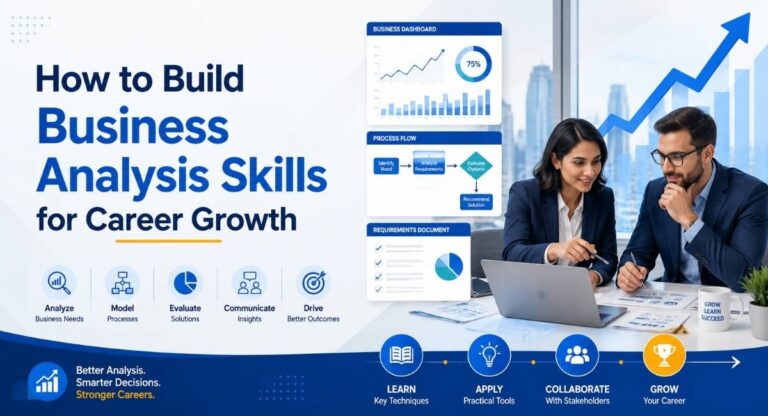
Develop Business Analysis Skills by learning how to understand business problems, ask better questions, analyse data, map processes, and explain solutions clearly to technical and non-technical teams. For many learners, this process can be simpler when they select a structured learning path through H2K Infosys, as it will provide them with guided business analysis training, instead of leaving them to figure everything out on their own. If you want long-term career growth, the right training can help you build that foundation faster and with fewer trial-and-error mistakes.
And honestly, that is where many beginners get stuck. They think business analysis is only about writing requirements documents. It is not. A good Business Analyst sits between business goals, customer pain points, technology limitations, stakeholder expectations, and actual delivery. Some days you are clarifying a vague requirement. Some days you are challenging a process that “has always been done this way.” Some days you are simply translating chaos into something a project team can act on.
That is the real skill.
Why Business Analysis Skills Matter More Than Ever
Business analysis has quietly become one of the most practical career paths for people who want to work in tech, consulting, product, operations, finance, healthcare, or digital transformation without being limited to one narrow technical role.
The reason is simple: companies are under pressure to change faster. AI adoption, automation, cloud systems, data-driven decision-making, cybersecurity concerns, and customer experience upgrades are all changing how businesses operate. The World Economic Forum’s Future of Jobs Report 2025 found that nearly 40% of workplace skills are expected to change by 2030, with employers pointing to the skills gap as a major barrier to transformation. It also highlighted the rising importance of AI, big data, cybersecurity, analytical thinking, leadership, and collaboration.
That sounds big and global, but you can see it in everyday work too.
A retail company wants to reduce cart abandonment. A bank wants to improve onboarding time. A healthcare provider wants cleaner patient data. A SaaS company wants to redesign a clunky customer dashboard. In each case, someone has to understand the problem, gather input, analyze the current process, define the future state, and help teams build the right solution.
That “someone” is often the Business Analyst.
How to Build Business Analysis Skills for Career Growth
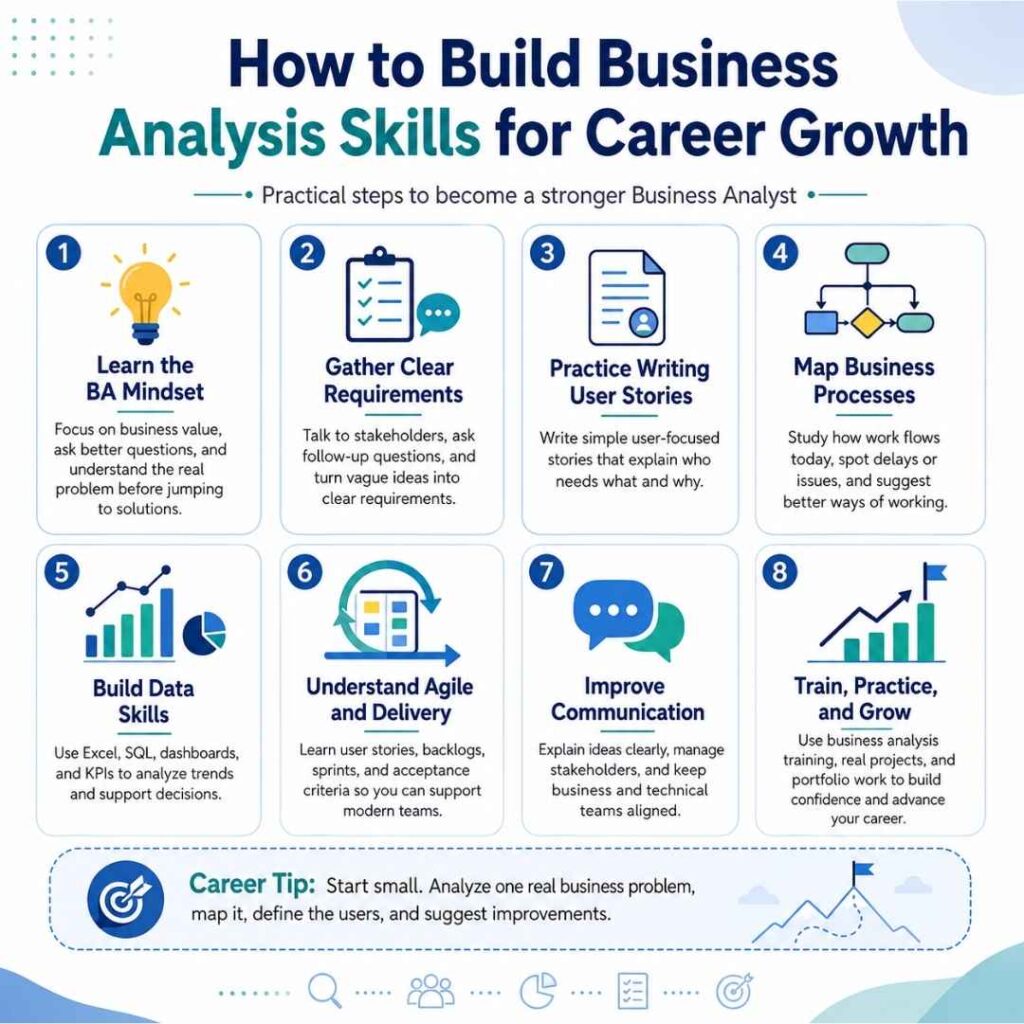
Start With the Core BA Mindset
Before tools, certifications, or templates, you need the mindset.
A Business Analyst does not jump straight to solutions. That is the rookie mistake. A stakeholder says, “We need a dashboard,” and a beginner may immediately ask what charts they want. A stronger BA asks, “What decision will this dashboard help you make?”
Tiny difference. Huge impact.
The BA mindset is built around curiosity, clarity, and business value. You are not there just to document what people say. You are there to understand what they mean, what they need, what is missing, and what outcome the business is really trying to achieve.
For example, a sales manager may say, “We need automation because the team is slow.” After proper analysis, the real issue may be duplicate lead entries, unclear follow-up ownership, poor CRM fields, or no standard qualification process. Automation may help, yes, but automating a messy process only makes the mess move faster.
This is why business analysis training should not only teach theory. It should teach how to think through messy, real-world situations.
Learn Requirements Gathering the Practical Way
Requirements gathering is one of the first skills every Business Analysis Skills must build. But it is often taught in a very dry way: functional requirements, non-functional requirements, business requirements, stakeholder requirements, and so on.
Those categories matter. Still, in real projects, requirements rarely arrive neatly labeled.
A stakeholder might say, “The system should be easy.” Another might say, “I want reports like the old tool.” Someone else might casually mention a compliance rule five minutes before the meeting ends. You have to listen carefully, ask follow-up questions, and separate needs from preferences.
A simple way to improve is to practice writing requirements in this structure:
As a [user], I want [capability], so that [business value].
For example:
As a customer support manager, I want to filter tickets by priority and age, so that I can identify overdue issues before they affect SLA performance.
That one sentence already gives you user context, feature direction, and business reason. Much better than “Add ticket filter.”
This is where business analysis online training can be useful, especially if it includes case studies, user stories, acceptance criteria, and mock stakeholder interviews. Theory alone will not make you job-ready.
Build Process Mapping Skills
Process mapping is one of those Business Analysis Skills that looks simple until you actually try it with a real team.
Ask five people how a process works, and you may get five different answers. The manager explains the official process. The employee explains the workaround. The system admin explains the tool limitation. The customer experiences something else completely.
Your job is to bring all of that into one visible flow.
Start with basic process maps before moving into BPMN or advanced modeling. Pick a process you know well, such as online order delivery, employee onboarding, refund approval, or loan application review. Then map:
- Where the process starts
- Who is involved
- What decision points exist
- What systems are used
- Where delays happen
- Where errors usually enter
- What the desired future state should look like
A good BA does not just map the process. They notice friction. They spot duplicate work. They ask why approval takes three days when the actual review takes ten minutes.
That is how you move from “documentation person” to “business improvement person.”
Get Comfortable With Data
You do not need to become a data scientist to grow as a Business Analyst. But you do need data literacy.
In 2026, this is no longer optional. AI and analytics are now part of normal business conversations. McKinsey’s 2025 State of AI survey found that 88% of respondents reported regular AI use in at least one business function, though many organizations are still in pilot or early scaling stages. The same report noted that high-performing organizations are more likely to redesign workflows and define when human validation is needed for AI outputs.
That creates a huge opportunity for BAs.
Why? Because AI projects fail when nobody understands the workflow, the data, the users, or the business outcome. A BA who can ask, “What data feeds this model?” or “How will users validate the recommendation?” becomes far more valuable than someone who only writes meeting notes.
Start with practical data Business Analysis Skills:
- Excel or Google Sheets for analysis
- SQL basics for querying data
- Power BI or Tableau for visualization
- KPI definition
- Data quality checks
- Basic statistics
- Dashboard interpretation
A small example: suppose a company says customer complaints increased after launching a new app feature. A weak analysis may stop at “complaints increased by 18%.” A better BA asks, “Which customer segment?” Which device? Which feature flow? Which release date? Which support category? Did complaints increase because the feature is bad, or because more users are using it?
That is business analysis in action.
Understand Agile, Product, and Delivery
Modern Business Analysts often work inside agile teams. That means you should understand backlogs, sprints, user stories, refinement sessions, acceptance criteria, demos, and retrospectives.
You do not need to pretend to be a Scrum Master or Product Owner. But you should know how your work supports delivery.
A BA in an agile team may help break a large feature into smaller user stories, clarify edge cases, define acceptance criteria, and make sure developers are not guessing what the business wants.
For example, “Build payment reminder feature” is too broad. A BA might break it into:
- Send reminder before due date.
- Send overdue reminder after due date.
- Allow user to choose email or SMS.
- Track reminder delivery status
- Exclude customers already on autopay.
Now the team can estimate, build, test, and release in smaller pieces.
This is why many learners choose BA training and placement programs that include agile project simulations. Reading about agile is one thing. Sitting in a mock backlog refinement session and defending your acceptance criteria is another.
Improve Communication and Stakeholder Management
This is the skill that separates average Business Analysis Skills from strong ones.
You can know every type of diagram and still struggle if you cannot manage stakeholders. A BA often works with people who are busy, opinionated, unclear, or not fully aligned with each other. That is normal. The job is not to wait for perfect clarity. The job is to create it.
Good stakeholder communication means:
- Asking direct but respectful questions
- Confirming assumptions
- Summarizing decisions
- Managing conflicting priorities
- Translating technical constraints into business language
- Translating business needs into delivery-ready details.
A useful habit: after every important discussion, send a short recap.
Something like:
“Based on today’s discussion, we agreed that phase one will include customer email verification, duplicate account checks, and admin review. SMS verification is out of scope for now and may be considered after launch.”
That one message can prevent two weeks of confusion.
IIBA’s 2025 Global State of Business Analysis findings also reinforce this human side of the role. The report highlights communication, critical thinking, adaptability, problem-solving, and data literacy as key skills for business analysis professionals as AI becomes more common in the workplace.
Tools change. Stakeholder confusion does not. Learn to handle it well.
Use AI, But Do Not Depend on It Blindly
AI can help Business Analysts draft user stories, summarize meetings, generate process questions, compare requirements, and create first-pass documentation. That is useful. Very useful, actually.
But AI is not a replacement for judgment.
A tool can suggest acceptance criteria, but it may miss a regulatory constraint. It can summarize a transcript, but it may not understand office politics or hidden stakeholder tension. It can generate a process map, but it may not know that one step exists only because an old system limitation was never fixed.
PwC’s 2026 Global AI Jobs Barometer notes that skills like judgment and leadership are becoming more critical and more rewarded in an AI-shaped labor market. That fits business analysis perfectly. The future BA is not the person who avoids AI. It is the person who uses AI carefully, checks the output, and connects it back to real business value.
A practical way to use AI as a BA:
- Generate interview questions before stakeholder meetings.
- Create draft user stories from rough notes.
- Summarize long requirement discussions.
- Identify missing edge cases.
- Compare current-state and future-state processes.
- Draft test scenarios from acceptance criteria
Then review everything manually. Always.
Choose Training That Feels Close to Real Work
Not all training is equal. Some courses only give definitions and slides. That may help you understand terminology, but it will not prepare you for interviews or project work.
Good business analysis training should include:
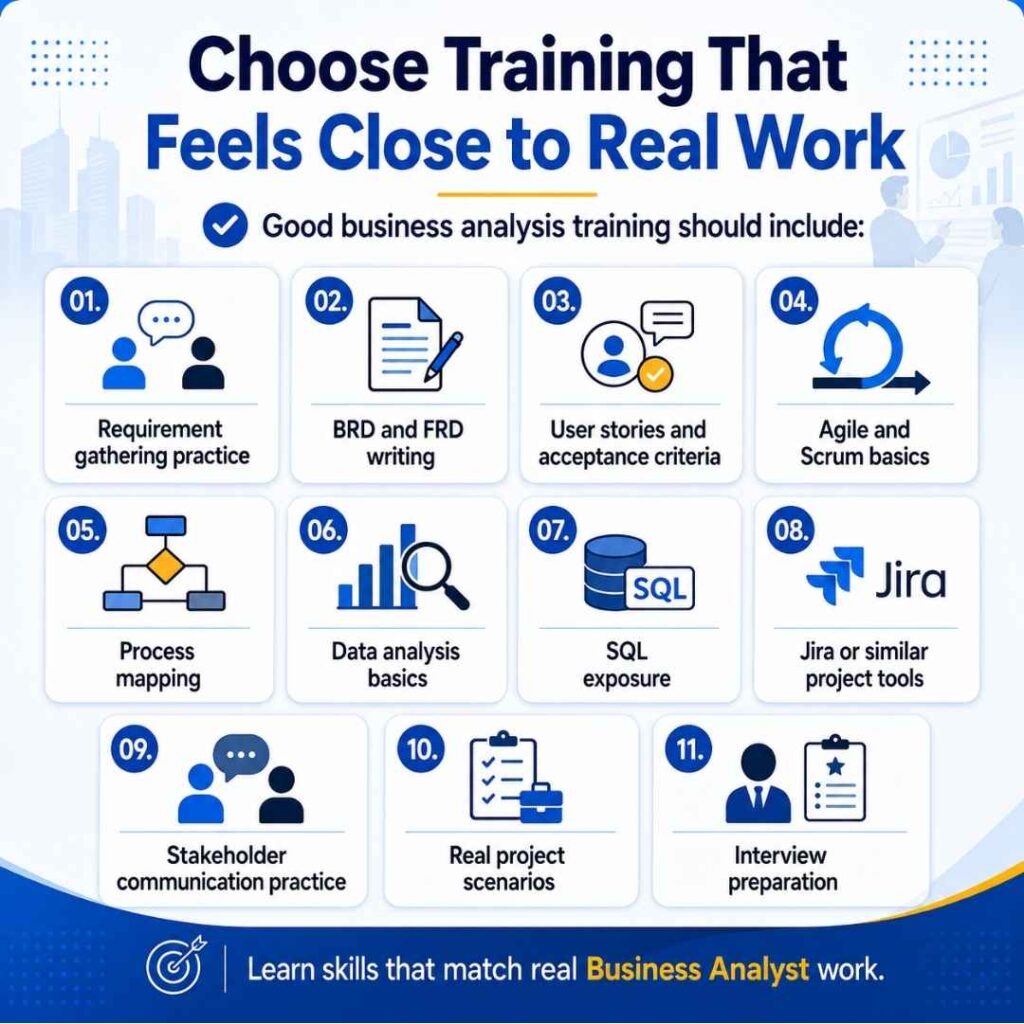
- Requirement gathering practice
- BRD and FRD writing
- User stories and acceptance criteria
- Agile and Scrum basics
- Process mapping
- Data analysis basics
- SQL exposure
- Jira or similar project tools
- Stakeholder communication practice
- Real project scenarios
- Interview preparation
If you are learning while working full-time, business analysis online training may be easier to manage. Look for live sessions, recorded access, assignments, mentor review, and project-based learning. Passive video watching is rarely enough.
For beginners, ba training and placement support can also be helpful when it includes resume preparation, mock interviews, LinkedIn profile guidance, and realistic project explanations. Just be careful with any program that promises a job without testing your Business Analysis Skills. Placement support is useful. Skill is still the thing that gets you through the interview.
Build a Small Portfolio – Business Analysis Skills
A Business Analysis Skills portfolio does not need to be fancy. It needs to show that you can think like a Business Analyst.
Create two or three sample case studies. For example:
Case Study 1: Food Delivery App Refund Process
Include a problem statement, stakeholders, current-state process, pain points, future-state process, sample user stories, and acceptance criteria.
Case Study 2: CRM Lead Management Improvement
Show how duplicate leads are created, how sales reps handle follow-ups, what data fields are missing, and what solution could improve conversion tracking.
Case Study 3: Employee Leave Management System
Add business rules, approval workflows, exception cases, reporting needs, and non-functional requirements.
This gives you something concrete to discuss in interviews. Instead of saying, “I know requirements gathering,” you can say, “In my sample CRM project, I identified duplicate lead creation as a process issue and wrote user stories to support validation rules.”
That sounds much stronger.
Practice Interview Scenarios Early
Many BA candidates wait until the end of training to prepare for interviews. That is a mistake.
Start early. Practice answering questions like:
How do you handle unclear requirements?
A strong answer should mention stakeholder interviews, follow-up questions, documentation, assumptions, validation, and sign-off.
What is the difference between BRD and FRD?
Explain it simply. BRD focuses on business needs and objectives. FRD describes functional behavior the system must support.
How do you manage conflicting stakeholder priorities?
Talk about business value, impact, urgency, data, trade-offs, and decision ownership.
How do you write acceptance criteria?
Use clear, testable conditions that confirm when a user story is complete.
Do not memorize robotic answers. Interviewers can hear that. Use project examples, even if they are practice projects.
Keep Learning After Your First BA Job
Career growth in business analysis does not stop after landing the first role. In fact, the first role is where the real learning begins.
Once you are working, start building depth in one or two areas:
- Product ownership
- Data analytics
- Process improvement
- Cybersecurity analysis
- Compliance and risk
- AI workflow analysis
- ERP or CRM systems
- Banking, healthcare, retail, insurance, or logistics domain knowledge
IIBA’s 2025 report found that business analysis is increasingly viewed as a strategic force, with 76% of respondents saying its impact is growing and 81% reporting formal recognition of the role in their organizations. That means the BA career path is not limited to junior analyst work. With experience, you can move toward Senior Business Analyst, Product Owner, Product Manager, Consultant, Business Architect, Data Analyst, or Program-level roles.
The people who grow fastest usually do three things well: they understand business deeply, communicate clearly, and keep updating their skills.
FAQs
1. What are business analysis skills?
Business Analysis skills are the abilities used to understand business problems, gather requirements, analyze processes, work with stakeholders, and help teams create better solutions.
2. How can I start learning business analysis?
You can start by learning requirement gathering, user stories, process mapping, Agile basics, data analysis, and communication skills. Joining structured business analysis training can make the learning process easier.
3. Do I need coding to become a Business Analyst?
No, coding is not required for most Business Analyst roles. However, basic knowledge of SQL, data tools, and how software projects work can be very helpful.
4. Is business analysis online training useful?
Yes, business analysis online training is useful if it includes live classes, real-time projects, assignments, tools like Jira, and interview preparation. It is also a good option for working professionals and students who need flexible learning.
5. What tools should a Business Analyst learn?
A beginner Business Analyst can start with Excel, Jira, Confluence, Draw.io, Lucidchart, SQL basics, and Power BI or Tableau basics.
Final Thought
Business analysis is a career skill set that rewards curiosity, structure, communication, and practical problem-solving. You do not need to know everything on day one. You do need to start practicing the real work: asking better questions, writing clearer requirements, mapping processes, reading data, and understanding how business decisions turn into working solutions.
The right Business Analysis Skills can shorten the learning curve. A strong business analysis online training program can help if you need flexibility. For learners who want a more guided path, H2K Infosys can be a practical choice because it connects BA concepts with real project-style learning and career-focused support. And a reliable BA training and placement path can support your job search when it is built around real projects, not empty promises.
Start small. Pick one business problem. Map it. Write the requirements. Define the users. Think through the edge cases. That is how Business Analysis Skills are built not by memorizing terms, but by practicing how businesses actually change.