Agile Scrum Master Certification is a professional credential that demonstrates a person’s understanding of Agile principles, Scrum practices, and the responsibilities of a Scrum Master. It can help professionals develop the knowledge and skills needed to support Scrum teams, facilitate Scrum events, remove impediments, and encourage continuous improvement.
Agile and Scrum are widely used in project and product development because they help teams respond to changing requirements, collaborate effectively, and deliver value incrementally. A Scrum Master plays an important role in helping teams understand and apply the Scrum framework effectively.
What Is Agile Methodology?
Agile methodology is an approach to project and product development that focuses on flexibility, collaboration, continuous feedback, and delivering value in smaller increments. Instead of following a fixed plan from beginning to end, Agile teams regularly review requirements and adapt their work based on customer feedback and changing business needs.
Agile encourages cross-functional teams to work collaboratively, make decisions quickly, and continuously improve the product or process. It is widely used in software development and other industries where requirements can change throughout a project.
Some key principles of Agile include:
- Responding to changing requirements
- Delivering work in smaller increments
- Continuous customer and stakeholder feedback
- Collaboration between cross-functional teams
- Regular improvement of processes and products
- Frequent delivery of valuable outcomes
What Is the Agile Scrum Framework?
Scrum is one of the most widely used frameworks within Agile. It provides a structured approach for teams to manage complex projects through short development cycles called Sprints.
The Scrum framework defines key roles, events, and artifacts that help teams organize their work, collaborate effectively, gather feedback, and continuously improve. Although Scrum is commonly associated with software development, its principles can also be applied to different types of projects and business environments.
A Scrum Team typically works together toward a common goal, with the Scrum Master helping the team understand and apply Scrum effectively.
You can learn more about the Agile Scrum framework to understand how Scrum works in real-world projects.
What Is Agile Scrum Master Certification?
Agile Scrum Master Certification validates a professional’s knowledge of Agile principles, Scrum practices, and the responsibilities associated with the Scrum Master role.
Certification programs generally cover important Scrum concepts such as roles, events, artifacts, Sprint planning, team collaboration, facilitation, and continuous improvement.
A Scrum Master does not simply assign tasks or manage employees. Instead, the Scrum Master supports the team by facilitating Scrum practices, helping remove obstacles, encouraging collaboration, and creating an environment where the team can work effectively.
For beginners and professionals moving into Agile environments, certification can provide a structured way to learn Scrum and demonstrate foundational knowledge.
What Does a Scrum Master Do?
A Scrum Master helps the Scrum Team understand and apply Scrum effectively. The role focuses on facilitation, coaching, collaboration, and continuous improvement.
Common Scrum Master responsibilities include:
- Facilitating Scrum events such as Sprint Planning, Daily Scrum, Sprint Review, and Sprint Retrospective
- Helping remove obstacles that affect the team’s progress
- Supporting communication and collaboration within the team
- Encouraging continuous improvement
- Helping team members understand Scrum principles and practices
- Supporting the Product Owner and development team
- Promoting an Agile mindset
- Helping the team become more self-managing
Strong communication, facilitation, leadership, and problem-solving skills are important for performing these responsibilities effectively.
Introduction to Certified ScrumMaster (CSM)
The Certified ScrumMaster (CSM) is one recognized certification option for professionals interested in developing their Scrum knowledge and pursuing Scrum-related roles.
A CSM program introduces learners to Scrum principles, roles, events, artifacts, and the responsibilities of a Scrum Master. It can provide a structured learning experience for people who are new to Scrum as well as professionals who want to strengthen their existing knowledge.
There are also other Scrum Master certification options available from different organizations. Therefore, professionals should compare the certification provider, course requirements, examination process, renewal requirements, cost, and learning objectives before selecting a program.
You can also explore Agile Scrum courses online to develop your understanding of Agile and Scrum practices.
What Are the Prerequisites for Scrum Master Certification?
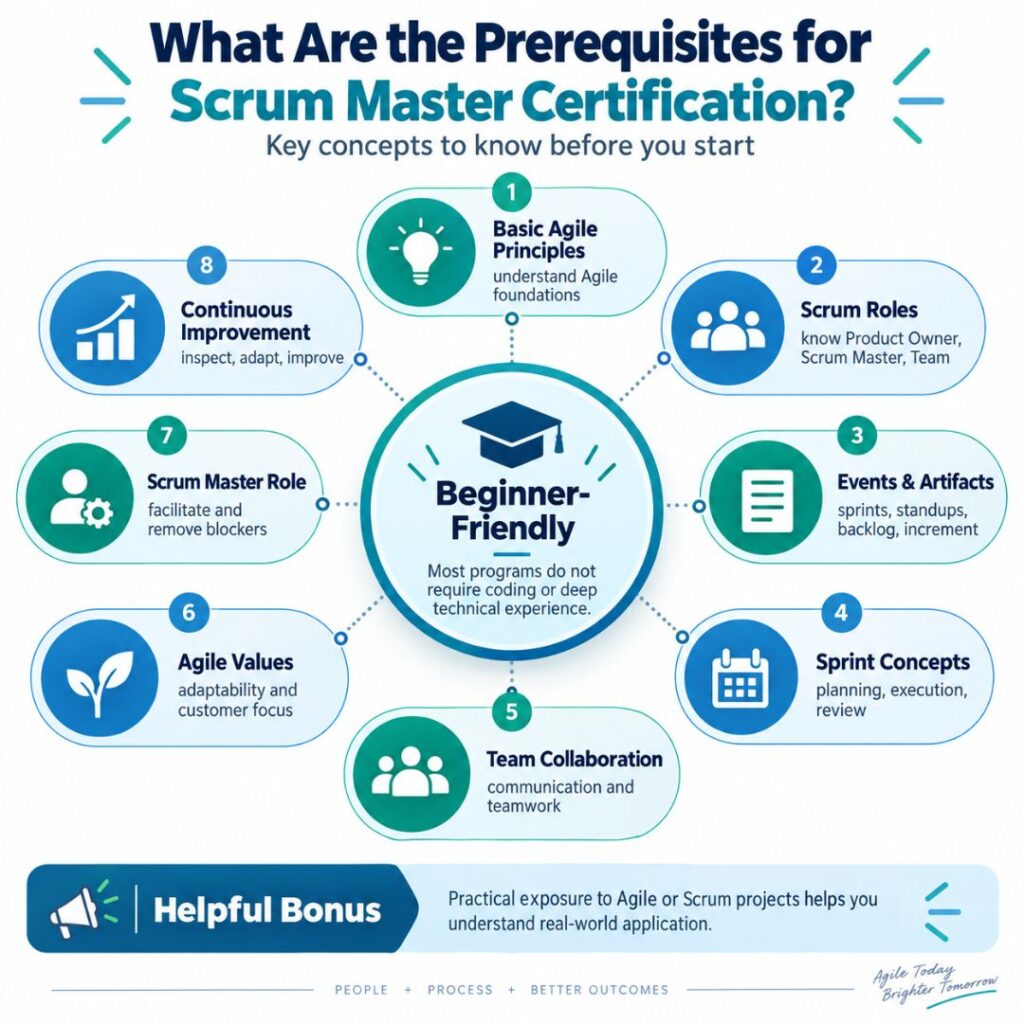
Prerequisites vary depending on the certification provider. Many Scrum Master certification programs are designed for beginners and do not require extensive technical or programming experience.
Before starting a certification program, it is helpful to understand:
- Basic Agile principles
- Scrum roles and responsibilities
- Scrum events and artifacts
- Sprint concepts
- Team collaboration
- Agile values
- The role of a Scrum Master
- Continuous improvement
Practical exposure to Agile or Scrum projects can also help you understand how Scrum practices are applied in real-world situations.
Note: Specific course, examination, question-count, passing-score, and language requirements can vary by certification provider. If you retain the original CSM examination details in this article, verify them against the current official certification requirements before publishing.
What Skills Does a Scrum Master Need?
Certification provides foundational Scrum knowledge, but successful Scrum Masters also need practical and interpersonal skills.
Communication
Scrum Masters regularly interact with team members, Product Owners, stakeholders, and other professionals. Clear communication helps teams understand goals and resolve issues.
Facilitation
A Scrum Master facilitates Scrum events and helps teams conduct productive discussions and meetings.
Problem-Solving
Scrum Masters help teams identify obstacles and work toward practical solutions.
Leadership
The Scrum Master role requires leadership through guidance, coaching, and support rather than simply assigning work.
Conflict Resolution
Teams can experience disagreements or communication challenges. A Scrum Master helps create an environment where issues can be addressed constructively.
Agile Mindset
A Scrum Master should understand the importance of flexibility, collaboration, feedback, and continuous improvement.
Benefits of Agile Scrum Master Certification
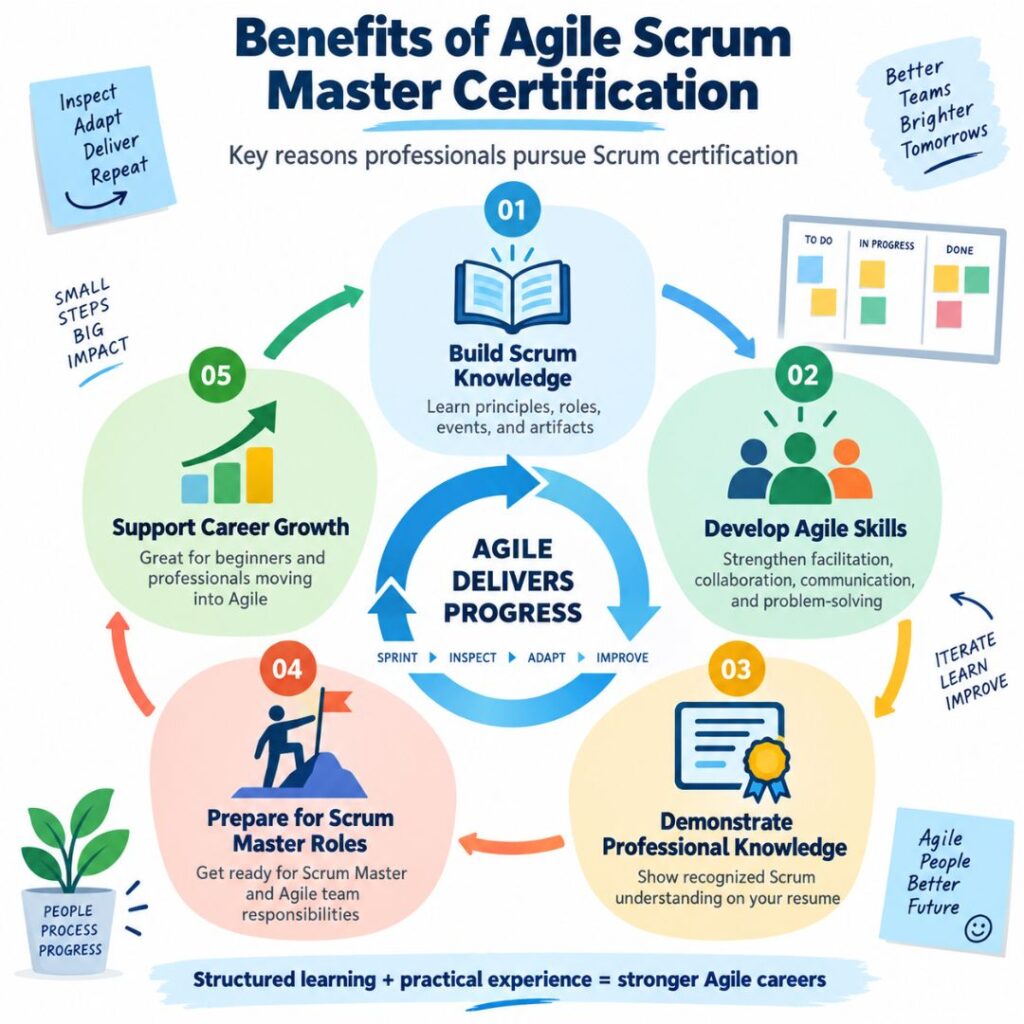
An Agile Scrum Master Certification can be useful for professionals who want to build their knowledge of Scrum and Agile practices.
1. Build Scrum Knowledge
Certification preparation helps you understand Scrum principles, roles, events, artifacts, and common team practices.
2. Develop Agile Skills
Learning Scrum can help strengthen skills related to facilitation, collaboration, communication, problem-solving, and continuous improvement.
3. Demonstrate Professional Knowledge
A recognized certification can demonstrate your foundational understanding of Scrum when updating your resume or discussing your skills with potential employers.
4. Prepare for Scrum Master Roles
Certification combined with practical experience can help prepare professionals for responsibilities associated with Scrum Master and other Agile-related positions.
5. Support Career Growth
For beginners and professionals transitioning into Agile environments, certification provides a structured way to develop Scrum knowledge and complement hands-on experience.
Agile Scrum Master Certification vs. Scrum Master Course
An Agile Scrum Master Certification and a Scrum Master course are related but not always the same.
A Scrum Master course primarily focuses on learning Scrum concepts, practices, tools, and responsibilities. A certification generally involves meeting the requirements of a certification provider and, depending on the provider, completing an assessment or examination.
Professionals can choose a course based on their learning needs and pursue certification when they want to demonstrate their knowledge through a recognized credential.
Is Agile Scrum Master Certification Worth It?
Agile Scrum Master Certification can be valuable for professionals who want to develop their understanding of Scrum and pursue Agile-related career opportunities.
It can be particularly useful for beginners, project professionals, Business Analysts, developers, testers, project coordinators, and professionals transitioning into Agile environments.
However, certification alone does not replace practical experience. Combining Agile Scrum training, certification, hands-on project experience, communication skills, and problem-solving abilities can provide a stronger foundation for a Scrum-related career.
How to Choose an Agile Scrum Master Certification
Before selecting a Agile Scrum Master Certification program, consider the following factors:
- Recognition of the certification provider
- Course content and learning objectives
- Certification requirements
- Examination process
- Training format
- Cost
- Renewal requirements
- Learning resources
- Practical learning opportunities
- Relevance to your career goals
Beginners should choose a program that explains Scrum fundamentals clearly and provides opportunities to understand how Scrum is applied in real-world situations.
Conclusion
Agile Scrum Master Certification can help professionals build a structured understanding of Agile principles, Scrum practices, and the responsibilities of a Scrum Master. While certification can demonstrate foundational knowledge, practical experience, communication skills, facilitation, and problem-solving are also important for success in an Agile environment.
For beginners, a combination of Agile Scrum training, certification preparation, and practical project experience can provide a strong foundation for pursuing Scrum Master and other Agile-related career opportunities.
FAQs about Agile Scrum Master Certification
Is Scrum Master certification suitable for beginners?
Yes. Many Scrum Master certification programs are designed for beginners and do not require extensive technical or programming experience.
Do I need coding skills to become a Scrum Master?
Coding is generally not a core requirement for a Scrum Master. However, understanding the software development process can be useful when working with technical teams.
What does a Scrum Master do?
A Scrum Master facilitates Scrum events, helps remove impediments, supports team collaboration, and promotes effective use of the Scrum framework.
What skills are important for a Scrum Master?
Communication, facilitation, leadership, problem-solving, conflict resolution, teamwork, and knowledge of Agile and Scrum are important skills.
Is CSM the same as Scrum Master certification?
CSM, or Certified ScrumMaster, is a specific Scrum Master certification. “Scrum Master certification” is a broader term that can refer to credentials offered by different certification organizations.