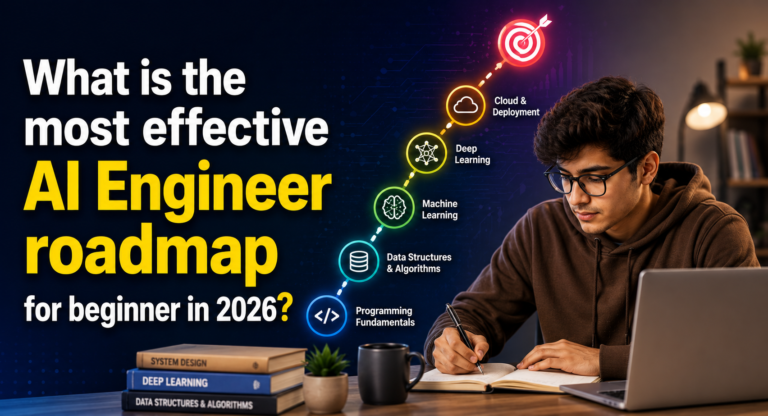
Starting at zero in 2026? The best AI Engineer roadmap is simple : learn strong fundamentals of programming and math, learn machine learning and deep learning, learn modern AI tools like LLMs and AI agents, work on real projects, and get industry-recognized training that prepares you for real job requirements, and not just theory.
There has been rapid growth in the AI industry over the last few years. Companies aren’t just hiring people who can build a neural network anymore. They are looking for engineers that can integrate AI into products, fine-tune foundation models, build AI agents, automate workflows, and scale applications. That’s a different skill set from what many older roadmaps still teach.
Here’s a walk through a roadmap that actually fits where the industry is headed in 2026.
One of the fastest-growing careers is AI engineering.
A few years back, AI was mostly in research labs and big tech companies. It’s all over the place today.
AI is used by banks for fraud detection. It is used in hospitals for analysing medical images. Recommendation systems are used by retailers. Manufacturers use predictive AI to optimise production. Even tiny startups are building products around generative AI.
The emergence of large language models has completely changed hiring expectations. Rather than asking if someone knows machine learning theory, employers are asking questions like:
- Yes I can build an AI chatbot for you.
- Can you plug an LLM into an application?
- Can AI agents drive workflows automation?
- Can you run an AI model on the cloud?
This is exactly why a modern AI Engineer roadmap 2026 needs to focus on practical application, not just academic concepts.
Step 1: Learn Python Really Good
Almost every AI Engineer roadmap starts their journey with Python.
This is not because Python is the “best” programming language for all situations. It’s because the entire AI ecosystem grew up around it.
Take the time to get comfortable with:
- Variables Functions Loops
- Object-Oriented Programming
- Error Handling
- File operations APIs
- Virtual worlds
- Git & Github
It’s surprising how many beginners jump into machine learning without a solid foundation in Python. Later on they find coding more of a struggle than AI itself.
Imagine Python as the foundation for your future career in AI.
Step 2: Build Mathematical Intuition
Here is something that scares the beginners a lot.
You don’t need a PhD in maths to become an AI Engineer.
What you do need is some intuition to understand why models behave the way they do.
Concentrate on:
- Linear Algebra Probability Statistics
- Basic calculus Concepts of optimisation
Visualise what the formulas mean instead of memorising them.
For instance, it’s much easier to understand gradient descent if you think of a ball rolling downhill to the lowest point, rather than staring at equations.
That mental picture is indelible.
Step 3: Master Data Management
The better the data used to train the AI models, the better the models will be.
You will spend far more time cleaning datasets than most tutorials admit.
Read:
- NumPy
- Pandas
- Data visualisation
- Data cleansing Feature extraction SQL
Real-world data are messy.
Data missing.
Same lines again.
Wrong labels.
Those problems are valuable skills to work through.
Step 4: Learn Machine Learning the Right Way
Now the exciting part starts.
Learn about supervised and unsupervised learning.
Cover algorithms such as:
- Linear Regression
- Logistic Regression
- Decision Trees
- Random Forest XGBoost K Means Support Vector Machines
More importantly, know this:
- Bias and variance
- Overfitting
- Validation cross
- Model assessment
- Hyperparameter Optimisation
A common mistake beginners make is trying to memorise every algorithm.
Instead, find out when each one is useful.
Step 5: Go Deep with Deep Learning
Today, most exciting applications of AI are powered by deep learning.
Learn frameworks such as:
- TensorFlow
- PyTorch
Know that:
- Neural Networks
- CNNs
- RNNs
- Transformers Transfer Learning
Transformers deserve special attention, because they now provide power to:
- Chatbots Translation
- Content creation
- Co-Pilots AI
- Coding assistants AI
Here is where training in modern AI Engineer roadmap gets very practical.
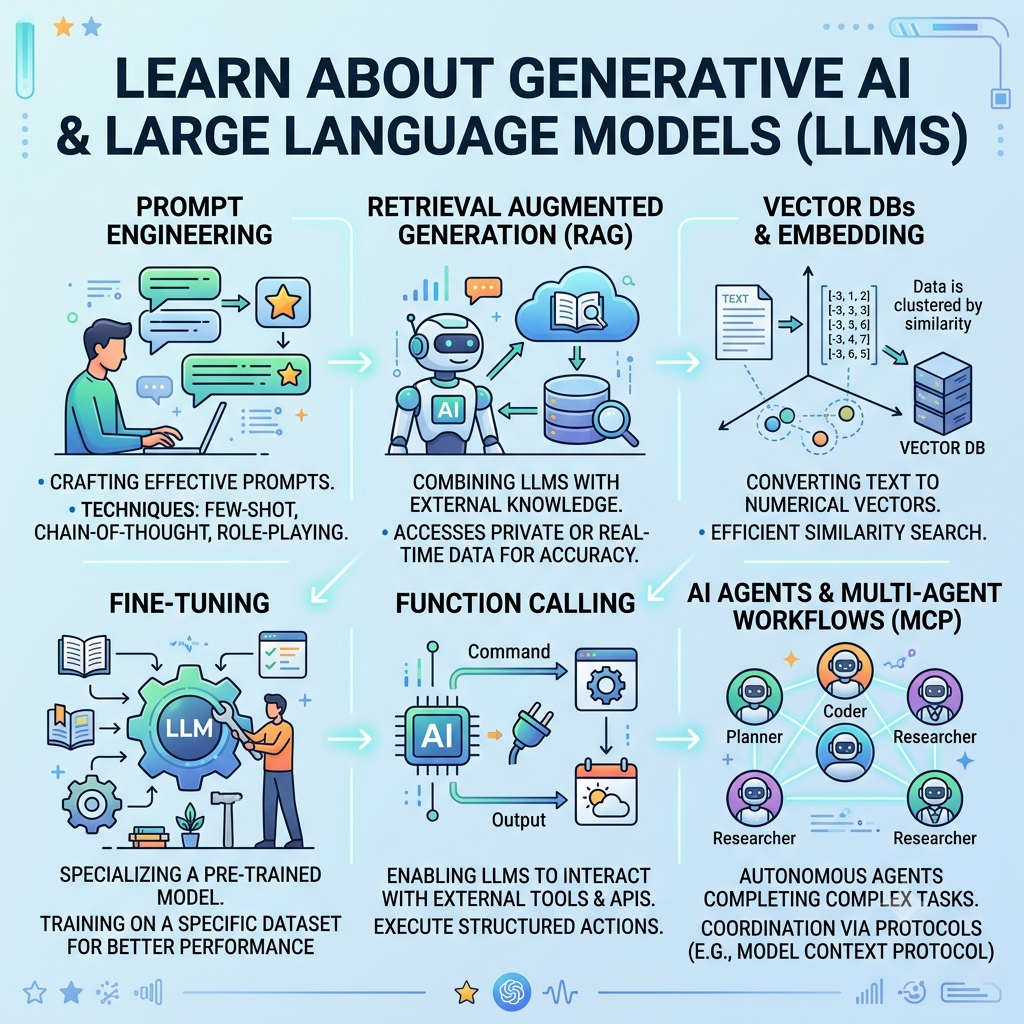
Step 6: Learn about Generative AI and Large Language Models
This step was barely there a few years ago.
Arguably it’s the most important part of becoming an AI Engineer now.
Focus on:
- Prompt Engineering Retrieval Augmented Generation (RAG)
- Vector DBs
- embedding
- Fine-tuning Function Calling
- Artificial Intelligence Agents
- Multi-agent workflows MCP (Model Context Protocol)
Companies increasingly expect engineers to build applications on top of foundation models rather than train everything from scratch.
If you’re learning AI in 2026, ignoring Generative AI is like learning web development without JavaScript.
Step 7: Understand MLOps and Cloud Deployment
Building a model isn’t enough.
Where you get business value is deploying it.
Learn:
- Docker Kubernetes essentials CI/CD MLflow
- FastAPI
- Azure AWS
- Google Cloud AI Application Monitoring
Often this is the difference between a portfolio project and a production-ready AI solution.
Step 8: Develop Real Projects
Tutorials do not teach lessons like projects do.
Try constructing:
- AI Resumè Analyser
- Medical Chat bot
- AI Customer Service Assistant
- Stock Prediction Dashboard
- Document Question Answering System
- AI Code Companion
- AI Voice Assistant Recommendation Engine
A single end-to-end built project is typically worth more than finishing ten separate online tutorials.
I still remember how much more I learned after hours of debugging an API integration than watching another “Complete AI Course” video. It’s frustrating in the moment but those experiences stick.
Step 9: Discover the AI Engineering Tools That Companies Use
Tools Modern AI Engineers should know:
- LangChain
- LangGraph
- LlamaIndex
- Huggingface
- OpenAPI APIs
- Ollama Docker Github Actions
- Weaviate ChromaDB Pinecone
These are becoming the norm across enterprise AI development.
Step 10: Be Prepared for Interviews
This is a stage that many beginners often underestimate.
In preparing for interviews you should:
- Python programming
- Machine Learning concepts
- Basics of Deep Learning
- Architecture of LLM
- Engineering Prompt
- Designing AI systems
- SQL Cloud fundamentals
- Type questions behavioural
Employers are increasingly asking candidates to explain design decisions, not just write code.
Why AI Engineers Need Structured Training
Self learning has never been easier, but it has a downside too: too much information.
There are thousands of tutorials, hundreds of AI tools, and a never-ending stream of new frameworks. Newbies often spend weeks jumping from YouTube videos to documentation and online forums with no real direction.
A structured AI Engineer roadmap is where you can really make a difference. A well planned curriculum covering python, machine learning, deep learning, generative AI, cloud deployment and real projects in a logical sequence. Instead of asking what to learn next, you can concentrate on building skills and getting experience.
H2K Infosys, for example, has updated its AI-focused programs to keep up with current industry expectations. The curriculum includes not only traditional machine learning but also generative AI concepts, large language models, AI agents, MLOps, cloud technologies, interview preparation, and project-based learning that mimics real-world workplace scenarios.
For career changers or those new to the field, having an instructor to coach you, a mentor to guide you, and realistic projects to work on can greatly reduce the time it takes to learn compared to trying to find random resources on your own.
How to Choose the Right AI Engineering Course
Not all AI Engineer roadmap courses are designed for the current hiring landscape. Don’t just look at the course title before you enrol, look at what you’ll actually learn.
A strong program should have:
- Python programming from the bottom up.
- Data analysis and visualisation
- Essentials of Machine Learning and Deep Learning.
- Generative AI, LLMs and Retrieval-Augmented Generation (RAG)
- Modern Orchestration Frameworks and AI Agents
- MLOps and deployment on the cloud.
- Capstone projects based on real business issues.
- Mock interviews, resume reviews & career help.
Generally, courses that combine technical depth with practical implementation are more valuable than those that are lecture or theory focused.
Common Mistakes Newbies Make
I’ve noticed a common behaviour among people who are new to AI. They will usually:
- Jump straight into advanced deep learning without learning Python.
- Watch endless tutorials without building any projects.
- Forget git and version control.
- Forget MLOps and deployment.
- Concentrate on certificates instead of demonstrable skills.
- Don’t chase every new AI framework to learn core concepts.
The AI ecosystem moves fast, but the fundamentals turn out to be surprisingly stable.
12-Month AI Engineer Roadmap for 2026: A Practical Guide
Here’s a realistic timeline for someone learning consistently:
- Areas Months
- 1–2 Python, Git, SQL, Problem Solving
- 3–4 Statistics, NumPy, Pandas, data visualisation
- 5-6 Machine Learning Algorithms and Applications
- 7–8 Deep Learning with TensorFlow or PyTorch
- 9–10 LLMs, RAG, AI agents, Gen AI
- 11 MLOps, cloud deployment, APIs
- 12 Portfolio polishing, interview prep, job applications
The exact speed will vary, but a structured sequence helps prevent gaps that can become obstacles down the road.
What is the best AI Engineer roadmap for beginners in 2026?
The best AI Engineer roadmap in 2026 starts with learning Python, basic mathematics, and data handling, followed by machine learning, deep learning, generative AI, large language models (LLMs), AI agents, MLOps, cloud deployment, and hands-on projects. A structured learning path combined with real-world experience is the fastest way to become job-ready.
How long does it take to become an AI Engineer?
For most beginners, it takes 9 to 12 months of consistent learning and project work to build the skills needed for entry-level AI Engineer roles. The timeline depends on your background, learning pace, and how much time you dedicate each week.
What skills are companies looking for in AI Engineers in 2026?
Employers are looking for professionals who can build and deploy AI applications using machine learning, deep learning, Generative AI, LLMs, Retrieval-Augmented Generation (RAG), AI agents, cloud platforms, APIs, and MLOps tools. Strong programming skills and practical project experience are equally important.
What is the difference between AI Engineer training and self-learning?
Self-learning offers flexibility but often lacks structure and mentorship. AI Engineer training programs typically provide a guided curriculum, instructor support, hands-on projects, interview preparation, and career assistance, making it easier for many beginners to stay on track and become job-ready.
What tools should every AI Engineer learn in 2026?
Some of the most valuable tools include:
Python
Pandas
NumPy
Scikit-learn
TensorFlow
PyTorch
Hugging Face
LangChain
LangGraph
LlamaIndex
Docker
Git & GitHub
FastAPI
MLflow
AWS, Azure, or Google Cloud
Learning these tools will prepare you for modern AI engineering workflows.
The Bottom Line
The best AI Engineer roadmap 2026 is not about trying to learn every new AI tool coming out. It’s about building a strong foundation, learning from real-world projects, understanding how modern AI systems are built and staying adaptable as the technology evolves.
If you’re serious about getting into the field, a structured AI Engineer training program can save you months of trial and error with a guided path, mentorship and hands-on experience. Programs like H2K Infosys are built on the foundation of what current employers expect, with Python, machine learning, generative AI, MLOps, cloud technologies, and career support all part of the same learning journey.
The trick is to be consistent, whether you decide to study on your own, get formal training, or a mix of both. Develop projects, learn more from real-world applications and solve real-world problems. It’s those habits, not just the certifications, that will ultimately prepare you for a thriving AI engineering career in 2026 and beyond.