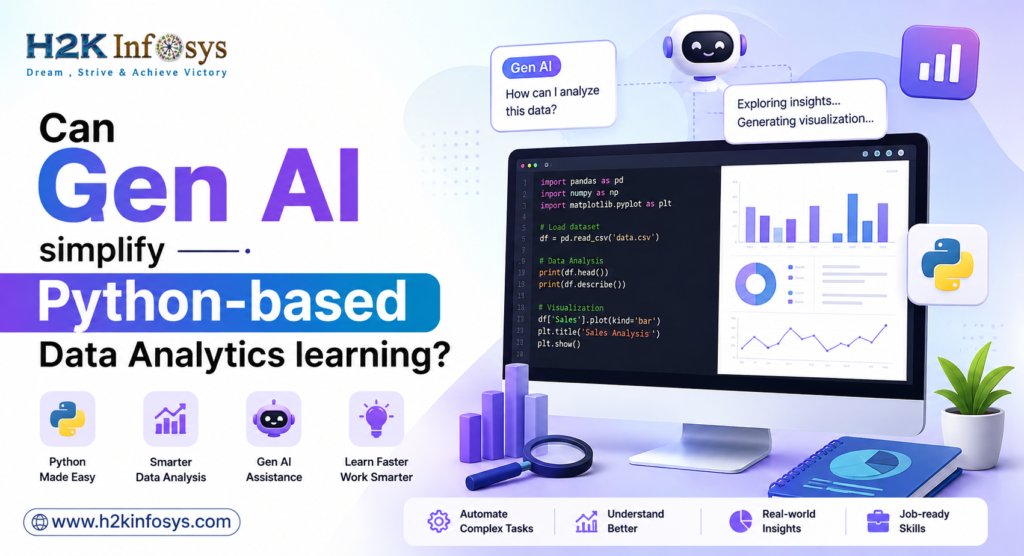
Yes, Artificial Intelligence Courses are worth it in 2026 but only if you choose a course that will help you use and build with AI and not just memorise AI terminology. With AI training, learners can establish a basis for careers in future technology, while an AI course for working professionals may help add AI skills to an existing career.
The bigger question isn’t really “Should I learn AI?” anymore.
“What type of AI skills will be really useful in the job that I want?”
And that’s a much better question to be asking.
The Significance of Artificial Intelligence Skills in 2026
AI is far beyond the experimental stage.
It’s being used by companies for software development, customer support, data analysis, content workflows, automation, fraud detection, forecasting and decision making. Meanwhile, employees are being asked to understand how AI fits into the jobs they already have.
The World Economic Forum’s Future of Jobs Report 2025 identified AI and big data as the fastest growing skill category for 2025–2030. It also includes Machine Learning and AI Specialists in its list of the fastest growing jobs.
And here is an important detail.
Learning AI doesn’t mean you become a machine learning researcher.
For example, a software tester might generate test cases using AI.
Standard artificial intelligence can be used by a business analyst to analyse requirements and documents.
Developers could build applications around large language models.
Marketing pros could automate research and content workflows .
The value of Artificial Intelligence training depends a lot on how you plan to use it.
Are AI Courses Worth It For Students
Yes, I would say that for students but don’t take an advanced Artificial Intelligence Courses because AI is hot right now.
Then build the foundation.
Ideally, a student contemplating a career in AI should become comfortable with:
- Programming in Python
- Elementary statistics and mathematics
- Data processing
- Basics of machine learning
- Deep learning ideas
- Natural Language Processing (NLP)
- Generative AI & LLMs
- Model assessment
- Responsible AI and AI Ethics
- Development of real-world projects
There is a simple reason for this: AI tools change very quickly.
The basics don’t change.
The model or framework that is popular today may be entirely different a few years down the road. But knowing how data is prepared, how models learn, how to evaluate results and how to translate a business problem into a technical solution, is still useful.
That combo, fundamentals + current tools + projects, in my opinion is much more valuable than collecting certificates.
How About Working Professionals?
Now here is where it gets really interesting.
Suppose you are already employed as a:
- Software developer
- Software QA Engineer
- Data Analyst.
- Business analysis
- IT Manager Project Manager
- Operations Specialist – Marketing Professional
You don’t have to leave your current career and start from scratch.
Instead you can bring AI into what you already know.
For example, a QA professional may learn testing and automation with AI. “Someone could become an AI application developer. machine learning and predictive analytics may be included by a data analyst.
That explains why an Artificial Intelligence Courses for working professionals may be justified if the curriculum is flexible and practical.
The World Economic Forum estimates that 39% of workers’ skillsets may be redefined or obsolete between 2025 and 2030. It also says half of employers say they will respond to AI by changing their businesses, and two-thirds say they will hire people with specific AI skills.
So upskilling isn’t just about chasing a new job title. In many cases it’s about staying useful in the job you have.
What Is a Good Artificial Intelligence Course Worth the Money?
This is where I would be careful.
There are hundreds of AI courses out there today. Some are really great. Some are pretty much a bunch of recorded videos and a certificate at the end.
A good program should answer “What can I actually do after I finish this?”
Search for:
1. Fundamentals of Machine Learning and Strong AI
You need to know the difference between:
Artificial intelligence, machine learning, deep learning, generative AI, large language models.
You don’t have to become a mathematician overnight, but you do need to know what’s going on under the hood.
2. Python and Data Skills
For machine learning and artificial intelligence, Python remains one of the best languages to use.
You should get hands-on experience with tools like NumPy, Pandas, and machine-learning libraries instead of just watching someone else code.
3. Practice Projects
This is a big one.
“A project is something concrete you can mention in an interview.
Instead of saying:
I took an AI cert.
You can say this:
I built a customer churn prediction model and evaluated it and explained why I chose that approach.”
Now that’s a much more powerful conversation.
4. Generative AI and LLMs
And I would also expect a modern AI curriculum in 2026 to cover some of the following:
- Prompt engineering Basics of LLM
- AI APIs
- RAG
- Vector database
- AI agents
- Developing AI applications
- Deployment concepts Responsible AI
These don’t replace fundamentals, however. They’re the next level up.”
Why You Should Choose H2K Infosys
If your first priority is a career-oriented Artificial Intelligence training course and not only theory then, H2K Infosys is one of the options to look for.
Its current Artificial Intelligence program is a 75-hour course covering topics such as Python, machine learning, deep learning, neural networks, NumPy, MLOps and LLMOps. The program also features a strong emphasis on live instructor-led training, project-based learning, cloud lab access, recorded sessions and career support.
H2K Infosys Artificial Intelligence Training Test
What I particularly like about this sort of structure is the focus on doing something with the concepts.
H2K Infosys also has a separate Generative Artificial Intelligence Courses that covers topics like Prompt Engineering, LLMs, OpenAI API, Hugging Face, LangChain, LlamaIndex, RAG, vector databases and Agentic AI along with real-time projects and career preparation.
Learn More H2K Infosys Generative AI Training
That distinction matters because someone who wants to become an AI application developer may need a slightly different learning path than someone who just wants to know how to use AI tools in the workplace.
Is H2K Infosys Good for Fresher?
This can be particularly helpful for learners who prefer a structured path instead of piecing together dozens of random tutorials.
H2K Infosys says its AI program is for beginners and IT professionals and includes live online classes, recorded training, hands-on projects, access to cloud labs, mock interviews, resume preparation and placement assistance.
That structure can solve a very common problem for a newbie.
“I want to study AI, but I don’t know where to begin.
That said, don’t believe everything a training provider tells you. Sign up for the demo, go over the curriculum, ask about the projects you will be working on, and ensure the schedule fits your lifestyle.
That’s a far more intelligent way of choosing a course.
Can AI be studied by working professionals without quitting their jobs?
Absolutely.
In fact, I would say that most professionals do not leave their job to learn AI unless they have a very specific reason to do so.
A better way to do this is to spend a few hours a week learning, and immediately applying what you’re learning to realistic problems.
For instance:
QA Specialist:
Learn Python → basics of machine learning → testing AI → automation → testing projects with AI.
Software engineer:
Learn basics of Python/AI → APIs → LLMs → RAG → agents → AI app dev.
Business analyst :
AI basics → prompting → data analysis → AI-assisted requirements analysis → automation.
Data analyst:
Learn Python → statistics → machine learning → predictive modelling → GenAI-aided analytics.
This is where an AI course for working professionals may really help – you’re not learning in isolation. You are linking new skills to experience you already have.
AI Training Is More Than Just Getting an AI Job
This point is often missed.
You can pay off AI training without becoming a “AI Engineer.”
AI is becoming an added layer on top of existing jobs
Recent analysis from the World Economic Forum also points to a future with humans and AI working together, with humans taking on more roles to define problems, place constraints, evaluate outputs and make final decisions.
So there could be value in becoming:
“A software engineer who is AI savvy.”
instead of just:
“Someone who took an Artificial Intelligence Courses.”
These two profiles are quite different.”
The first one has a professional identity and an additional capability.
So what is the outlook for AI jobs in 2026?
There’s real opportunity but I wouldn’t sell the idea that an Artificial Intelligence Courses certification automatically guarantees a job.
The market is becoming more skills focused.
The World Economic Forum’s 2025 report lists the fastest-growing roles through 2030 as Big Data Specialists, Machine Learning and AI Specialists, Software and Application Developers, and FinTech Engineers.
Its 2026 analysis, meanwhile, points to a growing shortage of AI critical skills and says AI skills are increasingly valuable in hiring. One analysis cited by the Forum found that UK job postings requiring AI skills had a significant advertized salary premium though this should not be interpreted to mean every learner or every country would be guarantyd to reach that salary.
The conclusion is pretty simple:
Companies need AI capability, but they need people who can use it.
What To Look For Before Joining An AI Training
Questions to Ask Before Paying for any Artificial Intelligence Courses
Yes, there are projects in the course.
If all is happening in slides and lectures, be careful.
Are the classes live or are they recorded?
Learning can be quite easier for beginners and working professionals with an instructor at hand.
Does the curriculum include cutting-edge artificial intelligence (AI) technologies?
A modern course must cover more than just old-school machine learning and, where relevant, explain the current GenAI/LLM ecosystem.
Will you create a portfolio?
In an interview, your GitHub projects, demos, and your ability to explain what you built can be more useful than a certificate sitting in a folder.
Interview preparation?
Resume guidance, mock interviews, and technical interview practice can be particularly helpful to career changers.
Is this schedule logical?
This is boring, I know. But important.
Little use finding the “perfect” class if you can’t get there regularly.
H2K Infosys: The Real Deal for Career-Oriented Students
There are several reasons to consider H2K Infosys for someone who is specifically looking for Artificial Intelligence training with a career-oriented approach.
Its current AI training page states:
- Instructor-led Live Sessions
- Practical projects
- Access of cloud test lab
- Training access logged
- Practice interviews
- Writing a resume
- “Career/placement help
- AI, machine learning, and deep-learning topics
And if you are particularly interested in Generative AI, H2K Infosys GenAI program delves deeper into LLMs, RAG, AI agents, APIs, and modern AI application development.
Explore H2K Infosys and check out the latest Artificial Intelligence Courses Details
Recommend taking the free demo before signing up. You’ll have a much better idea of the teaching style, and whether the curriculum is aligned with your actual career goal.
So, Are Artificial Intelligence training Courses Valuable?
Yes, but the course is not the investment. The skills you learn are
AI training can offer students a solid technical background and the opportunity to work on projects before they join the job market.
The right AI course for working professionals may help working professionals to convert their existing industry knowledge into an AI-enabled career profile.
And for those changing careers, organised Artificial Intelligence Courses can cut down on the confusion that comes with trying to learn everything from random tutorials.
Only, don’t go chasing the certificate.
- Know the fundamentals.
- Create projects.
- Use current AI tools.
- Know where standard artificial intelligence can go wrong.
- Learn to communicate your work.
- and connect AI skills to a real business problem.
That is all the employer can see.
For a structured, hands-on approach, H2K Infosys is the right choice for you. Especially if live training, practical projects and career support are important for you. Start with the demo, then read through the curriculum to see if it aligns with your goals.
Is Artificial Intelligence worth learning for freshers?
Yes, if the course teaches you the fundamentals, practical projects and a portfolio, not just a certificate.
Can AI be learnt by non-IT professionals?
Yes. The right starting point depends on the role you want Some AI applications need programming, others are more about AI tools, automation, analytics and domain knowledge.
Is AI course useful for working professionals?
Yes The best strategy is often to combine your current professional skills with AI, rather than starting your career from scratch.
Does H2K Infosys offer AI training for freshers?
H2K Infosys says its Artificial Intelligence Courses program is good for beginners and IT professionals and includes hands-on training and career support.
Should I go for AI training or Generative AI training?
If you are an absolute beginner, start with the fundamentals of machine learning and artificial intelligence. If you are already familiar with the core concepts and looking to develop applications using modern LLM technology then a Generative AI focused path might be appropriate. H2K Infosys currently offers both the options.
What is the biggest mistake people make learning AI?
Learning every new tool without building a solid foundation and doing practical projects. Collecting tools is not a sustainable strategy in the face of the velocity of AI.