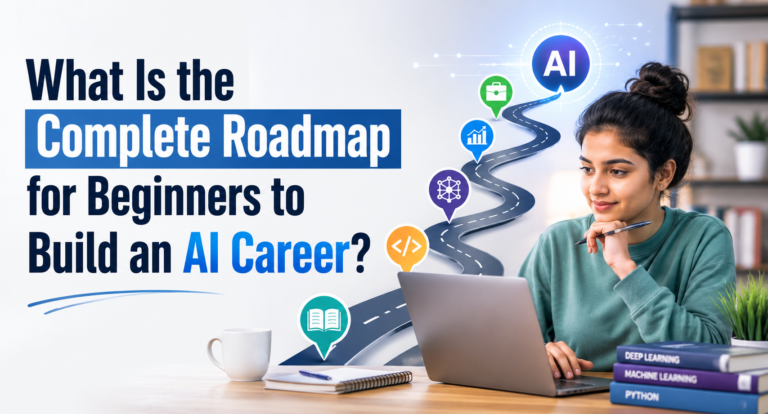
AI career is one of the hottest fields today, but you don’t need a computer science degree or years of coding experience to get started. The Right AI Roadmap for Beginners to Build an Roadmap for Beginners to Build an AI Career starts with sound fundamentals, practical projects, hands-on tools and structured Roadmap for Beginners to Build an AI Career that walks you through the process of building job-ready skills, step-by-step.
AI is not a passing fad anymore; it is a core competency for industries. Businesses in all industries, from healthcare and finance to manufacturing, retail, education and more, are looking for professionals who understand Roadmap for Beginners to Build an AI Career, and how to use it to solve real business problems. The biggest challenge is not the lack of opportunities if you start from zero. It’s knowing where to start.
In this guide, we’ll walk you through a realistic Roadmap for Beginners to Build an AI Career, what skills you’ll need to have to get hired in 2026, and how structured learning programs such as the ones offered by H2K Infosys can help you accelerate your journey.
This guide provides a comprehensive roadmap for beginners to build an Roadmap for Beginners to Build an AI Career and succeed in this dynamic field.
Why AI Is One of the Best Career Choices in 2026?
Until a few years agoRoadmap for Beginners to Build an AI Career was mainly confined to research labs and big tech companies. That’s a lot different.
“Now, companies of all sizes are using Roadmap for Beginners to Build an AI Career to run their day-to-day activities. Customer service teams employ AI assistants. Machine learning for marketing teams to analyse customer behaviour Predictive analytics is critical to healthcare organisations. Financial institutions employ smart algorithms to spot fraud.
GenerativeRoadmap for Beginners to Build an AI Career has also altered workplace expectations. Employers want candidates who understand large language models, Roadmap for Beginners to Build an AI Career and prompt engineering not just software development.
From my conversations with hiring managers and my review of job postings, I’ve noticed companies moving away from “Can you code Roadmap for Beginners to Build an AI Career?” to “Can you solve business problems with AI?” That makes a big difference for beginners, because real-world experience is often just as important as technical theory.
Step 1: Understand What AI Actually Is
Before you dive into machine learning models or neural networks, step back and get the big picture.
Artificial Intelligence is a general term for the set of technologies that allow computers to perform tasks that normally require human intelligence.
There are locations such as:
- Machine Learning
- Deep Learning
- Natural Language Understanding (NLU)
- Computer Vision
- Generative AI
- AI Automation Robotics
You don’t have to learn everything at once.
AI is like learning medicine you learn the human body then go on to specialise in cardiology or neurology.
Step 2. Build Core Technical Skills
Every great Roadmap for Beginners to Build an AI Career starts with core technical foundations.
Start learning Python
Python continues to be the go-to language for building Roadmap for Beginners to Build an AI Career, thanks to its ease of learning and near-universal support in all major AI frameworks.
Concentrate on:
- Variables Functions Loops
- Object Orientated Programming
- File manipulation APIs
You don’t have to be a programmer expert in a flash.
Learn Mathematics (Without Making It Difficult)
A lot of beginners hear “AI needs advanced maths” and lose confidence immediately.
The truth?
All you have to know how to do is:
Linear algebra Probability Statistics Basic calculus
Once you start building projects, these concepts make a lot more sense.
Learn to handle data
AI is data hungry.
Exercise:
SQL Excel Data Cleaning Data Visualisation Panda NumPy
If you’ve ever cleaned up messy spreadsheet data, you’ve done a simplified version of what data professionals do every day.
Step 3: Learn the Basics of Machine Learning
Now things get more interesting.
Let us start with supervised learning.
Classification Regression
Then find out:
- Decision Trees
- Random Forest Support
- Vector Machines
- Clustering Recommendation Systems
It’s not about learning algorithms by rote.
No, you understand:
- When each algorithm is running
- Why it was chosen
- Its ups and downs
Employers are looking for candidates who can explain why they used a model, not just ones who say they used a model.
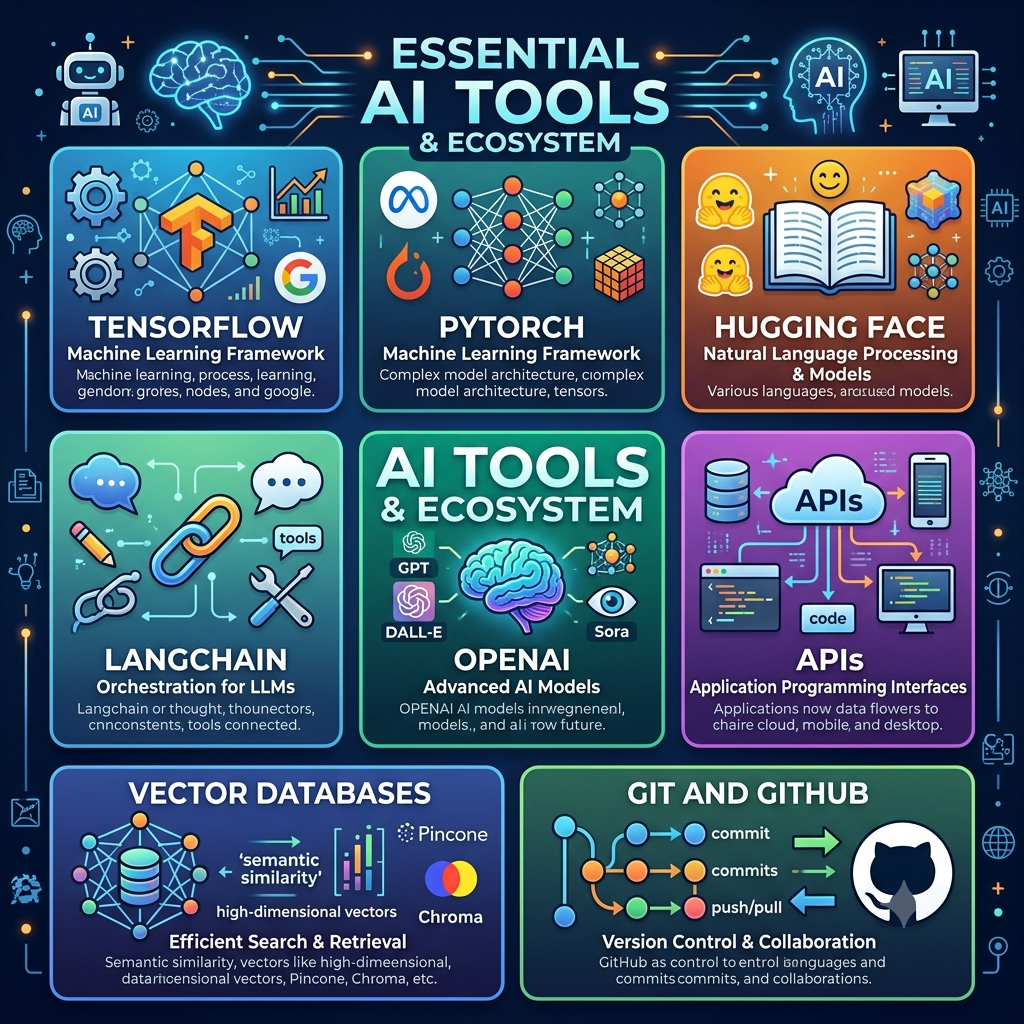
Step 4: Get Fluent in Modern AI Tools
“AI is moving fast and today’s professionals need to be comfortable with practical tools.
Examples are:
- Tensorflow
- PyTorch
- Hugging Face
- LangChain
- OpenAI
- APIs
- Vector databases
- Git and GitHub
Generative Roadmap for Beginners to Build an AI Career has become more important. Today, many companies leverage these technologies to develop internal chatbots, document assistants, AI-driven search, and workflow automation.
Understanding how these tools work in conjunction gives beginners a huge advantage.
step 5 : Create Real Projects
This is where many learners divide themselves.
Tutorials feel productive to watch.
Building projects actually develop skills.
Start with small steps:
- Movie recommendation system
- Spam email classifier.
- Resume filtering model
- Sentiment analysis.
- AI summary writer
Grow by building projects to solve business problems.
Like for instance:
Consider a retail company that is experiencing delays in customer support. Building an Roadmap for Beginners to Build an AI Career-powered FAQ assistant with a large language model demonstrates skills that employers can immediately recognise because it is related to a real-world problem.
Step 6: Cloud Platforms
Many Roadmap for Beginners to Build an AI Career models now run on cloud based environments instead of local computers.
Start learning:
- Microsoft Azure AWS
- Cloud Google
Even simple experience with cloud deployment helps your resume.
Step 7: Build An AI Portfolio
A resume rarely makes you stand out on its own.
A portfolio shows what you can really build.
Include:
- GitHub repositories
- Case study
- Pictures of the project
- Problematic statements
- Effect on business
- Lessons learned
It’s often said that one well-documented project makes a better impression than ten online courses.
Step 8: Obtain Industry-Recognized Certifications
Certifications help you structure your learning and show your commitment to employers.
Seek out programs that integrate:
- Instructor-led training
- Real world projects
- Mentoring in Career
- Interview practice
- Job placement assistance Resume support
There is no structure or accountability, which is why many beginners find it hard to teach themselves after a few weeks. That’s where guided Roadmap for Beginners to Build an AI Career can make a visible difference.
step 9: Prepare for AI job interviews
You should be preparing for interviews before you even start applying.
Look for questions such as:
- Explain overfitting.
- What is bias and variance?
- Decision Tree Vs Random Forest – Which One To Choose?
- Explain gradient descent.
- Tell me about a project you built.
- What would you do to improve an AI model?
Behavioural questions are important too.
Employers often look for communication, teamwork and problem-solving skills as much as technical knowledge.
Step 10: Never stop learning
AI is going so fast.
In just the last year, we’ve seen the meteoric rise of Roadmap for Beginners to Build an AI Career, reasoning-based systems, enterprise adoption of AI, and multimodal models. There’s no other option than to keep learning as new frameworks and tools are coming up all the time, it is just part of the job.
Fortunately, once you have a good set of fundamentals, it is much easier to adapt to new technologies.
Common Mistakes Made by Beginners
A few patterns keep showing up.
Attempting to Learn Everything
You needn’t be an expert in every AI framework.
Depth > endless tutorials.
Projects ignored
Projects build confidence.
They also give evidence in interviews.
Completely Avoiding Mathematics
You don’t have to be a maths major.
You do have to understand enough to be able to explain your models.
Ignoring github
Many recruiters check github before they schedule interviews.
Another certificate can make a better impression than a well documented & clean repository with projects.
Practical Roadmap for Beginners to Build an AI Career
A realistic progression is often like the following:
- Learn Python and programming fundamentals.
- Study statistics, data manipulation, and SQL.
- Grasp machine learning concepts.
- Discover deep learning and generative AI.
- Work on real projects.
- Explore cloud deployment and version management.
- Create a portfolio and a github profile.
- All structured AI Career training with hands on guidance.
- Get ready for technical interviews.
- Continue to learn and practise on a regular basis.
This roadmap is adaptable. Some students can move quickly, others need time to build confidence through projects. What is important is steady progress, not racing through a lot of topics.
How Structured AI Training Can Fast Track Your Journey
It is possible to learn AI on your own, but most beginners are overwhelmed by the sheer number of tutorials, frameworks and paths to learn.
Or you may find a more structured program, where theory is balanced with practical application, more helpful. Features of particular value include:
- Live, instructor-led classes
- Practical projects on real business cases
- Curriculum designed for industry in machine learning and generative AI
- Resume-building help
- Mock Interviews & Career Coaching
- Help with job searching
If you are a learner looking for a guided transition to Roadmap for Beginners to Build an AI Career, then H2K Infosys is one option worth considering. The AI training programs are designed for beginners and career changers, and they focus on practical experience, not just theory. Rather than teaching algorithms, the curriculum focuses on how AI is applied in real workplace environments, helping students build portfolios that can be shared with recruiters.
This strategy can be especially useful if you are trying to shorten the time it takes from learning concepts to being job-ready.
What is the best AI roadmap for beginners?
The best Roadmap for Beginners to Build an AI Career starts with learning Python, basic mathematics (statistics, probability, and linear algebra), SQL, and data analysis. Once you have these fundamentals, move on to machine learning, deep learning, generative AI, and real-world projects. Finally, build a portfolio, earn relevant certifications, and prepare for AI job interviews.
Can I start an AI career without a computer science degree
Yes. Many successful AI professionals come from engineering, business, finance, healthcare, and other non-computer science backgrounds. Employers increasingly value practical skills, project experience, and problem-solving abilities over specific academic degrees.
What projects should beginners build to start an AI career?
Some excellent beginner AI projects include:
Spam email detection
Movie recommendation system
Customer sentiment analysis
AI chatbot
Resume screening application
Sales prediction model
Document summarization using Generative AI
These projects demonstrate practical skills to employers and strengthen your portfolio.
Which AI skills are most in demand in 2026?
Companies are actively hiring professionals with skills in:
Machine Learning
Generative AI
Prompt Engineering
Natural Language Processing (NLP)
Deep Learning
Python Programming
SQL and Data Analytics
Cloud Platforms (AWS, Azure, Google Cloud)
AI Automation and Large Language Models (LLMs)
What is the best AI Career training for beginners?
The best Roadmap for Beginners to Build an AI Career combines instructor-led classes, real-world projects, mentorship, resume preparation, mock interviews, and placement assistance. Programs like H2K Infosys AI Training are designed to help beginners develop practical, job-ready skills through hands-on learning and industry-focused projects.
Can working professionals switch to an AI career?
Absolutely. Many professionals from software development, testing, business analysis, finance, and even non-technical fields successfully transition into AI by learning foundational concepts, building practical projects, and completing structured AI training programs.
Concluding thoughts
You won’t build an AI career overnight, but it doesn’t have to be just for seasoned programmers or researchers, either. AI Roadmap for Beginners – A structured approach will start from the basics, continue with consistent practice and make it meaningful with real-world projects.
Whether you’re a student, a working professional wanting to pivot your career, or just someone fascinated by artificial intelligence, the most important step is to start with a structured plan and keep building. How to Make the Journey Much Easier Combine self study with quality AI Career training and practical experience to make the journey much smoother.
Demand for AI talent is growing in all industries and it’s never been a better time to begin your AI career path for beginners. With persistence, hands-on learning and guidance from experienced mentors like those at H2K Infosys, you can acquire the skills employers are looking for and position yourself for long-term success in one of the world’s most exciting technology fields.