
The business analyst (BA) career has been growing steadily for a while now, and honestly, it doesn’t look like that’s slowing down anytime soon. The main reason is pretty simple: companies everywhere are leaning heavily on data and structured decision-making. And whenever that happens, someone is needed to connect the business side with the technical side. That’s exactly where a Business Analyst career growing steps in.
To support this Business Analyst career growing demand, many training providers and institutes are also focusing on skill development in this area, including H2K Infosys, which offers professional training programs aimed at helping learners build industry-relevant BA and IT skills.
What is a Business Analyst?
A business analyst is a professional who understands business problems and translates them into clear technical requirements.
They act as a bridge between the following:
- Business teams (who define needs)
- Technical teams (who build solutions)
Key Responsibilities in IT Projects
In most IT environments, a Business Analyst career growing ensures the following:
- Requirements are properly gathered, documented, and validated
- Business objectives align with technical implementation
- Gaps in processes are identified and improved
- Final solutions match user expectations
They typically work within Agile, Scrum, or sometimes Waterfall frameworks, depending on the organization.
How Fast is the Business Analyst Career Growing?
The growth of the Business Analyst career growing is steady and consistent, especially in IT-driven economies. It may not be flashy growth, but it is stable and long-term.
Key Reasons for Growth
- Rapid digital transformation across industries
- Increased use of data in decision-making
- Expansion of software products and SaaS platforms
- Adoption of Agile and product-based development models
Unlike some highly volatile tech roles, the Business Analyst career growing remains essential in almost every structured project.
Key Growth Drivers in the Business Analyst career Growing
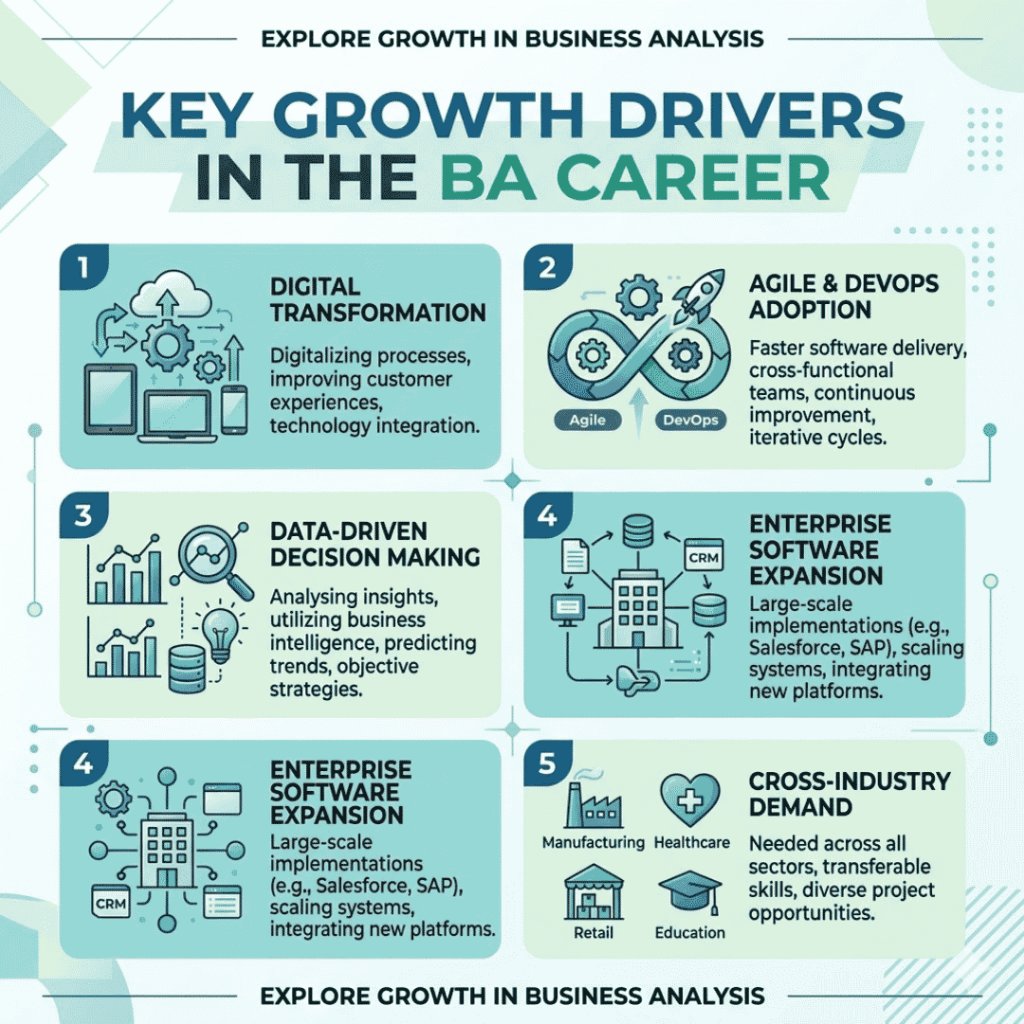
1. Digital Transformation
Organizations are upgrading legacy systems and moving to modern platforms, which requires structured requirement analysis and process mapping.
2. Agile & DevOps Adoption
Continuous delivery models need constant updates and clarification of requirements. BAs play a key role in backlog management and sprint planning.
3. Data-Driven Decision Making
Companies no longer rely on assumptions. Business Analyst career growing helps define KPIs, logic, and structured insights.
4. Enterprise Software Expansion
Systems like CRM, ERP, and SaaS platforms require detailed analysis before implementation.
5. Cross-Industry Demand
Industries such as banking, healthcare, insurance, logistics, and IT services all require a Business Analyst Career.
Why the Business Analyst Role is Important
The Business Analyst career growing role directly impacting project success, cost efficiency, and user satisfaction.
Key Importance Areas
- Reduces confusion in requirements
- Improves communication between business and technical teams
- Ensures business value is delivered through IT systems
- Supports better decision-making through structured analysis
For working professionals, it also provides a pathway into IT without requiring deep programming skills.
Skills Required to Become a Business Analyst
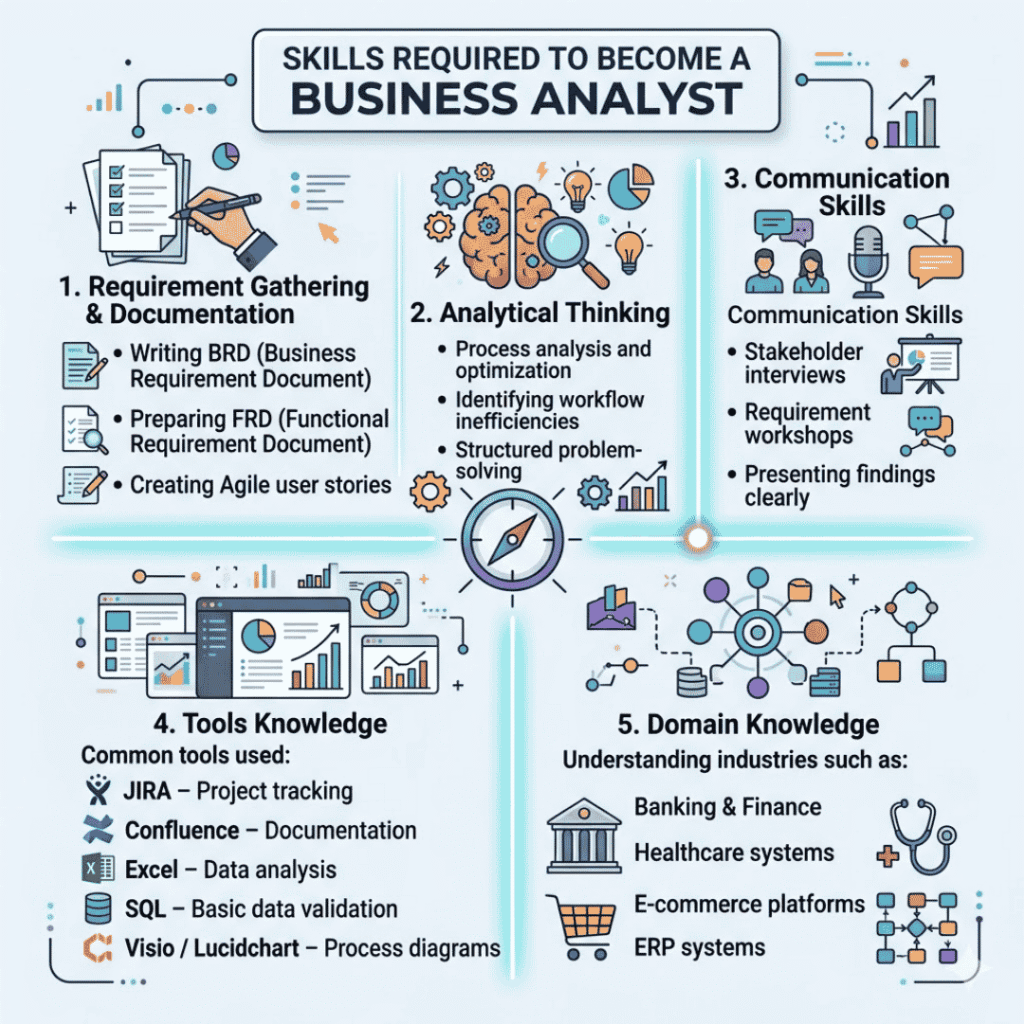
A business analyst needs a mix of analytical thinking, communication ability, and technical awareness.
1. Requirement Gathering & Documentation
- Writing BRD (Business Requirement Document)
- Preparing FRD (Functional Requirement Document)
- Creating Agile user stories
2. Analytical Thinking
- Process analysis and optimization
- Identifying workflow inefficiencies
- Structured problem-solving
3. Communication Skills
- Stakeholder interviews
- Requirement workshops
- Presenting findings clearly
4. Tools Knowledge
Common tools used:
- JIRA – Project tracking
- Confluence – Documentation, Excel – Data analysis
- SQL – Basic data validation
- Visio / Lucidchart – Process diagrams
5. Domain Knowledge
Understanding industries such as:
- Banking & Finance
- Healthcare systems
- E-commerce platforms
- ERP systems
How Business Analysis is Used in Real IT Projects
Business Analyst career growing are involved throughout the Software Development Life Cycle (SDLC).
Typical Workflow
Requirement Gathering
- Conduct stakeholder meetings
- Collect business needs
Requirement Analysis
- Identify gaps and dependencies
- Prioritize features
Documentation
- Prepare BRD / SRS documents
- Define acceptance criteria
Solution Design Collaboration
- Work with developers and architects
- Validate feasibility
Testing Support
- Assist QA teams with test cases
- Support User Acceptance Testing (UAT)
Post-Implementation Review
- Validate that business goals are met
- Document improvements
Job Roles That Use Business Analysis Skills
Many roles use BA skills even if the title is different.
Common Roles
- business analyst
- Product Owner
- Product Manager
- System Analyst
- Functional Consultant
- Data Analyst (partially overlapping)
- Project Coordinator
Skills Overlap
| Role | Business Analysis Usage | Focus Area |
| Business Analyst | High | Requirements & processes |
| Product Owner | High | Product backlog & prioritization |
| Data Analyst | Medium | Data insights |
| System Analyst | High | Technical mapping |
| Project Manager | Medium | Planning & coordination |
Career Paths After Learning Business AnalysisA
business analyst online opens multiple career directions depending on experience.
Entry-Level Roles
- Junior Business Analyst
- Support Analyst
- QA Analyst
Mid-Level Roles
- Business Analyst
- Product Analyst
- Functional Consultant
Senior-Level Roles
- Senior Business Analyst
- Product Manager
- Business Consultant
- Solution Architect (with experience)
Specialized Roles
- Agile Business Analyst
- ERP Consultant (SAP / Oracle)
- Data-focused BA roles
What is a Business Analyst Certification Course?
A business analyst certification course is structured training designed to prepare individuals for real-world BA roles.
What It Covers
- Requirement engineering
- Agile methodologies
- Process modeling
- Tools like JIRA and SQL
- Real-world case studies
Purpose of Certification
- Improves job readiness
- Validates skills
- Helps career transition into IT
- Strengthens practical understanding
Tools and Technologies Used by Business Analysts
Tool Categories
| Category | Tools | Purpose |
| Project Management | JIRA, Trello | Task tracking |
| Documentation | Confluence, Word | Requirements |
| Data Analysis | Excel, SQL | Data validation |
| Visualization | Power BI, Tableau | Reporting |
| Modeling | Visio, Lucidchart | Process design |
Challenges Faced by Business Analysts
Even though the career is strong, real-world challenges exist:
- Changing requirements during development
- Miscommunication between teams
- Lack of clear or reliable data
- Tight Agile deadlines
- Managing multiple stakeholder expectations
This is why communication and adaptability matter a lot in this role.
How to Start a Career in Business Analysis
Step-by-Step Path
- Learn SDLC and Agile fundamentals
- Understand requirement gathering techniques
- Practice documentation (BRD, user stories)
- Learn tools like JIRA and Excel
- Gain basic SQL knowledge
- Work on real-world case studies
- Take a structured Business Analyst course
- Consider certification for validation
FAQ – Business Analyst career growing
Is business analyst a growing career?
Yes, it is steadily growing due to digital transformation and increasing demand for structured decision-making.
What is the future of the business analyst career?
The future looks promising. As companies continue adopting digital transformation, cloud technologies, AI, and automation, the need for professionals who can bridge business needs and technology solutions is expected to grow.
What is the typical career path?
Junior BA → BA → Senior BA → Product Manager / Consultant
Does business analyst have good salary growth?
Yes. Business analysts often experience steady salary growth as they gain experience, specialize in domains, or move into senior roles such as Senior Business Analyst, Product Owner, Business Consultant, or Project Manager.
What industries hire business analysts the most?
Business analysts are hired in industries such as information technology, banking, healthcare, insurance, e-commerce, manufacturing, telecommunications, and government organizations.
Conclusion
The Business Analyst career growing trend reflects the increasing demand for professionals who can bridge the gap between business goals and technology solutions. As more organizations invest in digital transformation, skilled business analysts continue to enjoy strong job opportunities, competitive salaries, and long-term career stability. Whether you’re a recent graduate or planning a career change, developing practical business analysis skills through hands-on training and real-world projects can help you take advantage of this growing field and build a successful career.
Key Takeaways
- Business Analyst Career roles are steadily growing
- They are essential for bridging business and technology
- Skills include communication, analysis, and documentation
- Multiple career paths exist across industries
- Certification helps improve career opportunities
A structured learning approach through a Business Analyst career growing can help professionals build strong practical and theoretical skills needed in real IT environments.