Online AI training through H2K Infosys can help people transition into new roles faster but only when it’s done the right way. And “the right way” isn’t just about completing video lessons or checking off modules that part is relatively easy. What truly makes an impact is when structured learning is combined with hands-on experience working with real tools, navigating messy datasets, and solving problems that closely resemble what companies actually face in the real world.
Also, it’s worth being clear about one thing upfront: whether the Ai Machine learning Courses is online or offline isn’t the deciding factor. What matters way more is the quality of the curriculum, the kind of projects you’re doing, and how close it all is to real industry expectations
What is Online AI Training?
At its core,Online AI Training is just a structured way to learn artificial intelligence through digital platforms. No physical classroom. Instead, you get a blend of live sessions, recorded lessons, labs, maybe some assignments and projects.
Most programs cover things like:
- Machine learning fundamentals
- Data cleaning and analysis
- Building and testing models
- Deployment basics
- Real-world use cases
Some Online AI Training lean heavily into theory (a bit too much, honestly), while others go all-in on practical work. The better ones try to balance both.
And for working professionals, the flexibility matters more than people admit. Being able to learn after work or on weekends that’s often the only reason people can even attempt this.
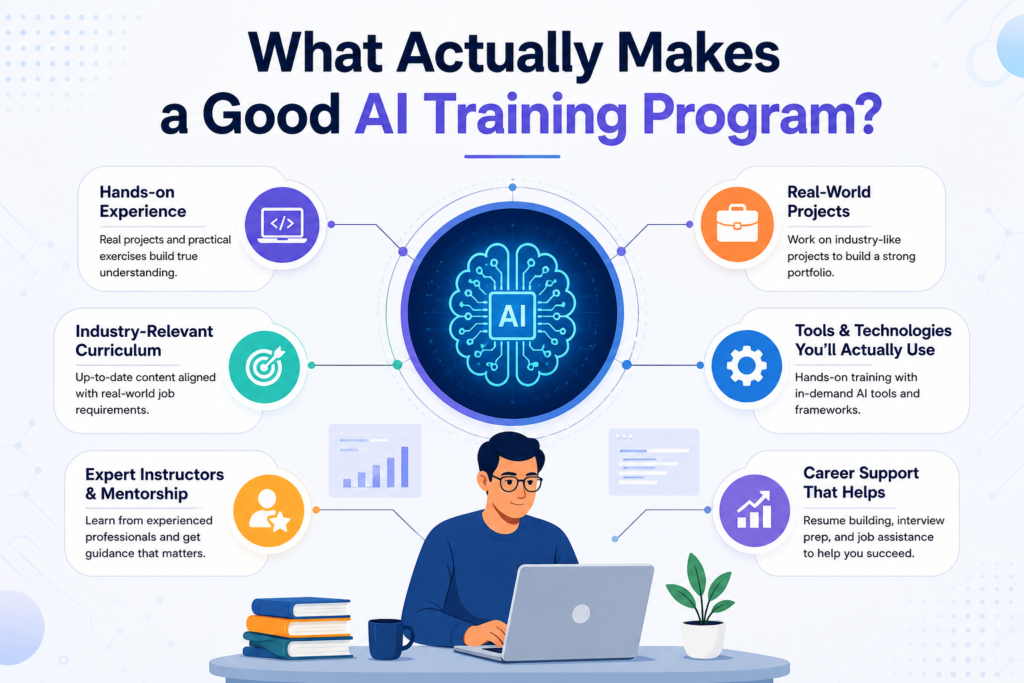
What Actually Makes a Good AI Training Program?
Not all courses are built equally. You can usually tell pretty quickly.
The stronger ones tend to include a mix of:
- Theory – things like supervised learning, neural networks
- Tools – Python, TensorFlow, Scikit-learn, etc.
- Practice – real datasets (not those tiny, perfect ones)
- Deployment – actually putting models into use
- Assessment – assignments, projects, something that tests you
If one of these is missing, it shows later. Usually when you try to build something on your own and get stuck.
How AI Actually Works in Real IT Projects
In real-world setups, AI isn’t just “build a model and done.” It’s more of a pipeline. A structured one, whether teams admit it or not.
It typically goes like this:
- Define the problem
Could be fraud detection, recommendations, forecasting… depends on the business. - Collect data
From databases, APIs, logs—wherever it exists. - Clean and prepare the data
This step? Takes way longer than people expect. - Build the model
Regression, classification, deep learning pick your approach. - Evaluate it
Accuracy, precision, recall this is where things get real. - Deploy it
APIs, cloud, integrations with existing systems. - Monitor and improve
Models degrade over time. They need maintenance.
Good Online AI Training try to simulate this flow through projects. That’s usually where the real learning sticks not during lectures.
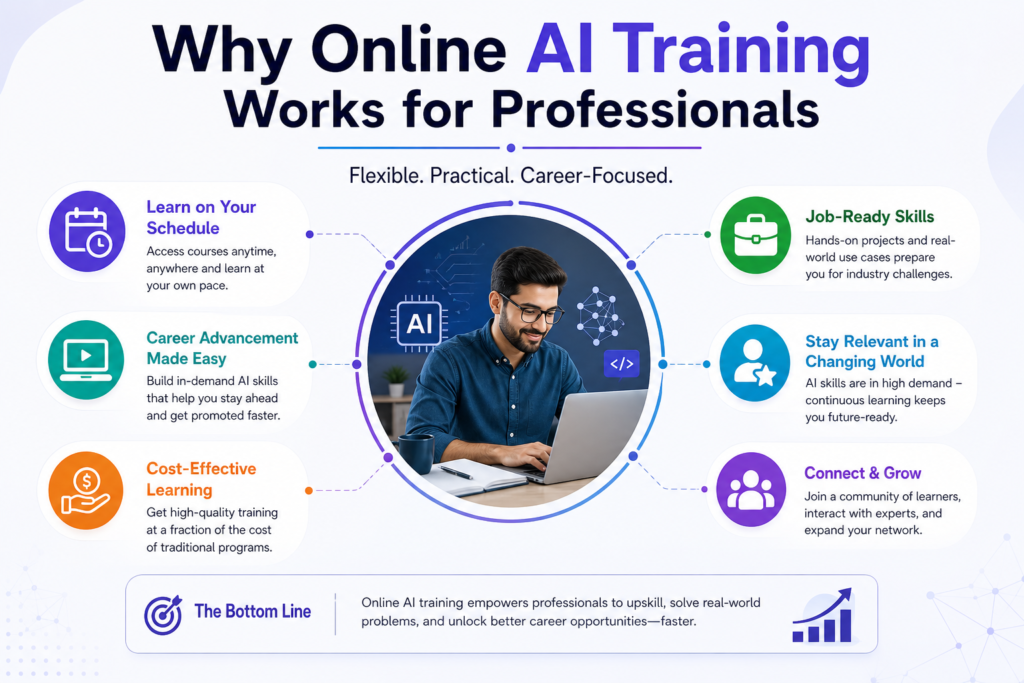
Why Online AI Training Works for Professionals
If you’re already working IT, analytics, testing, whatever online learning fits in a way traditional education just doesn’t.
A few practical reasons:
- You don’t have to quit your job
- You can apply what you learn almost immediately
- It’s usually cheaper than full-time degrees
- The focus is often more practical than academic
And there’s a real need for this shift right now. Teams are looking for:
- Analysts who can move into ML roles
- Developers who understand AI integration
- QA engineers who can validate AI outputs
Online training helps bridge that gap… slowly, but steadily.
What Skills Do You Actually Need?
AI isn’t one skill it’s a mix. That’s where most beginners feel overwhelmed.
Here’s a rough breakdown:
1. Programming
- Python (start here, no debate)
- Basic scripting, debugging
2. Math & Statistics
- Linear algebra (vectors, matrices)
- Probability
- Optimization basics
3. Data Handling
- SQL
- Cleaning messy data (this comes up a lot)
4. Machine Learning Concepts
- Supervised vs unsupervised learning
- Model evaluation
5. Tools
- Scikit-learn
- TensorFlow or PyTorch
- Jupyter notebooks
Most people move through stages like this:
Beginner → Python + data basics
Intermediate → ML algorithms
Advanced → Deep learning + deployment
Not perfectly linear, but close enough.
Where AI Shows Up in Companies
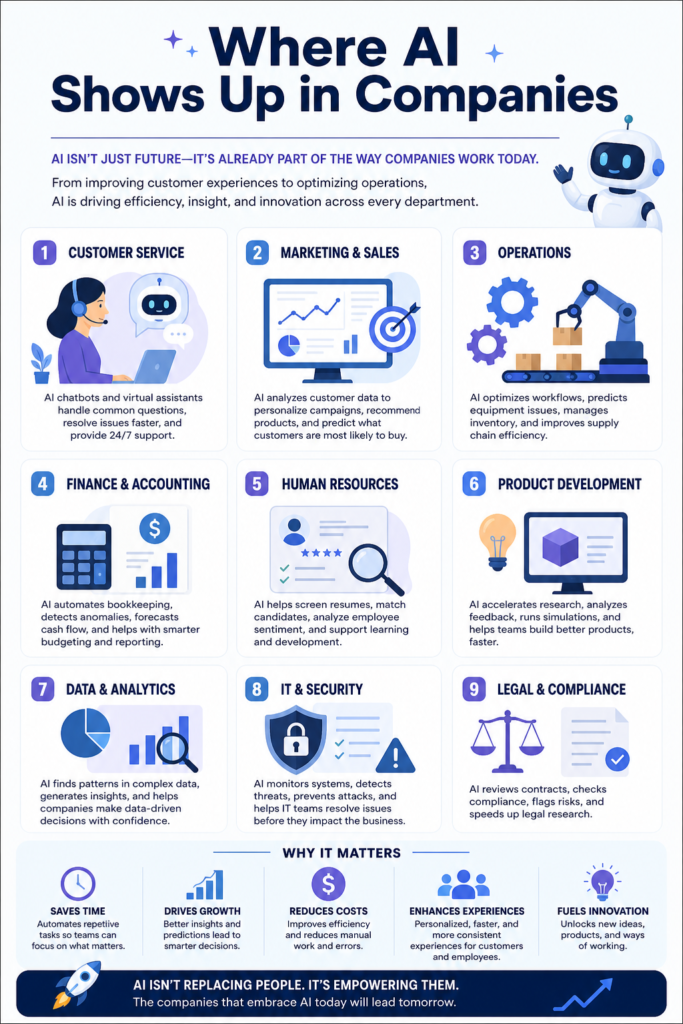
AI isn’t some abstract thing anymore it’s everywhere.
Common use cases:
- Customer analytics → recommendations, segmentation
- Fraud detection → spotting unusual activity
- Predictive maintenance → catching failures early
- Chatbots/NLP → automated support
- Supply chain optimization → demand forecasting
But companies also deal with real constraints:
- Data privacy laws (GDPR, HIPAA)
- Scaling issues
- Integration with legacy systems
- Continuous monitoring
Courses that include these realities tend to prepare you better. The rest… feel a bit disconnected.
Roles That Use AI Daily
It’s not just data scientists anymore.
- Data Scientist → builds and analyzes models
- ML Engineer → deploys and scales them
- Data Analyst → prepares and interprets data
- AI Engineer → integrates AI into applications
- Business Analyst → translates outputs into decisions
Day-to-day work often includes:
- Writing data pipelines
- Training models
- Evaluating results
- Collaborating with other teams
It’s rarely a solo job, despite how it’s sometimes portrayed.
Career Paths After AI Training
There’s no single path here. It depends a lot on your starting point.
Entry-level:
- Junior Data Analyst
- AI Support Engineer
- Junior Data Engineer
Mid-level:
- Machine Learning Engineer
- Data Scientist
- AI Developer
Advanced:
- AI Architect
- Lead Data Scientist
- AI Product Manager
People move around between these roles more than you’d expect.
Does Online AI Training Help With Job Placement?
Short answer: it can. But it’s not automatic.
What actually matters:
Hands-on projects
Employers look for real work GitHub repos, end-to-end solutions, not just certificates.
Tool proficiency
Python, TensorFlow, SQL… these are expected.
Portfolio
This shows how you think, not just what you know.
Relevant curriculum
Real case studies. Deployment. Practical challenges.
There’s a common misconception:
Finishing a course ≠ getting a job.
What really helps:
- Consistent practice
- Building projects
- Preparing for interviews
Simple, but not easy.
What to Look For in an Online AI Training
If you’re choosing one, check for:
- Depth in both theory and practice
- Real-world projects (not just demos)
- Coverage of modern tools
- Instructors with actual industry experience
- Some kind of mentoring or support
If a course feels too smooth or too easy… that’s usually a red flag.
Challenges Learners Face
A few honest ones:
- No clear learning path
- Struggling with math
- Lack of real-world exposure
- Inconsistent practice
What tends to help:
- Following a structured plan
- Working with real datasets
- Building projects regularly
- Talking to others (communities help more than people think)
FAQs
Is online AI training enough to get a job?
It can be—if you build solid projects and actually understand what you’re doing.
How long does it take?
Usually 4 to 9 months. Depends on your pace and background.
Do employers care about certifications?
Less than you’d expect. Skills matter more.
Which language should I learn?
Python. Start there.
Can non-IT professionals learn AI?
Yes. Just expect a slightly longer learning curve.
Final Thoughts
The Courses of Artificial Intelligence is a solid path especially if you’re already working. The flexibility is great, no doubt.
But it’s not magic.
What really counts is what you do with it. If you focus on building real skills, working on meaningful projects, and understanding how things play out in actual business environments, your chances improve quite a bit.