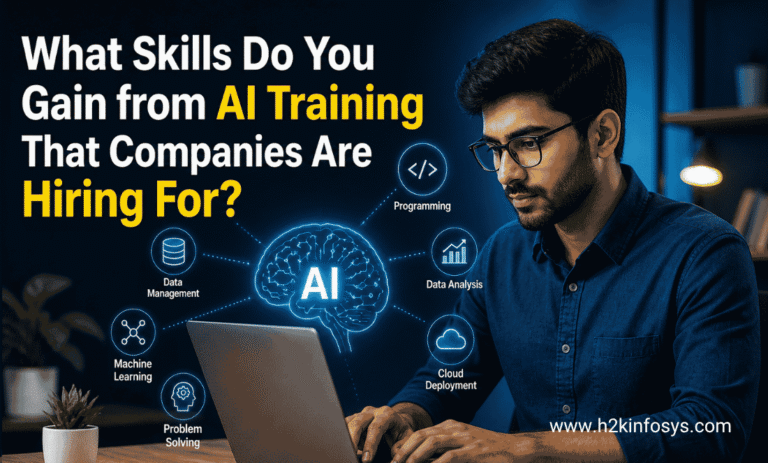
Artificial Intelligence (AI) training at H2K Infosys is really about helping people build Skills Do You Gain from AI Training that are genuinely useful in today’s tech-driven world. It goes beyond just theory and focuses heavily on practical application teaching learners how to analyze data, solve real-world problems, and design intelligent systems. The emphasis is on creating solutions that can make decisions independently or effectively support human decision-making, which is exactly what modern technology demands.
In most cases, this kind of training covers things like building machine learning models, working with data, writing code, and understanding how AI fits into real business environments. And right now, companies are actively looking for people who can do exactly that use data to drive decisions, automate repetitive work, and build systems that scale.
So, what exactly Skills Do You Gain from AI Training?
At its core, Ai and machine learning courses is a structured way of learning Skills Do You Gain from AI Training how to create systems that can handle tasks we usually associate with human intelligence things like recognizing patterns, making predictions, understanding language, or even making decisions.
If you take a typical Skills Do You Gain from AI Training, you’ll probably come across topics like:
- The basics of machine learning algorithms
- Cleaning and preparing data (which, honestly, takes more time than people expect)
- Evaluating how well a model performs
- Deploying models so they actually work in real systems
- And increasingly, how to use AI responsibly
The better Best Online Artificial Intelligence Course don’t just stop at theory they push you to build things. That hands-on part is what makes everything click.
Why does AI training matter for working professionals?
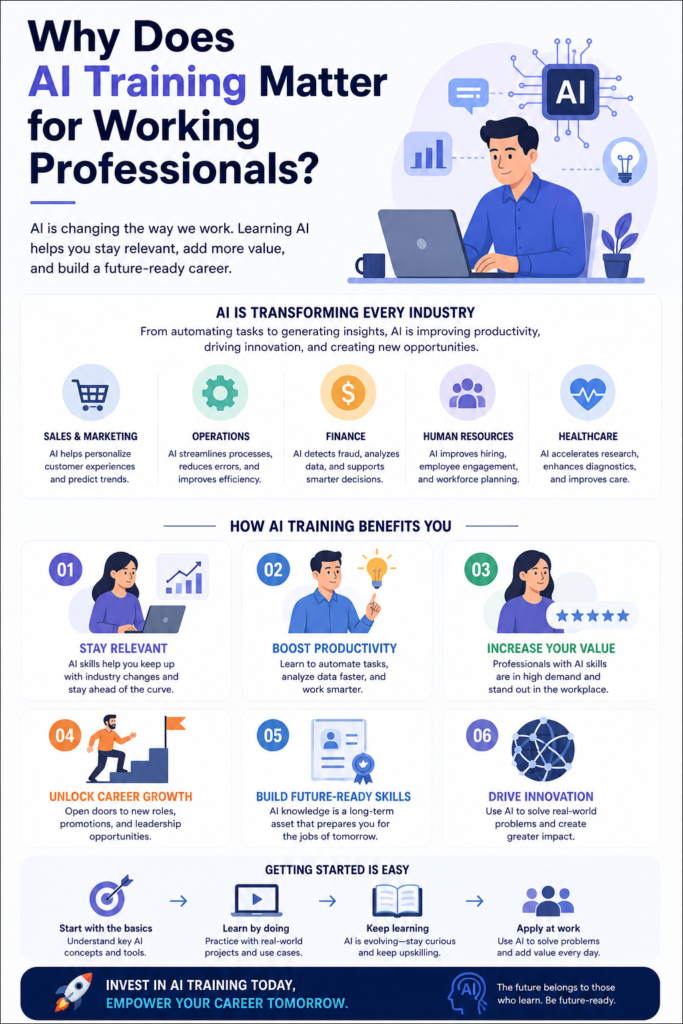
AI isn’t some future concept anymore it’s already baked into industries like finance, healthcare, retail, and manufacturing. If you’re working in tech (or even close to it), chances are you’ll run into AI-driven systems sooner or later.
Learning AI helps because:
- It cuts down manual work through automation
- It improves decision-making with real data (not just guesswork)
- It applies across roles—developers, analysts, operations teams
- And maybe most importantly, it keeps your skills relevant
In many workplaces now, you’re expected to at least understand how data and predictive models work—even if you’re not the one building them from scratch.
What skills do you actually gain from AI training?
Skills Do You Gain from AI Training isn’t just one skill it’s a mix of technical know-how and practical thinking. Here’s how it usually breaks down.
1. Programming (you can’t really skip this)
Most Skills Do You Gain from AI Training AI work revolves around programming, especially:
- Python (almost everywhere in ML)
- R (more for statistics-heavy tasks)
- SQL (for handling data)
You’ll also run into tools like NumPy, Pandas, Scikit-learn, TensorFlow, and PyTorch.
A simple example? Writing a Python script to clean customer data before feeding it into a fraud detection model. Sounds basic, but that’s real work happening in companies.
2. Data handling and preprocessing
If there’s one thing people underestimate, it’s this: AI models are only as good as the data you feed them.
You’ll learn how to:
- Clean messy datasets
- Handle missing or inconsistent values
- Create useful features
- Normalize and structure data
The workflow usually goes something like: extract → clean → transform → split → train.
3. Building machine learning models
This is where things get interesting.
You’ll work with:
- Supervised learning (like classification and regression)
- Unsupervised learning (clustering, dimensionality reduction)
- Basic reinforcement learning concepts
And you’ll go through the full cycle: data → training → evaluation → improvement.
Think of something like a product recommendation system—that’s a classic real-world use case.
4. Evaluating and improving models
Building a model is one thing. Making sure it actually works well? That’s another.
You’ll learn about:
- Cross-validation
- Hyperparameter tuning
- Bias vs variance (a tricky but important concept)
And metrics like accuracy, F1-score, and ROC-AUC.
5. Data visualization (because numbers alone don’t help)
At some point, you need to explain what your model found.
Tools like:
- Matplotlib
- Seaborn
- Tableau or Power BI
…help turn raw outputs into something stakeholders can understand. For example, showing why customers are leaving instead of just saying “churn increased.”
6. Understanding algorithms (not just using them)
It’s not enough to run models—you need to know why they work.
You’ll study:
- Decision trees
- Neural networks
- Support Vector Machines
- K-means clustering
This helps you pick the right approach instead of guessing.
7. Deployment (where many beginners struggle)
A model sitting on your laptop isn’t useful. It has to be integrated into real systems.
You’ll learn things like:
- Building APIs (Flask, FastAPI)
- Using Docker
- Deploying on cloud platforms
The process usually looks like: train → package → expose via API → deploy → monitor.
8. Working with big data
In real-world systems, datasets aren’t small.
You might work with:
- Apache Spark
- Hadoop
- Distributed systems
For example, analyzing millions of banking transactions for fraud detection.
9. Problem-solving mindset
Skills Do You Gain from AI Training really sharpens how you think.
You learn to break problems down step by step:
- What’s the goal?
- What data do we need?
- Which features matter?
- Which model fits?
- How do we measure success?
It’s less about tools, more about structured thinking.
10. Ethics and responsible AI
This part is getting more attention now (for good reason).
You’ll explore:
- Bias in data
- Privacy concerns
- Transparency in models
Companies care about this more than they used to.
How does AI actually work in real projects?
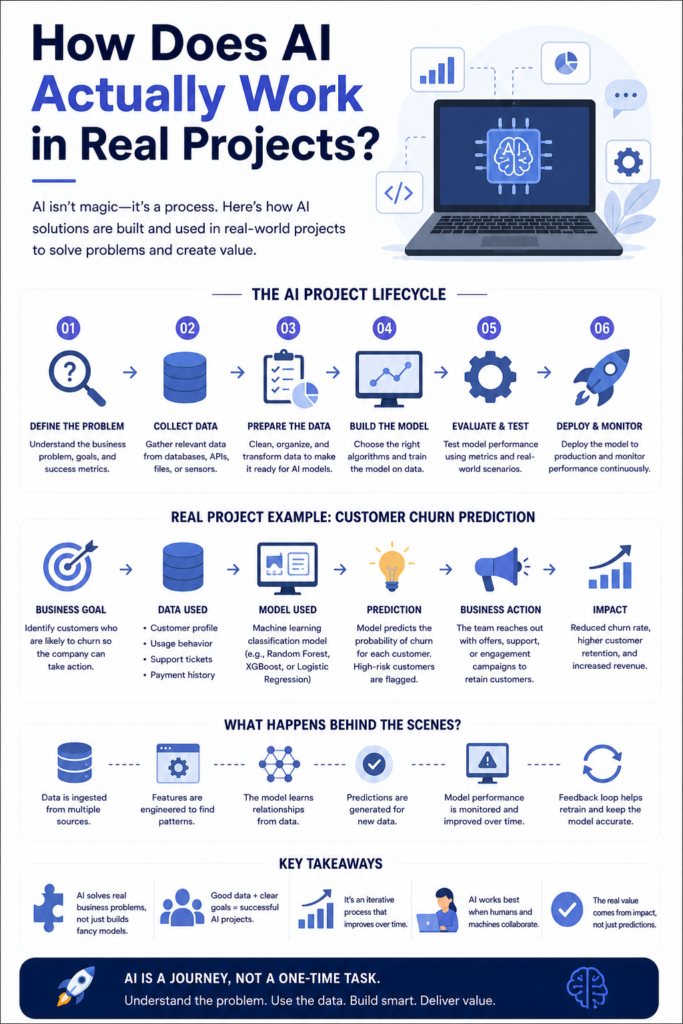
In practice, most AI projects follow a similar flow:
- Define the problem
- Collect data
- Clean and prepare it
- Choose a model
- Train and test
- Deploy
- Monitor and improve
It’s rarely a straight line—there’s usually a lot of going back and fixing things.
Where is AI used in real business settings?
Pretty much everywhere now:
- Finance → fraud detection, credit scoring
- Healthcare → diagnosis support, imaging
- Retail → recommendations, demand forecasting
- IT operations → anomaly detection, predictive maintenance
What do you need before learning AI?
You don’t need to be an expert, but it helps to have:
- Basic programming knowledge
- Some understanding of statistics
- Familiarity with databases
- Logical thinking skills
What roles actually use AI skills?
Skills Do You Gain from AI Training can lead to different paths, like:
- Data Scientist
- Machine Learning Engineer
- Data Analyst
- AI Engineer
- Business Analyst
Each role uses AI differently, but the foundation overlaps.
What can you do after learning AI?
Career options include:
- Machine Learning Engineer
- Data Scientist
- AI Developer
- NLP Engineer
- Computer Vision Engineer
And honestly, demand for these roles is Skills Do You Gain from AI Training growing because companies are leaning more into automation and data-driven systems.
A quick real-world example: customer churn prediction
Let’s say a company wants to reduce customer churn.
The process might look like:
- Collect customer data
- Clean and prepare it
- Select relevant features (usage, complaints, etc.)
- Train a classification model
- Evaluate results
- Deploy it into a dashboard
The outcome? The business can act before customers leave.
Common challenges (because it’s not always smooth)
In real projects, things can get messy:
- Poor data quality
- Models that overfit
- Difficulty integrating with old systems
- Scaling issues
- Regulatory constraints
This is where experience really matters.
Quick FAQs
What skills Skills Do You Gain from AI Training?
Programming, machine learning, data analysis, and deployment.
Do you need coding experience?
It helps especially Python but you can build it as you go.
How long does it take?
Usually 3 to 9 months, depending on how deep you go.
Is AI only for developers?
Not really. Analysts and business roles use it too.
What makes a good AI course?
Hands-on projects, real examples, and exposure to actual tools
Key takeaways
- Skills Do You Gain from AI Training builds both technical and analytical skills
- You learn everything from coding to deployment
- These skills apply across industries and roles
- Real-world Skills Do You Gain from AI Training work follows structured workflows
- Understanding ethics and scalability is just as important as building models