An effective H2K Infosys Artificial Intelligence Online Course in 2026 should cover foundational AI concepts, generative AI, machine learning operations (MLOps), responsible AI, AI automation, large language models (LLMs), cloud AI platforms, and enterprise AI implementation practices. The most valuable artificial intelligence certification online programs combine theory, practical labs, real-world workflows, and project-based learning aligned with current enterprise adoption trends.
Modern Artificial Intelligence Online Course are increasingly expected to include hands-on exposure to tools such as Python, TensorFlow, PyTorch, OpenAI APIs, vector databases, prompt engineering frameworks, cloud AI services, and AI governance practices. Courses that focus only on theory without practical implementation are becoming less relevant for working professionals.
What Is Artificial Intelligence?
Artificial Intelligence (AI) refers to computer systems designed to perform tasks that typically require human intelligence. These tasks include:
- Pattern recognition
- Natural language processing
- Decision-making
- Image analysis
- Speech recognition
- Predictive analytics
- Automation
AI systems use algorithms and data models to identify patterns, make predictions, and automate complex workflows. In enterprise environments, AI is commonly integrated into business applications, cloud platforms, customer support systems, cybersecurity tools, and analytics pipelines.
Major Areas of Artificial Intelligence
| AI Domain | Description | Common Enterprise Use Cases |
|---|---|---|
| Machine Learning | Models learn patterns from data | Fraud detection, forecasting |
| Deep Learning | Neural networks for complex tasks | Image recognition, NLP |
| Generative AI | AI creates content and outputs | Chatbots, document generation |
| Natural Language Processing | Understanding human language | Search engines, sentiment analysis |
| Computer Vision | Processing visual data | Surveillance, manufacturing QA |
| Reinforcement Learning | Learning through rewards | Robotics, optimization |
Why Is Artificial Intelligence Important for Working Professionals?
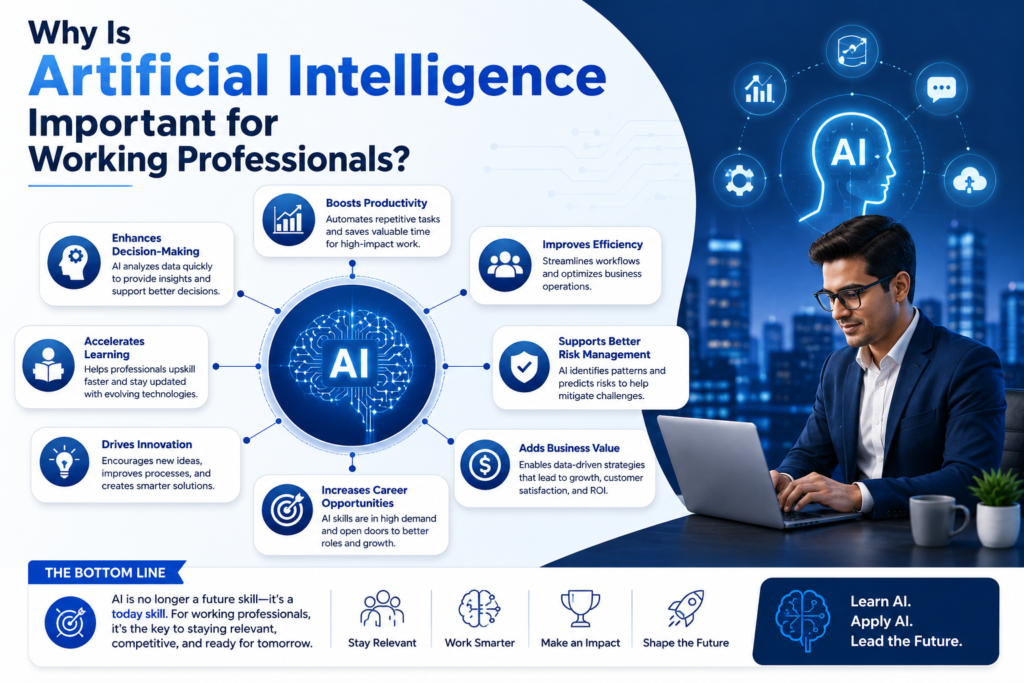
AI is increasingly integrated into enterprise software, cloud infrastructure, and business operations. Working professionals across IT, software development, data analytics, DevOps, cybersecurity, and cloud computing are expected to understand how AI systems function and how they can be deployed responsibly.
Organizations commonly use AI to:
- Automate repetitive workflows
- Improve customer support operations
- Analyze business data faster
- Enhance cybersecurity monitoring
- Optimize cloud infrastructure
- Improve software testing and monitoring
- Build intelligent applications
Professionals who understand AI workflows can contribute to modernization projects, automation initiatives, and data-driven decision-making processes.
Enterprise Drivers Behind AI Adoption
Operational Efficiency
AI automation tools reduce manual effort in repetitive tasks such as ticket classification, report generation, and document processing.
Data-Driven Decision Making
Machine learning models help organizations analyze large datasets and identify trends more efficiently.
Customer Experience Improvements
AI-powered chatbots and recommendation systems improve service response times and personalization.
Cloud and Infrastructure Automation
AI is increasingly integrated with cloud monitoring, observability, and DevOps pipelines.
Which Emerging AI Trends Should an Artificial Intelligence Online Course Cover in 2026?
An AI course designed for 2026 should align with technologies already being used or evaluated in enterprise environments.
1. Generative AI and Large Language Models
Generative AI remains one of the most significant developments in modern AI systems.
Topics should include:
- LLM architecture fundamentals
- Prompt engineering
- Retrieval-Augmented Generation (RAG)
- AI copilots
- AI agents
- Fine-tuning techniques
- Tokenization and embeddings
Common Enterprise Applications
- Automated documentation
- Customer support assistants
- Knowledge management systems
- AI coding assistants
- Enterprise search platforms
2. Responsible AI and AI Governance
Enterprise adoption increasingly requires AI systems to comply with governance and security requirements.
Important concepts include:
- Bias detection
- Ethical AI frameworks
- Explainable AI (XAI)
- Model transparency
- Data privacy
- AI compliance standards
Real-World Challenge
Organizations deploying AI models often face issues such as:
- Biased training datasets
- Regulatory compliance risks
- Model hallucinations
- Security vulnerabilities
- Inconsistent outputs
Courses that address governance are more aligned with enterprise implementation realities.
3. AI Integration With Cloud Platforms
Modern AI workloads are frequently deployed on cloud infrastructure.
AI learning courses should include exposure to:
| Cloud Platform | AI Services |
|---|---|
| Amazon Web Services | SageMaker, Bedrock |
| Microsoft Azure | Azure AI Studio, OpenAI Service |
| Google Cloud | Vertex AI |
| IBM | Watson AI |
Practical Skills
Learners should understand:
- Model deployment
- API integration
- GPU infrastructure basics
- Cloud AI pipelines
- Monitoring AI workloads
4. MLOps and AI Operations
MLOps combines machine learning with DevOps principles to manage AI systems in production.
Key Topics
- CI/CD for machine learning
- Model versioning
- Data pipelines
- Model monitoring
- Drift detection
- Experiment tracking
Common Enterprise Tools
| Tool | Purpose |
|---|---|
| MLflow | Experiment tracking |
| Kubeflow | ML orchestration |
| Docker | Deployment |
| Kubernetes | Scaling AI workloads |
5. AI Automation and Intelligent Workflows
AI automation platforms are increasingly used to improve operational efficiency.
Topics may include:
- Intelligent document processing
- Workflow automation
- AI-powered ticket routing
- Conversational AI
- AI-driven analytics
Enterprise Scenario
A support organization may use AI to:
- Analyze incoming support tickets
- Categorize issue severity
- Recommend solutions
- Route requests automatically
- Generate summaries for engineers
This type of workflow is commonly implemented using AI APIs integrated with automation tools.
How Does Artificial Intelligence Work in Real-World IT Projects?
AI projects typically follow a structured lifecycle involving data collection, model development, deployment, and monitoring.
Typical AI Workflow
| Phase | Activities |
|---|---|
| Data Collection | Gather enterprise data |
| Data Preparation | Cleaning and transformation |
| Model Training | Train ML or deep learning models |
| Validation | Accuracy and performance testing |
| Deployment | API or cloud deployment |
| Monitoring | Drift detection and optimization |
Example: AI-Based Customer Support System
Step 1: Data Ingestion
Historical customer conversations are collected from CRM systems.
Step 2: Data Processing
The text is cleaned, tokenized, and categorized.
Step 3: Model Training
An NLP model is trained to classify support requests.
Step 4: Deployment
The AI model is integrated into a support portal.
Step 5: Monitoring
Teams monitor accuracy, response quality, and failure cases.
This workflow demonstrates why AI professionals need both technical and operational knowledge.
What Skills Are Required to Learn Artificial Intelligence?
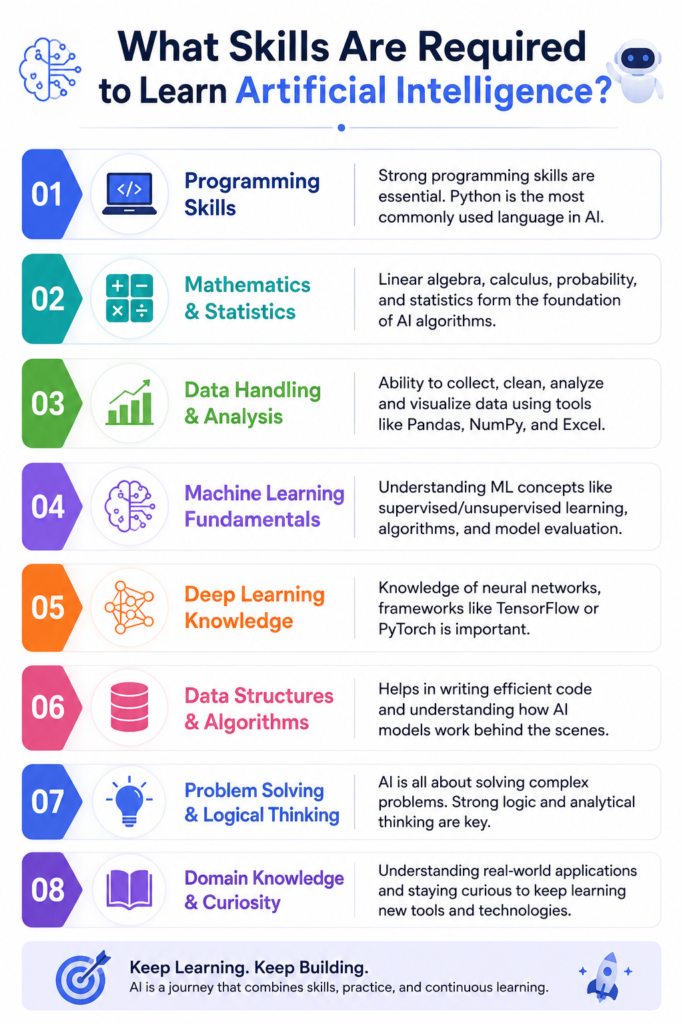
Most beginner-to-intermediate AI learning Courses assume foundational technical knowledge rather than advanced research expertise.
Core Technical Skills
| Skill Area | Why It Matters |
|---|---|
| Python Programming | Primary AI development language |
| Statistics | Understanding model behavior |
| Data Analysis | Preparing training datasets |
| SQL | Querying structured data |
| APIs | AI service integration |
| Cloud Basics | AI deployment environments |
Recommended Programming Languages
Python
Python remains the dominant language in AI development because of its extensive ecosystem.
Common libraries include:
- NumPy
- Pandas
- Scikit-learn
- TensorFlow
- PyTorch
SQL
SQL is widely used for enterprise data extraction and preprocessing.
What Should an Artificial Intelligence Certification Online Program Include?
A comprehensive Artificial Intelligence Certification online Program should balance foundational learning with practical implementation.
Recommended Course Components
1. Foundational AI Concepts
Topics should include:
- Machine learning basics
- Neural networks
- AI terminology
- Data preprocessing
- Model evaluation
2. Hands-On Labs
Learners benefit from practical exercises involving:
- Python notebooks
- API integration
- Cloud deployment
- AI workflows
- Prompt engineering
3. Real-World Projects
Effective AI learning courses often include projects such as:
| Project Type | Skills Practiced |
|---|---|
| Chatbot Development | NLP and APIs |
| Predictive Analytics | Machine learning |
| Recommendation Systems | Data modeling |
| AI Automation | Workflow orchestration |
| Fraud Detection | Classification models |
4. Enterprise Deployment Concepts
Courses should explain:
- Scalability
- Security considerations
- Infrastructure planning
- API architecture
- AI governance
How Is Artificial Intelligence Used in Enterprise Environments?
Enterprise AI implementations differ significantly from small academic projects.
Common Enterprise AI Use Cases
Customer Support Automation
AI assistants summarize tickets, recommend solutions, and automate responses.
Cybersecurity
AI models identify anomalies, suspicious network activity, and potential threats.
Financial Services
Machine learning models support fraud detection, risk analysis, and forecasting.
Healthcare
AI assists with medical imaging, clinical data analysis, and workflow automation.
Manufacturing
Computer vision systems inspect product quality and monitor equipment performance.
Enterprise Constraints Teams Must Consider
| Challenge | Impact |
|---|---|
| Data Quality | Poor predictions |
| Security Requirements | Restricted access controls |
| Scalability | Infrastructure costs |
| Compliance | Regulatory limitations |
| Model Drift | Reduced accuracy over time |
Understanding these operational realities is important for professionals pursuing AI careers.
What Job Roles Use Artificial Intelligence Daily?
AI skills are relevant across multiple technical and business-oriented roles.
Common AI-Related Roles
| Role | Typical Responsibilities |
|---|---|
| AI Engineer | Build and deploy AI systems |
| Machine Learning Engineer | Train and optimize models |
| Data Scientist | Analyze data and generate insights |
| AI Solutions Architect | Design enterprise AI platforms |
| NLP Engineer | Develop language processing systems |
| MLOps Engineer | Manage AI deployment pipelines |
| Business Intelligence Analyst | Use AI-driven analytics |
What Careers Are Possible After Learning Artificial Intelligence?
Professionals who complete structured Artificial Intelligence Online Course may pursue roles involving analytics, automation, AI engineering, or cloud AI integration.
Career Path Examples
| Experience Level | Potential Roles |
|---|---|
| Beginner | Junior Data Analyst, AI Support Specialist |
| Intermediate | ML Engineer, Data Scientist |
| Advanced | AI Architect, AI Platform Engineer |
Industries Hiring AI Professionals
AI skills are increasingly relevant in:
- Healthcare
- Banking
- Retail
- Telecommunications
- Manufacturing
- Logistics
- Cybersecurity
- Cloud services
What Tools Are Commonly Used in AI Learning Courses?
Modern Artificial Intelligence Online Course often include exposure to industry-standard tools.
AI Development Tools
| Tool | Primary Use |
|---|---|
| TensorFlow | Deep learning |
| PyTorch | Neural network development |
| Jupyter Notebook | Experimentation |
| Git | Source control |
| Apache Spark | Big data processing |
How Do AI Learning Courses Teach Practical Skills?
Practical AI education usually combines guided labs, projects, and workflow simulations.
Typical Learning Workflow
Step 1: Understand the Business Problem
Learners identify the use case and project objective.
Step 2: Prepare the Dataset
Data is cleaned and transformed.
Step 3: Build the Model
Machine learning or deep learning models are trained.
Step 4: Evaluate Performance
Metrics such as accuracy, precision, and recall are analyzed.
Step 5: Deploy the Model
The model is integrated into an application or API.
Step 6: Monitor and Improve
Production systems are monitored for performance degradation.
This workflow mirrors real enterprise AI project execution.
How Should Professionals Choose an AI Course in 2026?
Not all Artificial Intelligence Online Course address enterprise requirements or current industry trends.
Evaluation Criteria
| Factor | Why It Matters |
|---|---|
| Hands-On Labs | Practical implementation experience |
| Real Projects | Enterprise relevance |
| Cloud Integration | Modern deployment skills |
| Generative AI Coverage | Alignment with current trends |
| MLOps Training | Production readiness |
| Instructor Expertise | Real-world guidance |
Questions Professionals Should Ask
- Does the course include generative AI concepts?
- Are learners exposed to production workflows?
- Is cloud deployment covered?
- Are governance and responsible AI discussed?
- Are practical projects included?
Frequently Asked Questions
Are AI learning courses suitable for beginners?
Many Artificial Intelligence Online Course are designed for beginners with basic programming or IT knowledge. Foundational Python and data concepts are often included.
Is Python mandatory for learning AI?
Python is widely used in AI development because of its extensive ecosystem and industry adoption. Most practical AI courses use Python extensively.
What is the difference between machine learning and artificial intelligence?
Artificial Intelligence is the broader field involving intelligent systems. Machine learning is a subset of AI focused on training models using data.
Do AI courses cover generative AI?
Modern Artificial Intelligence Online Course programs increasingly include generative AI topics such as LLMs, prompt engineering, and AI assistants.
Key Takeaways
- AI courses in 2026 should include generative AI, MLOps, cloud AI, and responsible AI concepts.
- Practical, project-based learning is increasingly important for enterprise readiness.
- AI professionals commonly work with Python, cloud platforms, APIs, and machine learning frameworks.
- Enterprise AI projects require understanding of scalability, governance, monitoring, and deployment workflows.
- Artificial intelligence certification online programs are most valuable when they combine foundational theory with real-world implementation practices.
Explore H2K Infosys courses to build hands-on Artificial Intelligence Online Course skills aligned with modern enterprise environments and emerging AI trends.
Learn through practical projects, guided labs, and structured AI learning courses designed for working IT professionals