The best AI Training and job placement in USA 2026 will come from providers like H2K Infosys, which combine hands-on AI projects, online AI certification courses, career coaching, interview preparation, and real placement support not just video lessons and a certificate.
That sounds obvious, I know. But after looking at how fast the AI job market has changed, it’s clear that learners need more than “learn Python, build a chatbot, get hired.” Employers in 2026 are looking for people who can solve business problems with AI, explain what they built, work with real data, and understand where tools like generative AI, machine learning, automation, cloud AI, and AI governance actually fit.
Why AI Training Looks Different in 2026
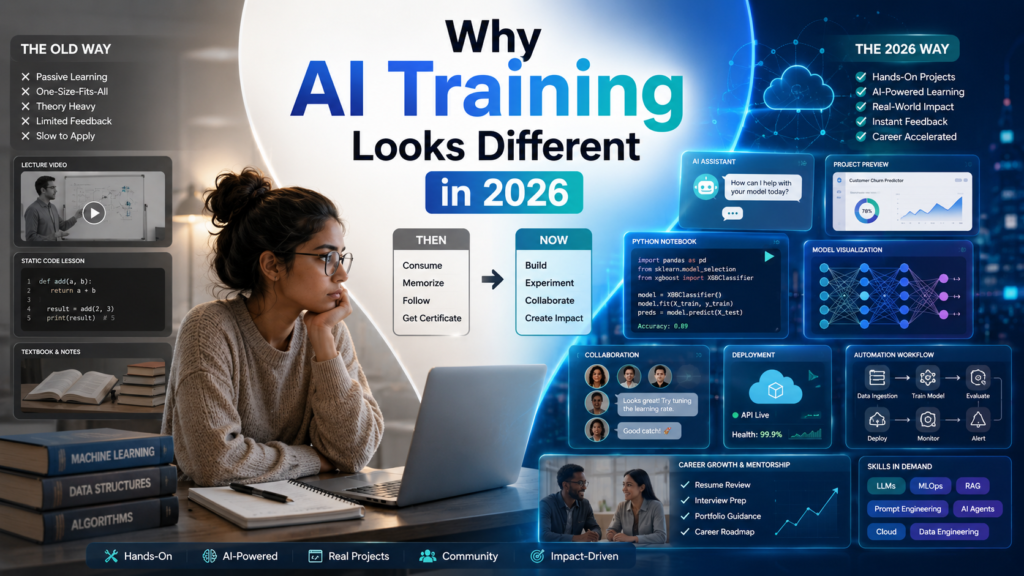
AI training in 2026 is not the same thing it was even two or three years ago. Back then, many courses focused heavily on machine learning theory, Python notebooks, and maybe a final project. Useful? Yes. Enough for a job? Not always.
Now the market is more practical.
Companies want people who can use AI inside real workflows. That might mean building a retrieval-augmented generation assistant for internal documents, using machine learning to reduce customer churn, automating reporting with generative AI, or helping a business use AI safely without leaking sensitive data.
The demand is real. The U.S. Bureau of Labor Statistics projects data scientist employment to grow 34% from 2024 to 2034, much faster than average, with about 23,400 openings per year. That does not mean every AI course leads to a job, but it does show why serious AI training still matters.
There is also a broader shift happening. The World Economic Forum’s Future of Jobs Report 2025 identifies AI and big data among the fastest-growing skill areas, while LinkedIn’s 2026 Jobs on the Rise list points to continued momentum in roles such as AI engineers, AI consultants, and data annotators.
So, yes, AI skills are valuable. But the better question is: who can actually train you well enough to compete?
What Makes an AI Training Provider “Best”?
The best provider is not always the one with the flashiest landing page or the biggest “job guarantee” headline. A good AI Training and job Placement provider should have a few non-negotiables.
First, the curriculum has to be current. In 2026, that means Python, data analysis, machine learning, deep learning, generative AI, prompt engineering, APIs, cloud deployment, vector databases, model evaluation, and responsible AI. Not every student needs all of it at expert level, but the program should show how these pieces connect.
Second, the training must be hands-on. Watching 80 hours of recorded lectures does not make someone job-ready. Building projects does. A learner should leave with a portfolio that includes practical work: maybe a predictive model, a chatbot connected to company-style documents, a recommendation system, or an AI automation workflow.
Third, placement support needs to be real. Resume edits are fine, but they are only the beginning. Good placement support includes mock interviews, LinkedIn optimization, recruiter outreach, GitHub/project review, salary negotiation guidance, and help translating projects into business language.
This is where many learners get stuck. They know the code, but when an interviewer asks, “Why did you choose this model?” or “How would this scale in production?” they freeze. A strong provider prepares students for that moment.
Top Types of AI Training Providers in the USA
There is no single perfect provider for everyone. A fresh graduate, a software engineer, a data analyst, and a non-technical manager all need different paths. But in 2026, the strongest options usually fall into four groups.
1. AI Bootcamps With Career Support
AI and machine learning bootcamps are a good fit for learners who want structure, deadlines, mentorship, and job search support. Providers such as Springboard and General Assembly have become known for practical tech training, live or mentor-supported learning, and career services.
Springboard’s Machine Learning Engineering and AI Bootcamp, for example, is fully online and emphasizes machine learning, deep learning, deployment, 1-on-1 mentorship, and career coaching. General Assembly offers live online tech training and has expanded its AI course catalog for professionals building practical AI skills for 2026.
These programs can work well for people who already have some technical background. A software developer who wants to move into AI engineering, for instance, may benefit from a bootcamp because they already understand programming logic and can focus on AI-specific skills.
The downside? Bootcamps can be expensive, and not every “job guarantee” is as simple as it sounds. Always read the fine print. Some guarantees require you to apply to a certain number of jobs per week, accept specific roles, live in approved regions, or meet strict completion requirements.
2. Online AI Certification Courses From Recognized Platforms
Online AI certification courses are best for people who need flexibility or want to build skills while working full-time Google, Microsoft, AWS, and DeepLearning.AI-style programs are popular because they let learners study at their own pace and often cost less than bootcamps.
Coursera reported heavy growth in generative AI learning demand, including millions of GenAI enrollments, showing how mainstream AI upskilling has become. Coursera also lists AI engineer, machine learning engineer, data engineer, robotics engineer, and related roles among AI career paths to explore in 2026.
The benefit of Online AI Certification Courses is flexibility. You can learn after work, test a field before committing, and stack credentials over time.
The limitation is that most certification platforms do not provide deep job placement support. You may get a certificate, but you still need to build your own projects, prepare for interviews, and network. For self-motivated learners, that is fine. For career changers who need accountability, it can feel lonely.
3. University-Backed AI Programs
University-backed certificates and professional education programs are useful for learners who want academic credibility. These may be offered by universities directly or through continuing education partnerships.
A 2026 mapping study found more than 350 undergraduate AI programs, majors, minors, concentrations, and certificates across U.S. four-year universities, which shows how quickly AI education has moved into mainstream higher education.
University programs are often stronger on fundamentals: algorithms, ethics, data structures, statistics, and machine learning theory. That matters, especially if you want to work in research-heavy or engineering-heavy roles.
But again, the same caution applies: a university certificate is not automatically a job placement engine. Some programs offer career services. Others mainly provide education. Before enrolling, ask directly: “Do you help with employer introductions, mock interviews, portfolio building, and job search strategy?”
4. Specialized AI Training Companies With Placement Support
Some learners prefer a specialized provider focused specifically on AI training and job placement. These companies usually position themselves as career-change partners, not just course sellers.
A good specialized provider should offer live instruction, labs, real-world projects, mentor access, certification preparation, and recruiter-facing job support. This is often the most appealing option for career switchers because it connects learning with employment outcomes.
But this category needs careful evaluation. Some providers overpromise. Be cautious with phrases like “guaranteed six-figure AI job” or “no coding needed, become an AI engineer in 8 weeks.” AI is accessible, yes, but serious AI work still requires effort, practice, and technical depth.
A trustworthy provider will be honest about prerequisites. If a student has no coding background, the provider should explain that they may need to start with Python, statistics, and data foundations before jumping into machine learning or generative AI engineering.
What Students Should Actually Look For
Here is the practical checklist I would use before choosing an AI training provider in 2026.
Look for a curriculum that includes:
- Python and data handling
- Machine learning fundamentals
- Deep learning basics
- Generative AI and LLM applications
- Prompt engineering
- API usage
- Cloud or deployment exposure
- Model evaluation
- AI ethics and responsible AI
- Portfolio-ready projects
Then look at the career support. Not the slogan the actual support.
Ask whether they provide:
- Resume and LinkedIn review
- GitHub/project portfolio feedback
- Mock technical interviews
- Behavioral interview coaching
- Recruiter or employer connections
- Job application strategy
- Alumni outcomes
- Support after graduation
That last point matters more than people think. The job search can take months, especially for career changers. A provider that disappears after the final class is not providing real placement support.
A Real-World Example: The Career Changer Problem
Let’s say someone named Mark works in operations at a logistics company. He has used Excel for years, understands business processes, and has started experimenting with ChatGPT at work. He wants to move into AI, but he is not a software engineer.
For Mark, the best path is probably not an advanced machine learning bootcamp on day one. He would be better off starting with online AI certification courses in Python, data analytics, and generative AI for business. Then he could build projects around logistics forecasting, route optimization, or automated reporting.
That domain experience is valuable. In fact, many employers do not only want “AI people.” They want professionals who understand finance, healthcare, logistics, retail, insurance, cybersecurity, or manufacturing and can apply AI inside those fields.
This is a big 2026 trend. Companies are no longer treating AI as only a tech-team skill. Autodesk, for example, announced a $350 million investment in AI-related training and tools, partly because many workers are comfortable using AI personally but less confident using it professionally.
That tells us something important: AI training is becoming workplace training, not just developer training.
Another Example: The Developer Moving Into AI Engineering
Now take someone like Priya, a backend developer with three years of Python and JavaScript experience. She already understands APIs, databases, and deployment. For her, a structured AI/ML bootcamp could be a smart move.
She does not need six months learning what a variable is. She needs machine learning workflows, model deployment, LLM integration, vector search, evaluation, and production thinking.
For Priya, the best AI training and job placement program would include advanced projects and mock interviews. A basic certificate might not be enough, because she is competing for AI engineer roles where hiring managers expect technical depth.
In her case, a provider like Springboard, General Assembly, or a strong university-backed AI engineering certificate could make sense especially if paired with cloud AI certifications from AWS, Microsoft Azure, Google Cloud, or IBM.
Are Job Guarantees Worth Trusting?
Sometimes. But they need inspection.
A job guarantee can be useful if the provider has a transparent refund policy, strong employer network, and clear placement process. But if the terms are vague, it is more marketing than protection.
Before trusting any job guarantee, ask:
- What counts as a “job”?
- Is contract work included?
- Is the salary range defined?
- What happens if I get an unrelated role?
- How many applications must I submit weekly?
- How long does support last?
- Are outcomes independently verified?
A serious provider will answer these questions clearly. A weak provider will dodge them.
Why Placement Support Matters More in 2026
The AI job market is competitive because many people are upskilling at once. growth in GenAI enrollments is one clue. Another is the rise of AI-related roles across job platforms and professional networks.
But employers are also becoming more careful. They know many applicants have taken quick AI courses. So they look for proof.
That proof usually comes from:
- Real projects
- Clean GitHub repositories
- Clear explanations
- Practical business use cases
- Strong interview performance
- Evidence of continuous learning
This is where good placement support helps. A mentor can look at your project and say, “This is technically okay, but it does not tell a business story.” That kind of feedback is hard to get from a self-paced course.
Best Overall Choice: A Hybrid Learning Path
For most learners, the best option in 2026 is not one single course. It is a hybrid path.
Start with online AI certification courses to build foundations. Then move into a project-based bootcamp or specialized AI training provider if you need structure and job placement support. Add one or two cloud or vendor certifications if your target jobs mention them.
For example:
Month 1–2: Python, data analysis, statistics
Month 3–4: Machine learning and model evaluation
Month 5: Generative AI, LLMs, prompt engineering, APIs
Month 6: Portfolio projects and deployment
Month 7 onward: Interview prep, applications, networking, and recruiter outreach
That path is not glamorous, but it is realistic. And realistic wins.
Who Can Provide the Best AI Training and Job Placement in USA 2026?
The best AI training provider is one that does four things well: teaches current AI skills, gives learners real projects, provides credible certification, and supports the job search until the learner can confidently interview.
For beginners, flexible online AI certification courses from recognized platforms may be the right first step. For career changers, a structured AI training and job placement program with mentorship may be better. For developers and data professionals, an advanced AI/ML bootcamp or university-backed AI engineering program may offer the fastest route.
The key is not choosing the most famous provider. The key is choosing the provider that matches your background, your schedule, your target role, and your need for career support.
AI is moving fast, but hiring still works in a very human way. Employers want to see whether you can think clearly, build useful things, explain your choices, and keep learning when the tools change. The right training program should help you do exactly that.
Final Thoughts
If you are serious about moving into AI in 2026, do not chase certificates just to collect logos. Choose training that creates evidence of skill.
A certificate may open the door. A strong portfolio gets attention. A good mentor sharpens your thinking. Real placement support keeps you from wasting months applying blindly.
That is what the best AI training and job placement providers in the USA should offer in 2026: not hype, not shortcuts, but a practical bridge between learning AI and actually getting hired.
FAQs
1. What is the best AI training and job placement program in the USA in 2026?
The best AI training and job placement program in 2026 is one that combines updated AI skills, hands-on projects, mentor support, interview preparation, and real career placement help. A good provider should teach machine learning, generative AI, prompt engineering, Python, data handling, and practical AI tools used in real companies.
2. Are online AI certification courses enough to get an AI job?
Online AI certification courses can help you build strong foundations, especially if you are learning Python, machine learning, data analytics, or generative AI. But a certificate alone is usually not enough. Employers also want to see real projects, GitHub work, case studies, and clear interview explanations.
3. Can beginners join AI training programs?
Yes, beginners can join AI training programs, but they should choose a program that starts with the basics. A beginner-friendly course should cover Python, statistics, data analysis, and machine learning fundamentals before moving into advanced AI topics like deep learning or LLM applications.
4. How long does it take to become job-ready in AI?
Most learners need around 6 to 12 months to become job-ready, depending on their background and study schedule. Someone with coding experience may move faster, while a complete beginner may need more time to build technical confidence and a strong project portfolio.
5. What skills should an AI course include in 2026?
A strong AI course in 2026 should include Python, machine learning, data analysis, deep learning basics, generative AI, prompt engineering, APIs, cloud deployment, vector databases, model evaluation, and responsible AI. These skills are more useful when taught through real-world projects, not just theory.
6. Do AI training providers really offer job placement?
Some AI training providers offer real job placement support, while others only provide basic resume help. Before enrolling, check whether the provider offers mock interviews, recruiter connections, LinkedIn optimization, portfolio review, and continued support after course completion.
7. Which is better: AI bootcamp or online AI certification course?
An AI bootcamp is better if you want structure, mentorship, projects, and career support. Online AI certification courses are better if you want flexibility, lower cost, and self-paced learning. Many learners use both: certifications for foundations and bootcamps for job placement support.
8. Can I get an AI job without a degree?
Yes, it is possible to get an AI job without a degree, especially in roles focused on AI tools, automation, data analysis, or applied machine learning. However, you will need strong projects, practical skills, and proof that you can solve real business problems with AI.
9. What kind of jobs can I get after AI training?
After AI training, learners may qualify for roles such as AI analyst, machine learning engineer, data analyst, AI engineer, prompt engineer, automation specialist, data scientist, or AI consultant. The exact role depends on your technical level, previous experience, and project portfolio.
10. How do I choose the right AI training provider?
Choose a provider that matches your current skill level, career goal, budget, and schedule. Look for updated course content, hands-on projects, mentor access, transparent placement support, alumni outcomes, and honest expectations about job readiness.