Entry-level Scrum Master roles in the USA focus on helping Agile teams run smoothly by facilitating Scrum ceremonies, clearing blockers, and reinforcing Agile values in daily work. These positions are in demand across industries like IT, healthcare, finance, and digital transformation.
Beginners typically need formal scrum master training and placement, hands-on practice, and strong communication skills. Key requirements include Scrum fundamentals, servant leadership, problem-solving ability, and familiarity with tools such as Jira or Azure DevOps. Salaries usually range from $72,000 to $120,000 annually. Certifications like CSM, PSM I, or SAFe SSM greatly improve job prospects, especially in major tech hubs.
What are Entry-Level Scrum Master Jobs in the USA?
Entry-level Scrum Master Jobs are junior to mid-associate roles where professionals work with cross-functional teams to implement the Scrum framework under the guidance of senior Scrum Masters or Agile Coaches. These roles are not managerial positions but service-oriented roles focused on team enablement and process adherence.
In most organizations, Entry-Level Scrum Master Jobs support:
- One or two Agile teams
- Ongoing product development or application maintenance projects
- Enterprise Agile transformation initiatives
Unlike senior roles, entry-level positions emphasize learning, observation, and gradual ownership of Agile processes while collaborating closely with developers, testers, product owners, and stakeholders.
How Does Agile Scrum Work in Real-World IT Projects?
Agile Scrum is a lightweight framework designed to manage complex software development and IT delivery work. In enterprise environments, Scrum is typically implemented within broader Agile or DevOps operating models.
A standard Scrum workflow includes:
- Product Backlog Creation – Maintained by the Product Owner
- Sprint Planning – Team commits to sprint goals
- Daily Stand-ups – 15-minute progress synchronization
- Sprint Review – Demonstration of completed work
- Sprint Retrospective – Continuous improvement discussion
In real-world projects, Scrum Masters coordinate these activities while ensuring alignment with organizational constraints such as security reviews, compliance checks, and release governance.
Entry-level Scrum Master Jobs often involve supporting these ceremonies while learning how Scrum integrates with tools like Jira, Azure DevOps, and Confluence.
Why Are Entry-Level Scrum Master Jobs Important for Working Professionals?

For working professionals, Entry-Level Scrum Master Jobs provide a structured entry point into Agile delivery without requiring deep programming expertise. These roles are particularly relevant for professionals transitioning from:
- Quality Assurance
- Business Analysis
- Project Coordination
- Technical Support
- Operations or Infrastructure roles
As Agile adoption continues across industries, organizations require trained professionals who understand Agile values, team dynamics, and delivery metrics. Entry-level roles allow professionals to gain practical experience while building credibility within Agile environments.
What Skills Are Required to Learn Agile Scrum Master Roles?
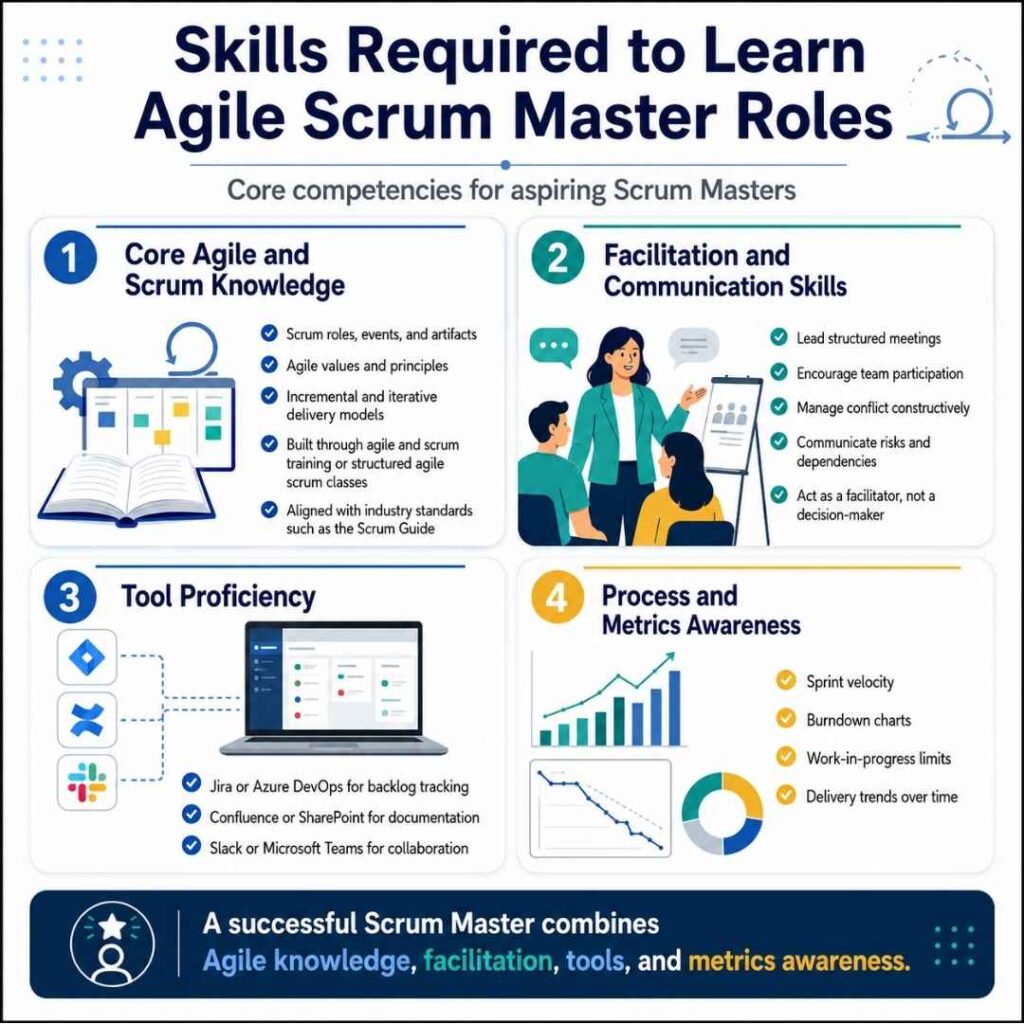
Core Agile and Scrum Knowledge
Professionals pursuing Scrum Master Jobs must understand:
- Scrum roles, events, and artifacts
- Agile values and principles
- Incremental and iterative delivery models
This knowledge is typically acquired through agile and scrum training or structured agile scrum classes aligned with industry standards such as the Scrum Guide.
Facilitation and Communication Skills
Scrum Masters act as facilitators rather than decision-makers. Key skills include:
- Leading structured meetings
- Encouraging team participation
- Managing conflict constructively
- Communicating risks and dependencies
Tool Proficiency
Most entry-level Scrum Master Jobs require familiarity with:
- Jira or Azure DevOps for backlog tracking
- Confluence or SharePoint for documentation
- Collaboration tools such as Slack or Microsoft Teams
Process and Metrics Awareness
Scrum Masters track and interpret:
- Sprint velocity
- Burndown charts
- Work-in-progress limits
- Delivery trends over time
How Is Agile Scrum Used in Enterprise Environments?
In enterprise settings, Scrum rarely operates in isolation. Instead, it is integrated with:
- Scaled Agile frameworks (SAFe, LeSS)
- DevOps pipelines
- Compliance and audit processes
- Release management workflows
Entry-level Scrum Master Jobs may involve working within hybrid models where Agile teams interface with traditional project governance structures. Understanding these constraints is critical for effective Scrum implementation.
What Job Roles Use Agile Scrum Daily?
While Scrum Masters are primary users, Agile Scrum practices are applied daily by:
- Software Developers
- QA Engineers
- Product Owners
- Business Analysts
- Release Managers
Professionals in Scrum Master Jobs collaborate closely with these roles to ensure shared understanding of priorities, acceptance criteria, and delivery expectations.
What Careers Are Possible After Learning Agile Scrum Master Skills?
Learning Scrum opens multiple career paths beyond Entry-Level Scrum Master Jobs. Common progression options include:
- Scrum Master (Mid-Level)
- Senior Scrum Master
- Agile Coach
- Delivery Manager
- Product Owner (with domain knowledge)
Experience gained in Scrum Master Jobs also supports lateral movement into program management or enterprise Agile transformation roles.
Scrum Master Training, Certification, and Cost Considerations
Scrum Master Training Options
Structured scrum master training typically includes:
- Scrum framework fundamentals
- Real-world case discussions
- Tool-based project simulations
- Enterprise workflow exposure
Many professionals combine training with scrum master training and placement programs to gain project experience alongside certification preparation.
Certification Pathways
Common agile software certification options include:
- Certified ScrumMaster (CSM)
- Professional Scrum Master (PSM I)
- SAFe Scrum Master (SSM)
Scrum Master Certification Cost
The scrum master certification cost varies depending on the certifying body, training provider, and region. Costs generally include:
- Training fees
- Exam fees
- Renewal or membership charges
Understanding certification scope is essential when targeting Scrum Master Jobs aligned with specific employer expectations.
Entry-Level Scrum Master Job Responsibilities
Typical responsibilities in Entry-Level Scrum Master Jobs include:
- Facilitating Scrum ceremonies
- Tracking sprint progress
- Removing minor impediments
- Coaching team members on Scrum practices
- Supporting Agile reporting
These responsibilities expand with experience as professionals gain confidence in stakeholder communication and process optimization.
Common Challenges Faced in Entry-Level Scrum Master Roles
New Scrum Masters often encounter challenges such as:
- Resistance to Agile adoption
- Incomplete backlog refinement
- Dependency management across teams
- Balancing facilitation with authority boundaries
Training programs that simulate enterprise scenarios help prepare professionals for these realities within Scrum Master Jobs.
Learning Path for Entry-Level Scrum Master Roles
| Stage | Focus Area | Outcome |
|---|---|---|
| Foundation | Agile principles, Scrum basics | Conceptual understanding |
| Tools | Jira, reporting dashboards | Practical execution |
| Simulation | Sprint-based projects | Real-world exposure |
| Certification | Industry-recognized exams | Credential validation |
| Placement Support | Resume, interviews | Entry-level Scrum Master Jobs |
How Agile Scrum Is Applied in Day-to-Day Tasks
A typical day in Scrum Master Jobs may include:
- Reviewing sprint metrics
- Facilitating daily stand-ups
- Coordinating with Product Owners
- Updating delivery dashboards
- Addressing blockers with stakeholders
These tasks reinforce Agile discipline while maintaining team focus on delivery goals.
FAQs: Entry-Level Scrum Master Jobs
How can I get an entry-level Scrum Master job with no experience?
To get an entry-level Scrum Master job, start by learning Agile and Scrum fundamentals, earning a Scrum certification, gaining hands-on experience through projects, and developing skills in communication, team collaboration, and problem-solving.
Is Scrum Master a good career for beginners?
Yes, Scrum Master is a good career choice for beginners who enjoy teamwork, leadership, problem-solving, and improving business processes. Many professionals transition into Scrum roles from project coordination, business analysis, QA, and IT backgrounds.
Do I need a Scrum certification to become a Scrum Master?
While not always mandatory, a Scrum certification can improve your chances of getting an entry-level Scrum Master job by showing employers that you understand Scrum roles, events, and principles.
What skills do I need for an entry-level Scrum Master job?
Key skills include Agile and Scrum knowledge, communication, leadership, conflict resolution, facilitation, Jira experience, sprint planning, backlog management, and working with cross-functional teams.
How long does it take to become a Scrum Master?
Many beginners can learn Scrum fundamentals and prepare for certification within a few weeks. Building practical experience through projects and team collaboration can help improve job readiness.
Key Takeaways
- Entry-level Scrum Master Jobs focus on facilitation, process adherence, and team enablement.
- Agile Scrum is widely used in enterprise IT delivery environments.
- Structured training, tool familiarity, and certification improve job readiness.
- Career progression is possible into senior Agile and leadership roles.
To build practical Agile skills and understand real-world Scrum workflows, explore hands-on Agile Scrum Master training programs offered by H2K Infosys.
These programs are designed to support structured learning and career development for working professionals.