If you’re planning to enroll in an AI Course , then start with Python. That’s the primary language used in most Artificial intelligence course for beginners programs today. Depending on your goals, you might also touch R, Java, C++, or SQL, but Python is where 90% of beginners begin and honestly, where many professionals stay.
Now let’s unpack that in a way that actually makes sense.
Why Python Is the First Language You Need
I’ve worked with students who came from non-tech backgrounds marketing, finance, even pharmacy and almost every reputable AI course online started them with Python. There’s a reason for that.
Python dominates AI because of its ecosystem. Libraries like:
- TensorFlow
- PyTorch
- Scikit-learn
- Pandas
- NumPy
…basically do the heavy lifting. When generative AI tools like ChatGPT went mainstream, much of the backend research and development across companies relied on Python frameworks.
Even tech giants such as Google and Meta build and publish AI research tools primarily in Python-compatible environments. That tells you something about industry standards.
And here’s something I’ve noticed beginners feel less intimidated by Python. The syntax reads almost like plain English. Compare that to C++ and you’ll see why Python feels friendlier at 11 p.m. when you’re debugging your first machine learning model.
What About R?
R is popular in academic and statistical circles. If your AI journey leans heavily toward research, data analysis, or bioinformatics, you might encounter it.
But in practical, job-oriented Ai training and placement programs? Python wins. Recruiters consistently list Python as a must-have skill in AI and machine learning roles. R is more niche now compared to five years ago.
Do You Need Java or C++?
Short answer: not at the beginning.
Long answer: it depends on your specialization.
- C++ is sometimes used in robotics or performance-heavy AI systems.
- Java appears in enterprise-level AI applications.
For example, autonomous systems research often blends Python (for modeling) and C++ (for real-time processing). Companies working on robotics platforms like Boston Dynamics use high-performance languages behind the scenes.
But if you’re just starting an Artificial intelligence course for beginners, don’t overload yourself. Focus on Python first.
SQL: The Quietly Essential Skill
This one surprises people.
AI models need data. Real-world data lives in databases. That’s where SQL comes in.
In most industry-focused AI course online programs, SQL is included because:
- You’ll need to extract datasets.
- You’ll clean and manipulate structured information.
- You’ll connect AI models to live data environments.
It’s not flashy, but it’s practical. In real jobs, querying data often takes more time than building the model.
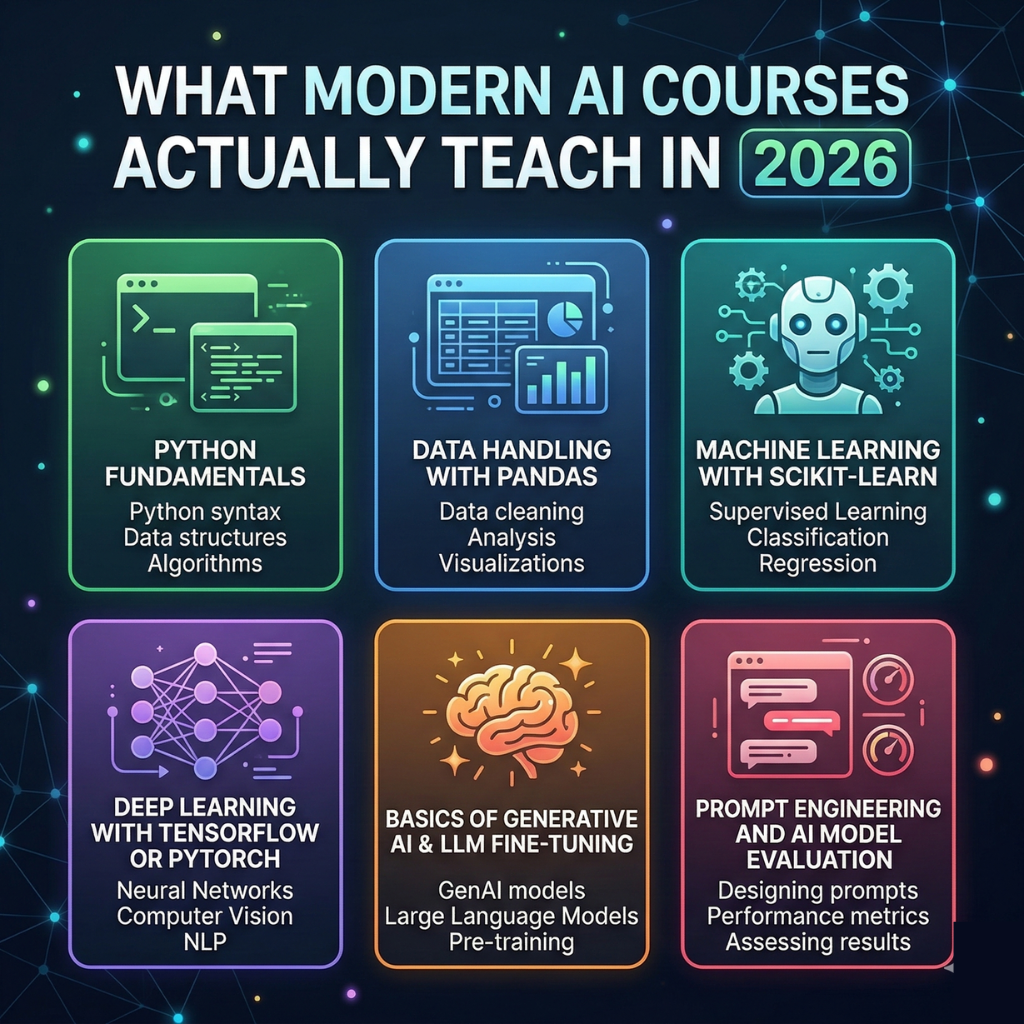
What Modern AI Courses Actually Teach in 2026
The AI education landscape has changed a lot in the past few years.
Today’s credible programs focus on:
- Python fundamentals
- Data handling with Pandas
- Machine learning with Scikit-learn
- Deep learning with TensorFlow or PyTorch
- Basics of Generative AI & LLM fine-tuning
- Prompt engineering and AI model evaluation
After the explosive growth of generative AI tools in 2023–2025, many Ai training and placement institutes started adding modules on:
- Working with APIs
- Building AI-powered apps
- Deploying models using cloud platforms
- Understanding AI ethics and governance
That last one matters more than people realize. With AI regulations evolving globally, companies want professionals who understand responsible AI use not just coding.
A Realistic Learning Path
Here’s what usually works best:
Step 1: Learn basic Python (loops, functions, data types).
Step 2: Understand statistics and probability.
Step 3: Move into machine learning concepts.
Step 4: Practice projects spam detection, recommendation systems, simple chatbots.
Step 5: Learn deployment basics.
I’ve seen students rush into neural networks without understanding data cleaning. It doesn’t end well. AI isn’t magic. It’s structured problem-solving powered by data.
Do You Need to Be a Coding Expert Before Joining an AI Course?
No.
A good Artificial intelligence course for beginners assumes you’re starting from scratch. The key isn’t knowing five programming languages. It’s understanding logic and being comfortable experimenting.
Honestly, consistency matters more than brilliance here.
I’ve watched people with average coding skills build solid AI portfolios simply because they practiced daily and built small, real projects.
Industry Expectations in 2026
Right now, hiring managers look for:
- Python proficiency
- Practical machine learning project experience
- Familiarity with cloud tools
- Understanding of generative AI systems
- Ability to explain models clearly
They care less about how many languages you know and more about whether you can solve problems.
Even startups building AI-powered SaaS products are mostly using Python stacks. The ecosystem is mature, well-documented, and backed by major tech companies.
Final Thoughts
If you’re wondering what programming languages are required to learn an AI course, here’s the honest answer:
Start with Python. Add SQL. Explore others only if your specialization demands it.
Don’t overcomplicate it.
The AI field moves fast, yes but the foundation hasn’t changed much. Strong Python skills, solid math basics, hands-on projects, and practical exposure through a structured AI course online or career-focused Ai training and placement program from H2K Infosys will take you much further than trying to master every programming language at once.
And if you’re just beginning? That’s actually the best time. The tools are more accessible than ever.