An AI course offers placement in 2026 usually isn’t built like an old-school, theory-heavy program. It’s more practical than that closer to a job-ready pathway. You’ll still learn the core concepts, but there’s a strong push toward actually doing things: building models, working on projects, and understanding how systems behave outside textbooks an approach followed in structured training programs like those offered by H2K Infosys.
Most of these programs also layer in career guidance along the way. Things like resume building, interview prep, sometimes even referrals through hiring networks. And almost all of it is delivered online now, especially through IT training providers targeting working professionals who are trying to upskill or pivot entirely.
One thing that’s better to understand upfront It’s more like structured help that nudges you in the right direction. Useful, yes but not a shortcut.
What is an Artificial Intelligence Engineer Course?
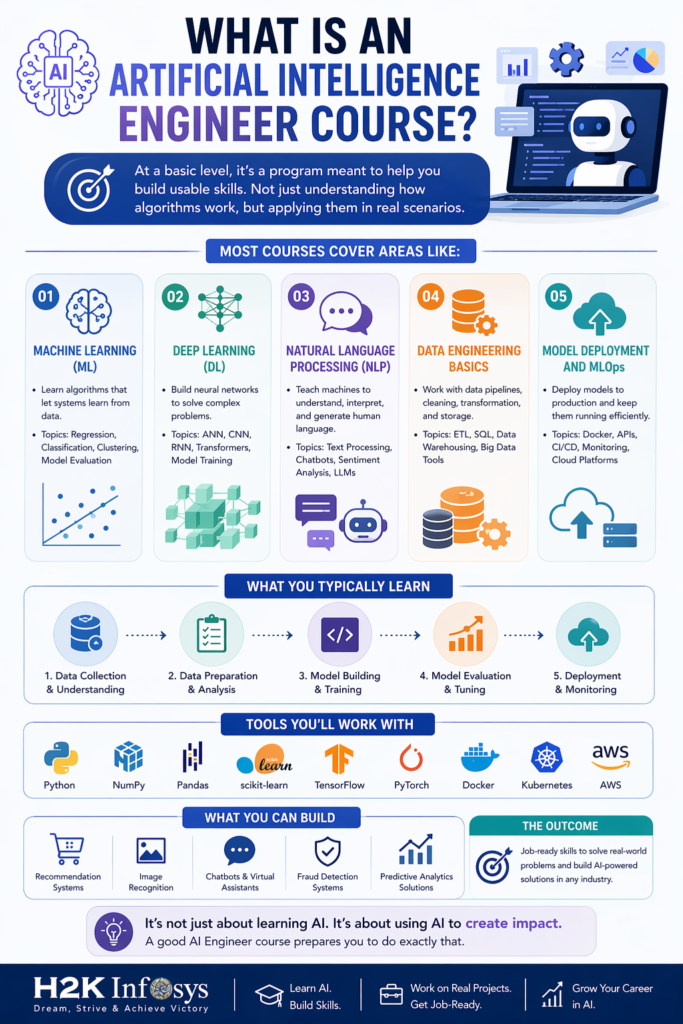
At a basic level, it’s an AI course offers placement meant to help you build usable skills. Not just understanding how algorithms work, but applying them in real scenarios.
Most courses cover areas like:
- Machine Learning (ML)
- Deep Learning (DL)
- Natural Language Processing (NLP)
- Data engineering basics
- Model deployment and MLOps
The goal is to prepare you for roles like AI Engineer, Machine Learning Engineer, or sometimes Data Scientist depending on how deep you go and what you focus on.
What You Actually Learn (and Work With)
The structure is fairly consistent across programs, though depth varies a lot.
You’ll usually start with:
- Programming fundamentals (mostly Python, plus some data structures)
Then move into:
- Machine learning models (supervised, unsupervised, using tools like Scikit-learn)
- Deep learning (neural networks, CNNs, maybe RNNs—with TensorFlow or PyTorch)
- Data handling (cleaning and transforming datasets with Pandas and NumPy)
Later, things get a bit more real-world:
- MLOps concepts (Docker, Kubernetes, deployment basics)
- Capstone projects (this is where everything comes together)
Honestly, the project phase is where most people finally get it. Before that, it can feel a bit abstract.
So… What Does Placement Support Really Mean?
This is where AI course offers placement try to differentiate themselves, but the reality is fairly grounded.
Placement support usually includes:
- Resume and LinkedIn profile refinement
- Mock interviews (often tailored to AI/ML roles)
- Help building a solid project portfolio
- Referrals through partner companies or networks
- Interview scheduling assistance
- Some soft skills coaching (how to explain your work, communicate clearly, etc.)
Again it’s support. Not a guarantee. But for a lot of learners, having that structure makes a noticeable difference.
How AI Actually Shows Up in Real Projects
In real environments, AI isn’t just “train a model and you’re done.” It’s a full pipeline.
Something like:
- Data collection (databases, APIs, logs)
- Preprocessing (cleaning, transforming messy data)
- Model training (choosing and tuning algorithms)
- Evaluation (metrics like accuracy, precision, recall)
- Deployment (APIs, integration into systems)
- Monitoring (tracking performance, retraining when needed)
Take fraud detection, for example. You feed in transaction data, run it through a model, and get a risk score in real time. That output might directly influence whether a transaction gets flagged or approved. It’s not just theory it’s tied to actual business decisions.
Why Placement-Focused Helps already working
If you’re already working, time becomes a constraint pretty quickly. You don’t always have the luxury to “figure things out slowly.”
That’s where structured programs help:
- Clear learning path aligned with job roles
- Hands-on exposure to real datasets
- Guidance for transitioning into AI/ML roles
- Less guessing about what matters in interviews
Without that, people often run into the same issues:
- Plenty of theory, not enough practical work
- Weak or incomplete project portfolios
- Uncertainty about industry expectations
- Struggling in interviews despite knowing concepts
Skills You’ll Need (and Build)
You don’t need to start as an expert, but a few basics definitely help.
Before starting:
- Some programming knowledge (Python is ideal)
- Basic math (linear algebra, probability, statistics)
- Comfort working with data
During the course, you’ll build:
- Strong Python skills
- Data preprocessing and analysis techniques
- Machine learning model development
- Deep learning fundamentals
- Deployment and MLOps understanding
- Problem-solving translating business problems into AI solutions
Where AI Fits in Real Companies
AI is already baked into a lot of systems—even when it’s not obvious.
Common use cases:
- Recommendation systems
- Chatbots and virtual assistants
- Fraud detection
- Predictive maintenance
- Healthcare diagnostics
Of course, real-world implementation isn’t always smooth. You’ve got constraints data privacy, scalability, explain ability, legacy systems. Things get messy.
Job Roles You Can Move Into
Once you’ve built the skills, there are a few common paths:
- AI Engineer – builds and deploys AI systems
- Machine Learning Engineer – focuses on models and pipelines
- Data Scientist – works on analysis and predictive insights
- NLP Engineer – specializes in language-based systems
- MLOps Engineer – handles deployment and monitoring
There’s overlap between these roles, but the focus shifts slightly depending on the job.
Career Progression (What Happens After)
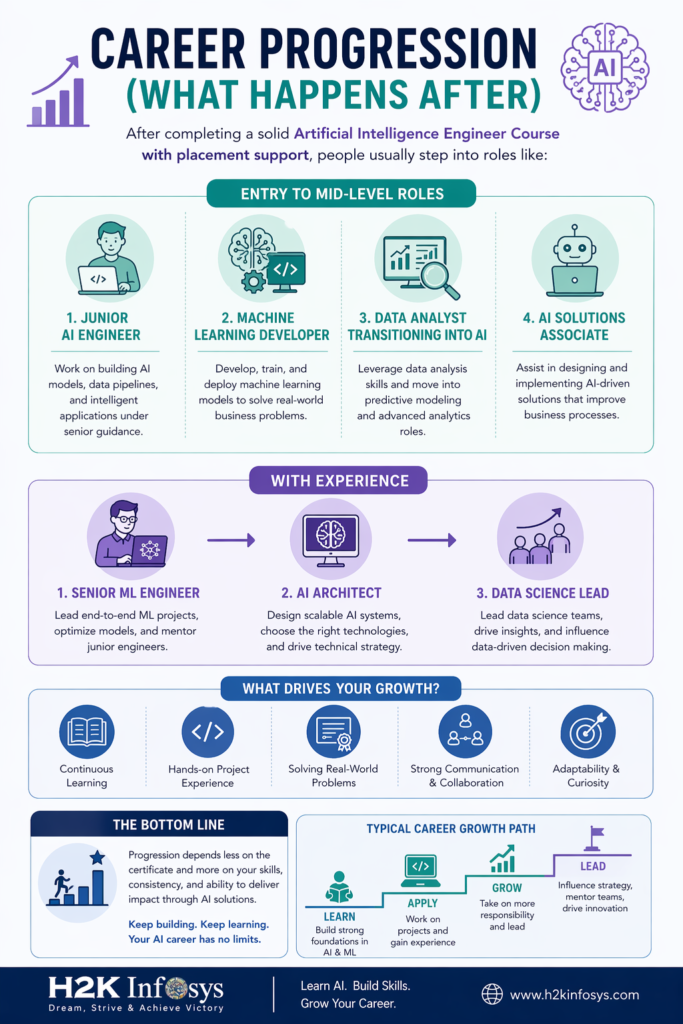
After completing a solid Artificial Intelligence Engineer Course with placement support, people usually step into roles like:
Entry to mid-level:
- Junior AI Engineer
- Machine Learning Developer
- Data Analyst transitioning into AI
- AI Solutions Associate
With experience:
- Senior ML Engineer
- AI Architect
- Data Science Lead
Progression depends less on the certificate—and more on your projects and practical exposure.
What Actually Matters When Choosing a Course (2026 Reality)
Not all courses are equal, even if they sound similar on paper.
Things that genuinely matter:
- Depth of curriculum (not just surface-level ML)
- Real-world projects (not toy examples)
- Instructor experience (industry exposure helps)
- Career support structure (ongoing, not one-off)
- Tools used (TensorFlow, cloud platforms, etc.)
- Flexibility (self-paced vs live—depends on you)
Online Certifications vs Traditional Degrees
There’s a clear difference:
- AI course offers placement: shorter (3–9 months), practical, flexible
- Traditional degrees: longer, more theory-focused
- Certifications: more affordable, often include placement support
So it really comes down to your goal—quick transition into a role, or deeper academic grounding.
A Typical Learning Flow (Rough Idea)
Most learners go through AI course offers placement something like:
- Learn Python
- Understand statistics and probability
- Study ML algorithms
- Practice with datasets
- Explore deep learning
- Learn deployment basics
- Build capstone projects
- Prepare for interviews
Not perfectly linear, but that’s the general rhythm.
Quick FAQ
Which AI course offers placement support in 2026?
Many AI course offers placement providers offer this. Some, like H2K Infosys, include structured support such as resume prep, mock interviews, and referrals.
Is AI course offers placement job guarantee?
No. It’s guidance and access—not a promise.
How long does it take?
Usually 3 to 9 months.
Can I learn while working?
Yes—most courses are designed for that.
Do I need coding experience?
Basic knowledge helps, but some courses start from scratch.
What tools will I use?
Python, TensorFlow or PyTorch, Scikit-learn, Pandas, NumPy, sometimes Docker/Kubernetes.
Do employers value these certifications?
They care more about what you can do. Projects matter more than the certificate itself.
Final Thoughts
If you strip it down, an Artificial intelligence certification online with placement support is really about two things: building practical skills and getting some guidance into the job market.
The support helps especially if you’re switching careers or don’t know what hiring teams expect. But at the end of the day, what really carries weight is your work. The projects you’ve built, how well you understand them, and how clearly you can explain them.