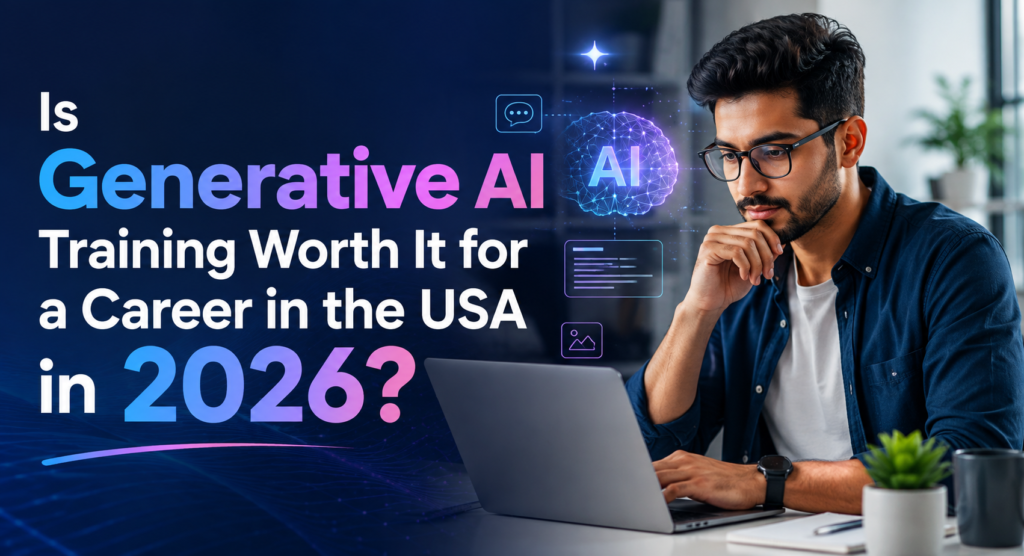
If you’re planning to build a future-proof tech career in the USA, Salesforce AI Certification is quickly becoming one of the smartest certifications to pursue right now. Companies are investing heavily in AI-powered CRM automation, predictive analytics, and intelligent customer experiences, and professionals who understand both Salesforce and AI are suddenly in very high demand.
A couple of years ago, most people looked at Salesforce as just CRM. That’s changed fast. With generative AI tools entering customer support, sales forecasting, healthcare systems, banking workflows, and even nonprofit operations, employers now want people who can work with AI directly inside the Salesforce ecosystem. That’s exactly where H2K Infosys has been gaining attention lately through practical training, project-based learning, and career-focused mentoring that actually prepares students for real-world work instead of only helping them pass exams.
And honestly, this shift feels bigger than another tech trend. The market is moving toward intelligent automation at a pace many professionals didn’t expect. That’s why Salesforce AI Certification is now showing up in job descriptions across the USA much more frequently than it did even a year ago.
Why Salesforce AI Certification Matters in 2026
The interesting thing about Salesforce AI Certification is that businesses aren’t using it only for flashy demos anymore. They’re using it to solve painfully real problems.
Think about a customer service team handling 15,000 tickets every week. AI can now summarize cases, suggest responses, predict escalation risks, and route issues automatically. Sales teams use predictive insights to decide which leads deserve attention first. Marketing departments personalize campaigns in real time based on behavior patterns.
That’s why Salesforce AI Certification has become valuable beyond traditional admin roles. Employers want professionals who understand how automation, data, AI prompts, and CRM workflows connect.
One hiring manager I spoke with recently described it pretty simply:
“Companies no longer want someone who only clicks buttons in Salesforce. They want someone who understands intelligent workflows.”
That sentence stuck with me because it explains the current market perfectly.
The demand is especially strong in industries like:
- Healthcare
- Banking and finance
- Insurance
- Retail and eCommerce
- SaaS companies
- Logistics
- EdTech
- Government consulting
A lot of businesses already use Salesforce. Now they’re layering AI into those environments. Naturally, professionals with Salesforce AI Certification are landing interviews faster because companies don’t want to train people from scratch anymore.
Salesforce AI Certification Cost in the USA
One of the first questions people ask is pretty practical:
“How much is this going to cost me?”
Fair question. Tech certifications can get expensive quickly if you aren’t careful.
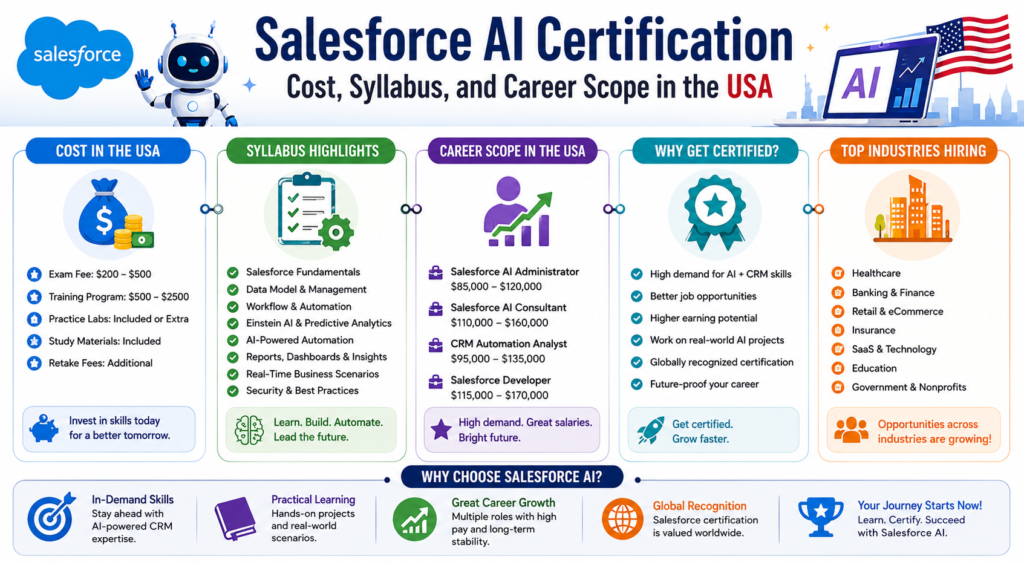
The average Salesforce AI Certification exam fee in the USA typically ranges between $200 and $500 depending on the certification path and specialization level. Training costs vary more widely because some programs are self-paced while others include live mentoring, projects, interview preparation, and placement assistance.
Here’s a realistic breakdown of what learners usually spend:
| Expense | Estimated Cost |
|---|---|
| Certification Exam | $200 – $500 |
| Training Program | $500 – $2500 |
| Practice Labs | Included or Extra |
| Mock Interviews | Often Included |
| Study Materials | Usually Included |
| Retake Fees | Additional |
Now, here’s something many beginners don’t realize immediately. Cheap courses often look attractive at first, but they sometimes skip practical AI implementation training. That becomes a problem during interviews because recruiters increasingly ask scenario-based questions rather than theory.
Good Salesforce online classes should include:
- Live Salesforce environments
- AI workflow exercises
- Prompt engineering basics
- Automation scenarios
- Resume preparation
- Real business use cases
- Placement guidance
That’s one reason many learners lean toward structured programs rather than random recorded tutorials floating around online.
Another trend worth mentioning: employers in the USA increasingly reimburse certification costs if candidates already show practical capability. Several consulting companies now sponsor internal AI upskilling because Salesforce AI adoption is growing faster than expected.
Salesforce AI Certification Syllabus: What You Actually Learn
The syllabus is much more practical than many people expect. It’s not just theoretical AI concepts copied from textbooks.
A modern Salesforce AI Certification program generally combines CRM administration, automation, analytics, and generative AI tools into one learning path.
Typical modules include:
Salesforce Fundamentals
You start with the Salesforce ecosystem itself:
- Objects and fields
- Data models
- Reports and dashboards
- Workflow automation
- User permissions
- Security settings
This part overlaps nicely with standard Salesforce administrator training, which is still extremely important because AI systems rely heavily on clean data structures.
AI and Automation Concepts
Then comes the newer AI-focused side:
- Predictive analytics
- Einstein AI tools
- AI-generated recommendations
- Workflow intelligence
- Automated case summarization
- Intelligent lead scoring
This is where many learners suddenly realize how powerful the platform has become.
A friend of mine who worked in retail operations switched into Salesforce consulting last year. He told me the biggest surprise wasn’t coding it was learning how businesses use AI to reduce repetitive work for employees.
That’s exactly the type of thinking modern employers want.
The technical side of Salesforce AI Certification also covers practical workflow building instead of just memorization. You’ll usually work with:
- Flow Builder
- AI-powered CRM automation
- Data-driven decision systems
- Customer engagement personalization
- Prompt-based AI configurations
Real-Time Business Scenarios
This section matters a lot.
Strong programs don’t teach AI in isolation. They teach real business implementation.
For example:
- Healthcare patient support automation
- Banking customer retention prediction
- Retail recommendation engines
- Insurance claim prioritization
- AI-driven sales forecasting
Honestly, this applied learning approach is what separates serious Salesforce certification courses from generic training videos.
Because recruiters can tell immediately whether someone learned from practical projects or only memorized exam questions.
Best Learning Path for Beginners
A lot of people entering this field are not from hardcore technical backgrounds. Some come from support jobs, finance, marketing, operations, healthcare, or even teaching.
That’s completely normal now.
In fact, many training institutes are redesigning their Salesforce online classes specifically for career switchers because the demand pipeline is growing so quickly.
The best approach usually looks something like this:
- Learn Salesforce basics
- Understand CRM workflows
- Practice automation
- Study AI-powered features
- Build projects
- Prepare for interviews
- Take certification exams
That sounds straightforward on paper. In reality consistency matters more than speed.
One mistake beginners make is jumping directly into AI topics without understanding Salesforce fundamentals first. That usually creates confusion later because AI recommendations depend heavily on platform structure and business logic.
A balanced Salesforce AI Certification training path should therefore include:
- Beginner-friendly explanations
- Hands-on labs
- Real client scenarios
- AI implementation practice
- Interview coaching
- Resume optimization
And honestly, Salesforce AI Certification mentorship matters more than many people think. When learners get stuck configuring automation or understanding business use cases, access to experienced trainers makes a huge difference.
For learners trying to enter this field, H2K Infosys has become one of the practical places where professionals start building those job-ready skills through structured Salesforce training certification programs and hands-on learning.
Career Scope of Salesforce AI Certification in the USA
This is probably the part most people care about the most.
Is the certification actually worth it for jobs?
Short answer: yes, especially in 2026.
The demand for AI-enabled CRM professionals is growing across the USA because businesses are trying to automate operations without replacing their entire software ecosystem. Since Salesforce already dominates the CRM space, organizations are simply adding AI capabilities into systems they already use.
That’s why Salesforce AI Certification now opens doors to multiple career paths instead of just one.
Popular job roles include:
- Salesforce AI Administrator
- Salesforce Consultant
- CRM Automation Specialist
- AI Workflow Analyst
- Salesforce Business Analyst
- AI Support Operations Specialist
- Salesforce Developer
- Customer Experience Automation Consultant
Average salary ranges in the USA currently look something like this:
| Role | Estimated Salary |
|---|---|
| Salesforce Administrator | $85,000 – $120,000 |
| Salesforce AI Consultant | $110,000 – $160,000 |
| CRM Automation Analyst | $95,000 – $135,000 |
| Salesforce Developer | $115,000 – $170,000 |
And yes, location still matters.
Cities like:
- Dallas
- Austin
- Atlanta
- Seattle
- New York
- Chicago
- San Francisco
continue seeing strong hiring activity for Salesforce-AI hybrid roles.
What’s interesting lately is that remote opportunities are increasing again. Many companies realized AI workflow configuration can easily be handled by distributed teams. That creates more flexibility for professionals entering through Salesforce training and placement programs.
Real Industry Trends Shaping the Future
There’s another reason this field feels especially strong right now.
Businesses are under pressure to improve customer experience without dramatically increasing staffing costs. AI inside Salesforce helps them do exactly that.
Recent enterprise trends include:
- AI-generated customer summaries
- Predictive customer churn analysis
- Smart recommendation engines
- Automated support workflows
- AI-assisted sales pipelines
- Conversational CRM systems
And this isn’t limited to giant corporations anymore. Mid-sized businesses are adopting AI tools much faster because implementation has become simpler and more affordable.
That expansion is directly increasing the value of Salesforce AI Certification in the job market.
I’ve noticed something else too. Recruiters are beginning to prioritize “problem-solving ability” over purely technical jargon. Candidates who can explain how AI improves customer operations tend to perform better in interviews than people who only memorize definitions.
That’s why project-based Salesforce certification courses are becoming more valuable than theory-heavy learning alone.
Why H2K Infosys Stands Out for Salesforce AI Training
There are plenty of training providers online, obviously. But learners usually look for a few very specific things now:
- Real projects
- Flexible schedules
- Interview preparation
- Placement support
- Practical labs
- Experienced mentors
That’s where H2K Infosys has built a pretty solid reputation in recent years.
Their approach toward Salesforce administrator training and AI-focused modules is more aligned with real hiring expectations instead of only exam preparation. Students often work on implementation-style scenarios that mirror actual workplace challenges.
One thing many learners appreciate is the combination of:
- Live instructor-led sessions
- Recorded access
- Mock interviews
- Resume guidance
- Hands-on project environments
- Career mentoring
The placement-focused structure matters because many students entering these programs are career changers rather than experienced Salesforce professionals.
A strong Salesforce AI Certification training experience should help people become employable, not just certified. That distinction is becoming more important every year.
Common Challenges Beginners Face
It’s not always smooth sailing at the beginning, honestly.
Most learners struggle with one of these:
Understanding CRM Logic
People sometimes focus too much on the software and forget the business process side.
Salesforce is really about customer workflows first.
Balancing AI and Administration
Some students rush into AI tools without understanding reporting, permissions, workflows, and automation basics.
That creates gaps later.
Lack of Real Practice
Watching tutorials isn’t enough anymore.
Recruiters increasingly ask:
“What projects have you built?”
That’s why practical Salesforce online classes matter much more than passive video learning.
Interview Anxiety
This one is huge.
A lot of talented learners know the material but freeze during interviews because they haven’t practiced scenario-based questions.
Programs offering Salesforce training and placement support can help bridge that gap significantly.
Is Salesforce AI Certification Worth It in 2026?
For most people entering cloud technology, CRM consulting, or AI-powered business operations, the answer is yes.
The combination of Salesforce and AI is becoming deeply integrated into how businesses manage customers, automate support, and improve decision-making.
That’s why Salesforce AI Certification is increasingly viewed as a long-term career investment rather than a short-term trend.
It’s especially valuable for:
- Career switchers
- IT beginners
- Business analysts
- Support professionals
- CRM specialists
- Operations managers
- Marketing professionals
And unlike some niche technologies that disappear after hype cycles, Salesforce already has massive enterprise adoption globally. AI is simply becoming the next layer on top of that foundation.
That creates unusually strong stability for professionals entering this space now.
Final Thoughts
The tech industry is changing fast, but not every certification keeps pace with real business demand. Salesforce AI Certification stands out because it combines two things companies actively need today: CRM expertise and practical AI implementation skills.
If you approach it seriously with hands-on learning, projects, and interview preparation the career opportunities can be genuinely impressive in the USA market. Strong Salesforce certification courses, practical Salesforce online classes, structured Salesforce administrator training, and reliable Salesforce training and placement support all play a major role in helping learners transition into high-paying roles with confidence.