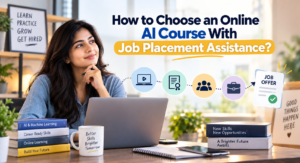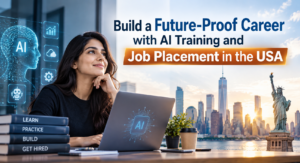
Yes, strong AI course career support can help you become job-ready and get hired faster but only when it goes beyond recorded lessons and a completion certificate. At H2K Infosys, the focus is on practical career development through guided projects, portfolio building, interview preparation, job-matching assistance, mentorship, and honest feedback about where your skills stand.
Plenty of learners complete an Ai Training and Job Placement and still feel stuck when they open a job portal. They know Python basics. They may have built a chatbot or trained a small machine-learning model. Yet when a recruiter asks, “What business problem did you solve?” the answer becomes vague.
This is the gap that effective AI training and job placement support is supposed to close.
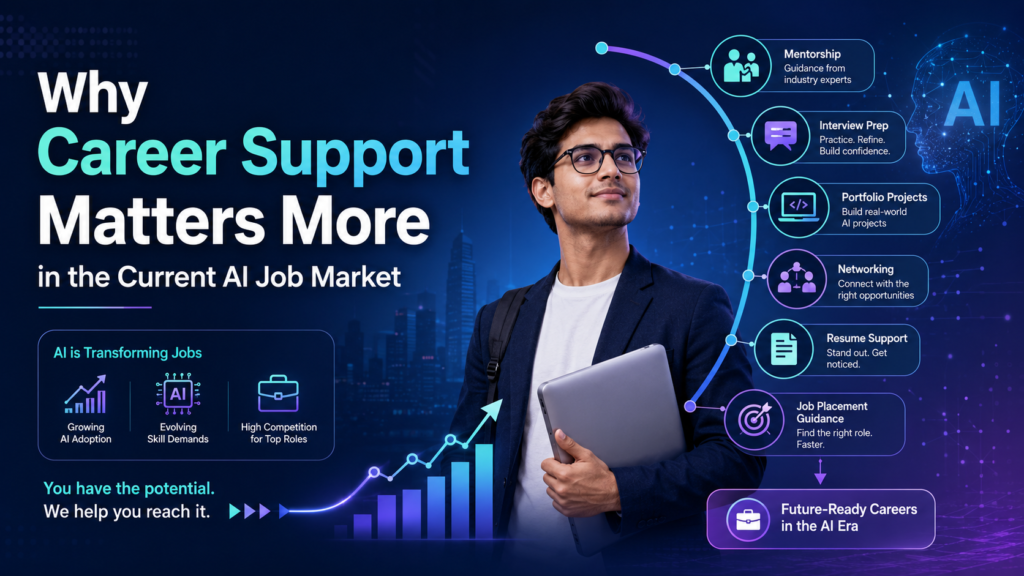
Why Career Support Matters More in the Current AI Job Market
The AI job market is growing, but it is not necessarily becoming easier to enter.
Indeed’s US labour-market data showed that job postings mentioning AI were 134% above their February 2020 level at the end of 2025, while total job postings were only about 6% above that baseline. In plain English, the overall hiring market remained fairly restrained, but AI-related AI Course Career Support skills were appearing in a growing share of available opportunities.
Entry-level expectations are changing too. An April 2026 survey from the National Association of Colleges and Employers found that more than one-third of entry-level jobs represented in its employer survey required AI Course Career Support skills nearly three times the proportion reported in fall 2025. Almost 60% of participating employers were also assigning interns work involving AI tools or skills.
So, yes, there are opportunities. But companies are becoming more particular about what “knowing AI” actually means.
They are not simply looking for someone who has watched 40 hours of videos. They want someone who can:
- Understand a real problem
- Select an appropriate AI approach
- Work with imperfect data
- Check the reliability of AI-generated output
- Explain the result to a non-technical person
- Make sensible decisions when the model gets something wrong
That is why the career-support layer of an AI course can be just as important as the syllabus itself.
What Does AI Course Career Support Actually Include?
Career support is a broad label. Sometimes it means a structured pathway from learning to interviews. Sometimes, frankly, it means access to a generic job board and two résumé templates.
A credible AI Course Career Support programme should help you move through four distinct stages.
1. Turning Course Knowledge Into Job-Ready Skills
Learning a concept and applying it at work are different things.
You might understand retrieval-augmented generation, for example. But can you build a AI Course Career Support assistant that retrieves the correct policy document, refuses to invent an answer when information is missing, and records user feedback for later evaluation?
That is closer to what an employer cares about.
Good AI Course Career Support helps you convert technical topics into practical abilities. Instead of merely saying, “I learned natural language processing,” you should be able to say:
“I built a document-search assistant for an HR use case, evaluated retrieval accuracy, identified common failure cases, and improved the response process by adjusting document chunking and validation rules.”
The second version gives an interviewer something concrete to discuss.
2. Building a Portfolio That Looks Like Real Work
A portfolio should not feel like a folder full of classroom assignments.
Recruiters see the same beginner projects repeatedly: house-price prediction, iris classification, sentiment analysis and a basic chatbot connected to an API. These exercises can be useful while learning, but they rarely make a candidate memorable on their own.
A stronger portfolio shows how you think.
For each project, explain:
- The problem you chose
- Who would use the solution
- Why AI was appropriate
- Which tools and models you considered
- How you evaluated the output
- What failed during development
- What you would improve before production
- What business or user outcome the project could affect
That “what failed” section is especially valuable. Real AI projects are messy. Models hallucinate, datasets contain gaps, integrations break and the first approach often performs badly. Pretending everything worked perfectly can actually make a project feel less credible.
A Practical Example: Two Candidates, Similar Technical Skills
Consider two learners applying for a junior AI analyst role.
The first candidate lists Python, machine learning, prompt engineering and three certifications. Their portfolio contains screenshots and links to notebooks, but very little explanation.
The second candidate has similar technical knowledge. However, one of their projects analyses customer-support tickets for a fictional e-commerce business. They explain how they cleaned the data, grouped recurring complaints, tested AI-generated classifications, measured errors and created a review process for uncertain results.
During the interview, the second candidate can discuss trade-offs, mistakes and business value. They may not know every technical answer, but they give the recruiter evidence of structured thinking.
In most real hiring situations, that evidence is far more useful than another logo on a certificate.
A good AI Course Career Support would help the first learner become more like the second.
Can AI Courses With Placement Guarantee a Job?
No responsible AI Course Career Support training provider can guarantee that every learner will receive a job.
Hiring depends on too many variables:
- Your starting skills
- The quality of your projects
- Your location and work eligibility
- The roles you target
- Salary expectations
- Communication ability
- Interview performance
- Market conditions
- The consistency of your applications
The phrase AI Courses with Placement should therefore be examined carefully. “Placement” may refer to guaranteed interviews, access to hiring partners, internship referrals, application support or simply the opportunity to apply for vacancies shared by the institute.
Before enrolling, ask the provider to define placement AI Course Career Support in writing. Find out whether it includes direct interview opportunities, and whether every learner receives them or only candidates who meet specific assessment criteria.
Also ask for outcome data that can be verified:
- How many students joined the programme?
- How many completed it?
- How many actively requested placement support?
- How many received interviews?
- How many accepted relevant jobs?
- What was the reporting period?
- Were internships and freelance assignments counted as placements?
- Is the published salary an average, a median or simply the highest offer?
How Career Support Can Help You Get Hired Faster
AI Course Career Support does not make recruiters lower their standards. What it can do is remove avoidable delays from your job search.
It Helps You Target the Right Roles
“AI job” is not one role.
Depending on your background, realistic starting points may include:
- Junior data analyst
- AI-enabled business analyst
- Machine-learning intern
- Data science associate
- Automation specialist
- Generative AI application developer
- AI operations analyst
- Model evaluation or quality analyst
- Product analyst working with AI features
- Domain specialist using AI in finance, marketing, healthcare operations
A commerce graduate with strong Excel, SQL and business-analysis skills may be better positioned for an AI-enabled analyst role than an entry-level AI Course Career Support machine-learning engineering position. That is not settling. It is choosing a more credible entry route.
Good mentors recognise this. Weak programmes push every learner toward the same glamorous job title.
It Improves Your Résumé and LinkedIn Positioning
Many candidates write résumés that describe what they studied instead of what they can do.
Compare these two statements:
Weak:
“Completed an AI and machine-learning course covering Python, NLP and deep learning.”
Stronger:
“Developed a customer-query classification workflow using Python and language models, evaluated incorrect classifications, and introduced a human-review rule for low-confidence outputs.”
The stronger version gives recruiters evidence. It also gives them keywords without sounding like a list copied from a course brochure.
This skills-first approach fits the broader direction of hiring. LinkedIn’s 2026 Skills on the Rise analysis says employers are placing greater emphasis on demonstrated skills rather than relying only on degrees, job titles or linear career histories. Its data also points to growing demand for both technical AI capabilities and AI business strategy.
In India, a World Economic Forum country analysis reported that 30% of surveyed Indian employers were implementing skills-based hiring by removing degree requirements, compared with 19% globally. AI Course Career Support AI and machine-learning specialists were also identified among the country’s fastest-growing roles.
It Gives You Real Interview Practice
AI interviews can become technical very quickly, but technical accuracy is only one part of the assessment.
An interviewer may ask:
- Why did you choose this model?
- How would you detect hallucinations?
- What happens when the source data changes?
- How would you protect confidential information?
- What metric did you use, and why?
- When should a human review the output?
- How would you explain this solution to a business manager?
- Why use AI here instead of a simpler rule-based system?
Mock interviews help because they expose unclear thinking before a real employer does.
They also reveal small habits that quietly hurt candidates: giving five-minute answers to simple questions, using technical terms without explaining them, claiming team projects as individual work, or avoiding discussion of errors.
It is uncomfortable feedback. Useful, though.
It Creates Access and Accountability
A well-run placement team may introduce learners to hiring partners, recommend suitable profiles, organise recruitment drives or share openings that are not widely advertised.
Even when direct introductions are limited, regular application reviews and follow-ups can keep a learner moving. Job searching is repetitive, and after a few rejections it is easy to start applying randomly or stop altogether.
AI Course Career Support creates a process:
- Identify suitable roles.
- Tailor the application.
- Track responses.
- Review rejection patterns.
- Improve weak areas.
- Apply again with better evidence.
That process is not exciting, but it works better than sending the same résumé to 200 unrelated vacancies.
Technical Skill Alone Is No Longer Enough
There is a persistent idea that every successful AI career requires advanced mathematics, model development and hardcore programming.
That is true for some roles, not all of them.
A 2026 OECD report concluded that fewer than 1% of workers are likely to require advanced AI-specific capabilities such as programming AI systems or developing models. A much larger group will need the ability to use digital tools, analyse data, interpret AI output and combine that knowledge with problem-solving, creativity, innovation and management skills.
This is actually encouraging.
It means a marketing professional can build expertise in AI-assisted campaign analysis. A finance professional can learn anomaly detection and automated reporting. A recruiter can specialise in responsible AI-assisted hiring workflows. A customer-service manager can learn to evaluate and improve support automation.
You do not always need to abandon your existing field. Often, the stronger career move is to add AI capability to domain knowledge you already possess.
Entry-Level Work Is Becoming More Analytical
AI is automating parts of junior work, but that does not automatically mean junior employees disappear.
The work itself is changing.
Research published by the Strada Education Foundation in 2026 found that more than 40% of surveyed employers said AI had increased the analytical responsibilities given to entry-level employees. A similar proportion reported reductions in routine administrative tasks. Employers still rated critical thinking, communication and collaboration as especially important.
That creates a slightly awkward situation for new candidates. Employers want people who can handle more complex work, but beginners still need a place to gain experience.
This is where simulations, internships, capstone projects and mentor-led assignments become useful. They cannot fully replace workplace experience, but they can give you realistic material to discuss in interviews.
How to Choose the Right AI Training and Job Placement Programme
Before paying for a course, look beyond the number of modules and tools listed on the sales page.
Check Whether the Curriculum Matches Current Jobs
Look at 20 to 30 recent job descriptions for roles you might realistically pursue. Write down the skills that appear repeatedly.
Then compare them with the curriculum.
A useful programme should teach relevant foundations while also covering current working practices such as model evaluation, generative AI application development, data handling, API integration, responsible AI, privacy and human oversight.
Be cautious of AI Course Career Support built almost entirely around one trendy tool. Tools change quickly. Your ability to define problems, test outputs and learn new systems will last longer.
Examine the Projects Closely
Ask to see anonymised examples of previous student projects.
Are they original and industry-focused, or does every learner build exactly the same application? Do students make meaningful decisions, or simply follow a tutorial line by line?
The project should leave room for interpretation, testing and improvement. Otherwise, you may finish with something that looks polished but cannot explain what is happening underneath.
Verify Mentor Quality
A mentor does not need to be a social-media celebrity. They should, however, understand current AI workflows and know how hiring works for the roles being discussed.
Check whether mentors provide individual feedback. Group webinars can be useful, but they are not a substitute for someone examining your project, résumé or interview answers.
Understand the Placement Terms
Ask direct questions:
- Are AI Course Career Support interviews guaranteed or only placement assistance?
- Which companies hired learners during the last 12 months?
- Which job titles were offered?
- How many learners were placed in genuinely AI-related roles?
- Does support expire after a fixed period?
- Are learners required to maintain attendance or assessment scores?
- Are unpaid internships included in the placement rate?
A trustworthy provider should answer without becoming defensive.
Speak With Former Learners
Do not rely only on testimonials published on the provider’s website.
Find former students independently on professional networks. Ask what the support looked like after course completion, how many interviews they received and what they had to do on their own.
One learner’s experience does not prove everything, of course. But after five or six conversations, patterns usually become visible.
Red Flags to Watch For
Think twice when a programme:
- Guarantees an unusually high salary regardless of experience
- Refuses to explain how placement rates are calculated
- Uses only the highest student salary in its marketing
- Promises an AI engineer role to complete beginners within a few weeks
- Offers no live project review
- Teaches tools without foundational concepts
- Cannot show recent employer relationships
- Counts every internship, freelance task or unrelated job as a placement
- Pressures you to enrol immediately because a “scholarship” expires tonight
The AI Course Career Support education market is crowded. Urgency is often a sales technique, not evidence that a programme is right for you.
What You Still Need to Do as a Learner
Even the AI Course Career Support cannot do the work on your behalf.
You will still need to:
- Practise consistently outside class
- Read documentation
- Rebuild projects without copying the instructor
- Apply for roles regularly
- Accept feedback without taking it personally
- Improve communication skills
- Keep learning as tools change
- Develop knowledge of the industry you want to enter
One useful habit is to keep a project journal. Write down what you attempted, what broke, what you changed and why. Those notes become excellent interview material later.
They also make your work sound like your work which, oddly enough, is becoming more important as recruiters receive more generic, AI-generated applications.
Can Career Support Help You Build a Successful Long-Term Career?
It can help you enter the market, but long-term success comes from something broader: career adaptability.
Your first AI-related job may not have your dream title. It might be an analyst position where 25% of the work involves AI. That can still be a valuable starting point.
Once you are inside an organisation, you begin learning things courses struggle to reproduce:
- How teams define priorities
- How data is actually stored
- Why technically good ideas get rejected
- How security and compliance affect implementation
- How users behave differently from test participants
- How to explain AI risks to decision-makers
- How to maintain a system after launch
Those experiences compound over time.
The people most likely to build sustainable AI Course Career Support will not be those who memorise the largest number of tools. They will be the ones who understand their domain, use AI responsibly, communicate clearly and keep adapting as the work changes.
Final Answer: Is AI Course Career Support Worth It?
AI course career support is worth paying for when it provides structured mentorship, relevant projects, portfolio feedback, interview preparation, realistic role targeting and genuine access to employers.
It is not worth much when “placement assistance” means receiving a list of public job links after completing the course.
The certificate may help begin a conversation. Your proof of work, judgment and communication will usually decide whether that conversation continues.
So, when comparing AI Course Career Support, do not ask only, “What will they teach me?”
Ask:
“What evidence will I have at the end, and how will they help me present that evidence to the right employers?”
That question tends to cut through the marketing surprisingly fast.
Frequently Asked Questions
Do AI courses with placement guarantee employment?
No. Reputable programmes may provide interview opportunities, employer introductions, application guidance and recruitment support, but the final decision remains with the employer. Always check the exact placement terms before enrolling.
Can a beginner get an AI job after completing a course?
Yes, but the target role should match the learner’s background and demonstrated skills. Beginners may enter through internships, analyst positions, automation roles, data-focused work or domain-specific jobs that use AI rather than immediately becoming machine-learning engineers.
How long does it take to become job-ready in AI?
The timeline depends on your existing knowledge, the role you are targeting and the amount of practical work you complete. Someone with programming and data experience may progress faster than a complete beginner. Project quality is generally more important than rushing through a fixed number of weeks.
Is coding required for an AI career?
Coding is essential for AI engineering and model-development roles, but many AI-enabled business, operations, product and domain roles require practical AI literacy rather than advanced programming. Data interpretation, critical thinking and communication remain important across both technical and non-technical positions.
What should an AI portfolio contain?
Include two to four well-documented projects that solve realistic problems. Explain the data, approach, evaluation method, limitations, ethical considerations, failures and possible business impact. A few detailed projects are usually stronger than a large collection of copied exercises.
What is the difference between placement assistance and guaranteed placement?
AI Course Career Support generally means support with applications, résumés, interviews, job leads or employer introductions. Guaranteed placement suggests a defined employment outcome, but such claims often include conditions and exclusions. Read the written policy carefully before paying.