Artificial Intelligence Online Training 2026 in USA by H2K Infosys is designed to provide working professionals with foundational and advanced knowledge in AI concepts, tools, and practical applications. These courses can include topics such as machine learning, deep learning, natural language processing (NLP), computer vision, and AI system deployment. Ai Training Programs offer flexible, self-paced learning options that can be accessed remotely, enabling professionals across the USA to upskill without relocating or interrupting their careers.
Who is Eligible for AI Training Programs in the USA?
Artificial Intelligence Online Training in the USA is generally open to a wide range of learners, provided they meet certain prerequisites:
- Working IT professionals seeking to advance in roles involving AI, data analytics, or automation.
- Recent graduates in computer science, information technology, mathematics, statistics, or related STEM fields.
- Career switchers from fields such as software development, business intelligence, or data engineering who want to specialize in AI.
- Entrepreneurs and business analysts aiming to integrate AI solutions in enterprise processes.
- Prerequisites usually include:
- Basic programming knowledge (Python is most common)
- Understanding of statistics, linear algebra, and probability
- Familiarity with databases and data manipulation
Most Artificial Intelligence Online Training 2026 in USA do not impose strict age or nationality limits; however, some programs may require proof of prior education or relevant experience.
How Does Artificial Intelligence Work in Real-World IT Projects?
AI operates in enterprise projects through a combination of algorithms, data processing pipelines, and model deployment strategies:
- Data Collection and Preprocessing
Professionals collect structured and unstructured datasets from enterprise systems, external APIs, or IoT devices. Data is cleaned, normalized, and prepared for model training. - Model Training and Evaluation
- Machine learning models (e.g., regression, classification, clustering) or deep learning architectures (e.g., CNNs for images, RNNs for sequential data) are trained on the prepared datasets.
- Evaluation metrics such as accuracy, precision, recall, and F1-score are applied.
- Deployment and Monitoring
Models are deployed in production using cloud platforms (AWS, Azure, GCP) or on-premise environments. Continuous monitoring ensures performance, scalability, and compliance. - Enterprise Workflows
AI can optimize workflows in finance, healthcare, logistics, retail, and customer service by automating routine tasks, generating insights, and enabling predictive analytics.
Why is AI Online Training Important for Working Professionals?
Artificial Intelligence Online Training 2026 in USA equips professionals with:
- Up-to-date technical skills to meet industry demands in AI, ML, and data-driven decision-making.
- Practical understanding of enterprise tools such as TensorFlow, PyTorch, scikit-learn, and NLP frameworks like spaCy.
- Career advancement opportunities in high-demand fields including AI engineering, data science, and machine learning operations (MLOps).
- Hands-on experience through projects and labs, bridging theoretical knowledge with practical application.
In 2026, organizations increasingly seek employees who can apply AI to optimize operations, enhance product intelligence, and drive strategic business insights.
What Skills Are Required to Learn Artificial Intelligence Online?
Professionals enrolling in AI Certified Courses should aim to acquire the following skill sets:
- Programming Skills: Python, R, or Java for algorithm implementation
- Mathematical Foundations: Linear algebra, probability, statistics, and calculus
- Data Engineering: Data wrangling, ETL processes, and database querying (SQL/NoSQL)
- Machine Learning & Deep Learning: Supervised, unsupervised, reinforcement learning
- AI Tools & Frameworks: TensorFlow, PyTorch, Keras, scikit-learn, OpenCV, NLP libraries
- Cloud & DevOps Knowledge: Deployment on cloud platforms, containerization (Docker), CI/CD pipelines
- Soft Skills: Problem-solving, critical thinking, and domain-specific knowledge
Table: Skill vs Role Mapping
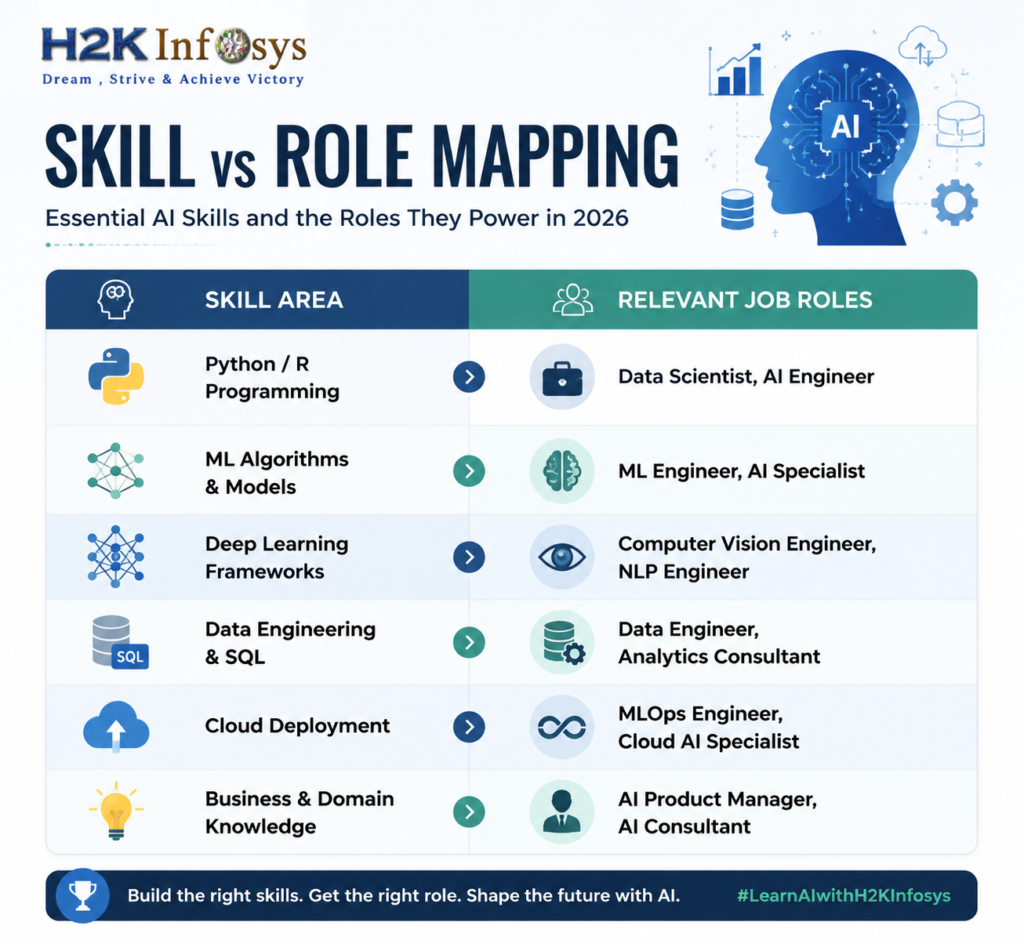
| Skill Area | Relevant Job Roles |
|---|---|
| Python / R Programming | Data Scientist, AI Engineer |
| ML Algorithms & Models | ML Engineer, AI Specialist |
| Deep Learning Frameworks | Computer Vision Engineer, NLP Engineer |
| Data Engineering & SQL | Data Engineer, Analytics Consultant |
| Cloud Deployment | MLOps Engineer, Cloud AI Specialist |
| Business & Domain Knowledge | AI Product Manager, AI Consultant |
How is AI Used in Enterprise Environments?
AI implementation varies across industry sectors:
- Healthcare: Predictive diagnostics, medical imaging, and patient monitoring.
- Finance: Fraud detection, credit scoring, and risk management.
- Retail: Recommendation systems, inventory optimization, and customer sentiment analysis.
- Manufacturing: Predictive maintenance, defect detection, and supply chain optimization.
- Customer Service: Chatbots, automated support, and sentiment-based interaction.
Workflow Example: AI-Powered Predictive Maintenance
- Sensor data collection from industrial machinery.
- Data preprocessing and feature extraction.
- Model training to predict failure probabilities.
- Integration into enterprise monitoring dashboards.
- Scheduled maintenance triggered by AI predictions.
What Job Roles Use AI Daily?
AI skills are increasingly integral to the following roles:
- AI Engineer
- Data Scientist / Machine Learning Engineer
- NLP Engineer
- Computer Vision Specialist
- MLOps Engineer
- AI Product Manager
- Business Intelligence Analyst
- Research Scientist (AI-focused)
Each role leverages AI frameworks, deployment pipelines, and analytics to solve domain-specific problems.
What Careers Are Possible After Completing AI Certified Courses?
Completing Artificial Intelligence Online Training opens up career pathways including:
- AI Engineer / Machine Learning Engineer: Develop and deploy predictive models.
- Data Scientist: Analyze data to uncover actionable insights using AI models.
- NLP Engineer: Build language-based AI applications such as chatbots and sentiment analysis tools.
- Computer Vision Engineer: Work on image recognition, object detection, and visual automation.
- MLOps Engineer: Maintain AI models in production with scalability, reliability, and performance.
- AI Consultant / Analyst: Advise organizations on AI adoption, feasibility, and ROI.
Table: Learning Path and Certifications
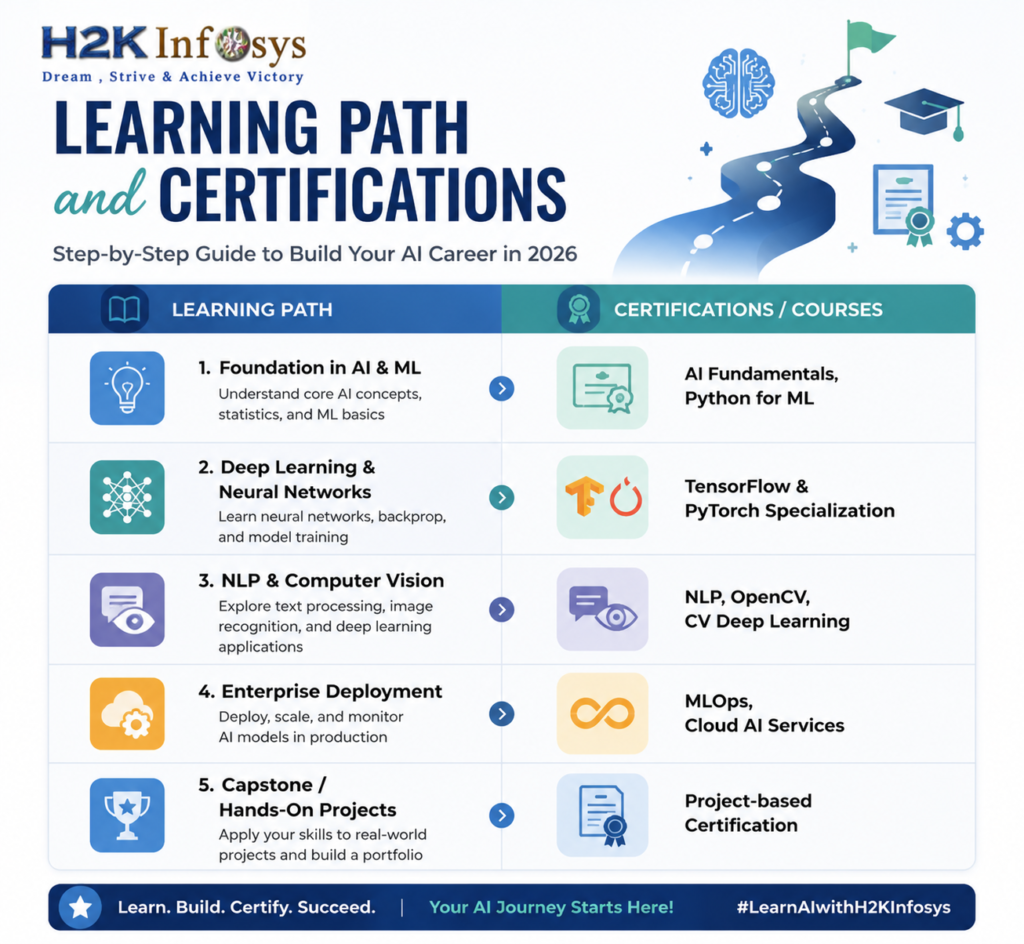
| Learning Path | Certifications / Courses |
|---|---|
| Foundation in AI & ML | AI Fundamentals, Python for ML |
| Deep Learning & Neural Networks | TensorFlow & PyTorch Specialization |
| NLP & Computer Vision | NLP, OpenCV, CV Deep Learning |
| Enterprise Deployment | MLOps, Cloud AI Services |
| Capstone / Hands-On Projects | Project-based Certification |
FAQ: Artificial Intelligence Online Training in USA
Q1: Do I need prior experience in AI to enroll?
A1: No prior AI experience is required, but basic programming and math knowledge is recommended.
Q2: Can non-IT professionals enroll?
A2: Yes, professionals from related domains (finance, business analysis, healthcare) can enroll if they are willing to acquire technical prerequisites.
Q3: Are these courses recognized in the USA?
A3: Most AI certified courses are industry-recognized and align with widely adopted AI frameworks and tools.
Q4: How long does it take to complete AI online training?
A4: Duration varies from 3–12 months depending on course depth and learning pace.
Q5: Is hands-on practice included?
A5: Yes, Artificial Intelligence Online Training programs emphasize practical projects, labs, and case studies to apply learned concepts.
Key Takeaways
- Artificial Intelligence Online Training 2026 in USA is accessible to IT professionals, STEM graduates, and career switchers.
- Prerequisites generally include basic programming, math, and data literacy.
- Courses cover AI concepts, machine learning, deep learning, NLP, and enterprise deployment.
- Hands-on learning with real-world tools like TensorFlow, PyTorch, and cloud platforms is emphasized.
- Career opportunities include AI Engineer, Data Scientist, MLOps Engineer, NLP/Computer Vision Specialist, and AI Consultant.