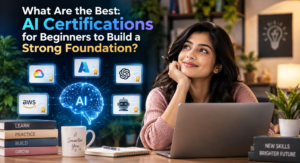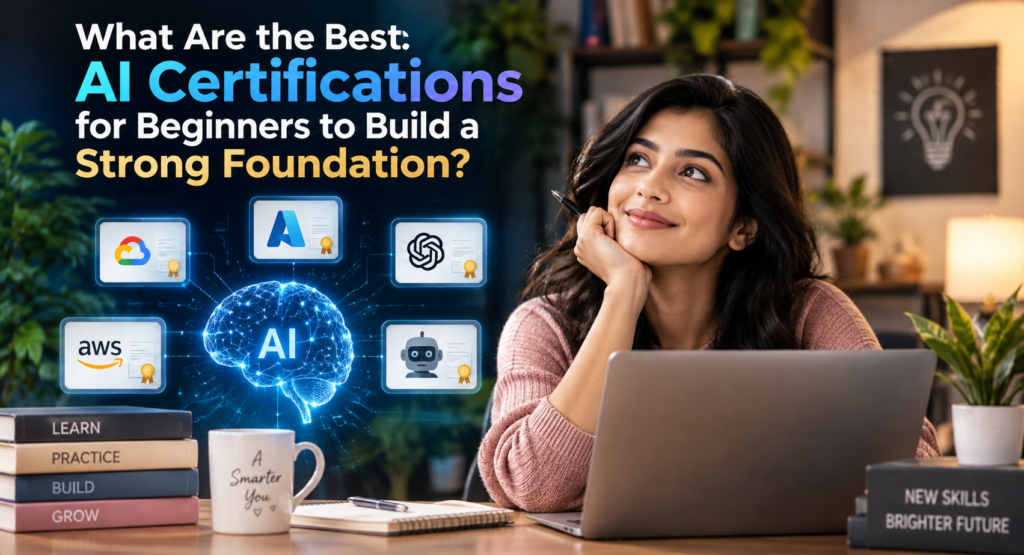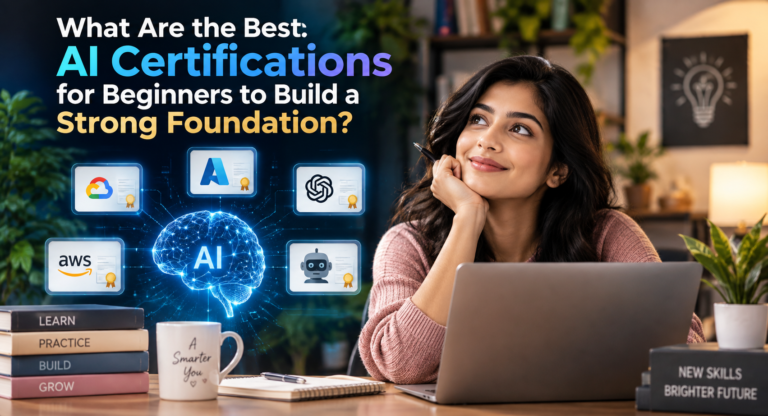
If you are looking for the best AI certifications for beginners, focus on programs that give you a solid foundation in AI, machine learning, Python, generative AI, and practical projects. For learners who want structured, career-focused training, H2K Infosys Artificial Intelligence Certification can be a strong place to begin.
AI is moving fast in 2026, and simply collecting certificates isn’t enough. You want to understand the technology, practice using it, and ideally build projects you can talk about in an interview.
Why AI Certifications Matter for Beginners
Starting AI can feel overwhelming.
You’ll come across terms like machine learning, deep learning, neural networks, LLMs, generative AI, NLP, computer vision, RAG, and AI agents almost immediately.
A structured certification program can make that learning curve much easier.
A good AI certification course should help you understand:
- AI and machine learning fundamentals
- Python for AI
- Data preparation and analysis
- Machine learning algorithms
- Neural networks and deep learning
- Generative AI and LLMs
- Prompt engineering
- AI application development
- Responsible AI
- Real-world projects
The certificate is useful, but the skills you develop while earning it are what really matter.
What to Look for in Best AI Certifications for Beginners
Before enrolling in a program, look beyond the certificate itself.
Start With Beginner-Friendly Content
You shouldn’t need years of programming or AI experience just to understand the first few lessons.
A good beginner program should introduce concepts gradually and give you opportunities to practice them.
Look for Hands-On Projects
This is one of the biggest differences between simply studying AI and actually learning it.
Instead of only watching demonstrations, look for opportunities to work with:
- Python
- Datasets
- Machine learning models
- Neural networks
- Generative AI tools
- APIs
- AI applications
Projects also give you something concrete to discuss when applying for jobs.
Check Whether the Curriculum Is Current
AI changes quickly.
A modern curriculum should go beyond traditional machine learning and address areas such as generative AI, LLMs, prompt engineering, and AI application development.
Consider Career Support
If you’re learning AI to change careers, training doesn’t necessarily end when the final lesson does.
Resume guidance, interview preparation, project discussions, and career assistance can make the transition from learning to job searching more manageable.
H2K Infosys Artificial Intelligence Certification
For beginners who want a structured path into AI, H2K Infosys Artificial Intelligence Certification is designed around building practical AI knowledge rather than simply introducing AI terminology.
Explore H2K Infosys Artificial Intelligence Training
The current H2K Infosys AI training program is listed as a 75-hour course covering areas including AI fundamentals, Python, NumPy, machine learning, neural networks, deep learning, MLOps, LLMOps, and practical AI applications. H2K Infosys also highlights real-time project work through a cloud test lab and career assistance.
That practical component is important.
Think about the difference between saying:
“I studied machine learning.”
and saying:
“I trained a model, evaluated its results, ran into problems, and figured out how to improve it.”
The second experience gives you much more to work with when you’re preparing for an interview.
What Will You Learn in H2K Infosys AI Training?
The program brings together several areas that beginners need to understand as they move into AI.
AI Fundamentals
You’ll start with the core ideas behind artificial intelligence and how AI systems are used in real-world scenarios.
Python for AI
Python is one of the most useful programming languages for AI and machine learning.
Learning Python in the context of AI can make the concepts easier to connect with actual applications.
Machine Learning
You’ll move into concepts such as data, algorithms, model development, and machine-learning workflows.
This is where AI starts becoming less abstract.
Neural Networks and Deep Learning
Deep learning is an important part of modern AI, particularly in areas involving images, language, speech, and other complex data.
Understanding the basic architecture of neural networks gives you a foundation for understanding today’s AI systems.
Generative AI and LLMs
Generative AI has become an important part of the modern AI landscape.
H2K Infosys also provides a dedicated Generative AI Certification Course, covering topics such as prompt engineering, LangChain, API integration, and LLM application development.
For someone interested in modern AI applications, this can provide a natural progression after learning the fundamentals.
Why Practical Experience Matters
One thing beginners sometimes discover a little late is that AI isn’t learned particularly well by memorizing definitions.
You can memorize what supervised learning means.
But building a small classification model makes the idea much easier to remember.
The same applies to generative AI.
Reading about RAG is one thing. Building a simple document-question-answering application is another.
That’s why practical projects should be an important part of your learning plan.
For example, a beginner could eventually work on projects such as:
- A customer-support chatbot
- A document Q&A application
- A simple recommendation system
- A sentiment-analysis application
- An AI-powered data-analysis tool
You don’t need to build something enormous.
A small project that you understand deeply can be more valuable than a complicated project you can’t explain.
A Simple AI Learning Roadmap for Beginners
If you’re completely new to AI, don’t try to learn everything at once.
A simple progression could look like this:
Step 1: Learn AI Fundamentals
Understand:
- Artificial intelligence
- Machine learning
- Deep learning
- Neural networks
- NLP
- Computer vision
- Generative AI
- Large language models
Step 2: Learn Python
Focus on the fundamentals first:
- Variables
- Functions
- Loops
- Lists and dictionaries
- File handling
- Basic programming logic
- NumPy
- Pandas
Step 3: Learn Machine Learning
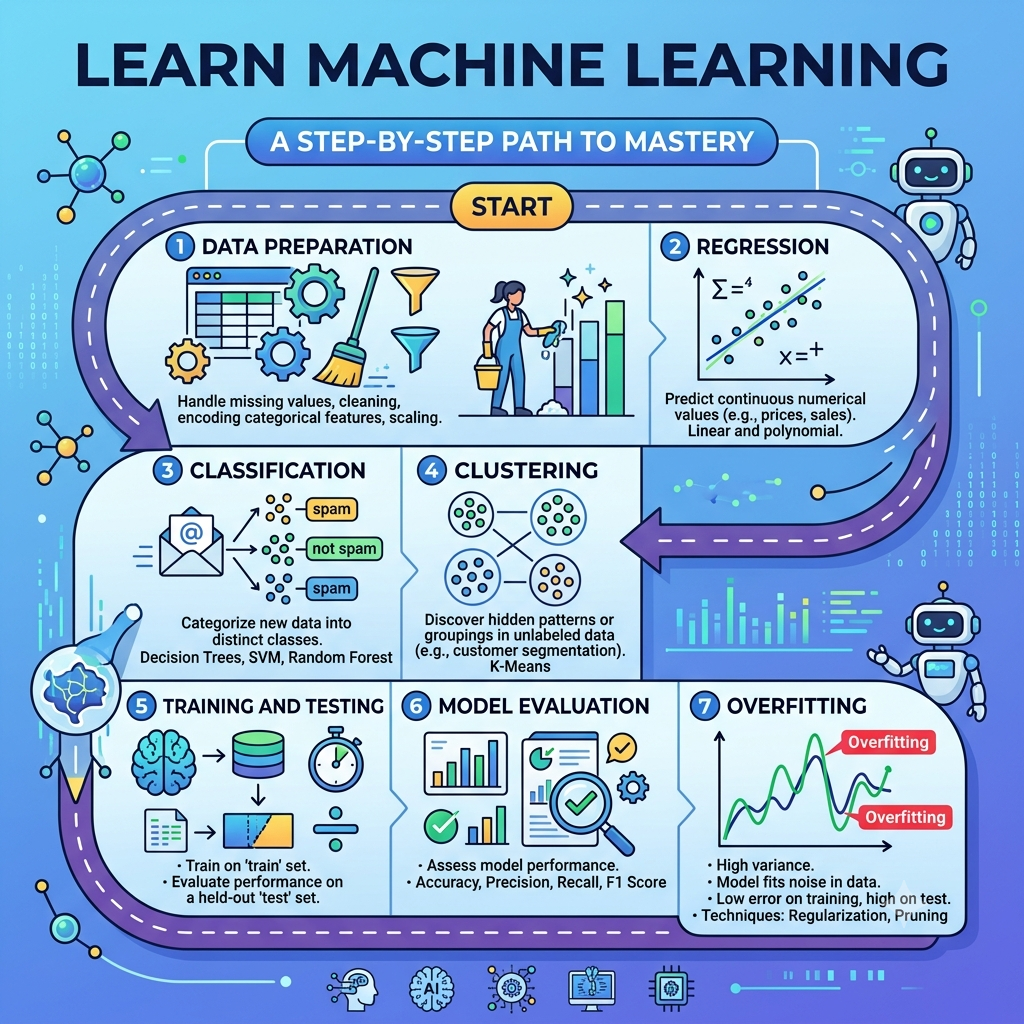
Move into:
- Data preparation
- Regression
- Classification
- Clustering
- Model evaluation
- Training and testing
- Overfitting
Step 4: Explore Generative AI
Once you have the basics, explore:
- LLMs
- Prompt engineering
- Embeddings
- RAG
- APIs
- AI application development
- AI agents
Step 5: Build Projects
This is where everything starts coming together.
Build a few projects that demonstrate what you’ve learned and document them clearly.
Can Beginners Learn AI Without a Technical Background?
Absolutely.
You don’t have to arrive with a computer science degree or years of coding experience.
What you do need is patience and a willingness to practice.
If you’re coming from software testing, development, data, business analysis, or even a completely different field, you can approach AI progressively.
Start with the concepts.
Then learn the programming.
Then work with data.
Then build models.
Then explore generative AI.
Trying to jump straight into advanced AI frameworks can make the learning process unnecessarily frustrating.
Is an AI Certification Enough to Get a Job?
A certification can demonstrate that you’ve completed structured learning, but it shouldn’t be viewed as a guarantee of employment.
Employers may also look at:
- Technical skills
- Projects
- Problem-solving ability
- Communication
- Relevant experience
- Portfolio work
- Interview performance
That’s why it’s smart to combine your certification with practical projects.
Your goal should eventually be to say:
“Here’s what I learned, here’s what I built, and here’s how it works.”
That makes your learning much easier to demonstrate.
Why Choose H2K Infosys for AI Training?
H2K Infosys’s current Artificial Intelligence program is structured to take learners through AI concepts, programming, machine learning, deep learning, and modern AI topics while incorporating practical project work. The course page also highlights career assistance and real-world applications.
For a beginner, having that structure can make a difference.
Instead of jumping between unrelated tutorials, you have a learning path to follow.
And if your interests eventually move toward generative AI, H2K Infosys has a dedicated GenAI program that can build on those fundamentals.
Which AI certification is best for beginners?
A suitable certification should match your current skill level and career goals. For beginners looking for a structured, practical learning path covering AI fundamentals, Python, machine learning, deep learning, and modern generative AI concepts, H2K Infosys’s Artificial Intelligence Certification is one option to consider.
Can I learn AI without knowing Python?
Yes. You can begin with AI fundamentals before learning Python. However, Python becomes increasingly useful once you move into machine learning and AI development.
How long does it take to learn AI?
There’s no fixed timeline. You can learn basic AI concepts relatively quickly, but developing practical skills takes consistent practice. A structured program can help you progress through the material in a more organized way.
Is generative AI part of learning AI?
Yes. Generative AI is now an important area of the broader AI field. Learning traditional AI and machine-learning fundamentals first can make concepts such as LLMs, RAG, and AI agents easier to understand.
Should beginners build AI projects?
Yes. Projects are one of the best ways to turn theoretical knowledge into practical experience. Start small and gradually increase the complexity.
Final Thoughts
The best AI certifications for beginners should give you more than a certificate.
Look for a program that helps you understand AI fundamentals, learn useful technical skills, practice through projects, and gradually move toward the technologies companies are using today.
For learners looking for a structured and career-focused route, H2K Infosys Artificial Intelligence Certification brings these elements together in one learning path, with AI fundamentals, Python, machine learning, deep learning, modern AI topics, hands-on projects, and career assistance.
If you’re starting your AI journey, don’t worry about learning everything immediately.
Build the foundation first. Practice as you learn. Build projects. Then keep moving deeper into the areas of AI that interest you most.