For professionals searching for Affordable Artificial Intelligence training, H2K Infosys Artificial Intelligence online training programs with flexible batch timings offer a practical way to build AI skills without stepping away from a current job. Most IT professionals already juggle deadlines, client meetings, support calls, and odd-hour deployments, making rigid classroom schedules difficult to manage. That is why many AI Certified Courses now provide weekday evening sessions, weekend classes, self-paced learning, and hybrid formats that allow learners to study at their convenience.
Artificial Intelligence (AI) online training programs are also helping professionals understand how machines process information, recognize patterns, automate decisions, and support real business operations through intelligent systems. A lot of today’s AI courses are built specifically for working professionals people balancing jobs, deadlines, and career growth at the same time. So naturally, flexibility matters. Most learners want practical projects, mentor guidance, and hands-on exposure without stepping away from their current roles.
What Is Artificial Intelligence?
Searching for Affordable Artificial Intelligence refers to systems designed to perform tasks that normally require human intelligence. That can mean recognizing patterns, understanding language, making predictions, analyzing images, or even automating repetitive decisions that humans used to handle manually.
Some common AI-driven tasks include:
- Pattern recognition
- Decision-making
- Language processing
- Image analysis
- Recommendation generation
- Predictive analytics
- Process automation
Under the hood, AI systems rely on algorithms, data models, and computational frameworks to detect relationships inside large datasets and produce outcomes based on learned behavior. Sounds technical because it is but in practice, AI is already woven into things most businesses use daily.
Core Areas of Artificial Intelligence
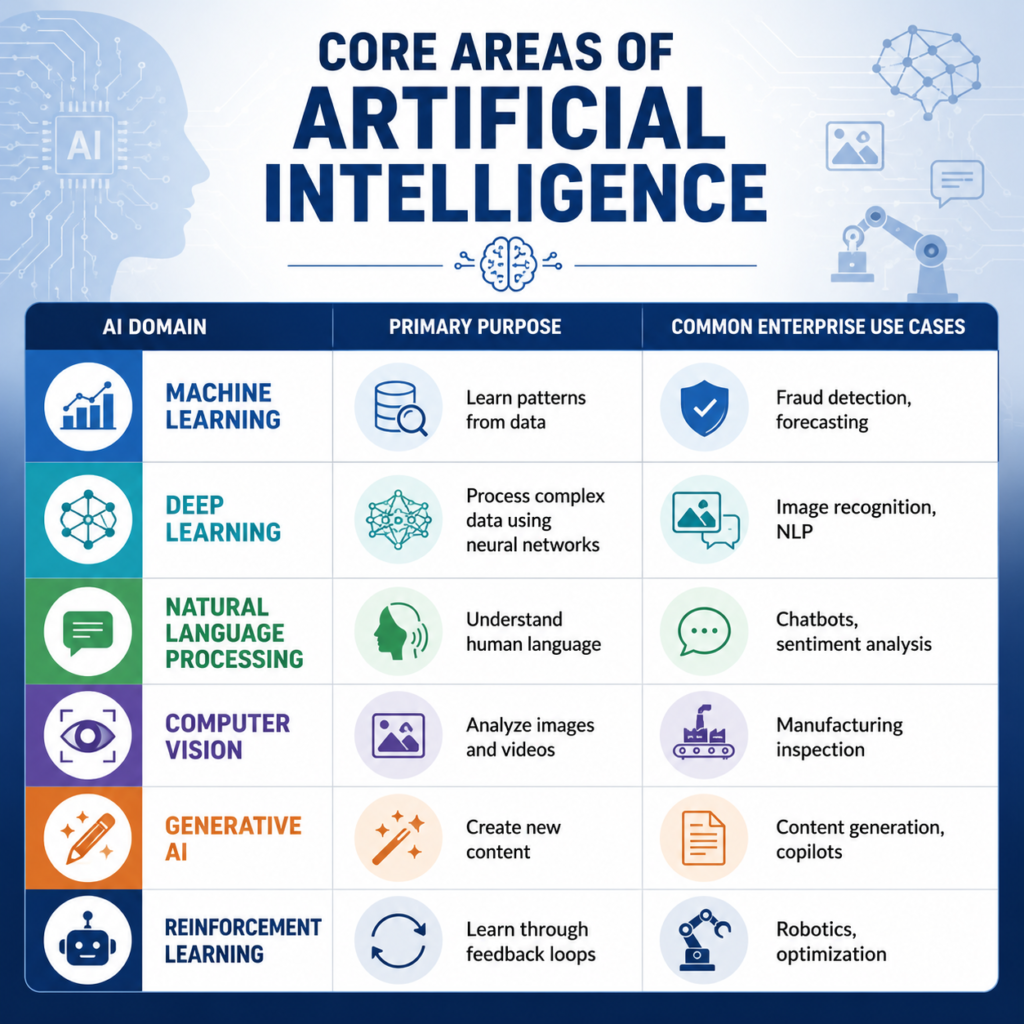
| AI Domain | Primary Purpose | Common Enterprise Use Cases |
|---|---|---|
| Machine Learning | Learn patterns from data | Fraud detection, forecasting |
| Deep Learning | Process complex data using neural networks | Image recognition, NLP |
| Natural Language Processing | Understand human language | Chatbots, sentiment analysis |
| Computer Vision | Analyze images and videos | Manufacturing inspection |
| Generative AI | Create new content | Content generation, copilots |
| Reinforcement Learning | Learn through feedback loops | Robotics, optimization |
Why Professionals Are Looking for Affordable Online AI Programs
There’s a pretty simple reason: demand keeps growing.
Companies across finance, healthcare, retail, logistics, cybersecurity, and software development are investing heavily in AI-driven systems. Even professionals who aren’t becoming “AI Engineers” are expected to understand automation, analytics, or AI-assisted workflows to some extent.
Most professionals searching for AI programs are usually looking for a mix of:
- Flexible online schedules
- Real-world projects
- Mentor support
- Enterprise-standard tools
- Practical deployment workflows
- Career transition opportunities
And honestly, many learners prefer modern training programs over traditional degree paths because they’re more operational and less theoretical. People want to know how AI works in production environments not just how it looks in textbooks.
Common Professional Motivations
| Professional Goal | AI Learning Objective |
|---|---|
| Career transition into AI | Learn ML and Python fundamentals |
| Upskilling for current role | Automate workflows and analytics |
| Cloud engineering growth | Deploy AI models in cloud environments |
| Software development enhancement | Build AI-enabled applications |
| Data analytics advancement | Use predictive modeling techniques |
How Artificial Intelligence Works in Real IT Projects
In real enterprise environments, Searching for Affordable Artificial Intelligence projects usually follow a structured lifecycle. It’s rarely just “build a model and you’re done.” There are multiple stages, and most teams spend more time preparing and managing data than people initially expect.
A typical workflow looks something like this:
- Data collection
- Data preprocessing
- Feature engineering
- Model selection
- Model training
- Performance evaluation
- Deployment
- Monitoring and optimization
Example: AI Workflow in Customer Support Automation
| Stage | Activity |
|---|---|
| Data Collection | Gather customer conversations |
| Data Cleaning | Remove duplicate and incomplete data |
| NLP Processing | Convert text into machine-readable format |
| Model Training | Train chatbot response model |
| Testing | Validate accuracy and response quality |
| Deployment | Integrate with CRM platform |
| Monitoring | Track customer satisfaction metrics |
One thing professionals quickly discover is that production AI comes with real operational headaches too:
- Poor data quality
- Biased datasets
- Infrastructure scaling problems
- Model drift
- Security compliance concerns
- High compute costs
- Legacy system integration issues
Good AI training should talk about these realities, not just ideal scenarios.
What Skills Are Needed to Learn Artificial Intelligence?
A lot of beginners assume AI requires advanced mathematics right from day one. That’s not always true.
You don’t necessarily need a research background to get started, although having some technical fundamentals definitely helps.
Technical Skills Commonly Needed
| Skill Area | Importance |
|---|---|
| Python Programming | Essential |
| Basic Statistics | Important |
| Data Handling | Essential |
| SQL Fundamentals | Helpful |
| Cloud Computing Basics | Helpful |
| Problem Solving | Essential |
Common Tools Used in AI Training
| Tool | Purpose |
|---|---|
| Python | Core AI development |
| Jupyter Notebook | Experimentation and prototyping |
| TensorFlow | Deep learning |
| PyTorch | Neural network development |
| Scikit-learn | Machine learning algorithms |
| Pandas | Data manipulation |
| NumPy | Numerical computing |
| OpenCV | Computer vision |
| Hugging Face | NLP model integration |
What Topics Are Covered in the Best Online AI Courses?
The Searching for Affordable Artificial Intelligence programs usually balance theory with implementation. Learners need both enough conceptual understanding to know why something works, and enough practical exposure to actually build systems.
Typical AI Curriculum
Foundation Modules
- Introduction to Artificial Intelligence
- Python for AI
- Statistics and Probability
- Data Analysis Fundamentals
Intermediate Modules
- Machine Learning Algorithms
- Supervised and Unsupervised Learning
- Feature Engineering
- Model Evaluation Techniques
Advanced Modules
- Deep Learning
- Neural Networks
- NLP Systems
- Computer Vision
- Generative AI
- Large Language Models (LLMs)
Deployment and Operations
- MLOps workflows
- API integration
- Cloud deployment
- AI security considerations
- Production monitoring
How AI Is Used in Enterprise Environments
AI isn’t limited to tech companies anymore. It’s being integrated into everyday business operations almost everywhere.
Common Enterprise AI Applications
| Industry | AI Application |
|---|---|
| Banking | Fraud detection |
| Healthcare | Diagnostic support |
| Retail | Recommendation systems |
| Manufacturing | Predictive maintenance |
| Logistics | Route optimization |
| Cybersecurity | Threat detection |
| HR Technology | Resume screening |
| Insurance | Risk assessment |
Many organizations now deploy AI workloads through cloud providers like:
- Amazon Web Services
- Microsoft Azure
- Google Cloud
Cloud platforms make it easier to scale infrastructure, train models faster, reduce hardware overhead, and support distributed teams. For many businesses, cloud AI has become the default approach.
Why Mentors Matter in AI Training
This is something people often underestimate.
Learning AI theory from videos is one thing. Debugging a broken machine learning pipeline at midnight is something else entirely.
Mentor-guided programs help learners move past common blockers by giving practical guidance around:
- Model optimization
- Data preprocessing issues
- Deployment architecture
- Evaluation metrics
- Production troubleshooting
Areas Where Mentorship Helps Most
| Learning Area | Mentor Contribution |
|---|---|
| Model Selection | Explain trade-offs |
| Data Preparation | Identify preprocessing mistakes |
| Deployment | Guide production workflows |
| Performance Tuning | Improve efficiency and accuracy |
| Career Preparation | Align projects with industry expectations |
Mentorship becomes especially valuable for professionals transitioning from fields like QA, system administration, business analysis, or traditional software development.
What Makes an AI Course Practical and Searching for Affordable Artificial Intelligence?
Searching for Affordable Artificial Intelligence automatically mean low quality. And expensive doesn’t guarantee practical skills either.
The real value usually comes down to curriculum depth, hands-on implementation, instructor accessibility, and how closely the training reflects enterprise workflows.
Key Evaluation Criteria
| Evaluation Area | What to Check |
|---|---|
| Curriculum Depth | Covers modern AI workflows |
| Project Experience | Includes hands-on implementation |
| Instructor Access | Live sessions or mentor support |
| Flexibility | Suitable for working professionals |
| Tool Exposure | Uses enterprise-standard platforms |
| Deployment Skills | Covers real-world implementation |
| Career Alignment | Includes role-relevant projects |
Before enrolling, professionals should also check whether the program includes:
- Real datasets
- Cloud deployment labs
- GitHub workflows
- API integrations
- AI ethics and governance topics
- Capstone projects
- Resume-focused project guidance
Those details matter more than flashy marketing pages, honestly.
How Generative AI Is Changing AI Training
Generative AI has reshaped modern AI learning paths in a huge way over the last couple of years.
Many Searching for Affordable Artificial Intelligence now include:
- Prompt engineering
- Large Language Models (LLMs)
- Retrieval-Augmented Generation (RAG)
- Conversational AI
- AI copilots
- Vector databases
- AI agent workflows
Common Generative AI Tools
| Tool | Usage |
|---|---|
| OpenAI APIs | Conversational AI |
| LangChain | AI workflow orchestration |
| Pinecone | Vector search |
| Hugging Face Transformers | NLP model access |
| Ollama | Local LLM deployment |
| ChromaDB | Vector database operations |
Organizations are increasingly exploring generative AI for:
- Internal knowledge assistants
- Document summarization
- Code assistance
- Customer support automation
- Enterprise search systems
At the same time, businesses also have to think seriously about:
- Data privacy
- Hallucination risks
- Governance policies
- Security compliance
- Cost management
So Searching for Affordable Artificial Intelligence training is starting to include these operational concerns too not just model development.
What Roles Use AI Skills Daily?
AI knowledge is useful across a surprisingly wide range of roles now.
Common AI-Related Roles
| Role | Primary Responsibilities |
|---|---|
| AI Engineer | Build AI systems and pipelines |
| Machine Learning Engineer | Develop predictive models |
| Data Scientist | Analyze and model data |
| NLP Engineer | Build language-processing systems |
| AI Product Manager | Coordinate AI implementation |
| Cloud AI Engineer | Deploy AI infrastructure |
| Business Intelligence Analyst | Use predictive analytics |
| Automation Engineer | Implement intelligent automation |
Even outside dedicated AI teams, professionals in DevOps, cybersecurity, software engineering, QA, and business analysis increasingly interact with AI-enabled systems.
A Practical AI Learning Path
One mistake many beginners make is jumping randomly between tutorials without structure. A step-by-step path tends to work better.
Recommended Learning Sequence
Phase 1: Technical Foundations
- Python basics
- Data structures
- Statistics fundamentals
- SQL
Phase 2: Data and Analytics
- Data cleaning
- Visualization
- Exploratory analysis
- Feature engineering
Phase 3: Machine Learning
- Regression models
- Classification algorithms
- Clustering
- Model evaluation
Phase 4: Deep Learning
- Neural networks
- CNNs
- RNNs
- Transformers
Phase 5: Enterprise AI
- Cloud AI services
- MLOps
- APIs
- Monitoring systems
Phase 6: Generative AI
- LLMs
- Prompt engineering
- Retrieval systems
- AI orchestration frameworks
Managing AI in Production Environments
Building models is only one part of enterprise AI. Managing production systems is where many real-world challenges show up.
Common Production Concerns
| Area | Enterprise Requirement |
|---|---|
| Security | Protect sensitive datasets |
| Scalability | Handle large workloads |
| Monitoring | Detect performance degradation |
| Compliance | Meet regulatory standards |
| Cost Optimization | Manage compute resources |
| Version Control | Track model updates |
Common MLOps Tools
| Tool | Purpose |
|---|---|
| MLflow | Experiment tracking |
| Kubeflow | ML orchestration |
| Docker | Containerization |
| Kubernetes | Scaling deployments |
| GitHub Actions | CI/CD automation |
What Professionals Should Look for in Online AI Courses
The strongest Online AI Programs usually focus on implementation, not just theory-heavy lectures.
Professionals should prioritize programs that include:
- Hands-on labs
- Instructor interaction
- Enterprise use cases
- Portfolio projects
- Real deployment exercises
- Cloud integration training
- Flexible schedules
Indicators of Practical Training
| Indicator | Why It Matters |
|---|---|
| Real datasets | Reflect actual business problems |
| Capstone projects | Demonstrate applied skills |
| Live mentoring | Helps resolve technical blockers |
| Git workflows | Support collaborative development |
| Cloud deployment labs | Mirror enterprise environments |
FAQ: Searching for Affordable Artificial Intelligence
What are online AI programs?
Searching for Affordable Artificial Intelligence are structured training courses that teach artificial intelligence concepts, tools, workflows, and deployment practices through virtual classes, labs, projects, and mentor-led sessions.
Are affordable AI courses beginner-friendly?
Yes. Many Searching for Affordable Artificial Intelligence are designed for beginner-to-intermediate learners and start with Python, statistics, and machine learning fundamentals before moving into advanced topics.
Which programming language is most commonly used in AI?
Python remains the most widely used programming language in AI because of its extensive ecosystem of machine learning and data science libraries.
Do AI courses include projects?
Most practical Searching for Affordable Artificial Intelligence AI training programs include projects involving model training, data analysis, cloud deployment, APIs, and production workflows.
How long does it take to learn AI?
That depends on your background and consistency. Many working professionals Searching for Affordable Artificial Intelligence spend several months building foundational and intermediate AI skills through structured programs and hands-on projects.
Is mentor support really important?
For many learners, yes. Mentors can help troubleshoot technical issues, explain deployment workflows, review projects, and provide guidance that’s difficult to get from self-paced videos alone.
Which industries hire AI professionals?
Healthcare, finance, cybersecurity, retail, logistics, insurance, telecommunications, manufacturing, and software development all actively use AI-driven systems.
Are cloud platforms important for AI careers?
Absolutely. Many enterprise AI systems run on AWS, Azure, or Google Cloud because these platforms provide scalable infrastructure and managed AI services.
Final Thoughts
Artificial Intelligence training has become increasingly valuable for professionals looking to build practical skills in automation, analytics, machine learning, and enterprise Searching for Affordable Artificial Intelligence AI implementation. The strongest online AI programs usually combine flexibility, hands-on projects, mentor guidance, and exposure to real production workflows.
And realistically, that combination matters more today than ever before. Employers are looking for professionals who can apply AI concepts in business environments not just explain theory during interviews.
Key Takeaways
- AI training works best when theory and implementation are combined
- The best online AI courses often include projects, cloud tools, and mentor support
- Enterprise AI workflows involve data preparation, deployment, monitoring, and optimization
- Generative AI and MLOps are becoming essential parts of modern AI learning paths
- Flexible, project-based programs are especially useful for working professionals
Explore H2K Infosys Artificial Intelligence training programs to build hands-on AI skills through practical projects and mentor-guided learning. Learn modern AI workflows, deployment practices, and enterprise technologies that support long-term career growth in today’s evolving IT landscape.