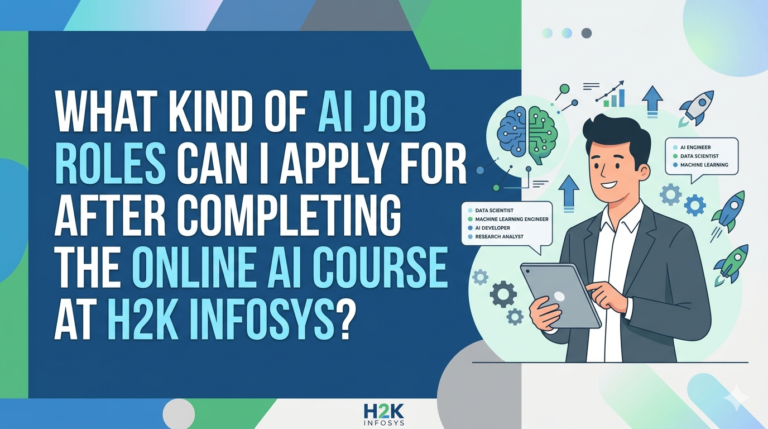
If you have completed an online AI course at H2K Infosys, you can realistically apply for roles like AI Engineer, Machine Learning Engineer, Data Scientist, AI Analyst, and even entry-level AI Product roles depending on how hands-on your training was.
Now let’s unpack that in a way that actually reflects what happens in the real world AI job roles.
So… what jobs can you actually land after an online AI course?
When people finish an online AI course, they often expect a single AI job. But the industry doesn’t work like that. AI is more like a toolkit and companies hire for very specific use cases.
From what I’ve seen and honestly, what hiring managers are doing lately, your role depends heavily on three things:
- how much coding you practiced
- whether you worked on real datasets
- and if you can explain your projects clearly
That’s where structured programs like the one from online AI course H2K Infosys quietly make a difference they tend to focus on job-oriented skills rather than just theory.
1. AI Engineer
If your Artificial Intelligence Engineer course covered model building, deployment, and tools like TensorFlow or PyTorch, this is your lane.
What you’ll actually do:
- Build and deploy AI models (think recommendation engines, chatbots, fraud detection systems)
- Work with APIs and cloud platforms
- Optimize models for performance (this part surprises most beginners it’s less glamorous, more engineering)
Real-world example:
After the rise of tools like ChatGPT, companies started hiring AI engineers not just to build models but to integrate them into apps. A lot of job descriptions now mention “LLM integration” or “AI-powered workflows.”
2. Machine Learning Engineer
This role leans heavier into coding and system design than pure AI theory.
If your online AI course covered data pipelines, feature engineering, model tuning then you are well on your way.
- data pipelines
- feature engineering
- model tuning
you’re already on track.
Day-to-day reality:
- Cleaning messy datasets (yes, a lot of this)
- Training models and improving accuracy
- Deploying models into production environments
Quick insight:
Companies don’t just want models, they want models that work reliably at scale. That’s why ML Engineers are in serious demand in 2026.
3. Data Scientist
This is where many learners end up and honestly, it’s a solid starting point.
What makes this role accessible:
- It balances statistics, business understanding, and some ML
- You don’t always need deep AI expertise to get started
Typical tasks:
- Analyzing trends in data
- Building predictive models
- Communicating insights to non-technical teams
Real-world scenario:
Retail companies now use AI-driven demand forecasting. A data scientist might build the model, while an AI engineer later scales it.
4. AI Analyst / Business Intelligence with AI
This role doesn’t get talked about enough.
If you are not deeply into coding but understand AI concepts, this can be a great fit.
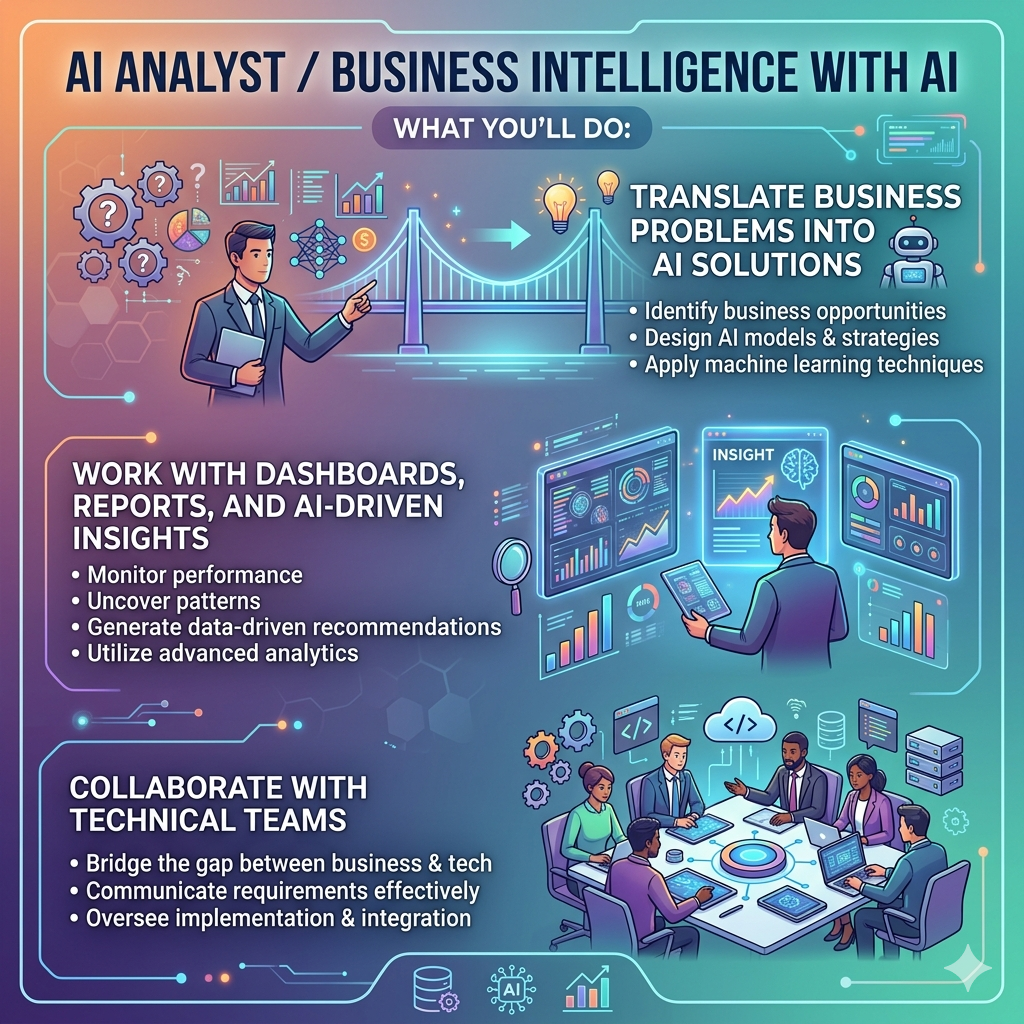
What you’ll do:
- Translate business problems into AI solutions
- Work with dashboards, reports, and AI-driven insights
- Collaborate with technical teams
Why this role is growing:
Companies are realizing they don’t just need builders they need people who understand where AI fits into business decisions.
5. Entry-Level AI Product or Prompt Engineer Roles
This is a newer category and it’s evolving fast online AI course.
Post-AI boom of 2024, jobs like:
- Prompt Engineer
- AI Product Associate
- Conversational AI Designer
started springing up all over the place.
What’s interesting here:
You don’t always need hardcore ML skills. Instead, you need:
- Understanding of AI capabilities
- Ability to design workflows using AI tools
- Strong problem-solving mindset
Where H2K Infosys actually helps and why it matters
Let me be blunt for a second most people don’t struggle with learning online AI course. They struggle with getting hired after learning it.
This is where programs like the online AI course from H2K Infosys stand out a bit:
- They tend to include real-time project exposure
- There’s usually a focus on job-ready skills, not just concepts
- Some learners mention getting guidance on interviews and resume building (which is half the battle)
And in today’s market, having even one real-world project (like a fraud detection system or chatbot) can matter more than finishing ten theoretical modules.
A quick reality check
Finishing an online AI course doesn’t automatically make you job-ready.
But here’s what does:
- Building 2–3 solid portfolio projects
- Practicing real interview questions
- Understanding how AI is used in industries like healthcare, finance, or retail
I’ve seen people with shorter courses land roles while others with long certifications struggle just because they skipped this part.
Final thought
online AI course are absolutely accessible after a good Artificial Intelligence and Machine learning course, but they’re not one-size-fits-all.
You’re not just getting into AI.
You’re choosing a direction within it:
- Engineering
- Data
- Business
- Product
And if your training like the one from online AI course H2K Infosys actually includes hands-on work + career support, you are already a step ahead of most beginners trying to figure it out alone.
FAQs: AI Job Roles After Completing an Online AI Course
What job roles can I get after completing an online AI course?
After completing an AI course, you can apply for roles such as AI Engineer, Machine Learning Engineer, AI Analyst, Data Scientist, AI Automation Specialist, and AI Consultant.
Is an online AI course enough to get an AI job?
An online AI course can help you build essential AI skills, but gaining practical experience through projects, hands-on practice, and certifications can improve your job opportunities.
Can beginners apply for AI jobs after completing an AI course?
Yes, beginners can apply for entry-level AI roles after learning AI fundamentals, tools, and practical applications through structured training and projects.
What skills are required for AI job roles?
Common skills required for AI jobs include artificial intelligence concepts, machine learning basics, data analysis, problem-solving, programming knowledge, and experience working on AI projects.
What is the future scope of AI careers?
AI careers have strong growth potential as organizations across industries are adopting artificial intelligence for automation, data-driven decision-making, and business solutions.