The Artificial Intelligence AI Training at H2K Infosys seems to be built around a pretty straightforward idea: help people learn skills they can actually use on the job especially in the U.S. market. It’s not one of those programs where you just sit through theory and hope it somehow clicks later. There’s a clear push toward hands-on work, tools, and real-world scenarios, which honestly makes a difference.
At its core, the An Online Ai Certification Courses is meant to prepare you for roles like data analyst, AI engineer, or machine learning specialist. In other words, jobs where you’re expected to do something with data not just understand definitions.
So what is this AI Training, really?
If you strip it down, it’s a structured AI Training program that walks you through AI basics, machine learning techniques, and practical data science work. The content tends to line up with what companies are currently hiring for, which is… kind of the whole point.
You’ll usually go through things like:
- Core AI and machine learning concepts
- Python programming (there’s really no avoiding this one)
- Data cleaning and analysis
- Building and testing models
- Working on projects that feel closer to actual business problems
One thing that stands out a bit is the balance. It’s not just tools, and it’s not just theory either it sits somewhere in between, which is probably why people often compare it with stronger AI Training certification-style programs.
What does AI look like in real IT projects?
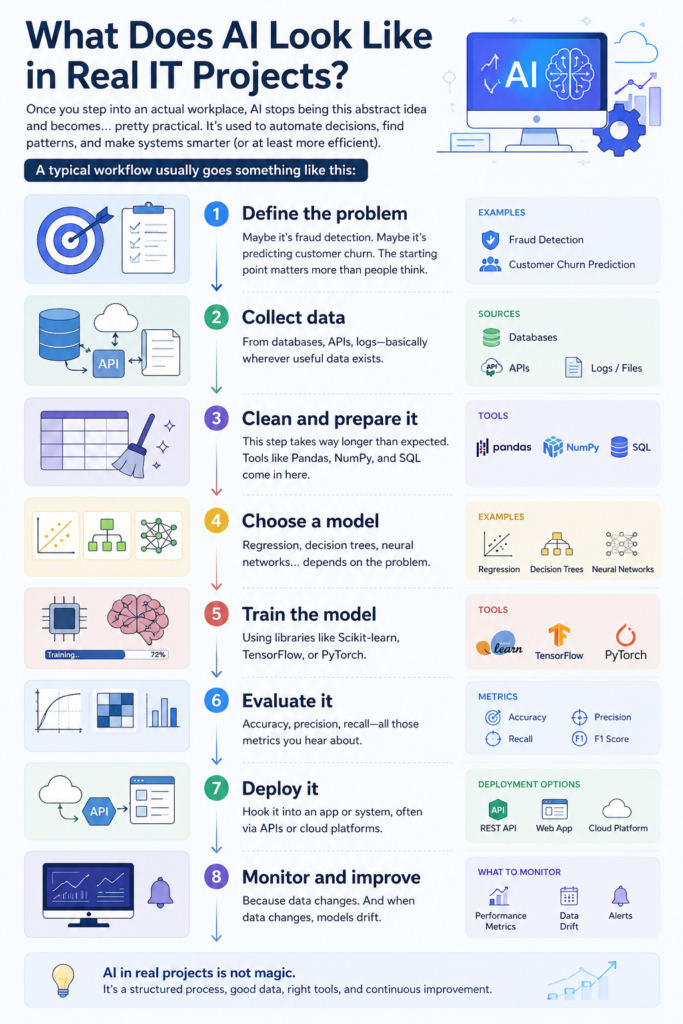
Once you step into an actual workplace, AI Training stops being this abstract idea and becomes… pretty practical. It’s used to automate decisions, find patterns, and make systems smarter (or at least more efficient).
A typical workflow usually goes something like this:
- Define the problem
Maybe it’s fraud detection. Maybe it’s predicting customer churn. The starting point matters more than people think. - Collect data
From databases, APIs, logs basically wherever useful data exists. - Clean and prepare it
This step takes way longer than expected. Tools like Pandas, NumPy, and SQL come in here. - Choose a model
Regression, decision trees, neural networks… depends on the problem. - Train the model
Using libraries like Scikit-learn, TensorFlow, or PyTorch. - Evaluate it
Accuracy, precision, recall all those metrics you hear about. - Deploy it
Hook it into an app or system, often via APIs or cloud platforms. - Monitor and improve
Because data changes. And when data changes, models drift.
A simple example? A retail company predicting future demand from past sales. Sounds easy on the surface, but there’s a lot happening behind the scenes.
Why does AI Training even matter right now?
Companies aren’t guessing as much anymore they’re relying on patterns, predictions, and insights. That’s where AI fits in.
Some common reasons people move into AI:
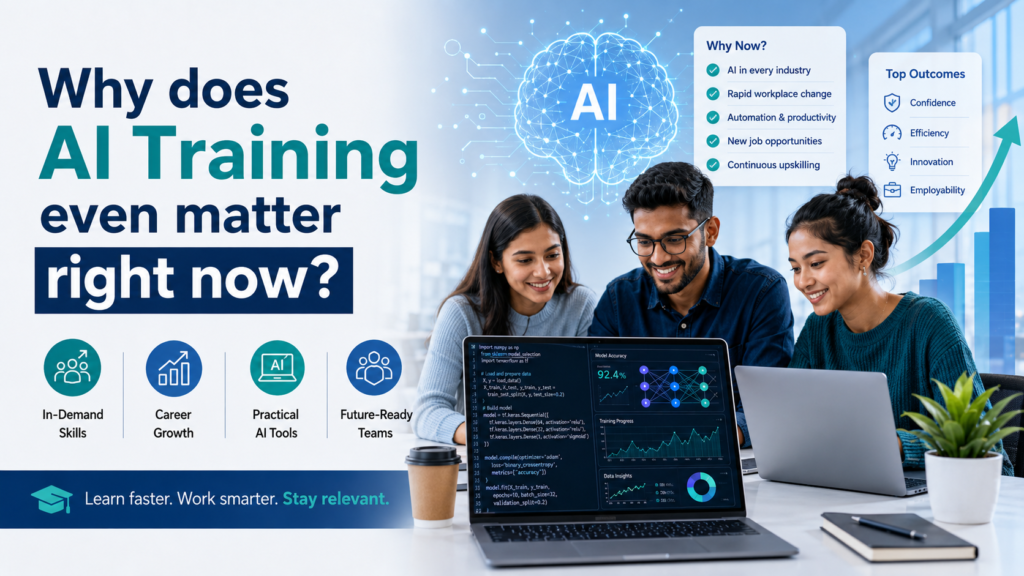
- Automating repetitive tasks
- Making better decisions using data
- Growing demand for AI Training-related roles
- Integration with cloud platforms and big data
But real-world work isn’t just about building models. You also deal with:
- Data privacy rules
- Scaling systems
- Explaining results to non-technical teams
That last one? Surprisingly tricky.
What skills do you actually need?
You don’t need to know everything upfront (no one does), but a few areas keep showing up:
Technical basics:
- Python
- Math (linear algebra, probability, statistics)
- Data handling (SQL, cleaning, feature engineering)
- Machine learning concepts
- Tools like TensorFlow, PyTorch, Scikit-learn
Other skills that matter:
- Problem-solving
- Analytical thinking
- Understanding business context
- Communicating results clearly
Most beginner paths start with Python and basic stats and yeah, that’s usually the right move.
Where is AI Training actually used?
Pretty much everywhere at this point.
Customer analytics:
- Personalization
- Recommendation systems
Finance:
- Fraud detection
- Risk analysis
Healthcare:
- Predictive diagnostics
- Image analysis
IT operations:
- Log monitoring
- Detecting anomalies
In real production systems, though, things get more complicated. You’re dealing with scale, security, compliance, performance all at once.
What jobs use AI day-to-day?
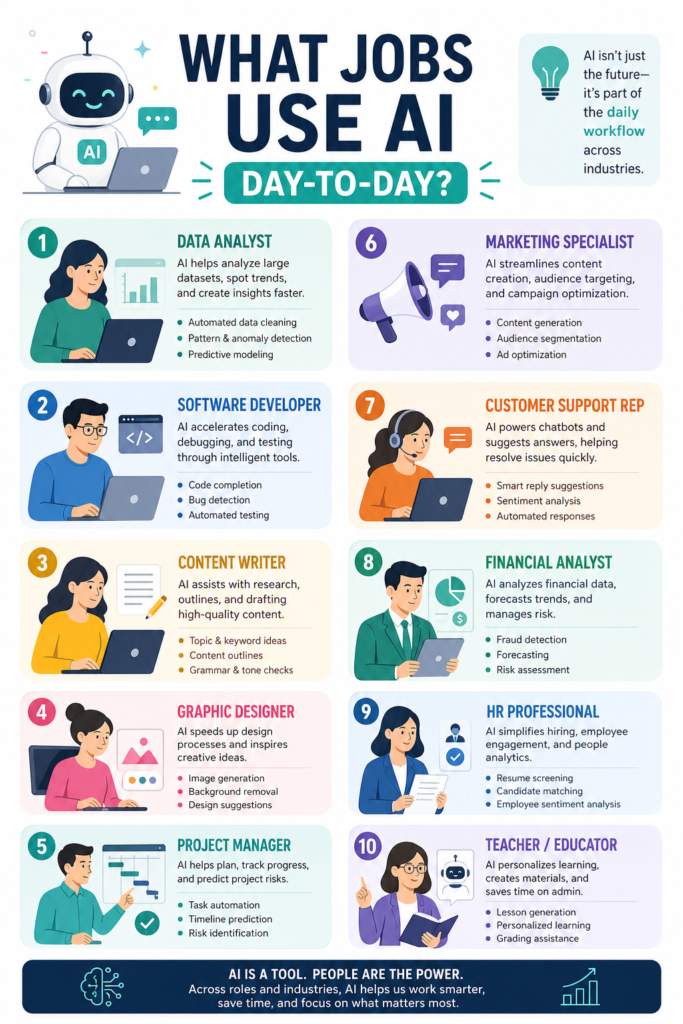
AI shows up across different roles, just in different ways:
- Data Analyst → SQL, Python, dashboards
- Machine Learning Engineer → building and deploying models
- Data Scientist → statistics, predictions, experimentation
- AI Engineer → deep learning, neural networks
- Business Analyst → interpreting and communicating insights
Day-to-day work often involves cleaning messy data, tweaking models, debugging issues, and explaining results (sometimes more than building them).
Career paths you can move into
Depending on where you’re starting:
Entry-level:
- Junior Data Analyst
- AI Support Engineer
Mid-level:
- Data Scientist
- Machine Learning Engineer
Advanced:
- AI Architect
- Research roles
Most people progress from data handling → model building → designing systems.
How does H2K Infosys help with job readiness?
This is where AI Training things get more practical.
Some parts of the training focus on:
- Hands-on projects
Working with real datasets, not just textbook examples - Tool-based learning
Python, SQL, TensorFlow, visualization tools—the usual stack - End-to-end workflow exposure
You see the full lifecycle, not just isolated steps - Interview prep
Resume help, mock interviews, scenario-based questions
That last part tends to matter more than people expect when they actually start applying.
If you’re just starting out…
A simple path might look like this:
- Learn Python basics
- Pick up probability and statistics
- Practice data analysis (Pandas, NumPy)
- Move into machine learning
- Explore deep learning
- Work on projects
No real shortcuts here. Practice is what makes things stick.
Tools you’ll probably use
- Python → core programming
- Pandas → data manipulation
- NumPy → numerical operations
- Scikit-learn → machine learning
- TensorFlow / PyTorch → deep learning
- Tableau / Power BI → visualization
Common challenges (yeah, they happen)
- Understanding the math side
- Debugging models
- Handling large datasets
- Picking the right algorithm
- Turning business problems into technical solutions
A small tip? Start with simpler datasets. Jumping into complex ones too early just makes things frustrating.
Quick FAQs
How long does AI Training take?
Could be a few weeks, could be several months—it depends on how deep you go.
Do you need coding experience?
Helpful, yes. But many programs start from scratch.
Which industries use AI the most?
Finance, healthcare, retail, tech… honestly, almost all of them now.
AI vs Machine Learning?
AI is the bigger concept. Machine learning is one part of it.
Are certifications useful?
They can help, especially when you’re starting and need something to show.
Final thoughts
AI Training today isn’t just about learning algorithms it’s about figuring out how to use them in real situations. Programs like Best Ai Courses for Beginners the one from H2K Infosys lean into that practical side, which can make the transition into a job a bit smoother.
If you’re serious about getting into AI, the biggest difference-maker is simple: build things. The theory and tools start to make more sense once you actually use them.