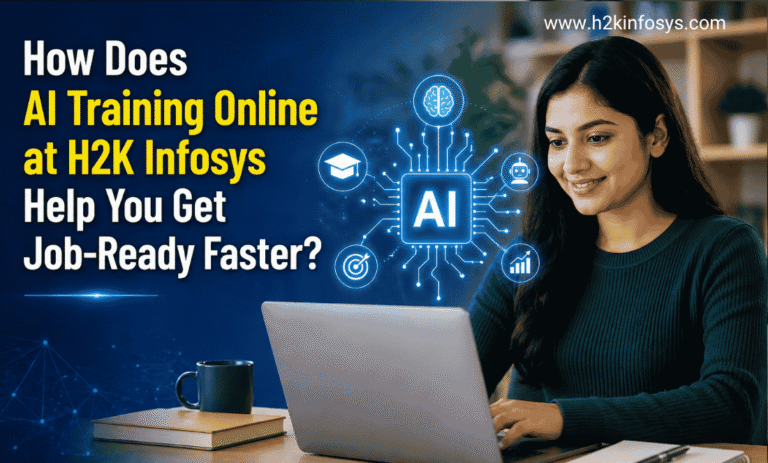
AI training online at H2K Infosys is built around a pretty simple idea: help people become job-ready without dragging them through a lot of unnecessary fluff. Instead of leaning heavily on theory which, honestly, can start to feel disconnected after a point the program blends structured learning, live instructor sessions, and hands-on projects that resemble actual IT work.
That combination tends to matter more than people expect. Understanding a concept is one thing. Applying it especially in something that feels even remotely like a real project is where most learners slow down or get stuck.
Here, the focus is clearly on doing. You’re not just watching or reading you’re working with tools, following workflows, making mistakes, fixing them, and gradually getting comfortable with how things actually work. Over time, that shift from “I kind of understand this” to “I can actually handle this task” starts to happen.
What is AI Training Online at H2K Infosys?
At its core, it’s a structured, instructor led Best Online Artificial Intelligence Course program delivered online. It’s mostly designed for working professionals people managing jobs, deadlines, maybe even family responsibilities, but still trying to build practical AI skills without putting life on pause.
The program typically covers:
- Core AI concepts like machine learning, data handling, and automation
- Tools such as Python, TensorFlow, and SQL
- Project work that goes beyond basic examples
- Interview prep and job-oriented exercises
One thing that stands out is the emphasis on enterprise use cases. You’re not just learning definitions or isolated concepts you’re seeing how AI fits into actual systems and workflows. That context makes a difference.
How Does AI Training Work in Real-World IT Projects?
This is where things start to click for most people.
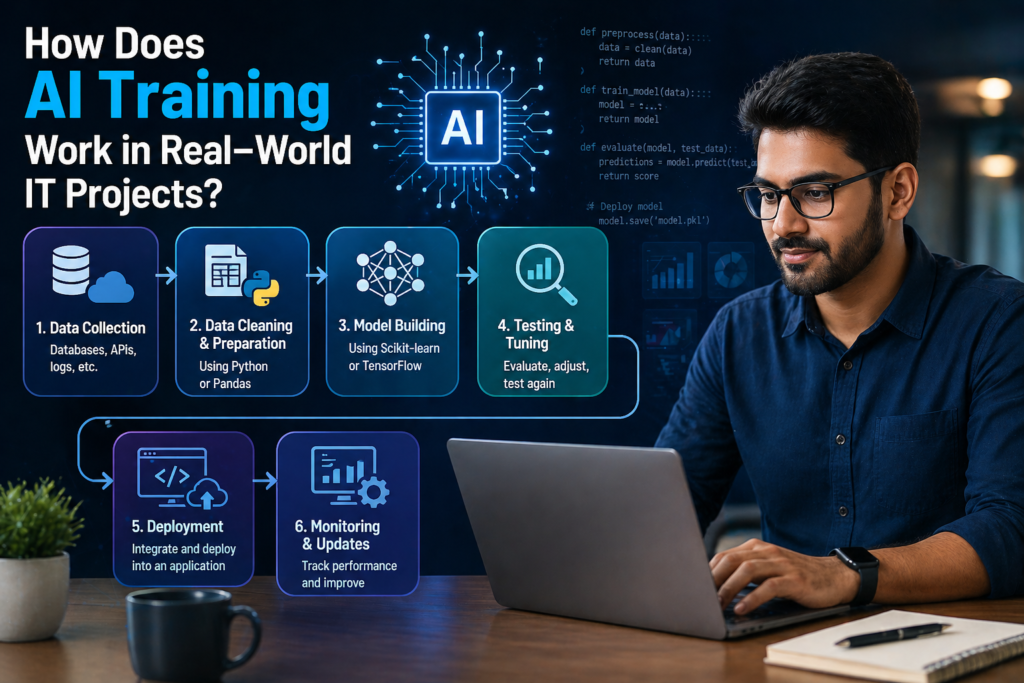
In a real IT environment, AI training online isn’t some standalone piece it’s part of a larger pipeline. A typical workflow usually looks like this:
- Data gets collected (databases, APIs, logs whatever’s available) It’s cleaned and prepared, often using Python or Pandas
- Models are built using libraries like Scikit-learn or TensorFlow
- Performance is tested, adjusted… tested again
- Then comes deployment into an application
- And after that, monitoring and updates in production
Take something like a recommendation system. Sounds simple on the surface, but there’s a lot happening underneath data collection, processing, training, integration, iteration.
Good training programs don’t just explain these steps. They try to simulate them. And honestly, understanding how all the pieces connect that’s usually the tricky part.
Why is AI Training Important for Working Professionals?
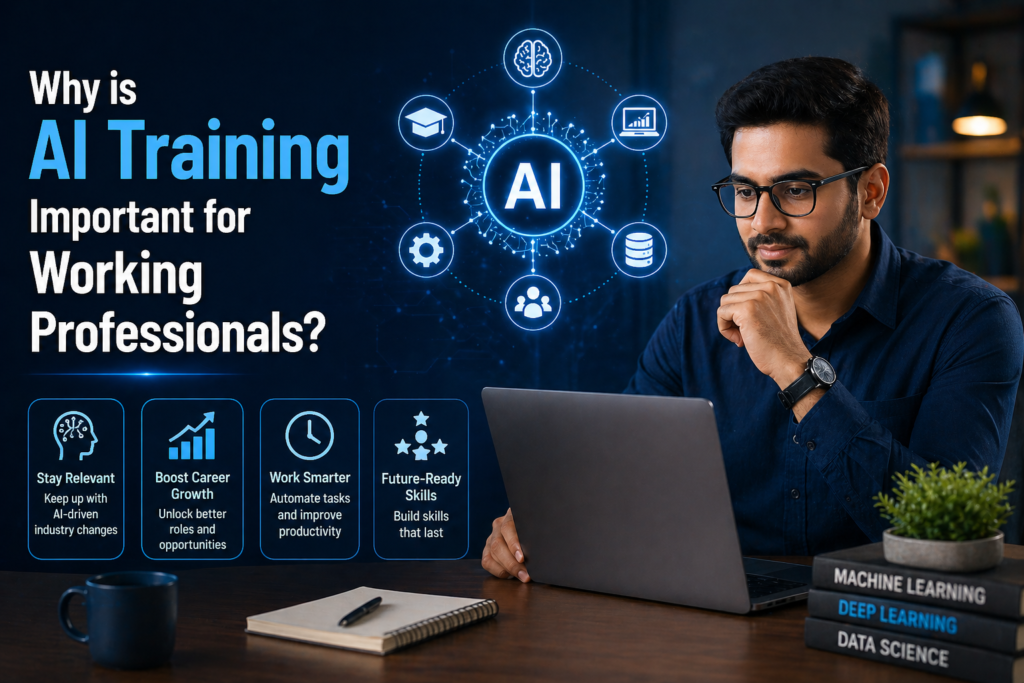
AI isn’t really optional anymore. It’s quietly becoming part of how a lot of work gets done, even in roles that weren’t technical before.
Some common reasons people move into this space:
- It opens up new career paths (especially from testing, support, operations)
- You start understanding what automation actually does not just the buzzwords
- Data-driven decisions are becoming the norm
- It makes collaboration with data teams a lot smoother
Even if you’re not aiming to become an AI training online, having that baseline knowledge helps more than you might expect in day-to-day work.
What Skills Are Required to Learn Artificial Intelligence?
You don’t need to show up as an expert. But having a few basics definitely helps.
Core areas:
- Programming (mostly Python)
- Basic math statistics and probability
- Working with datasets and simple queries
- Logical thinking and problem-solving
- Familiarity with tools like Pandas or NumPy
Some additional skills that can give you an edge:
- Cloud platforms like AWS or Azure
- Version control (Git)
- Working with APIs
The good thing is, structured programs usually build these step by step. You’re not expected to know everything upfront.
How is Artificial Intelligence Used in Enterprise Environments?
In real-world business settings, AI training online is less about flashy demos and more about solving practical problems.
You’ll often see it used for:
- Predicting customer behavior
- Fraud detection in financial systems
- Automating repetitive tasks
- Chatbots and virtual assistants
- Personalized recommendations
Of course, real systems come with constraints data privacy, scalability, performance. That’s where practical training starts to feel a lot more relevant than theory alone.
What Makes an Online AI Course Actually Effective?
Not every course gets this right. Some stay too theoretical, and that gap becomes obvious pretty quickly when you try to apply what you’ve learned.
The more effective ones usually include:
- Live, instructor-led sessions
- Hands-on work with real datasets
- Exposure to commonly used tools
- A clear, structured learning path
- Assignments that reflect actual job tasks
There’s a clear difference between knowing something and being able to use it. That gap doesn’t close on its own—you need practice.
How Do AI Courses Help Build Job-Ready Skills?
Most solid programs follow a kind of layered approach:
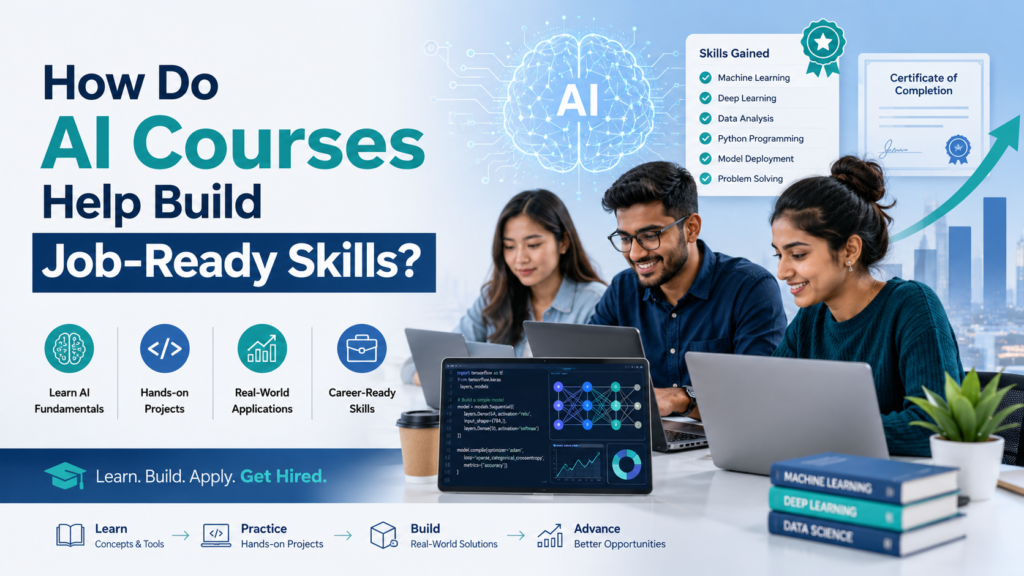
- Start with concepts
- Move into tools
- Work on projects
- Debug, fix, repeat
- Then simulate deployment scenarios
It’s not always smooth. There’s trial and error, and sometimes a bit of frustration but that’s usually where the real learning happens.
What Job Roles Use AI Regularly?
AI shows up in more roles than people initially think.
Some common ones:
- Data Analyst
- Machine Learning Engineer
- AI Engineer
- Business Analyst
- Automation Engineer
Each role uses AI training online differently, but the underlying skills tend to overlap quite a bit.
What Careers Can You Move Into?
There’s a range of paths you can take, depending on your background and how deep you want to go:
- Entry-level AI Developer
- Junior Data Scientist
- Machine Learning Engineer
- AI Support Analyst
- Automation Specialist
Most people don’t jump straight into advanced roles. It’s usually a gradual shift—learn, apply, build experience, then move forward.
How Does AI Training Speed Up Job Readiness?
This is where structured learning really helps.
Instead of figuring things out randomly (which can get overwhelming fast):
- You follow a clear path
- You get hands-on experience early
- Instructors help you avoid common mistakes
- You work on scenarios that feel close to real tasks
Compared to self-learning, it just feels more directed… less guesswork.
What Tools Are Commonly Used?
Most programs cover tools you’ll likely see in real jobs:
- Python
- Pandas and NumPy
- Scikit-learn
- TensorFlow or Keras
- Matplotlib
- Flask and Docker
But it’s not just about learning each tool individually it’s about understanding how they connect.
What Challenges Do Learners Usually Face?
AI isn’t always easy, especially in the beginning.
Some common hurdles:
- Getting comfortable with the math
- Working with messy or large datasets
- Debugging models (this can be frustrating, no way around it)
- Moving from theory to actual implementation
Structured AI training online helps by breaking things down and giving you room to practice without feeling completely stuck.
FAQ:AI training online and Job Readiness
How long does it take to become job-ready?
Usually around 3–6 months, depending on consistency.
Do I need programming experience?
Not necessarily, but having some basics helps. Many programs start from scratch anyway.
Are AI training online effective?
They can be—especially if they include real projects and instructor guidance.
What’s the difference between AI and machine learning?
AI is the broader field; machine learning is a subset focused on learning from data.
Can I learn AI while working full-time?
Yes. Most online programs are designed with flexibility in mind.
Key Takeaways
- AI training online focuses more on practical, job-ready skills than just theory
- Real-world projects make a noticeable difference
- Hands-on tools and workflows are essential
- Structured learning helps you move faster and with more clarity
- AI skills are useful across a range of roles not just specialized ones
If you’re exploring options, programs like Courses of Artificial Intelligence the ones from H2K Infosys are worth looking into mainly because they lean toward real-world application rather than just concept-heavy learning. And when it comes time to actually apply for jobs, that kind of experience tends to show.