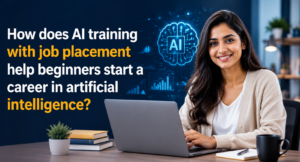
A comprehensive AI training online program at H2K Infosys isn’t really the kind of thing where you just sit through slides and call it learning. It’s usually built more like a progression. You start with the basics, sure but pretty quickly, you’re pulled into doing actual work. Not exactly production-level chaos, but close enough to feel how things behave outside of theory.
And that’s where it shifts. You’re not just learning what AI training online program is you start seeing what happens when you actually use it. Data comes in messy (way messier than expected), models don’t behave the way you thought they would, things break, you fix them… and slowly, it starts making sense. That jump from understanding to applying is where things either click or… stall a bit.
Most of these programs try to balance things out. You still get the core concepts machine learning, data pipelines, modeling but you’re also working with datasets, experimenting with tools, and following workflows that feel pretty close to what real teams do. By the end, you don’t just know isolated topics you’ve got a rough, practical feel for the whole pipeline, from cleaning data to getting something deployed.
What is an AI Training Online Program?
At a basic level, it’s just a structured way to learn AI training online program, delivered online. But the better ones don’t feel like a playlist you’re grinding through at 1.25x speed.
They tend to mix formats guided lessons, instructor input, hands-on exercises, sometimes live sessions where things don’t go perfectly (which, honestly, is useful). You’re not just checking off topics. You’re connecting them, even if that takes a bit of time.
Most programs touch on machine learning, deep learning, NLP, and some data engineering. Not as separate boxes, but as parts of a larger system.
Key Components of an AI training online program
A well-rounded program usually brings together a few core pieces:
- AI and machine learning fundamentals
- Basic programming (mostly Python)
- Data preprocessing and feature engineering
- Model building and evaluation
- Deployment concepts, sometimes a bit of MLOps
- Real-world projects or case studies
That said… not every course gets the balance right. Some stay too theoretical, others throw you into tools before you’re ready. You usually notice that midway through.
What is Included in a Comprehensive AI Training Online Program at H2K Infosys?
The structure AI training online program is typically layered. You don’t jump straight into neural networks on day one that would be overwhelming. Instead, things build step by step.
1. Foundational AI and Machine Learning Concepts
This is where everything starts, even if it feels a bit slow at first.
You’ll go through:
- Types of AI (narrow vs. general)
- Learning methods—supervised, unsupervised, reinforcement
- Basics of probability and statistics
- Some linear algebra
It can feel abstract, not going to lie. But skipping it? That usually causes problems later.
2. Programming and Environment Setup
Python is the main language here. You’ll spend time getting comfortable with tools like:
- Pandas, NumPy (for data work)
- Matplotlib or Seaborn (visualization)
- Scikit-learn (machine learning)
- TensorFlow or PyTorch (deep learning)
There’s also the setup side Jupyter notebooks, environments, installs. Not exciting, but kind of necessary.
3. Data Preprocessing and Feature Engineering
This is where things start to feel real.
Because raw data is rarely clean. Actually… it’s almost never clean.
You’ll work on:
- Handling missing values
- Dealing with outliers
- Feature transformation and selection
- Encoding categorical variables
- Scaling and normalization
A lot of people think model-building is the hardest part. In reality, this stage often takes more time—and patience.
4. Machine Learning Model Development
Once your data is usable, you start building models.
Common ones include:
Supervised learning
- Linear regression
- Logistic regression
- Decision trees, random forests
- Support vector machines
Unsupervised learning
- K-means clustering
- Hierarchical clustering
- PCA for dimensionality reduction
This is usually where things start to click you see predictions happening, not just formulas.
5. Model Evaluation and Optimization
Building a model is one thing. Knowing whether it’s actually good is another.
You’ll work with:
- Train-test splits and cross-validation
- Metrics like precision, recall, F1-score
- Confusion matrices, ROC curves
Then comes tuning:
- Hyperparameter optimization
- Grid search, random search
- Regularization techniques
It can feel a bit technical here, but this is what separates a basic model from something usable.
6. Deep Learning and Neural Networks
This usually comes later, once the basics are in place.
You’ll cover:
- Neural networks
- CNNs (for images)
- RNNs (for sequences, text)
- NLP fundamentals
These are behind things like chatbots, recommendation systems, image recognition the stuff people interact with every day without thinking twice.
7. Real-World Project Implementation
Probably the most valuable part of the program.
A typical project flow:
- Define the problem
- Gather and prepare data
- Train a model
- Evaluate results
- Deploy (or simulate deployment)
Projects might include churn prediction, fraud detection, sentiment analysis. Not just practice you can actually use these in a portfolio.
8. AI in Enterprise Environments
This is where things start connecting to real work.
You’ll see how AI training online program is used in areas like:
- Healthcare (disease prediction)
- Finance (fraud detection)
- Retail (recommendation systems)
- IT operations (predictive maintenance)
There’s also discussion around real challenges data privacy, bias, scaling. These aren’t edge cases… they show up all the time.
9. MLOps and Deployment Basics
A model sitting in a notebook isn’t very useful.
So programs usually introduce:
- Model serialization (Pickle, Joblib)
- APIs for serving predictions
- Basics of Docker
- CI/CD pipelines for ML
This is the bridge between “I built something” and “it’s actually being used.”
10. Interview Preparation and Resume Guidance
Some programs include career support as well:
- Resume building for AI training online program roles
- Mock interviews
- Scenario-based questions
- Portfolio guidance
It’s not a guaranteed shortcut to a job but it does help you present your work more clearly.
How Does AI Work in Real-World IT Projects?

In practice, AI training online program follows a fairly structured pipeline:
- Data is collected (databases, APIs, logs)
- It’s cleaned and transformed
- Models are trained on historical data
- Results are evaluated
- The model is deployed
- Performance is monitored and updated
Looks simple on paper. In reality, each step has its own complications.
Why is AI Training Important for Working Professionals?
AI isn’t limited to niche roles anymore it’s showing up everywhere.
People usually learn it to:
- Automate repetitive tasks
- Make better decisions using data
- Integrate AI training online program into existing systems
- Move into more advanced roles
Even a basic understanding can change how you approach problems.
What Skills Are Required AI training online program?
Technical:
- Basic Python
- Data structures
- Some statistics
- Problem-solving
Non-technical:
- Analytical thinking
- Attention to detail
- Interpreting results (this one matters more than most expect)
What Careers Can You Move Into?

After completing a program like this, people often explore roles such as:
- Data analyst
- Machine learning engineer
- AI engineer
- Data scientist (with more experience)
- Business analyst with AI exposure
The certificate helps, sure—but what you’ve actually built tends to matter more.
Quick FAQ
How long does it take?
Usually around 3–6 months, depending on depth.
Do you need coding experience?
Not always. Some programs start from scratch, though a bit of familiarity definitely helps.
Are projects included?
Yes, most solid programs include hands-on projects.
What tools will you learn?
Python, Scikit-learn, TensorFlow, Pandas, and visualization libraries.
Is certification important?
It helps but practical experience carries just as much weight, sometimes more.
Final Thoughts
If you strip it down, a good Ai Machine learning Courses isn’t just about algorithms or tools.
It’s about understanding how everything fits together data, models, workflows… and all the messy parts in between. That’s the part people don’t always expect going in.
And honestly, that’s what makes the difference. Not just knowing AI training online program but being able to use it when things aren’t perfectly clean or predictable.