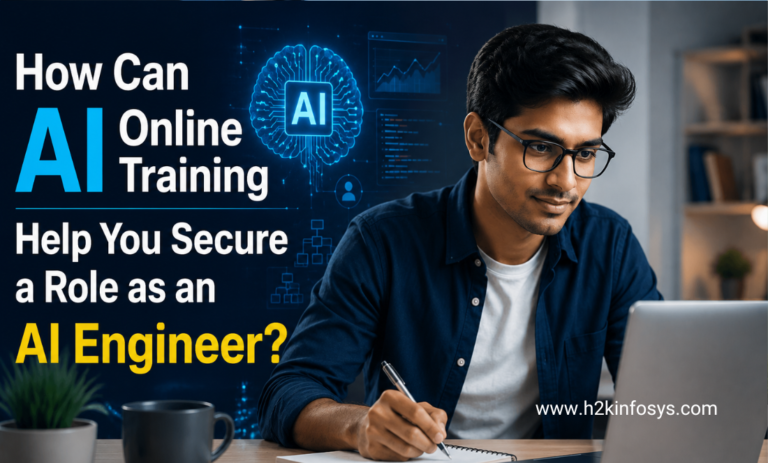
Role as an AI Engineer requires practical expertise in artificial intelligence technologies and their real-world applications. AI online training by H2K Infosys is a structured digital learning program designed for professionals seeking to build practical skills in machine learning, deep learning, natural language processing (NLP), and computer vision.
Core components include:
- Theoretical video courses
- Hands-on labs
- Coding exercises
- Supporting assignments
- Real project simulations
- Course completion certification
Enterprise AI Implementation Scenarios
Main Scenarios and Supporting Tools
- Predictive Analytics
- Tools: pandas, scikit-learn, AWS SageMaker, Azure ML
- Natural Language Processing (NLP)
- Tools: Hugging Face Transformers, SpaCy, NLTK
- Computer Vision
- Tools: OpenCV, TensorFlow, PyTorch
- Recommendation Systems
- Tools: scikit-learn, Spark MLlib
- AI-Augmented RPA
- Tools: UiPath AI Integration, Automation Anywhere, Blue Prism
Practical Value for Working Professionals
- Addresses the AI talent gap across industries: finance, healthcare, e-commerce, IT
- Supports career transitions for software, data, Role as an AI Engineer professionals
- Provides full-process hands-on practice with enterprise-level scenarios
- Course certification enhances employability
- Keeps learners up-to-date with rapid AI technology iterations
- Meets both enterprise AI talent needs and individual career advancement goals
Core Skills Required for Entry-Level AI Engineer Courses
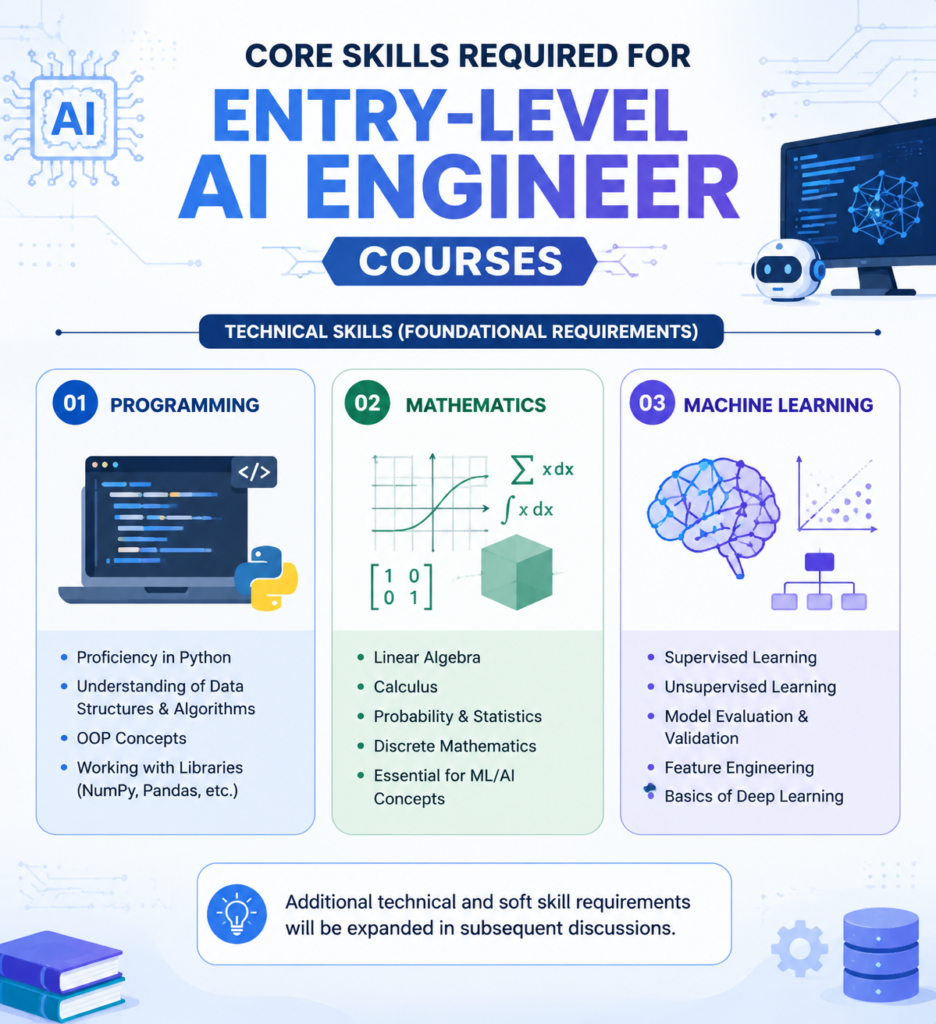
Technical Skills (Foundational Requirements)
- Programming
- Mathematics
- Machine Learning
Additional technical and soft skill requirements will be expanded in subsequent discussions.
Structured AI Industry Modules
1. Foundational Competency Classification
Technical Sub-Categories:
- Algorithms: supervised learning, unsupervised learning, reinforcement learning
- Deep learning models: CNN, RNN, LSTM
- Processing methods: data preprocessing, feature engineering, visualization
- AI frameworks: TensorFlow, PyTorch
- Cloud deployment tools: AWS SageMaker, Docker
- Version control: Git
Soft Skill Sub-Categories:
- Problem-solving: translating business needs into AI solutions
- Communication: conveying AI insights to non-technical stakeholders
- Project management: managing AI workflows and deployment cycles
2. Enterprise AI Implementation Module
Six-Step Standardized Workflow:
- Problem Identification – define quantifiable business goals (e.g., reducing churn, fraud detection)
- Data Preprocessing – clean, normalize, handle missing values, outliers, and imbalance
- Model Development – select and adapt appropriate algorithms
- Model Evaluation – metrics: accuracy, precision
- Model Deployment – scalable deployment via API or cloud integration, container orchestration
- Operation & Maintenance – performance monitoring, drift detection, retraining
Core Challenges:
- Data privacy
- Meeting performance requirements
- Maintaining model interpretability
Enterprise AI Roles & Tools:
- Responsibilities, authority, and suitable tools mapped for six core AI-related roles
3. Career Paths for AI Certification Graduates
- Ai Certified Courses graduates can pursue multiple career paths (details to be expanded in future updates)
- Core responsibility: coordinate full AI product lifecycle from initiation to iterative implementation while aligning with business objectives
- Industry-recognized AI certifications verify technical skills and practical abilities, aiding recruitment
4. Practical Enterprise Case Study: Customer Churn Prediction
Seven-Step AI Development Process:
- Data collection
- Data cleaning
- Feature engineering
- Model training
- Validation
- Launch
- Full-link monitoring and regular retraining
Algorithms Used:
- Random Forest
- Gradient Boosting
- Logistic Regression
Evaluation Metrics:
- Accuracy, precision, recall, F1-score, ROC-AUC curve
Deployment:
- Docker packaging
- Cloud platforms: AWS SageMaker, Azure ML, GCP AI Platform
Online AI Training Program Highlights
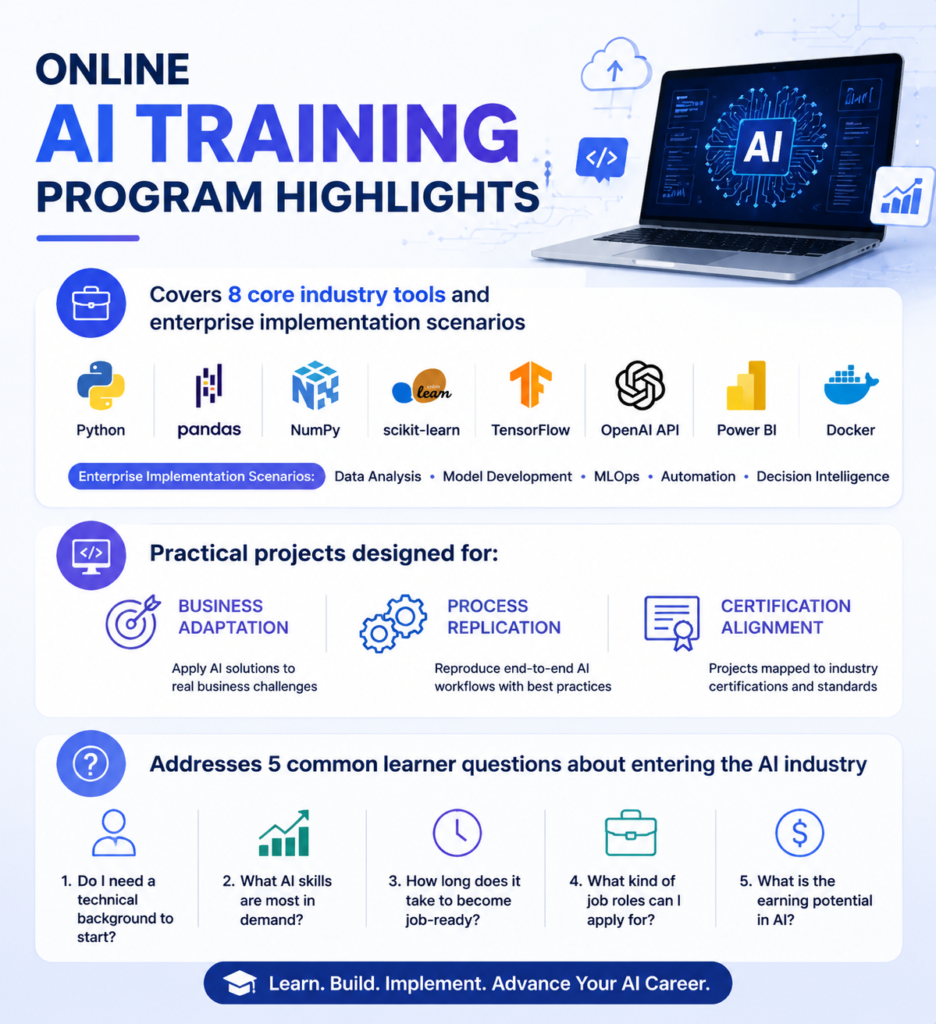
- Covers 8 core industry tools and enterprise implementation scenarios
- Practical projects designed for:
- Business adaptation
- Process replication
- Certification alignment
- Addresses 5 common learner questions about entering the AI industry
H2K Infosys Online AI Engineer Training
- Participants apply AI concepts to real enterprise workflows
- Master hands-on skills for TensorFlow, PyTorch, and cloud ML platforms
- Earn professional Role as an AI Engineer skill certifications
- Curriculum covers four major application scenarios:
- Predictive Analytics
- NLP
- Computer Vision
- AI Automation
- Balances technical and soft skills
- Supports full-process deployment of AI solutions
- Unlocks career growth in the AI field
FAQs
1. What is online AI training?
- A structured system with video courses, labs, coding exercises, projects, and certification.
2. Which enterprise scenarios does it cover?
- Predictive Analytics, NLP, Computer Vision, Recommendation Systems, AI-Augmented RPA.
3. What value does it bring to professionals?
- Bridges AI skill gaps, career transitions, hands-on experience, certification boosts employability, keeps skills updated.
4. What skills are needed to enroll?
- Technical: Programming, Mathematics, Machine Learning
- Soft Skills: Problem-solving, Communication, Project management
5. How is the training structured?
- Modules: foundational competency → enterprise AI implementation → practical projects
- Tools: TensorFlow, PyTorch, AWS SageMaker, Docker, Git
6. What career paths are available?
- Roles in predictive analytics, NLP, computer vision, AI automation, full AI lifecycle coordination.
7. How does H2K Infosys training help?
- Apply AI in real workflows, master hands-on tools, complete full-process AI deployment, earn certifications, advance career.
Conclusion
Online AI training provides a complete pathway for Ai Learning Courses to gain both theoretical knowledge and practical experience in AI. By covering foundational skills, enterprise implementation scenarios, and hands-on projects, it prepares professionals to bridge the AI talent gap, advance their careers, and contribute effectively to real-world AI initiatives. Certifications from recognized programs, like H2K Infosys, validate learners’ skills and enhance employability, making this training a strategic investment for both individuals and enterprises aiming to stay competitive in the rapidly evolving AI landscape.