H2K Infosys Online Ai Programs provide structured training Courses which helps you get academic and practical skills AI Job Interviews required for jobs in Artificial Intelligence. Hands-on programs like AI teach essential concepts in AI, machine learning (ML), and data analysis using exercises and enterprise-grade tools
These courses educate learners to:
- Explain concepts
- Exhibit technical skills
- Solve real-world problems
These skills are necessary to succeed in AI job interviews.
Linking Academic Knowledge to Industry
These AI Job Interviews relate academic knowledge to industry expectations via:
- Coding laboratories
- Tool-based exercises
- Scenario-driven projects
This preparation is especially important for working professionals aspiring to move into AI or ML professions, as recruiters now value both conceptual understanding and practical knowledge.
What AI Can Do in Real IT Projects
Enterprise AI uses machine learning models and algorithms to:
- Automate processes
- Offer insights
- Improve decision-making
The AI project in IT usually has the following steps:
1. Data Collection and Processing
- Collect SQL, Python or API organised & unstructured data collections
- Data cleansing, normalisation and feature extraction using Pandas, NumPy or Spark
- “Impute missing data and outliers for model robustness.”
2. Building the Model
- Select acceptable algorithms according to business needs
- Supervised Learning: Regression, Classification (Logistic Regression, Decision Trees)
- Unsupervised Learning: K Means, PCA, Clustering, Dimension Reduction
- Neural Networks: For image recognition, NLP, or prediction (Deep Learning)
- TensorFlow, PyTorch, scikit-learn model implementation
3. Model Fine-Tuning and Evaluation
- Performance evaluation: Accuracy, precision, recall, F1-score, ROC-AUC
- Feature engineering, cross-validation, and hyper-parameter tuning for model improvement
4. Implementation and Maintenance
- Deploy models using Docker, Kubernetes, or cloud platforms like AWS SageMaker, Azure ML, Google Cloud AI
- Monitor model performance in production and adjust for drift, retrain if necessary
AI Job Interviews are the best way to teach these workflows so applicants may talk about end-to-end project experience during interviews and demonstrate technical and problem-solving skills.
Why Should Working Professionals Prepare for AI Job Interviews?
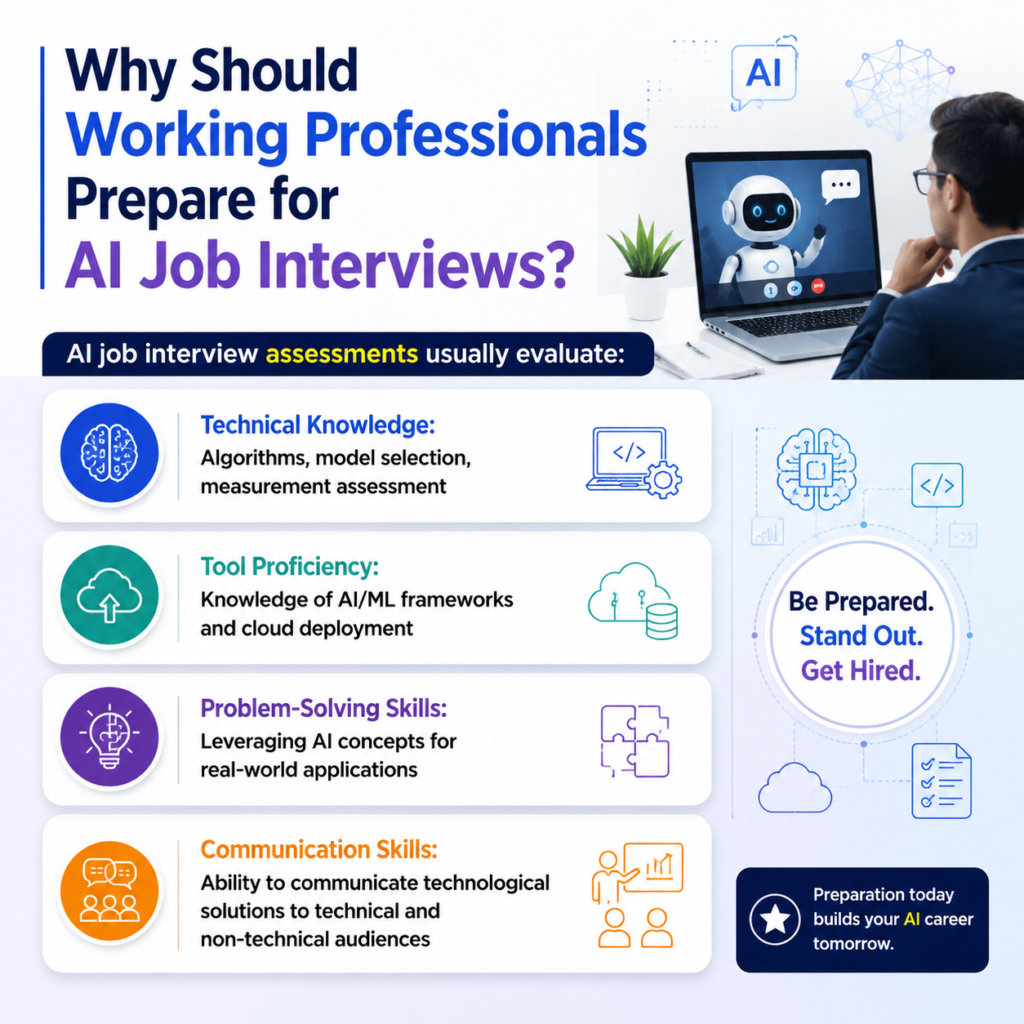
AI job interview assessments usually evaluate:
- Technical Knowledge: Algorithms, model selection, measurement assessment
- Tool Proficiency: Knowledge of AI/ML frameworks and cloud deployment
- Problem-Solving Skills: Leveraging AI concepts for real-world applications
- Communication Skills: Ability to communicate technological solutions to technical and non-technical audiences
AI courses are ideal for people with an IT background who want to work on AI projects. They provide:
- Systematic learning
- Practical application
- Interview preparation
- Reduced learning curve
Skills You Need to Learn in AI Course
The AI course prepares you for AI Job Interviews with the following skills:
- Programming: Python or R
- Libraries: Numpy, Pandas, Matplotlib, Seaborn
- Math & Stats: Basic linear algebra, probability, statistics, and calculus
- Machine Learning: Regression, classification, clustering, decision trees, random forests, deep learning
- Data Engineering: Data preprocessing, feature engineering, pipeline automation
- AI/ML Frameworks:
- TensorFlow, PyTorch models
- Scikit-learn for classical ML
- MLflow for model tracking and deployment
- Cloud & Deployment Tools: AWS SageMaker, Azure ML, Docker, Kubernetes
The AI Job Interviews build these abilities through exercises, guided labs, and projects for use in interviews and real-world work.
AI in Enterprise Environments
Organisational adoption of AI applications includes:
- Customer Intelligence: Chatbots and NLP-based customization engines
- Process Automation: AI-powered RPA for mundane tasks
- Predictive Maintenance (PdM): Predicting equipment failures using sensor and IoT data
- Fraud Detection: Identifying anomalies and fraud in financial transactions
- Supply Chain Optimization: Machine learning models for demand forecasting and inventory management
Courses are designed around these corporate settings with datasets and project-based exercises, giving learners interview-ready experience.
Jobs That Use AI Daily
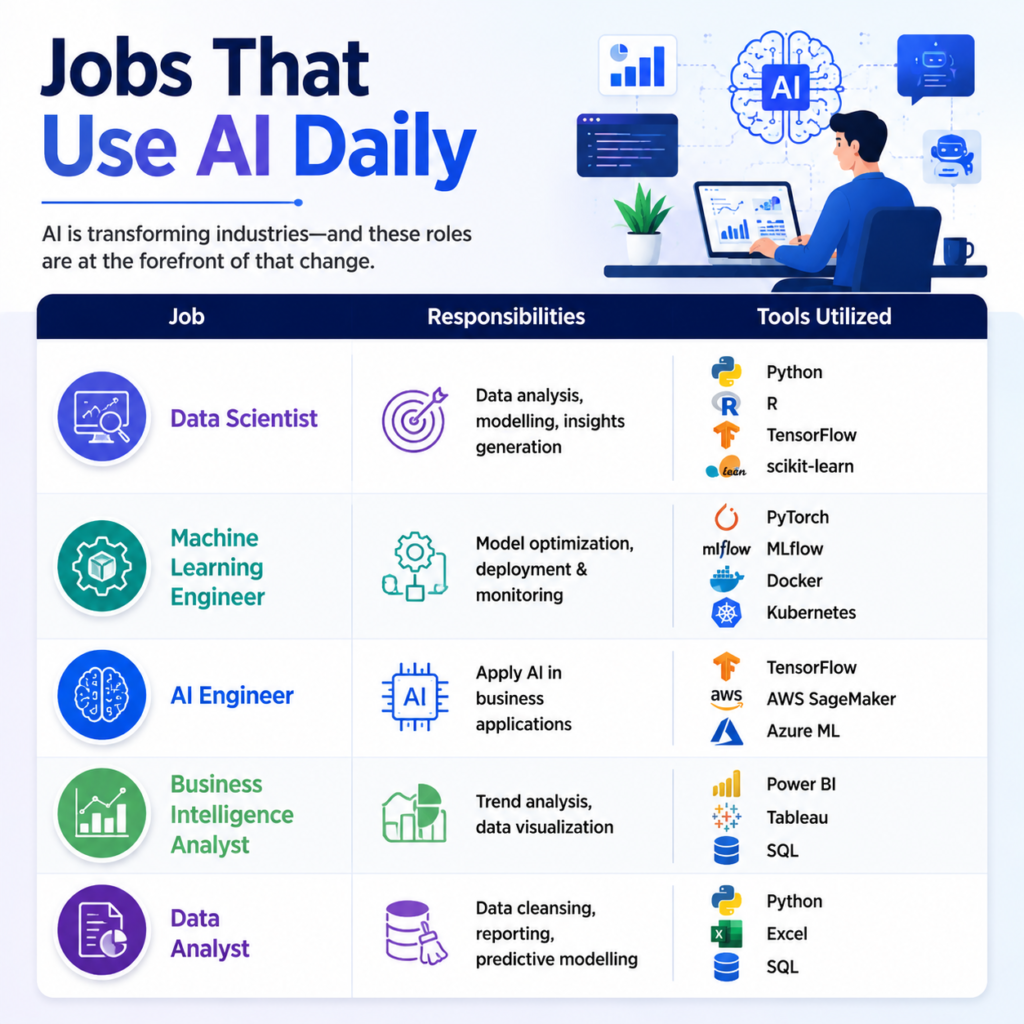
| Job | Responsibilities | Tools Utilized |
|---|---|---|
| Data Scientist | Data analysis, modelling, insights generation | Python, R, TensorFlow, scikit-learn |
| Machine Learning Engineer | Model optimization, deployment & monitoring | PyTorch, MLflow, Docker, Kubernetes |
| AI Engineer | Apply AI in business applications | TensorFlow, AWS SageMaker, Azure ML |
| Business Intelligence Analyst | Trend analysis, data visualization | Power BI, Tableau, SQL |
| Data Analyst | Data cleansing, reporting, predictive modelling | Python, Excel, SQL |
Mapping course modules to these occupations helps learners decide which skills to emphasize in interviews and practical tasks.
AI Course Jobs: Post-Completion
AI training targets professionals who wish to become:
- ML Engineer
- AI Data Scientist
- AI Consultant for Enterprise IT
- Analytics Expert
- AI/ML Research Assistant
Employability and interview skills are enhanced through hands-on labs, end-to-end project activities, and portfolio development.
How AI Online Courses Prepare You for Interviews
1. Labs & Hands-On Projects
- Build practice models using real-world datasets
- Implement supervised and unsupervised algorithms with enterprise-grade restrictions
2. Skills with Tools
- Hands-on experience with TensorFlow, PyTorch, scikit-learn, and cloud ML platforms
- Learn Docker & Kubernetes deployment techniques
3. Understanding Algorithms and Models
- Understand algorithm theory
- Cross-validation, hyperparameter tweaking, performance tuning
- Assess pros and cons of alternative models in interviews
4. Problem Solving in Scenario-Based Situations
- Address data imbalance, missing values, and large-scale data processing
- Model real-world constraints (time, computation, memory limits)
5. Practice Mock Interviews
- Practice coding and algorithm problems
- Explain workflow decisions and model interpretations
6. Building Your Portfolio
- “Completed projects are real proof of skills”
- Shareable GitHub repositories for interviewers to view hands-on expertise
These strategies teach students to communicate concepts and practice interviews confidently.
Real-World Enterprise Workflow + AI Courses
The H2K Infosys AI course covers real-life workflows:
- Data Pipeline Development: Raw data → Clean → Feature engineering → Store processed data
- Model Training and Evaluation: Model selection → Training → Validation → Hyperparameter tuning → Testing
- Deployment Pipeline: Containerize models → Deploy to cloud/on-prem → Monitor performance
- Continuous Improvement: New data collection → Retrain models → Update deployed models
These workflows mirror enterprise AI project tasks, giving real AI Job Interviews experience.
FAQ
Q1: Is programming experience necessary to join the IAI course?
A: Basic Python expertise is advised; introductory modules cover basics for newbies.
Q2: How do AI courses help with behavioural interviews?
A: Projects simulate cooperative problem-solving and focus on team collaboration, planning, and decision-making.
Q3: Will the courses provide AI certifications?
A: Yes, the AI course aligns with mainstream AI Job Interviews standards.
Q4: How long is the course?
A: Usually 3-6 months part-time, depending on past experience and learning speed.
Q5: Are there datasets for training?
A: Yes, datasets from Kaggle, open source repositories, and simulated enterprise environments are provided.
Highlights
- Best Ai Certification Courses integrates academic knowledge with real company projects
- Hands-on labs and tool proficiency help learners answer technical and problem-solving interview questions
- Possible careers: Analytics Specialist, Data Scientist, AI Engineer, ML Engineer
- Structured learning builds confidence to describe AI workflows, algorithms, and enterprise applications
H2K Infosys – Hands-on experience in AI & Machine Learning and preparation for technical AI Job Interviews.
Begin your career as an AI specialist now with study pathways for enterprise skills.