Artificial Intelligence (AI) is a subfield of computer science concerned with the development of intelligent agents capable of performing activities that traditionally require human intelligence, including learning, reasoning, predicting, language understanding, and decision making. Fast-forward to 2026, and AI is becoming increasingly vital in every industry, from healthcare and banking to retail and manufacturing to cybersecurity and software development. Job Seekers Invest in Artificial Intelligence As organizations accelerate their digital transformation initiatives, An Online Ai Programs providers such as H2K Infosys are helping professionals develop in-demand AI, machine learning, and data science skills needed to thrive in an AI-driven workforce and adapt to rapidly evolving technological landscapes.
Why Should Job Seekers Invest in Artificial Intelligence get organised knowledge of AI ideas, tools and practical workflows used in modern organisations. Online AI education can also assist professionals build the skills needed for developing career opportunities, and enhance their ability to deal with data-driven technology.
What is Artificial Intelligence Online Training?
Why Should Job Seekers Invest in Artificial Intelligence is a systematic format of education offered via digital channels that imparts knowledge on AI ideas, tools, algorithms, and practical implementation skills.
These programs often feature:
- Machine Learning
- Deep Learning
- Natural Language Processing (NLP)
- Computer Vision
- Generative AI
- Data Science Fundamentals
- AI Model Deployment
- Cloud-Based AI Services
- AI Ethics and Governance
Learning on your own from many different sources might be difficult, but many online AI classes are structured and may include:
- Guided learning journeys
- Practical Labs
- Exercises based on projects
- Tools important to industry
- Support from instructor
- Skill development for careers
If you’re a working professional, online learning provides the flexibility you need to meet industry needs.
The Importance of Artificial Intelligence for Job Seekers in 2026
The use of AI has extended to technical and non-technical jobs in companies. Organisations are rapidly deploying AI-powered solutions to increase productivity, automate operations, analyse big data, and support decision-making.
As a result, businesses are often looking for applicants who can:
- Discover the ideas of AI
- Tools Powered By AI
- Interpret AI insights
- Create or support applications powered by AI
- Work with Data Science Teams
Key Drivers of Demand for AI Skills
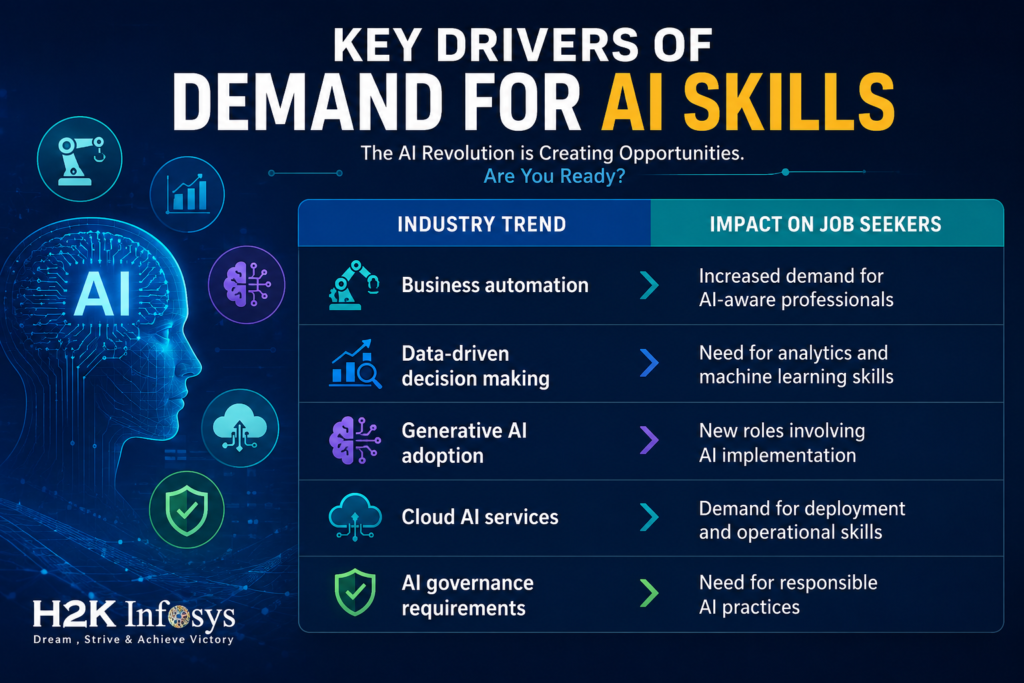
| Industry Trend | Impact on Job Seekers |
|---|---|
| Business automation | Increased demand for AI-aware professionals |
| Data-driven decision making | Need for analytics and machine learning skills |
| Generative AI adoption | New roles involving AI implementation |
| Cloud AI services | Demand for deployment and operational skills |
| AI governance requirements | Need for responsible AI practices |
Professionals who understand the concepts of Why Should Job Seekers Invest in Artificial Intelligence may be better placed to take part in digital transformation initiatives in their organizations.
How Does Artificial Intelligence Work in Real-World IT Projects?
AI systems learn from data in the form of patterns and utilise those patterns to underpin predictions, classifications, recommendations or judgements.
Typical Enterprise AI Workflow
Step 1: Data Collection
Organisations collect data from:
- Customer engagement
- App Business
- Gadgets of IoT
- Data bases
- Web Applications Enterprise Systems
Step 2: Data Preparation
Data engineers and analysts:
- Dataset cleaning
- Remove duplicates
- HandleMissing Values
- Change formats.
- Create training data sets
Step 3: Model Development
Data scientists use machine learning algorithms to:
- Models train
- Testing performance
- Increase precision
- Reduced prejudice
Step 4: Deployment
To deploy models into production contexts, AI developers use:
- APIs
- Cloud platforms:
- Containers for Business Applications
Step 5: Monitoring
The teams are constantly watching:
- Performance
- Accuracy
- Security
- Compliance
- Resource utilization
Example: Customer Support Automation
Performance Accuracy Security Compliance Resource utilisation Example: Customer Support Automation
- Analyze customer inquiries
- Categorize support requests
- Recommend responses
- Escalate complex issues
This reduces manual effort while maintaining service quality.
Why should job seekers invest in AI online training in USA 2026?
1. AI Skills Are Cross-Functional
AI is no longer only for data scientists.
Professionals in areas such as:
- Business analysis
- Software development
- Project management
- Cyber security
- Cloud engineering
- Digital Advertising
increasingly interact with AI-powered systems.
A good knowledge of AI ideas enables professionals to work efficiently across departments.
2. Practical AI Knowledge is Valued by Organisations
The majority of employers want to see candidates that can show:
- Experience with AI projects
- Data interpretation skills
- Automation skills Experience with AI solutions
The Why Should Job Seekers Invest in Artificial Intelligence are structured in a way that most of the time there is project work that helps the learners comprehend how to implement what they learn in practice.
3. AI Opens Up Career Transition Opportunities
People from all walks of life can get into the AI field by acquiring essential information and technical abilities.
Examples include:
| Current Role | Potential AI Path |
| Software Developer | Machine Learning Engineer |
| Data Analyst | Data Scientist |
| QA Engineer | AI Testing Specialist |
| Business Analyst | AI Product Analyst |
| Cloud Engineer | AI Infrastructure Engineer |
4. Learning That Works for the Working Professional
Many learners balance:
- Full-time job
- Family obligations
- Certifications Professionnelles
Why Should Job Seekers Invest in Artificial Intelligence enables learners to learn without disturbing their current tasks.
5. AI Literacy is a Growing Core Professional Competency
Even when employees aren’t directly constructing Why Should Job Seekers Invest in Artificial Intelligence systems, they may need to:
- Assess AI results
- Know the limits of the model
- Use AI software
- Meet governance requirements
AI literacy is increasingly supported by workplace performance.
What Skills You Need To Learn Artificial Intelligence?
You don’t need to be an expert to start Why Should Job Seekers Invest in Artificial Intelligence, even if you’re a beginner. But there are some basic abilities that help speed up the learning process.
Technical Foundations
Mathematics
Useful topics include:
- Stats Probabilities
- Linear Algebram
- Basic calculus Programming
Programming
Python remains one of the most commonly used programming languages in AI.
Important concepts include:
- Variables Functions Loops
- Data structure
- Object-oriented programming
- Data analyses
Data Analysis
Professionals should understand:
- Data cleansing
- Visualising data
- Preliminary examination
- Data set management
Essential Tools Commonly Taught in Online AI Classes
AI Development Tools
| Tool | Purpose |
| Python | AI and machine learning development |
| Jupyter Notebook | Interactive experimentation |
| TensorFlow | Deep learning framework |
| PyTorch | Machine learning and neural networks |
| Scikit-learn | Traditional machine learning |
| Pandas | Data manipulation |
| NumPy | Numerical computing |
| OpenCV | Computer vision applications |
Cloud AI Platforms
| Platform | Common Enterprise Usage |
| Amazon SageMaker | Model development and deployment |
| Microsoft Azure AI | Enterprise AI services |
| Google Vertex AI | Machine learning lifecycle management |
| Databricks | Data engineering and AI workflows |
Understanding these tools helps learners align training with real-world enterprise environments.
How Is Artificial Intelligence Applied in Business Settings?
Organisations are not just embracing AI to adopt technology, they are doing it to solve real business problems.
Healthcare
AI supports:
- Medical image analysis
- Clinical decision support
- Assessing risk of patients
- Operational Optimisation
- Financial Services
Financial Services
Common applications include:
- Detecting fraud
- Risk evaluation
- Credit scoring Customer service automation Retail
Retail
Retail organizations use AI for:
- Product recommendations
- Inventory forecasting
- Demand prediction
- Customer behavior analysis
Manufacturing
Manufacturers deploy AI for:
- Predictive maintenance
- Quality inspection
- Supply chain optimization
- Production forecasting
Cybersecurity
Security teams use AI to:
- Detect anomalies
- Identify threats
- Automate incident response
- Analyze security logs
What Challenges Do AI Teams Face in Production Environments?
Understanding real-world challenges helps learners prepare for enterprise projects.
Data Quality Issues
Common problems include:
- Incomplete data
- Inconsistent formats
- Missing records
- Duplicate information
Model Drift
Over time, business conditions change and model accuracy may decline.
Organizations address this through:
- Retraining
- Monitoring
- Performance evaluation
Security Concerns
AI systems must protect:
- Sensitive information
- Customer data
- Intellectual property
Regulatory Compliance
Organizations often implement governance frameworks to ensure:
- Transparency
- Accountability
- Ethical AI practices
These considerations are frequently discussed in advanced Why Should Job Seekers Invest in Artificial Intelligence programs.
What Job Roles Use Artificial Intelligence Daily?
AI skills can help you in a range of technical and business vocations.
AI-Focused Roles
| Job Role | Primary Responsibilities |
| Machine Learning Engineer | Build and deploy ML models |
| Data Scientist | Analyze data and develop predictive models |
| AI Engineer | Develop AI-powered applications |
| NLP Engineer | Build language processing systems |
| Computer Vision Engineer | Develop image recognition solutions |
Supporting Roles
| Job Role | AI Usage |
| Business Analyst | Analyze AI-generated insights |
| Product Manager | Manage AI product initiatives |
| Cloud Engineer | Support AI infrastructure |
| DevOps Engineer | Automate AI deployment pipelines |
| Cybersecurity Analyst | Use AI-driven security tools |
What Careers Are Possible After Learning Artificial Intelligence?
Career opportunities depend on experience, technical depth, and specialization.
Entry-Level Opportunities
- Junior Data Analyst
- AI Support Specialist
- Business Intelligence Analyst
- Data Operations Associate
Mid-Level Opportunities
- Data Scientist
- Machine Learning Engineer
- AI Developer
- NLP Engineer
Advanced Career Paths
- AI Architect
- Lead Data Scientist
- AI Product Manager
- AI Solutions Consultant
- Head of AI Strategy
Many professionals begin with foundational Why Should Job Seekers Invest in Artificial Intelligence knowledge and gradually specialize in a specific domain.
Recommended Learning Path for Artificial Intelligence in 2026
Phase 1: Foundations
Learn:
- Python
- Statistics
- Data analysis
- SQL
Phase 2: Machine Learning
Study:
- Supervised learning
- Unsupervised learning
- Model evaluation
- Feature engineering
Phase 3: Deep Learning
Explore:
- Neural networks
- Convolutional Neural Networks (CNNs)
- Recurrent Neural Networks (RNNs)
- Transformers
Phase 4: Generative AI
Focus on:
- Large Language Models (LLMs)
- Prompt engineering
- Retrieval-Augmented Generation (RAG)
- AI assistants
Phase 5: Deployment and MLOps
Learn:
- APIs
- Docker
- Kubernetes
- CI/CD pipelines
- Model monitoring
This progression mirrors common enterprise AI development workflows.
How Can Job Seekers Evaluate an Artificial Intelligence Online Training Program?
Before selecting a Why Should Job Seekers Invest in Artificial Intelligence, consider the following factors.
Curriculum Coverage
The program should include:
- AI fundamentals
- Machine learning
- Deep learning
- Generative AI
- Deployment concepts
Hands-On Practice
Look for:
- Labs
- Projects
- Real datasets
- Practical exercises
Industry-Relevant Tools
Training should include tools commonly used in production environments.
Instructor Expertise
Programs taught by experienced Why Should Job Seekers Invest in Artificial Intelligence often provide practical context beyond theoretical concepts
Career Alignment
Evaluate whether the training supports your target role and learning objectives.
Frequently Asked Questions (FAQ)
Is Artificial Intelligence difficult to learn?
AI involves multiple disciplines, including programming, mathematics, and data analysis. However, many beginners successfully learn AI through structured learning paths and consistent practice.
Do I need a computer science degree to learn AI?
No. Many professionals enter AI-related fields from backgrounds such as engineering, analytics, business, and information technology.
Which programming language is most important for AI?
Python is one of the most widely used programming languages in machine learning, deep learning, and data science.
Are online AI classes suitable for working professionals?
Yes. Many online programs provide flexible schedules that allow professionals to learn while maintaining full-time employment.
What is the difference between AI and Machine Learning?
Artificial Intelligence is the broader field focused on creating intelligent systems. Machine Learning is a subset of AI that enables systems to learn patterns from data.
How long does it take to learn AI?
Learning timelines vary. Foundational concepts may take several months, while advanced expertise often requires continuous learning and hands-on experience.
What industries hire AI professionals?
Industries commonly using AI include healthcare, finance, retail, manufacturing, logistics, telecommunications, cybersecurity, and software development.
Is Generative AI part of Artificial Intelligence?
Yes. Generative AI is a branch of AI that creates content such as text, images, code, audio, and other outputs using trained models.
Conclusion
Why Should Job Seekers Invest in Artificial Intelligence continues to influence how organizations analyze data, automate processes, and build intelligent applications. As AI technologies become integrated into enterprise workflows, professionals who understand AI concepts, tools, and implementation practices can contribute more effectively to modern IT environments.
Key Takeaways
- Why Should Job Seekers Invest in Artificial Intelligence helps professionals build practical AI knowledge.
- AI skills are increasingly relevant across technical and business roles.
- Enterprise AI projects involve data preparation, model development, deployment, and monitoring.
- Common AI tools include Python, TensorFlow, PyTorch, Scikit-learn, and cloud AI platforms.
- Career opportunities range from data analysis to machine learning engineering and AI architecture.
- Structured Why Should Job Seekers Invest in Artificial Intelligence can provide hands-on experience aligned with real-world workflows.
- Understanding AI governance, security, and operational challenges is important for enterprise success.
Explore H2K Infosys Artificial Intelligence Online Programs to gain hands-on experience with industry-relevant tools and workflows.
Enroll in a structured Why Should Job Seekers Invest in Artificial Intelligence learning path designed to support practical skill development and long-term career growth.