
A business analyst will learn core skills through a combination of study, practice, and working through real-world scenarios, not just theory. With the right roadmap, you can be job-ready in a few months as a beginner without getting lost in the maze of unnecessary tools or confusion. Many learners also explore the training providers such as H2KInfosys to get a more structured learning experience.
Most people begin with a business analyst course, where they learn the basics of gathering requirements, talking to stakeholders, and documentation. This is where platforms like H2KInfosys come in. They give business analyst training that is a mix of theory and practical case studies and that is exactly what beginners need when everything still feels a bit abstract in the beginning. Eventually, learners pursue an online business analyst certification to validate their Business Analyst Skills and enhance job visibility.
It’s not about the number of courses you take, but if you are really practicing how to break down Business Analyst Skills problems and translate them into clear, actionable requirements. Once you get that thinking in place, everything else is much easier to connect.
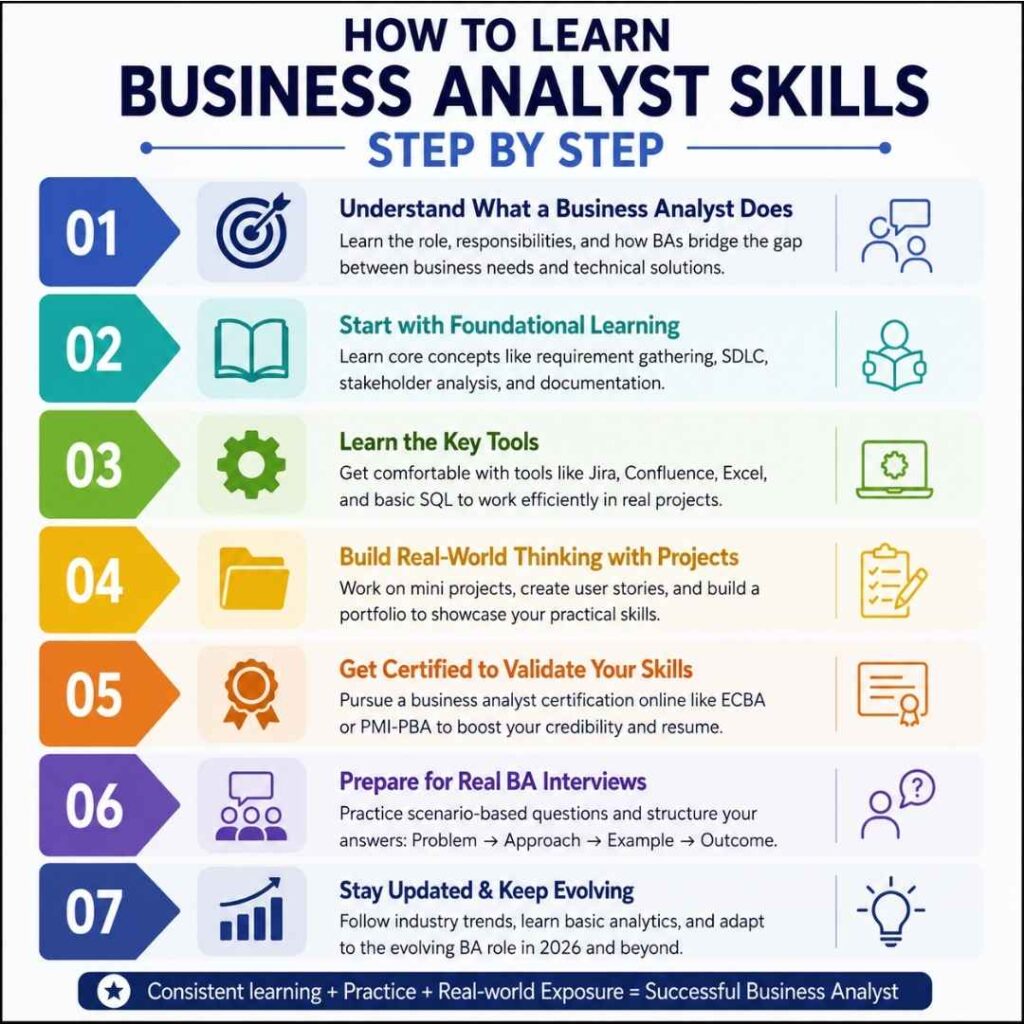
How to Learn Business Analyst Skills Step by Step
If you’re trying to break into Business Analyst Skills right now, you’re actually at a good time. Companies are still hiring aggressively for roles that can translate messy business problems into clear requirements for tech teams, especially in fintech, SaaS, healthcare systems, and even government digitization projects.
I’ve seen people come from totally unrelated backgrounds teachers, support agents, even sales executives and land Business Analyst Skills roles within 6–10 months of focused learning. The difference isn’t “talent,” it’s structure.
Let’s break it down in a way that actually makes sense in real life.
Step 1: Understand what a Business Analyst actually does (not the textbook version)
A lot of beginners skip this and jump straight into tools. That’s usually where confusion starts Business Analyst Skills.
In reality, a Business Analyst Skills:
- Talks to stakeholders who don’t always know what they want
- Translates vague problems into structured requirements
- Works with developers and product teams to shape solutions
- Documents everything so nothing gets lost in translation
Think of it like being a translator between business and technology but also part detective, because half the job is figuring out what the real problem actually is.
Step 2: Start with foundational learning (don’t rush tools yet)
This is where a solid Business Analyst Skills program helps.
You want to focus on:
- Requirement gathering techniques (interviews, workshops, surveys)
- Basic SDLC (Software Development Life Cycle)
- Stakeholder analysis
- Writing user stories and acceptance criteria
A good business analyst course usually gives you case studies. Pay attention to those. Honestly, those case studies matter more than theory because they mirror what you’ll actually do at work.
Small side note: people often underestimate how much writing is involved. You’ll write a lot. Not essays but structured, precise documentation.
Step 3: Learn the key tools used in 2026 workplaces
Tools won’t make you a Business Analyst Skills, but they’ll make you useful faster once you get in.
Common ones include:
- Jira / Azure DevOps (tracking requirements and tasks)
- Confluence / Notion (documentation)
- Excel or Google Sheets (analysis still heavily lives here, surprisingly)
- Basic SQL (yes, even non-technical BAs benefit from this)
I’ve noticed a trend recently: companies are leaning more toward “tool-flexible” BAs rather than specialists tied to one platform. So don’t over-invest emotionally in any single tool.
Step 4: Build real-world thinking through mini projects
This is where most learners Business Analyst Skills either level up or stall.
Try this:
- Pick a real app (like Uber, Swiggy, or a banking app)
- Write down what problem it solves
- Identify user types
- Create 5–10 user stories
- Define acceptance criteria for one feature
It feels simple, but this exercise forces you to think like a BA instead of just “studying” like a student.
If you’re serious, build 2–3 small case studies and keep them in a portfolio. That alone makes you stand out during interviews.
Step 5: Consider certification
A business analyst certification online can definitely help, especially for resume screening, Business Analyst Skills.
Popular certifications include:
- ECBA / CBAP from International Institute of Business Analysis
- PMI-PBA from Project Management Institute
But here’s the honest truth people don’t say enough:
Certification gets you noticed. Skills get you hired.
So use certification as support, not the foundation.
Step 6: Learn how real Business Analyst Skills interviews actually feel
This is where reality hits Business Analyst Skills differently.
Most interviews don’t ask definitions. They ask:
- “How would you handle unclear requirements?”
- “What if stakeholders disagree?”
- “How do you prioritize features?”
You’ll notice something: there’s rarely one correct answer. They’re testing your thinking process more than anything else.
A small tip that helped many beginners always structure your answer like:
Problem → Approach → Example → Outcome.
Keeps you grounded even when you’re nervous.
Step 7: Stay updated with how BA roles are evolving
In 2026, Business Analyst Skills roles are blending more with:
- Product management
- Data analysis
- Agile delivery roles
Especially in SaaS companies, Business Analyst Skills are now expected to understand user behavior data more deeply than before. Not full data science but enough to question assumptions.
So if you’re doing a Business Analyst Skills training program today, make sure it includes at least basic analytics exposure.
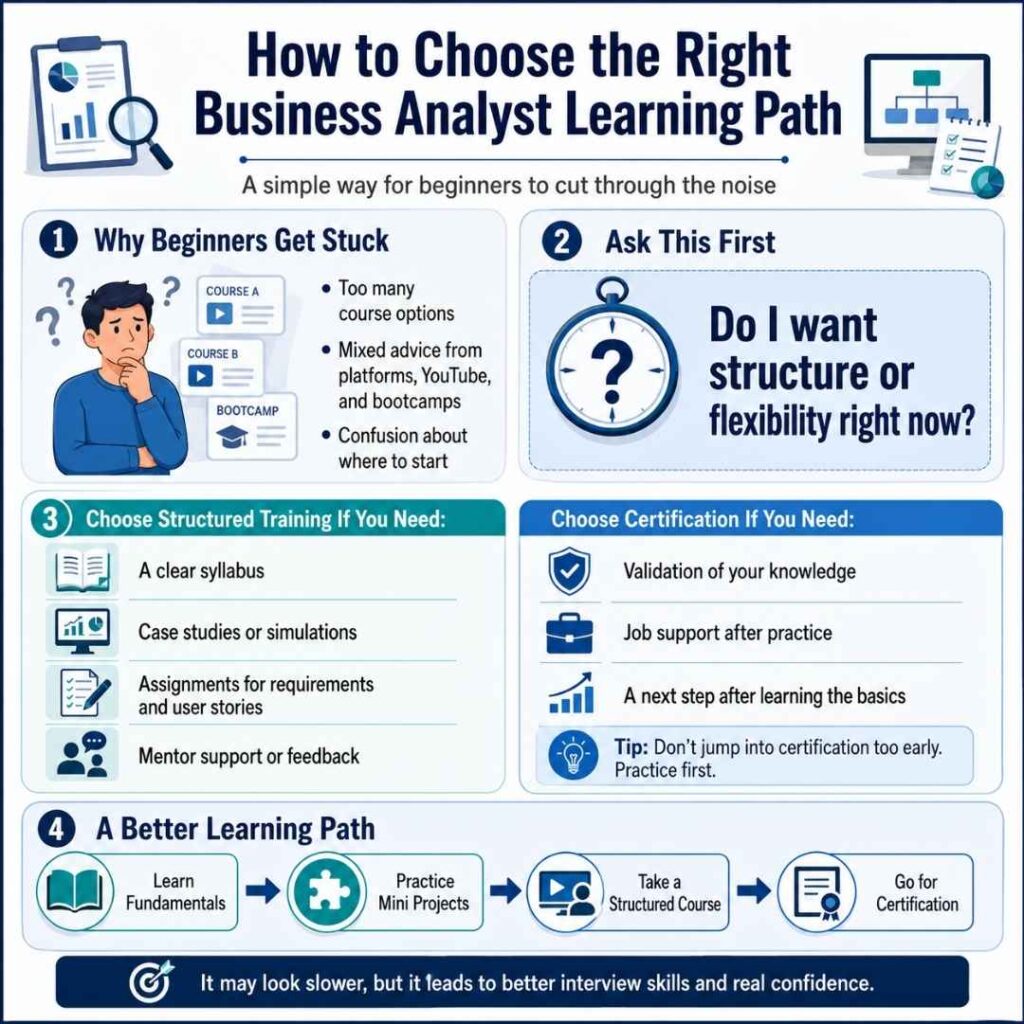
How to Choose the Right Business Analyst Learning Path
This is usually where most beginners get stuck, Business Analyst Skills, not because the content is hard, but because there are too many options floating around.
You’ll see people recommending different Business Analyst Skills platforms, YouTube playlists, bootcamps, and even fast-track certifications. And honestly, it can feel like everyone is saying something slightly different.
Here’s a simple way to cut through the noise.
Start by asking yourself one question: Do I want structure or flexibility right now?
If you need structure (most beginners do), go for a guided Business Analyst Skills program that gives you:
- A clear syllabus from basics to advanced topics
- Case studies or real-world simulations
- Assignments that force you to write requirements and user stories
- Some form of mentor or feedback loop
If you already understand the basics and just want validation or job support, then a business analyst certification online might make more sense but only after you’ve practiced a bit.
One thing I’ve noticed (and this is a pattern, not a theory): people who jump straight into certifications without practice usually end up memorizing concepts instead of understanding them. That shows up quickly in interviews.
A better path looks more like this:
Learn fundamentals → practice mini projects → take a structured course → then certification.
It’s slower on paper, but faster in real outcomes.
And honestly, the moment you stop trying to “collect courses” and start building clarity on what a Business Analyst Skills actually does daily, everything becomes much easier to navigate.
FAQs
1. Do I need a technical background to become a business analyst?
No, a technical background is helpful but not required. Many successful BAs come from non-technical fields like commerce, HR, or customer support. What matters more is structured thinking, communication, and understanding business problems.
2. Which is better: a business analyst course or certification?
A business analyst course helps you build skills from scratch, while a business analyst certification online validates those skills in the job market. Ideally, you need both course first, certification later.
3. How long does it take to learn Business Analyst Skills?
On average, it takes 4–8 months of consistent effort to become job-ready. This depends on your background, how much you practice, and whether you’re doing real-world projects alongside learning.
4. What tools should I learn first as a beginner BA?
Start with Jira, Excel/Google Sheets, and basic documentation tools like Confluence or Notion. Later, add SQL basics if you want to stand out in technical interviews.
5. Is business analysis still in demand in 2026?
Yes, demand is strong especially in SaaS, fintech, healthcare, and AI-driven product companies. Roles are also evolving to include more data awareness and product thinking, making BAs even more valuable than before.
Conclusion
The people who succeed in this field aren’t the ones who “study the most.” They’re the ones who start thinking in structured problems early and keepBusiness Analyst Skills practicing even when they feel unsure.
If you follow a decent Business Analyst Skills, pair it with hands-on mini projects, and eventually validate it with a business analyst certification online, you’re already ahead of a large chunk of beginners who are still stuck in theory loops.
And honestly, the moment you start explaining messy real-world problems clearly that’s when you’re already thinking like a business analyst.