Artificial Intelligence (AI) doesn’t really feel like “future technology” anymore. That version of the conversation is mostly over. start At this point, Artificial Intelligence Career is already woven into everyday business operations sometimes quietly in the background, sometimes front and center where everyone notices it. Companies across healthcare, finance, retail, cybersecurity, and cloud computing now rely on AI for automation, analytics, customer support, fraud detection, and decision-making.
Because of this shift, more professionals are looking for practical AI skills that match real industry needs. Training programs from H2K Infosys focus on helping learners understand how AI is actually used in modern workplaces through live training, hands-on projects, and career-oriented learning.
That’s a huge reason why so many professionals across the USA are moving toward Ai Machine learning Courses in 2026. Companies aren’t only looking for people who understand AI conceptually anymore. They want people who can actually build things, troubleshoot problems, clean messy datasets, deploy systems, monitor models, and handle the weird behavior AI sometimes shows once it’s running in production.
And production systems are rarely clean or predictable, honestly.
A lot of beginners still assume AI requires some elite-level math background or years of research experience before they can even get started. Usually not true. Plenty of working professionals transition into AI from completely different paths software development, QA, cloud operations, business analysis, IT support, infrastructure engineering, sometimes even networking teams.
That’s where practical AI and machine learning programs matter. The stronger programs go beyond “here’s what machine learning is” and push people into actual implementation work building projects, dealing with imperfect datasets, deploying APIs, monitoring systems, fixing broken pipelines, debugging strange issues late at night when nothing seems to work properly. Real-world stuff. The kind tutorials usually gloss over.
Because real environments are messy. Way messier than most learning platforms make them look.
Today businesses use AI for things like:
- Automating repetitive workflows
- Improving customer experiences
- Detecting fraud and security threats
- Forecasting demand and operational risks
- Processing massive amounts of business data
- Supporting faster decision-making
And because of that, AI knowledge matters far outside traditional data science teams now.
What AI Actually Means
At its core, AI refers to systems designed to perform tasks that normally require some level of human intelligence.
Depending on the situation, that could involve:
- Recognizing patterns
- Understanding language
- Making predictions
- Interpreting images or speech
- Automating decisions
- Detecting unusual behavior
AI itself is really more of an umbrella term. Under it sit several specialized areas that companies use differently depending on the problem they’re trying to solve.
| AI Area | Main Goal | Common Business Use |
|---|---|---|
| Machine Learning | Learn patterns from data | Fraud detection, recommendations |
| Deep Learning | Neural-network learning | Computer vision, NLP |
| NLP | Understand human language | Chatbots, document analysis |
| Computer Vision | Interpret visual information | Medical imaging, inspections |
| Generative AI | Create text, code, media | AI assistants, automation |
In real enterprise environments, AI systems usually combine multiple approaches together. Rarely does one perfect model magically solve everything. People sometimes imagine AI as one giant brain sitting somewhere in the cloud, but most systems are really layers of pipelines, monitoring tools, automation scripts, APIs, and models stitched together carefully.
Why More Professionals Are Learning AI
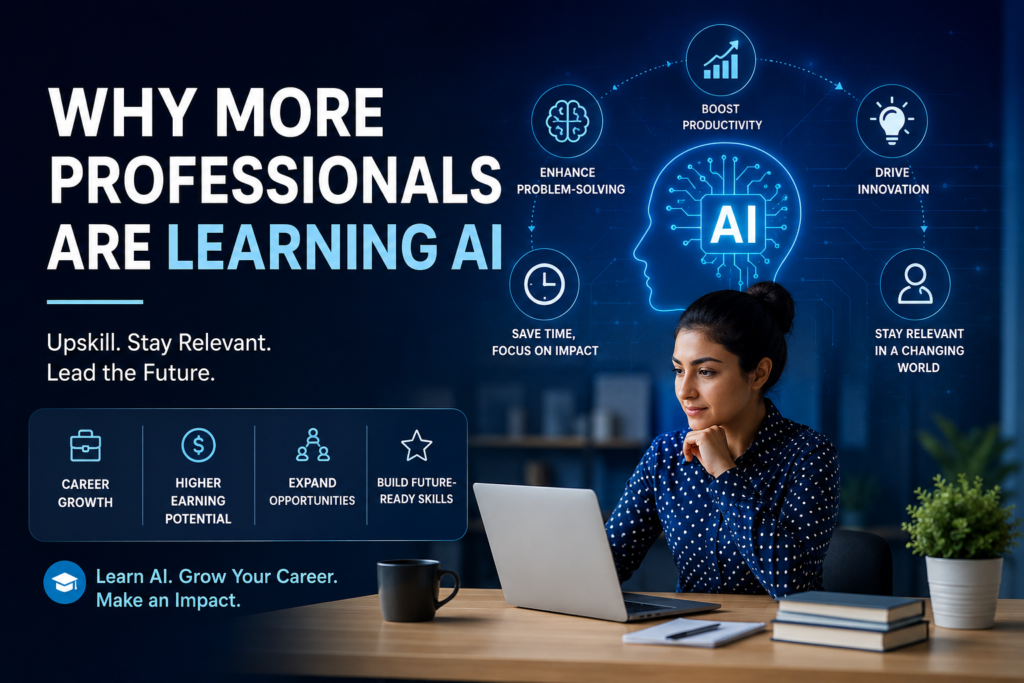
A few years ago, AI still felt tied mostly to research labs or experimental teams.
Now AI is built directly into enterprise software, cloud ecosystems, analytics platforms, security tools, customer support systems basically modern IT infrastructure in general.
That’s why more professionals are learning AI even if they don’t plan on becoming full-time “AI engineers.”
Organizations increasingly need people who can:
- Work alongside AI automation tools
- Understand machine learning outputs
- Support AI-powered applications
- Integrate cloud AI services
- Collaborate with infrastructure and data teams
A surprising number of people entering AI today come from areas like:
- Software development
- QA testing
- Business analysis
- DevOps
- Cybersecurity
- Database administration
- Cloud operations
And honestly, most enterprise AI programs are built around those transitions now. They focus less on heavy academic theory and more on how AI behaves in production environments where things break unexpectedly and data quality becomes everyone’s problem.
How AI Usually Works in Real Projects
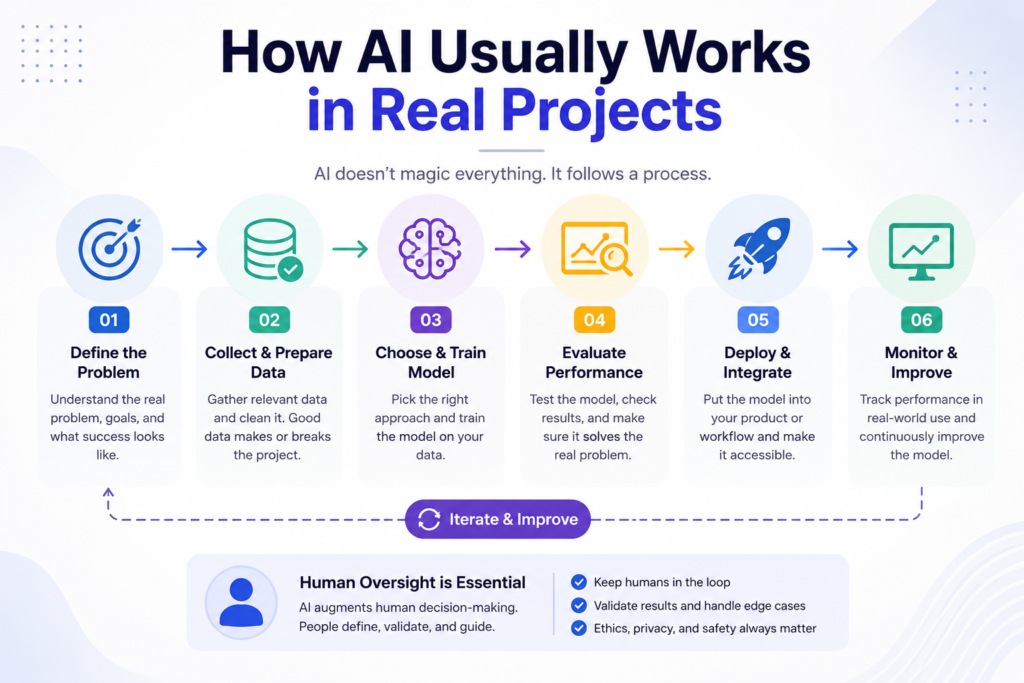
Most enterprise AI workflows follow a pretty similar structure, even though the tools vary between companies.
| Stage | What Happens | Common Tools |
|---|---|---|
| Data Collection | Gather raw data | SQL, APIs, Hadoop |
| Data Cleaning | Remove inconsistencies | Pandas, NumPy |
| Feature Engineering | Prepare ML inputs | Scikit-learn |
| Model Training | Train algorithms | TensorFlow, PyTorch |
| Evaluation | Measure performance | MLflow, Scikit-learn |
| Deployment | Push systems to production | Docker, Kubernetes |
| Monitoring | Track drift and stability | Grafana, Prometheus |
A lot of newcomers are surprised by how much time gets spent cleaning data instead of building fancy models. Data quality problems can eat entire weeks. Sometimes months, depending on the company.
Example: Fraud Detection in Banking
Banks use machine learning heavily for fraud detection in near real time.
A simplified workflow usually looks something like this:
- Transaction data gets collected from banking systems
- Historical fraud patterns get analyzed
- Features like location, device type, and transaction amount are extracted
- Models are trained using labeled fraud datasets
- Incoming transactions are evaluated continuously
- High-risk activity gets flagged for manual review
Production systems almost never stay that neat though. There are edge cases everywhere — missing records, false positives, latency problems, infrastructure bottlenecks, compliance issues, weird user behavior nobody anticipated. That’s where AI work becomes much more operational than many beginners expect initially.
Still, it’s a good example of how Artificial Intelligence Career connects databases, APIs, cloud infrastructure, analytics systems, monitoring tools, and automation workflows together.
Skills People Usually Need for AI
Learning AI generally involves some combination of programming, data handling, cloud concepts, and math foundations.
Not necessarily PhD-level mathematics despite what social media sometimes makes it sound like.
Programming Skills
Languages commonly used include:
- Python
- SQL
- R
- Java
Python dominates most AI workflows mainly because the ecosystem is huge and constantly evolving.
Math Foundations
Professionals usually benefit from understanding:
- Statistics
- Probability
- Linear algebra
- Basic calculus
That said, practical implementation often matters more than deeply theoretical math for many entry-level roles.
Data Skills
AI projects depend heavily on usable datasets.
Which means teams spend huge amounts of time dealing with:
- Data cleaning
- ETL pipelines
- SQL queries
- API integrations
- Dataset preparation
And real datasets are almost never clean the first time you see them. That lesson shows up pretty quickly once someone starts working on actual projects.
Cloud and Deployment Knowledge
Modern Artificial Intelligence Career systems are commonly deployed through platforms like:
- AWS
- Microsoft Azure
- Google Cloud Platform
Containerization tools show up constantly too:
- Docker
- Kubernetes
At enterprise scale, deployment skills become almost as important as building models themselves. Sometimes even more important.
Common AI Tools Used in Enterprises
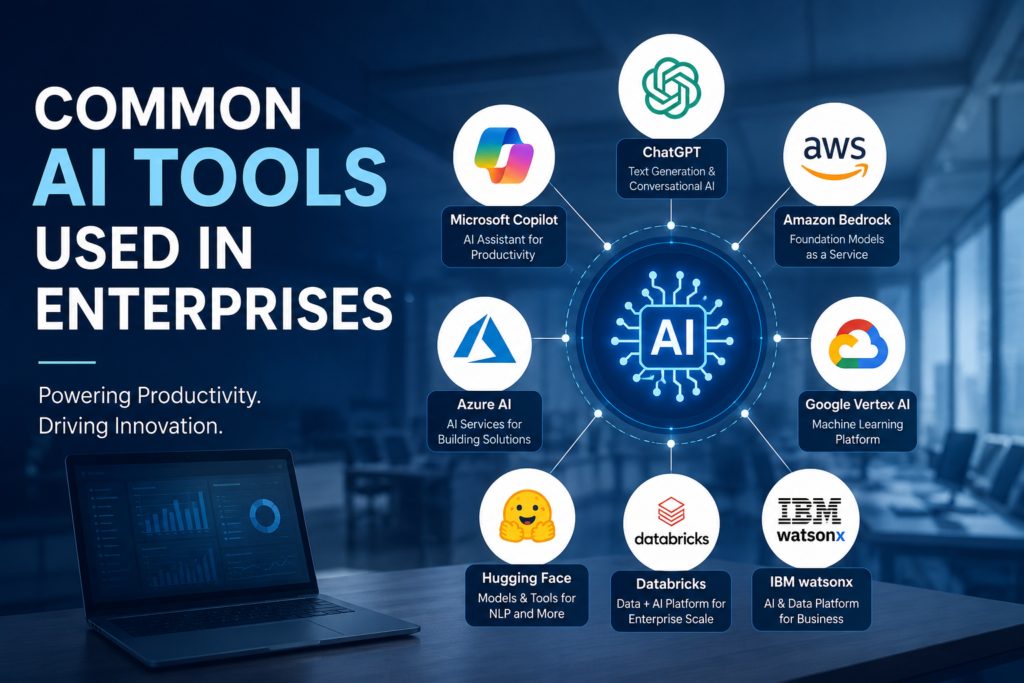
| Tool | Primary Purpose | Why Companies Use It |
|---|---|---|
| Python | AI programming | Industry standard |
| TensorFlow | Deep learning | Scalable systems |
| PyTorch | Flexible AI development | Research + production |
| Scikit-learn | Traditional ML | Predictive analytics |
| Jupyter Notebook | Experimentation | Rapid prototyping |
| MLflow | Lifecycle management | Model tracking |
| Apache Spark | Big data processing | Distributed workloads |
| Hugging Face | NLP development | Language AI systems |
Popular Cloud AI Platforms
| Platform | Main AI Services |
|---|---|
| AWS SageMaker | Training and deployment |
| Azure AI Services | Enterprise integrations |
| Google Vertex AI | Full ML lifecycle |
These tools appear in many AI training programs because they reflect actual enterprise environments instead of isolated classroom demos that never resemble real work later.
How AI Courses Usually Progress
Most professional AI programs build skills gradually instead of throwing advanced deep learning concepts at beginners immediately.
| Learning Phase | Main Focus |
|---|---|
| Beginner | Python, SQL, statistics |
| Intermediate | Machine learning algorithms |
| Advanced | Deep learning, deployment |
| Enterprise Level | Cloud AI, MLOps, monitoring |
Hands-on learning often includes:
- Building predictive models
- Working with real datasets
- Creating APIs
- Deploying cloud applications
- Monitoring model performance
Some stronger programs also introduce Git workflows, CI/CD pipelines, and containerized deployments early on. Those become incredibly useful later once projects get larger and teams grow.
Machine Learning Basics Beginners Should Know
Machine learning is basically a branch of AI where systems learn patterns from data instead of relying entirely on hardcoded rules.
Main Types of Machine Learning
| Type | Description | Example |
|---|---|---|
| Supervised Learning | Learns from labeled data | Spam filtering |
| Unsupervised Learning | Finds hidden patterns | Customer segmentation |
| Reinforcement Learning | Learns through rewards | Robotics |
Common Algorithms
Regression Models
Used for predicting numerical outcomes like:
- Revenue forecasting
- Demand prediction
- Sales estimation
Classification Models
Used for category-based predictions:
- Fraud detection
- Medical diagnosis
- Sentiment analysis
Clustering Models
Helpful for identifying hidden patterns:
- Market segmentation
- Behavioral analysis
Understanding where these models fit usually matters more than memorizing textbook definitions word-for-word.
Where AI Is Used Across Industries
AI adoption has spread almost everywhere now.
Healthcare
AI helps with:
- Medical image analysis
- Patient risk prediction
- Clinical data processing
Banking and Finance
Common use cases include:
- Fraud detection
- Risk analysis
- Trading systems
- Compliance monitoring
Retail and E-Commerce
AI supports:
- Recommendation engines
- Inventory forecasting
- Customer behavior analytics
Cybersecurity
Security teams use AI for:
- Threat detection
- Anomaly monitoring
- Log analysis
Manufacturing
AI systems assist with:
- Predictive maintenance
- Quality inspection
- Production optimization
Most of these projects involve multiple teams working together — developers, analysts, architects, cloud engineers, security teams, business stakeholders. AI rarely exists in isolation the way marketing videos sometimes make it seem.
Challenges AI Teams Commonly Face
Artificial Intelligence Career projects are exciting, sure. But production environments get complicated fast.
Data Quality Problems
Machine learning systems depend heavily on clean data.
Common issues include:
- Missing values
- Duplicate records
- Inconsistent formatting
Even advanced models fail badly when the underlying data quality is poor.
Scalability Challenges
Enterprise AI systems may process millions of records continuously.
That often requires:
- Distributed computing
- GPU acceleration
- Cloud autoscaling
Security and Compliance
Organizations handling sensitive data must comply with standards like:
- HIPAA
- GDPR
- SOC 2
Security practices usually involve:
- Encryption
- Access controls
- Audit logging
Model Drift
Over time, real-world behavior changes and models lose accuracy.
Teams constantly monitor systems to:
- Track prediction quality
- Retrain models
- Detect abnormal behavior
That operational side of AI — monitoring, maintenance, retraining — is something beginners often underestimate early on.
Job Roles That Use AI Daily
AI knowledge now supports a surprisingly wide range of careers.
| Role | Key Skills |
|---|---|
| Machine Learning Engineer | Python, TensorFlow, deployment |
| Data Scientist | Statistics, predictive modeling |
| AI Engineer | APIs, cloud integration |
| Data Analyst | SQL, analytics |
| NLP Engineer | Language models |
| MLOps Engineer | Kubernetes, CI/CD |
| BI Analyst | Reporting, forecasting |
A lot of professionals start with foundational AI training before specializing further.
Career Paths After AI Training
Machine Learning Engineer
Typically focuses on:
- Building models
- Optimizing algorithms
- Production deployment
Data Scientist
Usually more focused on:
- Statistical analysis
- Predictive insights
- Business intelligence
AI Solutions Architect
Designs enterprise AI systems and integrations.
MLOps Engineer
Handles:
- Deployment pipelines
- Infrastructure automation
- Monitoring systems
NLP Engineer
Builds systems involving:
- Chatbots
- Search engines
- Document processing
AI Product Analyst
Bridges technical systems with business goals.
And honestly, that role involves a lot more communication and cross-team coordination than many people initially expect.
How Beginners Usually Start Learning AI
Most people learn AI step by step instead of trying to master everything immediately.
That slower approach usually works better long term.
Step 1: Learn Python and SQL
Start with basics:
- Variables
- Functions
- Loops
- Database queries
Step 2: Learn Data Analysis
Focus on tools like:
- Pandas
- NumPy
- Visualization libraries
Step 3: Study Machine Learning Basics
Practice:
- Regression
- Classification
- Model evaluation
Step 4: Build Small Projects
Beginner-friendly projects include:
- Churn prediction
- Sales forecasting
- Sentiment analysis
Projects usually matter more than certificates once interviews start happening.
Step 5: Explore Cloud AI Platforms
Learn services from:
- AWS
- Azure
- Google Cloud
Step 6: Understand Deployment and MLOps
Important areas include:
- Docker
- APIs
- CI/CD pipelines
Once people start deploying systems themselves, AI usually stops feeling abstract and starts feeling practical very quickly.
What Makes a Good AI Training Program
Strong Artificial Intelligence Career programs usually balance theory with hands-on implementation.
| Feature | Why It Matters |
|---|---|
| Hands-on Labs | Reinforces practical skills |
| Real Datasets | Reflects production environments |
| Cloud Integration | Matches enterprise workflows |
| Deployment Training | Improves production readiness |
| Instructor Guidance | Simplifies difficult topics |
| Project Work | Demonstrates real ability |
Good programs also tend to include:
- Git workflows
- API development
- Security basics
- Monitoring practices
- Deployment exercises
Those areas become extremely relevant once someone starts working in enterprise environments instead of isolated demo projects.
Frequently Asked Questions
Is AI hard for beginners?
It can feel overwhelming at first because the field is huge. Most people do better when they start with Python, statistics, and basic machine learning instead of jumping directly into advanced deep learning.
Do AI professionals need advanced math?
Not always. Many practical AI roles rely more on applied problem-solving and statistics than deeply advanced mathematics.
Which programming language matters most?
Python remains the dominant language mainly because the ecosystem is massive, flexible, and constantly evolving.
Are AI courses suitable for working professionals?
Yes. Many programs are designed specifically for professionals transitioning from software development, analytics, cloud operations, QA, or IT backgrounds.
Which industries hire AI professionals?
Healthcare, finance, cybersecurity, retail, manufacturing, logistics, and cloud technology companies continue investing heavily in AI talent.
Final Thoughts
Artificial Intelligence Career continues reshaping enterprise systems, automation strategies, analytics workflows, and cloud infrastructure across industries in 2026.
A few things stand out pretty clearly now:
- AI combines automation, machine learning, and data-driven decision-making
- Real-world AI work depends heavily on practical implementation
- Python, cloud platforms, and MLOps have become core technologies
- Hands-on projects matter far more than passive learning
- Companies across the USA continue investing aggressively in AI systems
For professionals exploring Ai training courses programs, practical exposure usually makes the biggest difference over time. Building projects, deploying systems, troubleshooting pipelines, breaking things occasionally honestly, that’s where most of the real learning happens.
And once people stop only reading about Artificial Intelligence Career and actually start building with it, the field usually feels far less intimidating than it did at the beginning.