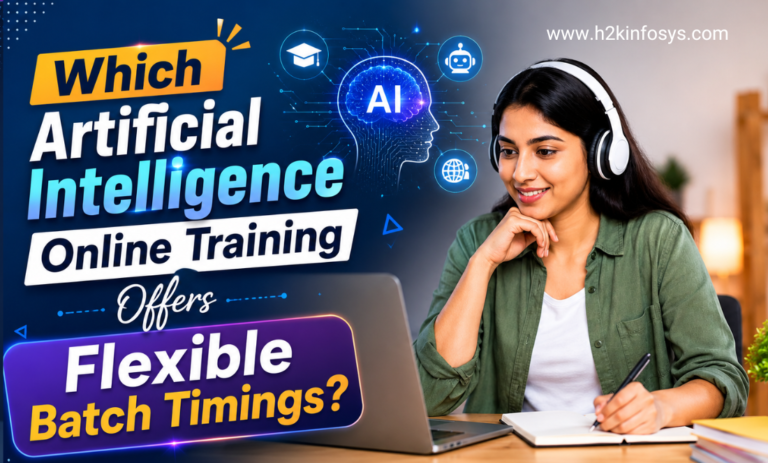
H2K Infosys Artificial Intelligence Online Training Programs with flexible batch timings are becoming a practical choice for working professionals who want to build AI skills without stepping away from their current jobs. Most people in IT already juggle deadlines, client meetings, support calls, or odd-hour deployments, so rigid classroom schedules just don’t fit anymore. That’s why many AI certified courses now offer weekday evening sessions, weekend classes, self-paced learning, and hybrid formats that let learners study on their own time.
The better programs don’t stop at flexibility alone. They usually combine structured mentorship, hands-on labs, real-world projects, and certification pathways that actually reflect how AI is used inside companies today. You’ll often see topics like machine learning, deep learning, generative AI, data engineering basics, and enterprise AI deployment included as part of the curriculum. And honestly, that enterprise angle matters more than people think.
What Is Artificial Intelligence Online Training?
Artificial Intelligence online training is essentially a guided learning program that teaches professionals how AI systems are built, trained, deployed, and managed in real business environments. Some courses lean heavily into theory, but the stronger ones balance concepts with practical implementation.
Most programs usually cover areas like:
- Machine Learning fundamentals
- Neural networks and deep learning
- Natural Language Processing (NLP)
- Computer Vision
- Generative AI concepts
- Model deployment and MLOps
- AI governance and ethics
These AI certified courses are commonly delivered through live instructor-led sessions, recorded modules, virtual labs, and collaborative project environments. A lot of learners prefer having recordings available because work schedules rarely stay predictable for long.
Common Formats of AI Training
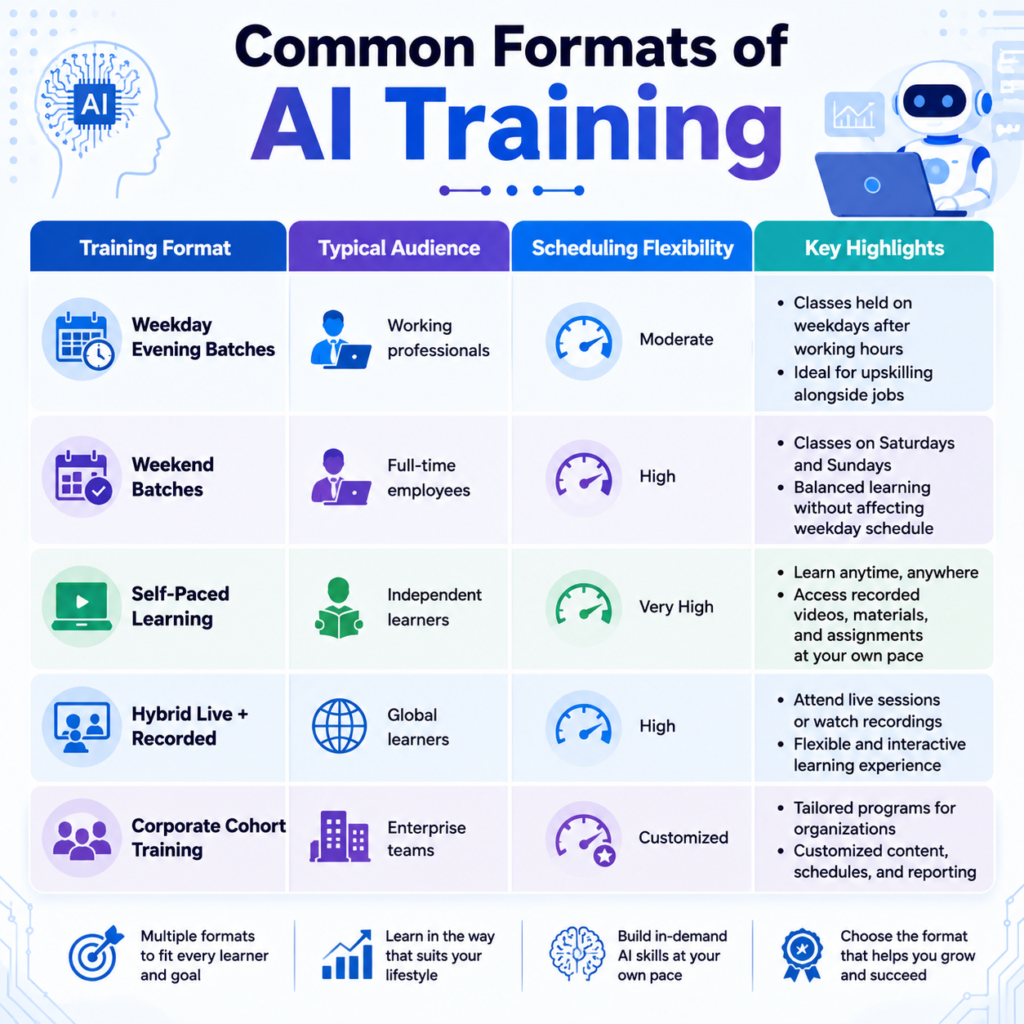
| Training Format | Typical Audience | Scheduling Flexibility |
|---|---|---|
| Weekday Evening Batches | Working professionals | Moderate |
| Weekend Batches | Full-time employees | High |
| Self-Paced Learning | Independent learners | Very High |
| Hybrid Live + Recorded | Global learners | High |
| Corporate Cohort Training | Enterprise teams | Customized |
Flexible batch timings are especially useful for professionals working in areas like:
- Software development
- Cloud engineering
- Data analytics
- DevOps
- QA automation
- IT operations
- Cybersecurity
A DevOps engineer on rotation duty, for example, probably can’t commit to fixed weekday afternoons every week. Realistically, most IT roles come with unpredictable schedules.
Why Flexible Batch Timings Matter for Working Professionals
People working full-time already have enough on their plate:
- Production support responsibilities
- Sprint deadlines
- Client meetings across time zones
- Certification prep
- Family obligations
- Random after-hours escalations
Traditional learning schedules don’t always align with how enterprise teams actually operate. Flexible Artificial Intelligence online training gives professionals a way to upskill without disrupting work commitments or personal routines.
Common Scheduling Challenges in IT Roles
| IT Role | Typical Scheduling Constraint |
|---|---|
| DevOps Engineer | On-call rotations |
| Software Developer | Sprint deadlines |
| Data Analyst | Reporting cycles |
| Cloud Administrator | Maintenance windows |
| QA Engineer | Release testing schedules |
Good AI course certification programs usually try to accommodate these realities with:
- Multiple batch timings
- Recorded session access
- Weekend labs
- Flexible assignments
- Mentor office hours
- Replay options for missed classes
That flexibility becomes especially important for professionals transitioning into AI-focused roles while still working full-time.
What Should You Look for in an AI Course Certification Program?
Not every AI certified course delivers the same value. Some look impressive on paper but stay too theoretical. Others focus heavily on tools without teaching how AI systems actually operate in production environments.
A balanced program usually covers both technical depth and practical usability.
1. Flexible Learning Schedules
Look for programs that offer:
- Weekend-only batches
- Multi-timezone support
- Recorded classes
- Self-paced modules
- Easy rescheduling options
It sounds basic, but accessibility often determines whether learners actually complete the course.
2. Hands-On Enterprise Projects
This part is huge. AI concepts make much more sense when applied to realistic workflows.
Useful projects may include:
- Building recommendation systems
- Training NLP models
- Deploying ML APIs
- Creating data pipelines
- Working with cloud AI services
Theoretical quizzes alone rarely prepare someone for enterprise AI work.
3. Industry-Relevant Tools
Strong Artificial Intelligence training programs typically include tools such as:
| Category | Common Tools |
|---|---|
| Programming | Python |
| ML Libraries | Scikit-learn, TensorFlow, PyTorch |
| Data Processing | Pandas, NumPy |
| Visualization | Matplotlib, Seaborn |
| Deployment | Docker, Kubernetes |
| Cloud AI | AWS SageMaker, Azure ML |
| Versioning | Git |
| MLOps | MLflow, Kubeflow |
And yes, knowing how these tools fit together operationally matters just as much as knowing the syntax.
4. Experienced Instructors
Programs tend to feel more practical when instructors have real deployment experience instead of purely academic backgrounds.
That usually includes:
- Enterprise AI implementation exposure
- Cloud integration experience
- Production troubleshooting knowledge
- Real-world deployment practices
Learners often benefit most from hearing what breaks in production and how teams actually solve problems.
5. Certification That Reflects Real Skills
An AI course certification should ideally validate practical competency, not just theoretical recall.
Strong certification programs often assess:
- Data preprocessing
- Model development
- Performance tuning
- Deployment workflows
- End-to-end project execution
A certification tied to hands-on implementation generally carries more weight in enterprise hiring environments.
How Artificial Intelligence Works in Real IT Projects
At its core, Artificial Intelligence helps systems analyze large amounts of data, identify patterns, automate decisions, or generate predictions.
In enterprise environments, AI workflows usually involve:
- Data collection
- Data preprocessing
- Feature engineering
- Model training
- Validation and testing
- Deployment
- Monitoring and retraining
Example Enterprise AI Workflow
| Stage | Activity |
|---|---|
| Data Ingestion | Collect logs, customer records, transactions |
| Cleaning | Remove duplicates and inconsistencies |
| Training | Build ML models using datasets |
| Evaluation | Measure accuracy and bias |
| Deployment | Expose models through APIs |
| Monitoring | Track drift and performance |
Real-world AI systems are rarely “train once and forget forever.” Models degrade over time. Data changes. Business rules evolve. Monitoring becomes a major part of production AI.
Real-World AI Use Cases
Customer Support Automation
AI chatbots use NLP models to:
- Understand customer requests
- Route tickets automatically
- Generate responses
Some systems work surprisingly well. Others… not so much. Usually depends on training quality and data consistency.
Fraud Detection
Financial organizations commonly use AI to:
- Detect suspicious transactions
- Assess risk levels
- Prevent unauthorized access
This area relies heavily on anomaly detection and behavioral modeling.
Predictive Maintenance
Manufacturing companies use AI systems to:
- Analyze sensor data
- Predict equipment failures
- Reduce downtime
Preventing failures before they happen can save enormous operational costs.
Healthcare Data Analysis
AI applications may assist with:
- Medical image analysis
- Patient risk prediction
- Clinical workflow optimization
Healthcare AI also introduces stricter compliance and governance requirements, which many beginners underestimate.
Skills Needed to Learn Artificial Intelligence
Artificial Intelligence training is generally accessible to beginner-to-intermediate IT professionals. A strong math background helps, but it’s not always mandatory at the start.
Helpful Prerequisites
| Skill Area | Importance |
|---|---|
| Basic Programming | High |
| Python Fundamentals | High |
| Mathematics | Moderate |
| Statistics | Moderate |
| Logical Thinking | High |
| Data Handling | Moderate |
Important Technical Areas
Python Programming
Most AI Certified Courses use Python because the ecosystem is mature and widely adopted.
Common tasks include:
- Data manipulation
- Automation scripting
- API integration
- Model development
Statistics and Probability
AI models rely on concepts such as:
- Probability distributions
- Mean and variance
- Regression techniques
- Classification metrics
Machine Learning Fundamentals
Professionals generally learn:
- Supervised learning
- Unsupervised learning
- Reinforcement learning
- Feature engineering
- Hyperparameter tuning
Deep Learning Concepts
Advanced Artificial Intelligence online training often includes:
- Neural networks
- CNNs
- RNNs
- Transformers
- Large Language Models (LLMs)
The jump from basic ML to deep learning can feel steep initially, but hands-on projects usually make the concepts easier to absorb.
Artificial Intelligence in Enterprise Environments
Enterprise AI is less about flashy demos and more about scalability, governance, reliability, and operational efficiency.
Enterprise AI Architecture Components
| Component | Purpose |
|---|---|
| Data Pipelines | Data ingestion and transformation |
| ML Models | Prediction and automation |
| APIs | Application integration |
| Monitoring Tools | Performance tracking |
| Cloud Infrastructure | Scalable compute resources |
| Security Controls | Data protection |
Common Enterprise AI Challenges
Data Quality Issues
Organizations frequently struggle with:
- Incomplete datasets
- Duplicate records
- Inconsistent formatting
Garbage in, garbage out still applies. Probably more than ever.
Model Drift
Production models may lose accuracy over time as business patterns change.
Scalability Constraints
Large-scale AI systems often require:
- Distributed compute environments
- GPU acceleration
- Efficient model serving infrastructure
Compliance and Governance
Industries like healthcare and finance must comply with:
- Data privacy regulations
- Security requirements
- Audit standards
That’s why practical AI training should include operational and governance awareness alongside algorithms.
Job Roles That Use Artificial Intelligence
AI skills now show up across a surprisingly wide range of roles.
| Job Role | Typical Responsibilities |
|---|---|
| Machine Learning Engineer | Build and deploy ML models |
| Data Scientist | Analyze and interpret data |
| AI Engineer | Develop AI-powered applications |
| NLP Engineer | Create language processing systems |
| Computer Vision Engineer | Build image recognition solutions |
| MLOps Engineer | Manage deployment pipelines |
| Data Analyst | Use predictive analytics tools |
AI also intersects with:
- Cloud engineering
- DevOps
- Software development
- Cybersecurity
- Business analytics
Many professionals begin with AI certified courses before gradually transitioning into more specialized AI responsibilities.
Career Opportunities After Learning AI
Artificial Intelligence training can support career growth across several domains depending on previous experience and specialization.
Career Transition Paths
| Existing Background | Potential AI Path |
|---|---|
| Software Development | ML Engineer |
| Data Analytics | Data Scientist |
| Cloud Engineering | AI Infrastructure Engineer |
| QA Automation | AI Test Engineer |
| Business Intelligence | AI Analyst |
Entry-Level Roles
- Junior Data Analyst
- AI Support Associate
- ML Operations Associate
Mid-Level Roles
- Machine Learning Engineer
- AI Developer
- NLP Specialist
Advanced Roles
- AI Architect
- Lead Data Scientist
- AI Platform Engineer
Career growth usually depends on more than certifications alone. Project experience, cloud exposure, deployment skills, and problem-solving ability often matter just as much.
A Flexible AI Learning Path for Working Professionals
A structured roadmap helps learners progress steadily without burning out trying to study after exhausting workdays.
Example Learning Path
| Phase | Topics |
|---|---|
| Foundation | Python, statistics, linear algebra |
| Core ML | Regression, classification, clustering |
| Advanced AI | Deep learning, NLP, computer vision |
| Deployment | APIs, Docker, cloud integration |
| MLOps | CI/CD for ML, monitoring, retraining |
Weekly Learning Structure
| Day | Focus Area |
|---|---|
| Weekdays | Theory and recorded sessions |
| Weekends | Labs and projects |
| Flexible Hours | Assignments and revision |
This structure tends to work well for employed learners because it spreads the workload realistically instead of cramming everything into rigid schedules.
Hands-On Learning in AI Certified Courses
Practical implementation is where most learners finally connect the dots.
Typical Hands-On Components
Lab Exercises
Learners may practice:
- Dataset preprocessing
- Model training
- Hyperparameter tuning
- Performance evaluation
Project-Based Learning
Common projects include:
- Customer churn prediction
- Fraud detection systems
- Recommendation engines
- Sentiment analysis platforms
Cloud-Based Deployments
Professionals may also learn how to:
- Deploy ML models to cloud environments
- Build inference APIs
- Monitor production performance
Example Simplified Workflow
# Load dataset
data = load_dataset()

# Preprocess data
clean_data = preprocess(data)

# Train model
model = train_model(clean_data)

# Evaluate accuracy
score = evaluate(model)

# Deploy API
deploy_model(model)
That workflow may look simple, but it mirrors the foundation of many enterprise machine learning pipelines.
What Makes AI Training Enterprise-Focused?
Enterprise-oriented AI training usually goes beyond academic theory.
Important areas often include:
- CI/CD concepts
- Monitoring and logging
- Cloud infrastructure
- Security practices
- Version control workflows
- Collaboration environments
AI teams frequently work using:
- Git repositories
- Agile methodologies
- Shared notebooks
- Code reviews
- Automated deployment pipelines
Programs that expose learners to these workflows often provide stronger real-world preparation.
How to Choose the Right AI Course Certification
Before enrolling in any Artificial Intelligence online training program, it helps to evaluate a few practical factors carefully.
Evaluation Checklist
| Evaluation Area | Questions to Ask |
|---|---|
| Flexibility | Are weekend and recorded sessions available? |
| Curriculum | Does it include deployment and MLOps? |
| Projects | Are projects enterprise-focused? |
| Mentorship | Is instructor guidance available? |
| Certification | Is assessment project-based? |
| Tools | Are modern frameworks included? |
Signs of a Strong AI Training Program
- Hands-on labs
- Real project scenarios
- Cloud deployment exercises
- Industry-standard tooling
- Version control practices
- Model monitoring concepts
Programs that focus only on theory often leave learners struggling once they encounter real production environments.
Frequently Asked Questions
Which Artificial Intelligence online training programs offer flexible batch timings?
Many Artificial Intelligence online training providers now offer weekday evening, weekend, and self-paced options specifically for working professionals and global learners.
Are AI course certification programs beginner-friendly?
Yes. Many programs begin with Python fundamentals, statistics, and basic machine learning concepts before moving into advanced AI topics.
How long does an AI certified course usually take?
Most professional AI training programs range from around 3 to 9 months depending on depth, pace, and specialization.
Do flexible AI courses include live instructor sessions?
Many programs combine live classes with recorded sessions so learners can revisit topics whenever needed.
Which programming language is most commonly used in AI?
Python remains the dominant language because of its extensive machine learning ecosystem and library support.
Is project experience important?
Absolutely. Real-world projects help learners understand workflows like preprocessing, deployment, monitoring, and optimization far better than theory alone.
Final Thoughts
Artificial Intelligence online training with flexible batch timings gives working professionals a realistic path to build practical AI skills without pausing their careers. The most valuable AI course certification programs combine flexibility with hands-on learning, enterprise workflows, cloud integration, and real implementation experience.
A few things consistently stand out:
- Flexible schedules make long-term learning sustainable
- Hands-on projects matter far more than memorizing theory
- Skills in Python, machine learning, deployment, and MLOps are increasingly valuable
- Enterprise AI requires understanding scalability, monitoring, and governance
- Real-world project exposure often becomes the biggest differentiator during hiring
Professionals exploring career growth in AI can look into the Artificial Intelligence training programs offered by H2K Infosys to gain practical exposure to enterprise AI tools, workflows, and implementation practices through flexible learning schedules and project-driven training.